equine therapeutics
 Call Kai
 Learn
Learn Practice Test
 Spaced Repetition
 Match
Match Flashcards
 Knowt Play
1/16

There's no tags or description
Looks like no tags are added yet.
Name | Mastery | Learn | Test | Matching | Spaced | Call with Kai |
|---|
No analytics yet
Send a link to your students to track their progress
17 Terms
factors affecting treatment choices (5)
Accurate diagnosis
Timing in progression of lameness
Client budget
Prognosis (expected success of outcome)
Future use
Survivability
Patient signalment
Age, Sex, Life stage
Treatment categories
Prevention
Conservative management/supportive care
Medical Management
Surgical management
Rehabilitation
Alternative therapies
Prevention: vaccines
For viral disease; expose immune system to viral antigen in safe manner
Inactivated or greatly reduced infection capability
Allow body few weeks to mount primary response via antibiotics
Administering a booster will increase immune response a second time, resulting in much longer immunity
Most vaccines administered once, booster 3-4 weeks later, annual administration after
Prevention: good husbandry (3)
Environmental management
Provide protection from environmental extremes
Provide good footing
Indoor = slip resistant/appropriate bedding
Outdoor = dry pasture with few rocks
Safe training surfaces
Nutritional management
Discussed more in GI section
Horses are: herbivores, hindgut fermenters, grazers
Lameness specific
a) Routine hoof management
Farrier ever 4-6 weeks
Keep foot balanced to prevent absecces, bruises, cracks, thrush, laminitis
b) Appropriate job assignment
Racing thoroughbreds not suited to pull heavy loads
Draft horses not well suited for jumping
Conservative management/supportive care (4)
Fluid therapy: stabilizes and maintains hydration
Probiotics: especially if getting antibiotics
Temperature regulation: prevents animal from expending extra energy
Lameness specific: Rest and confinement/reduced exercise–stall rest, paddock rest, field rest, hand walking (all allow for reintroduction to full function)
Types of shoes (7)
Regular
Rim: big groove down middle for extra traction
Scotch bottom: draft breeds
Bar: closed heel, more likely to come off (extra shoe coming off back)
Wedge: corrective shoes
Racing plates: aluminum, lightweight
Glue on: for horses that can't have shoes nailed on
*see images
Therapeutic shoeing (supportive care) (5)
Rollover shoes: beveled volar surface facilitates normal breakover (between when heel leaves ground and when toe leaves the ground)
Suspensory shoe: extra support around toe to prevent over stretching of suspensory ligament
Toe extensions: force heel down and stretch contracted tendons
Bar shoe: extra support at heel to prevent shifting (straight bar, egg bar, heart bar)
Wedge shoe: take pressure off navicular bone if diagnosed with navicular disease
*see images
Medical management: general
Antimicrobials: Systematic = whole body, Local = near infection point
Pain management: corticosteroids (steroid) or NSAIDS = flunixin, meglumine, phenylbutazone (nonsteroids)
Lameness Medical management: 1,2,3
Bandaging
For wounds:
Absorb exudate
Reduce swelling
Prevent contamination
Keep tissue bed viable
Prevent over proliferation of scar tissue (proud flesh: when it dries out)
Important to maintain proper tension, have cushion layer, prevent increased pressure over prominences
Splinting
Uses: stabilizing minor fractures, stabilize soft tissue disruptions (tendon, ligaments)
Important to stabilize above and below joint, be rigid/secure, use over padding
Soaking
Treatment for foot abscess, usually epsom salt solution (hypertonic to draw out liquid)
Used with opening abscess and bandaging foot with salve to promote drainage
Lameness Medical management: 4+5
5 types
5 types
Joint supplements
Typically not FDA regulated
Glucosamine: major cartilage component
Chondrotin: major cartilage component (used with Glucosamine)
Hyaluronic acid: major synovial fluid component
Dimethyl sulfoxide DMSO: anti-inflammatory, leaves bad taste when absorbed via skin, byproduct of pulp industry
Hydrolyzed collagen: component of connective tissue, broken down into more digestible form
Non antibiotic injectables
IRAP: taken from blood drawn from same horse, inhibits further degradation of cartilage
Platelet rich plasma PRP: platelets taken from blood, helps improve new collagen formation (especially for tendon/ligament injuries)
Hyaluronic acid: improves function of synovial fluid, alleviating pain associated with osteoarthritis
PSGAG/Adequan: improves function of synovial fluid
Corticosteroids: reduce inflammation and therefore pain
Surgical management
type 1: 5 types
type 2: 3 types
→ Soft tissue surgery
GI
Respiratory
Reproductive
Neurologic
Wound closure
→ Orthopedic surgery
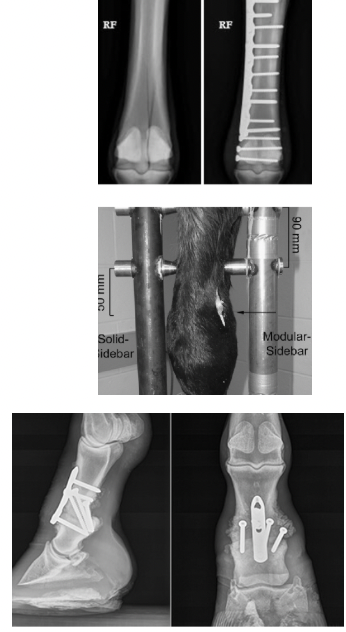
Fracture repair
Internal fixation: screws and/or plates attached directly to bone internally (permanent)
External fixation: support attached from outside body (temporary)
Joint fusion (arthrodesis)
Intentional fusion of a joint (normally joints that don't move a lot in general)
Treatment for articular fractures, osteoarthritis, or other instability
Remove cartilage and immobilize joint until bones fuse together
Fragment removal
Typically arthroscopic (with small camera, light, graspers)
Can be done standing, depending on severity of lesion
Rehabilitation
Controlled reintroduction to function
Similar to conservative treatment, but after surgical treatment
Lameness specific methods: low impact exercise, alternative therapies
Alternative therapy: acupuncture
fine needles at acupoints (high density nerves, vessels, arteries)
Stimulation of acupoints releases endorphins, serotonin, other neurotransmitters
Often accompanied by weak electrical signal stimulation
Needles left in places for 5-30 mins
Considered safe, can be done without meds (good for drug tested horses)
Alternative therapy: ultrasound
low frequency ultrasound waves to promote tissue/bone healing
Combination of acoustic and mechanical effects with heat increase circulation and oxygenation of tissue
Painless, no sedation
Alternative therapy: laser
high powered lasers to promote healing and tissue repair (red lasors)
Used for wound management, pain management, tendon/ligament injuries, etc
Seems effective particularly on ligament and tendon injuries
Alternative therapy: shock wave
high amplitude acoustic waves at specific point within tissue to treat disease
Break up bladder stones
Stimulate fracture healing
Generally improve musculoskeletal healing in slow healing tissues
*Not well understood, but evidence of new blood vessels in healing area
*Analgesia (pain reduction) seems to only last a few days
Alternative therapy: spinal manipulative therapy
manual adjustments to spinal vertebrae to ensure correct motion and articulation
Goal: improve comfort, manage pain, improve performance
Typically used with standard lameness exams
Chiropractic adjustments technically only done in humans, CVMPP or CVSMT done by vets in horses

