3.1 Classification
 Call Kai
 Learn
Learn Practice Test
 Spaced Repetition
 Match
Match Flashcards
 Knowt Play
1/62

There's no tags or description
Looks like no tags are added yet.
Name | Mastery | Learn | Test | Matching | Spaced | Call with Kai |
|---|
No analytics yet
Send a link to your students to track their progress
63 Terms
What is taxonomy? (1)
It is the science of biological classification, which explores the principles and methods used to group organisms.
What is classification? (1)
It is the organisation of the vast diversity of living organisms into convenient groups.
What is phylogeny? (1)
It is the study of the evolutionary relationships and history between organisms.
What is artificial classification? (3)
- It is the separation of organisms into groups according to easily observable characteristics, such as the number of legs.
- This method provides no information about the evolutionary relationships between species.
- It is considered flawed because it does not focus on evolutionary descent.
What is natural classification? (3)
- It is a system that reflects the natural relationships and evolutionary descent of organisms.
- It is based on similarities and differences between organisms that suggest they are derived from a common ancestor.
- The greater the similarities in features, the more recently the species are thought to have evolved from a common ancestor.
What features are considered in natural classification? (3)
- Biochemical, chromosomal, and DNA similarities are analysed.
- Important structural similarities are also considered.
- Homologous features are considered, whereas analogous features are ignored.
What are analogous features? (3)
- These are structures that perform the same function but are found in organisms that do not descend from a common ancestor.
- They have different origins within the body and arise from similar selection pressures in a process called convergent evolution.
- An example is the wings of birds and insects, which are both used for flight but have different origins.
What are homologous structures? (3)
- These are features that show organisms are derived from a common ancestor.
- They are modifications of a common structural plan, such as the pentadactyl limb found in all vertebrates.
- An example is the similarity in bones found in a human arm, the leg of a horse, and the limb of a mole.
Why are biochemistry and nucleic acids important in classification? (3)
- Similarities and differences in the biochemistry of organisms have become an important factor in taxonomy.
- The composition of nucleic acids often gives a more accurate picture of evolutionary relationships than structural features alone.
- It is possible to estimate the relatedness of organisms by the amount of variation in their DNA.
How does the binomial system for naming organisms work? (3)
- It is a universal system that provides a scientific name for an organism.
- Every organism is given two Latin names; the first is the genus and the second is the species.
- The generic name begins with a capital letter and the whole name is written in italics, for example, Homo sapiens.
How is the classification system organised? (3)
- The basic unit of the classification system is the species.
- Groups of similar or related species are grouped together into a genus.
- Related genera are further grouped into larger groups such as a family, and this process repeats until it reaches a Kingdom.
What is the relationship between organism number and relatedness in the taxonomic hierarchy? (2)
- As you move down the hierarchy from Kingdom to species, there are more groups but fewer organisms in each group.
- The organisms within each group become more closely related as you move down the hierarchy.
What is electrophoresis? (2)
- It is a process used to separate particles, including biologically important molecules such as DNA, RNA, and proteins.
- The separation typically involves using a gel with tiny pores that acts as a molecular sieve.
How are DNA fragments separated during electrophoresis? (3)
- Biological molecules are separated because they carry an electrical charge.
- The phosphate groups in DNA fragments give them a net negative charge, causing them to move towards the positive pole.
- The smaller the molecule, the faster it can move through the gel.
How is the movement of DNA fragments tracked during electrophoresis? (2)
- One method uses fluorescent markers to label nucleotides, which tracks the time at which each fragment passes a particular point.
- Another method allows the fragments to move for a set time, after which a UV light is used to identify the final position of the fragments.
What is the basis of DNA profiling? (3)
- It is based on the principle that the lengths of DNA fragments generated from each individual are different.
- These differences are found in the non-coding areas of DNA, sometimes called "junk DNA".
- DNA profiling involves examining these non-coding areas to compare individuals.
How can comparing proteins establish relationships between organisms? (3)
- Comparable proteins, for example haemoglobin, may have slight variations in their amino acid sequence between different species.
- These protein variations will migrate different distances when subjected to electrophoresis.
- This allows the degree of similarity between organisms to be established using biochemical data.
What is bioinformatics? (3)
- It is the development of software and mathematical tools needed to organise and analyse biological data.
- This data includes DNA base sequences and the amino acid sequences in proteins.
- It uses algorithms, mathematical models and statistical tests to perform the analysis.
How is the process of DNA sequencing carried out? (5)
1. The DNA molecules are cut up into pieces at very specific points by enzymes.
2. The pieces of DNA are chemically modified and tagged with fluorescent dyes, which give a different colour for each base.
3. These pieces of DNA are then separated by electrophoresis.
4. The bases are recognised by the colour of their fluorescence.
5. When the sequence of these pieces of DNA is recorded, they are then linked together to make up the base sequence of the whole DNA.
How is the process of extracting and preparing DNA for electrophoresis completed? (5)
1. DNA is extracted from tissue samples by mechanically breaking up the cells, filtering off the debris, and breaking down cell membranes using detergents.
2. The protein framework of the chromosomes is removed by incubation with protease enzymes.
3. The DNA is then isolated from this mixture of chemicals by precipitation with ethanol.
4. DNA strands are re-suspended in an aqueous, pH-buffered medium.
5. The DNA is then sliced or chopped into fragments by the addition of restriction endonucleases, also known as restriction enzymes.
How is gene sequencing used to assess the relationship between species? (3)
1. Advances in technology are used to determine the entire base sequence of an organism's genome.
2. This base sequence is then compared with the sequences from other species.
3. The degree of similarity is assessed; a greater similarity between the DNA sequences indicates that the species are more closely related.
What is DNA barcoding? (3)
- It refers to the sequencing of short DNA stretches from comparable parts of different organisms' genomes.
- It is used to establish possible evolutionary relationships between different species.
- The mitochondrial cytochrome oxidase I gene is used for animals, while chloroplast DNA is compared in plant species.
What is the cladistic approach to classification? (3)
- It is an approach that focuses on shared characteristics derived from a common ancestor.
- It uses morphological features and molecular analysis to classify organisms into groups descended from a common ancestor.
- This method emphasises objective, quantitative analysis rather than subjective decisions.
What is the reproductive or biological species concept? (3)
- A species is defined as a group of actually or potentially interbreeding natural populations.
- These populations are reproductively isolated from other such groups.
- Successful reproduction requires the production of fertile offspring, allowing for the flow of genetic material.
Why is it difficult to apply the reproductive species concept? (3)
- It cannot be used to identify species that are geographically separated or that reproduce asexually.
- It is impossible to apply to fossil organisms since they can no longer mate.
- The definition is less useful for plants because closely related plant species can often cross-pollinate and produce fertile hybrids.
What is the mate recognition concept of a species? (2)
- Organisms are assigned to the same species if they have evolved a common fertilisation system.
- This system can include courtship behaviour, genital structure, and the chemical signals that attract sperm or pollen.
Why is it difficult to apply the mate recognition concept? (3)
- It cannot be applied to species that reproduce asexually.
- Difficulties can arise because different plant species may be able to cross and produce fertile hybrids.
- It is difficult to test because the mating process often cannot be observed in nature.
What is the morphological species concept? (3)
- Organisms are divided into species based on similarity in their physical form, or phenotype.
- Scientists analyse the outer and inner morphology, or structure, of the organisms.
- The degree of difference and similarity of the physical characteristics is used to group them into species, genus, and so on.
Why is it difficult to apply the morphological species concept? (2)
- It is problematic when considering fossil species, as we do not know if they were reproductively isolated from modern organisms with similar morphology.
- There can be significant physical differences within a single species, such as between males and females, which is known as sexual dimorphism.
What is the ecological species concept? (2)
- It is a concept where organisms are allocated to a species according to the ecological niche they occupy in their environment.
- A problem with this concept is that sometimes very different and unrelated species can occupy the same ecological niche.
What is the genetic species concept? (2)
- This concept defines a species as a group of genetically compatible interbreeding populations that are genetically isolated from other such groups.
- A problem is that a decision has to be made regarding how genetically different two organisms must be before they are classed as different species.
What is the phylogenetic species concept? (2)
- According to this concept, a species consists of all those individuals that share a common evolutionary history and are evolving together.
- A problem with this is that it is often not easy to establish the complete evolutionary history of an organism with certainty.
What is the role of scientific journals in the scientific community? (3)
- Scientific research and results are submitted to and published in credited scientific journals.
- These published reports contain full details of the methodology, original data, and analysis of the findings.
- The journals are made available globally, allowing the scientific community to read about new developments regularly.
How does the process of peer review work? (3)
- Before scientific research is published, it must be assessed by an independent panel of scientists who are experts in the same field.
- This process involves scrutinising the details of the method used, the data that was collected, and the validity of the conclusions.
- Peer reviewers often ask the researchers for more details or for a revision of their conclusions before approving the work for publication.
What is the role of scientific conferences? (2)
- Universities and other institutions host meetings where specialists from around the world present their latest findings.
- The most important function of these meetings is to allow individuals to convey and exchange their ideas and discuss common problems.
What are the five kingdoms of life? (1)
The five kingdoms are Prokaryotae, Protoctista, Fungi, Animalia, and Plantae.
What are the main features of the Protoctista kingdom? (3)
- They are made of eukaryotic cells.
- They can be unicellular or made of chains, and some have simple branching bodies.
- Some are photosynthetic, while others are heterotrophic and consume other organisms.
What are the main features of the Animalia kingdom? (3)
- They are eukaryotic and multicellular.
- Their cells have no cell walls.
- They are heterotrophic, meaning they consume plants and animals for energy.
What is a Domain in biological classification? (3)
- A domain is one of three major forms of life used in the most recent suggestions for the classification of living things.
- The organisms within each domain share a distinctive, unique pattern of ribosomal RNA.
- The differences in their ribosomal RNA are used to help establish their evolutionary relationship.
What is the significance of plasmids in the classification of domains? (2)
- Plasmids are small, circular, double-stranded DNA molecules that are distinct from a cell's chromosomal DNA.
- They are present in Bacteria and Archaea but are rare in Eukaryota, making them a useful distinguishing feature.
How can immunological techniques be used to determine relationships between species? (2)
- Antibodies are specialized proteins that recognize and bind to a specific antigen, such as haemoglobin.
- If an antibody against a human protein also binds to a similar protein from another species, it suggests a closer evolutionary relationship.
What is the phylogenetic classification system? (2)
- It is a system that arranges species into groups based on their evolutionary origins and relationships.
- It uses a hierarchy in which smaller, more closely related groups are placed within larger, more inclusive groups.
What are the eight main taxonomical groups in the phylogenetic classification system, in the correct order? (1)
The correct order is Domain, Kingdom, Phylum, Class, Order, Family, Genus, and Species.
What are three key features of the classification system? (3)
- An organism can only be in one group at each level, meaning there is no overlap between groups.
- Organisms in the same lower groups are more closely related than organisms that are only in the same higher groups.
- The system is continually updated and changed as new methods of analysis, like gene sequencing, are discovered.
What is binomial nomenclature? (2)
- It is a system developed by Carl Linnaeus for naming organisms.
- It gives each species a unique two-part scientific name, consisting of the genus name and the species name, such as Homo sapiens.
Why is classification important in biology? (3)
- It helps us to understand the evolutionary relationships between different organisms and the diversity of life on Earth.
- It provides a framework for scientists to identify and name new species in a consistent way.
- It helps to track the spread of diseases and make predictions about the characteristics of organisms.
What are the key features of the Archaea domain? (3)
- Their membrane proteins and overall membrane structure are unique.
- They have an ether link in their lipids, which gives the molecules a branched structure.
- This structure provides additional strength, enabling them to survive in extreme environments as extremophiles.
Why is the kingdom Protista considered paraphyletic? (2)
- Protista is a large, diverse group of eukaryotic organisms that do not fit into the other eukaryotic kingdoms.
- They are considered paraphyletic because they do not form a clade, which is a group of related organisms that includes a common ancestor and all of the descendants of that ancestor.
How did the classification system transition from five kingdoms to three domains? (3)
- Initially, the largest classification groups were the five kingdoms.
- In 1990, an alternative three-domain system was proposed, which introduced domains as "superkingdoms" above the kingdoms.
- In this system, the kingdom Prokaryotae was divided into two domains, Archaea and Bacteria, and all organisms with a nucleus were organised into the domain Eukarya.
What are three key differences between the Bacteria and Archaea domains? (3)
- Bacteria have a peptidoglycan cell wall, which is absent in Archaea.
- The membrane lipids in Bacteria are ester-linked and unbranched, whereas in Archaea they are ether-linked and branched.
- The ribosomes of Bacteria are sensitive to chloramphenicol and streptomycin, while the ribosomes of Archaea are not.
What are three key differences between the Archaea and Eukaryota domains? (3)
- Archaea lack a membrane-enclosed nucleus, which is present in Eukaryota.
- Archaea have 70S ribosomes, while Eukaryota have 80S ribosomes.
- The initiator tRNA in Archaea is methionine, while in Eukaryota it is also methionine, but in Bacteria it is formyl-methionine.
What is the function of an operon? (2)
- An operon is a functioning unit of DNA that contains a cluster of genes under the control of a single promoter.
- Operons are present in Bacteria and Archaea but are absent in Eukaryota.
Why can it be difficult to classify a newly discovered organism as a separate species? (2)
- Some species, such as ring species, can successfully interbreed with other different species and still produce fertile offspring.
- There can be a large amount of physical variation within a single species, such as sexual dimorphism or polymorphism.
How does the "wholphin" hybrid demonstrate a limitation of the biological species concept? (2)
- According to the definition of a species, dolphins and killer whales are separate species and therefore should not be able to interbreed to produce fertile offspring.
- However, the wholphin hybrid was fertile and able to produce its own live offspring, which challenges and shows a limitation of this definition.
How can protein banding patterns be used to confirm that fish are from separate species? (3)
- The banding patterns produced by the proteins from each type of fish are different.
- Different species of fish have different proteins, which is what leads to the different banding patterns.
- The differences in proteins indicate that the fish have different genetic material, as the DNA and genes of an organism code for the specific proteins it produces.
Why are pure protein samples included in the gel during electrophoresis? (2)
- Pure protein samples are included to help identify the unknown proteins present in the fish samples by comparing the resulting bands.
- The thickness of the bands indicates the amount or abundance of that particular protein fragment.
How can the study of classification help to protect the environment? (3)
- It allows us to identify and track the spread of invasive species and monitor changes in biodiversity.
- It helps in identifying areas of high conservation value that need to be protected.
- It helps us to understand the ecological relationships between organisms and the impact of human activities on the natural world.
What are genetic diversity and evolution? (2)
- Evolution refers to a change in the frequency of alleles in a population of a species over a period of time.
- Genetic diversity is a measure of the number of different alleles of a particular gene that exist within a specific population.
What are the genetic differences between populations that reproduce sexually versus asexually? (2)
- Within a sexually reproducing species, individuals are genetically non-identical because they have different alleles of each gene.
- In an asexually reproducing species, most members of a population can be genetically identical to one another since no meiosis occurs.
What evidence led to the three-domain model of classification? (3)
- Techniques of molecular phylogeny, such as protein biochemistry and bioinformatics, were used to analyse organisms.
- This analysis revealed fundamental similarities and differences between the domains of Archaea and Bacteria.
- Specific differences were found in their membrane structure, membrane proteins, ribosomes, and plasmids.
Why does gel electrophoresis produce individual DNA profiles? (2)
- Each individual's DNA is unique because of differences in hypervariable regions within their genome.
- This results in DNA fragments of different lengths, which are then separated out by size during the process.
What information can scientists use to classify an organism as a new species? (3)
- Scientists can compare the anatomy, morphology, or other physical characteristics of the organism to known species.
- They can observe the organism's behaviour and determine if it occupies a different ecological niche.
- Molecular phylogeny techniques such as DNA profiling, DNA sequencing, or protein biochemistry can be used to compare its genetic material.
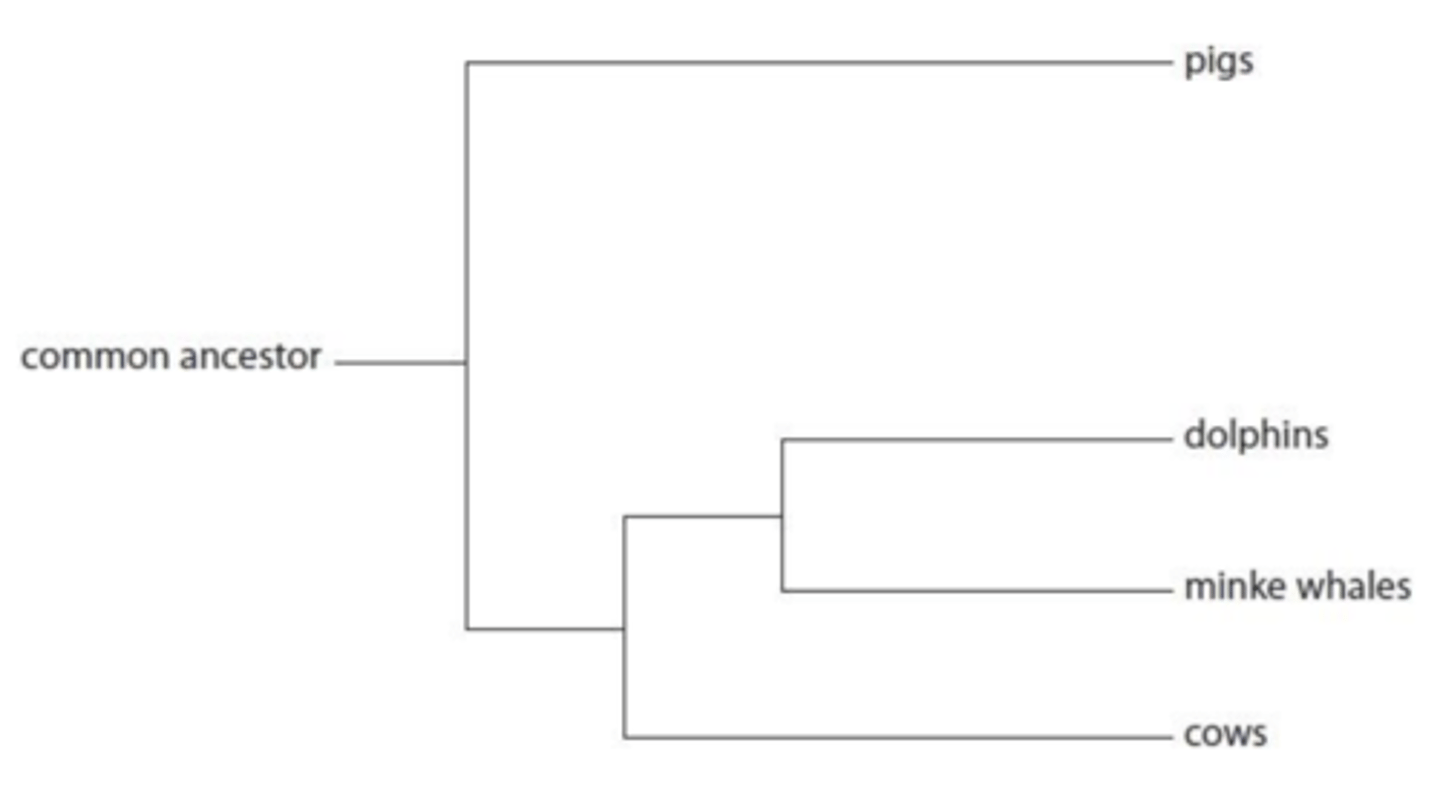
What is the evolutionary relationship between the four animals shown in the phylogenetic tree? (3)
- Dolphins and minke whales are the most closely related as they share the most recent common ancestor.
- The shared common ancestor of dolphins and minke whales then shares a common ancestor with cows.
- Pigs are the most distantly related to the other three animals as they were the first to diverge from the main ancestral line.