Spinal Cord and PNS

0.0(0)
studied byStudied by 0 people
0.0(0)
call kaiCall Kai
learnLearn
examPractice Test
spaced repetitionSpaced Repetition
heart puzzleMatch
flashcardsFlashcards
GameKnowt Play
Card Sorting

1/18

encourage image

There's no tags or description

Looks like no tags are added yet.

Last updated 2:19 AM on 2/3/26
Name
Mastery
Learn
Test
Matching
Spaced
Call with Kai

No analytics yet

Send a link to your students to track their progress

19 Terms
1
New cards
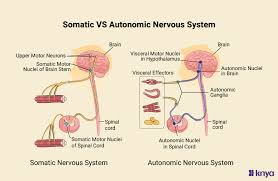
<p>What are the somatic and autonomic nervous system?</p>

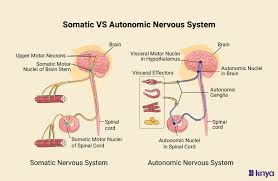
What are the somatic and autonomic nervous system?

  • part of the motor division of the PNS

  • somatic = voluntary

  • autonomic = automatic

<ul><li><p>part of the motor division of the PNS</p></li><li><p>somatic = voluntary</p></li><li><p>autonomic = automatic</p></li></ul><p></p>
2
New cards

What is gray matter in the PNS called?

ganglia
3
New cards
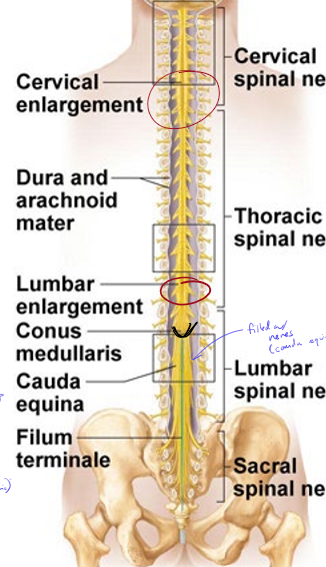
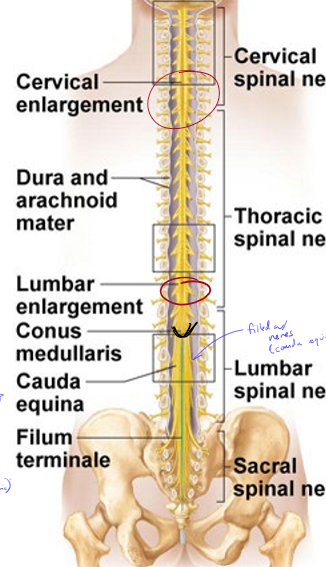
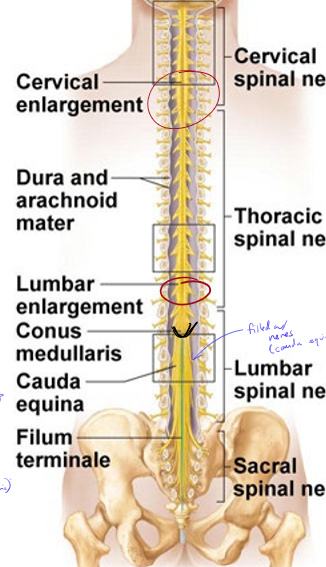
<p>Why are there enlargements in the cervical and lumbar regions of the spinal cord?</p>

Why are there enlargements in the cervical and lumbar regions of the spinal cord?

arms and legs are very innervated, so more cell bodies are stored in the enlargements
<p>arms and legs are very innervated, so more cell bodies are stored in the enlargements</p>
4
New cards
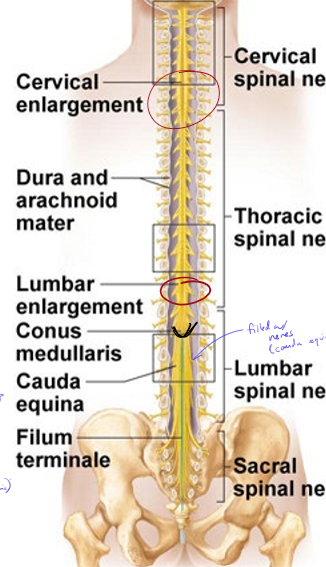
<p>Where does the spinal cord end?</p>

Where does the spinal cord end?

near the L1 vertebrae
<p>near the L1 vertebrae</p>
5
New cards
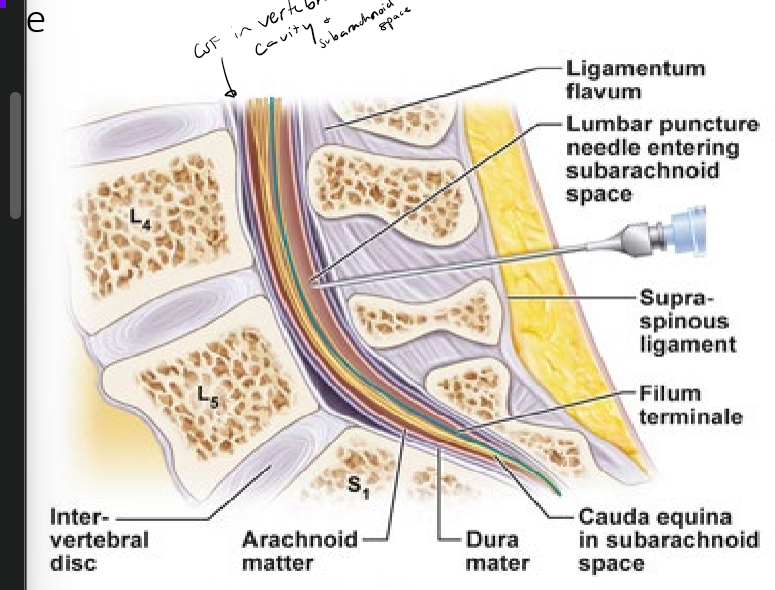
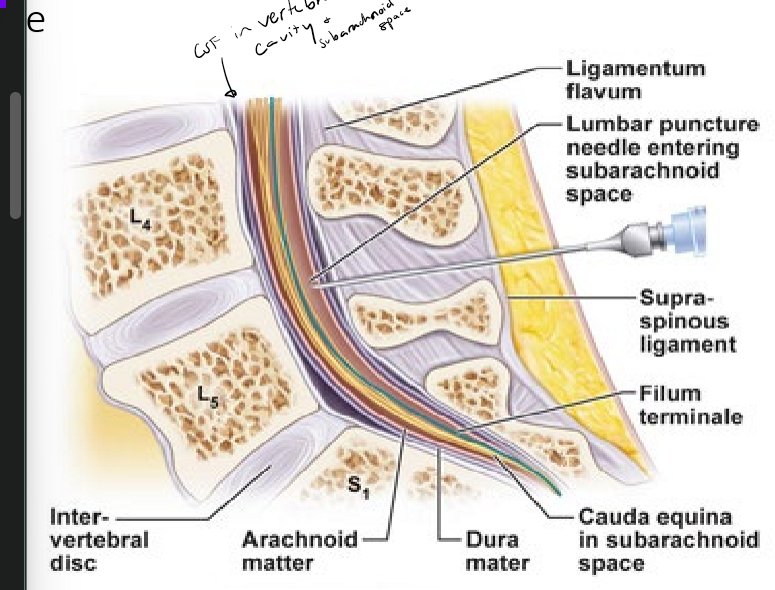
<p>What is a lumbar puncture (spinal tap) and why is it performed?</p>

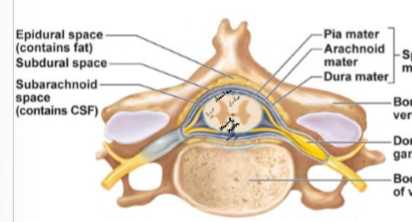
What is a lumbar puncture (spinal tap) and why is it performed?

  • done below spinal cord to avoid hitting spinal cord

  • done to get CSF from the subarachnoid space to look for bacteria
<ul><li><p>done below spinal cord to avoid hitting spinal cord</p></li><li><p>done to get CSF from the subarachnoid space to look for bacteria</p></li></ul><p></p>
6
New cards
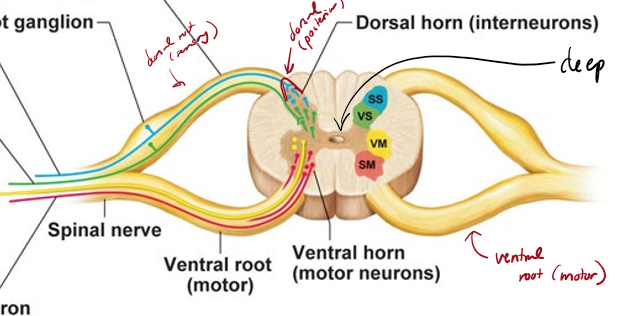
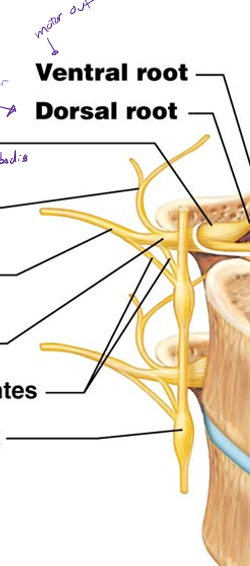
<p>What are the parts of he spinal cord and what does each do?</p>

What are the parts of he spinal cord and what does each do?

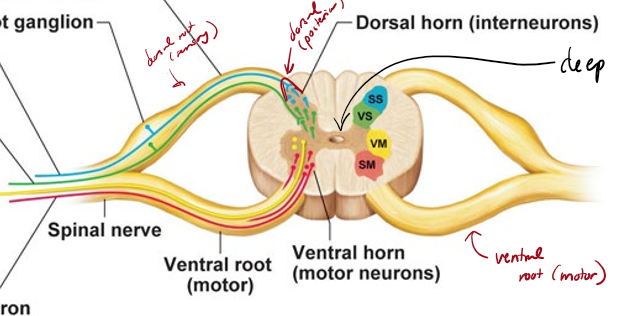
  • dorsal horn - gray matter, interneurons

  • ventral horn - gray matter, motor neurons

  • ventral root - carries motor neurons away from spinal cord

  • dorsal root - carries sensory neurons towards spinal cord

  • dorsal root ganglion - contains sensory cell bodies

  • spinal nerve - carries both sensory and motor nerves
<ul><li><p>dorsal horn - gray matter, interneurons</p></li><li><p>ventral horn - gray matter, motor neurons</p></li><li><p>ventral root - carries motor neurons away from spinal cord</p></li><li><p>dorsal root - carries sensory neurons towards spinal cord</p></li><li><p>dorsal root ganglion - contains sensory cell bodies</p></li><li><p>spinal nerve - carries both sensory and motor nerves</p></li></ul><p></p>
7
New cards
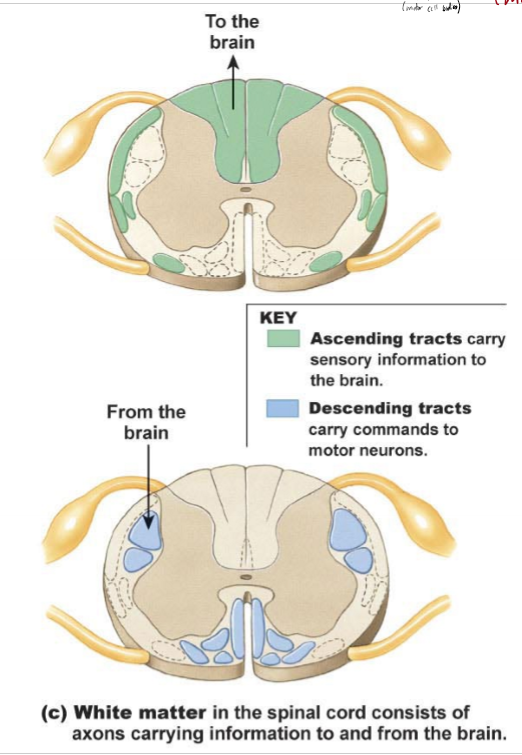
<p>What are ascending and descending tracts?</p>

What are ascending and descending tracts?

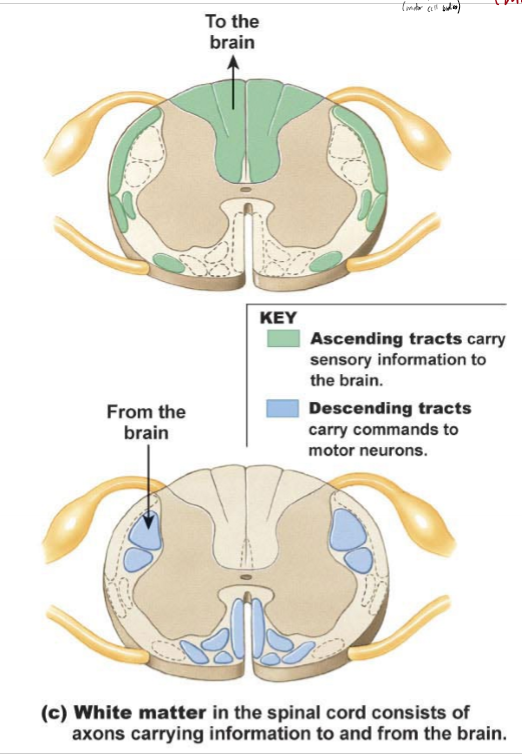
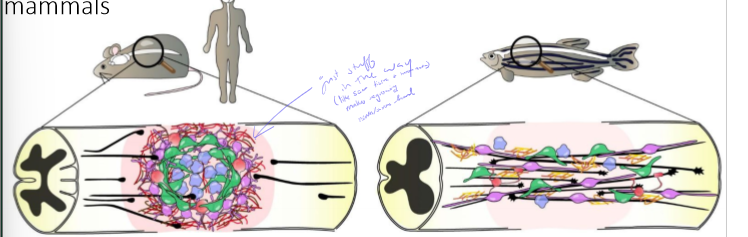
  • white matter (axons) in the spinal cord traveling to/from the brain

  • ascending - info to the brain up spinal columns, decussation occurs in brainstem or spinal cord, 3 neuron circuits from receptor to primary somatosensory cortex (parietal lobe)

  • descending - info to motor neurons from CNS, dessucation in brainstem/spinal cord, 2 or 3 neuron circuits from primary motor cortex to muscle
<ul><li><p>white matter (axons) in the spinal cord traveling to/from the brain</p></li><li><p>ascending - info to the brain up spinal columns, decussation occurs in brainstem or spinal cord, 3 neuron circuits from receptor to primary somatosensory cortex (parietal lobe)</p></li><li><p>descending - info to motor neurons from CNS, dessucation in brainstem/spinal cord, 2 or 3 neuron circuits from primary motor cortex to muscle</p></li></ul><p></p>
8
New cards
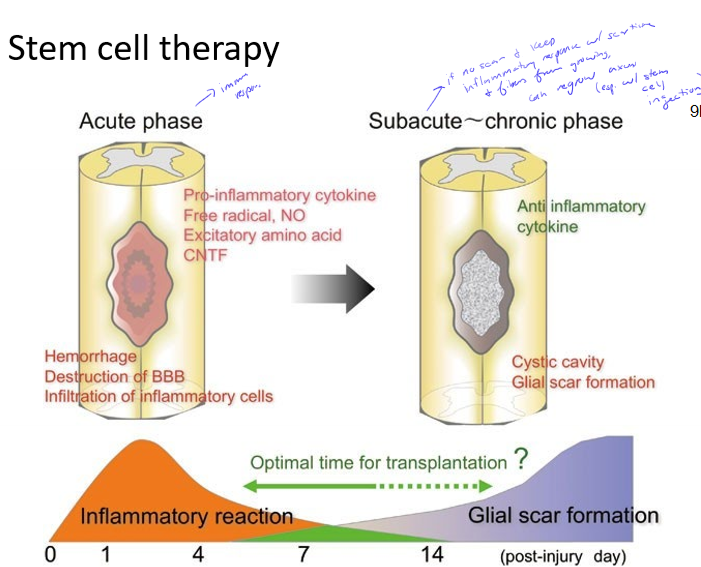
<p>Why don’t spinal cords regenerate very well?</p>

Why don’t spinal cords regenerate very well?

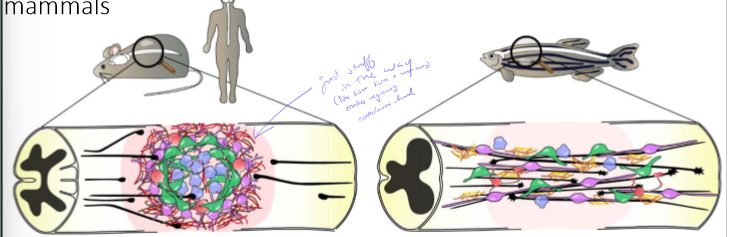
immune system puts fibroblasts, scar tissue, etc. in way of where axons need to grow
<p>immune system puts fibroblasts, scar tissue, etc. in way of where axons need to grow</p>
9
New cards
<p>Describe the stem cell therapy treatment for spinal cord injuries and why they work</p>

Describe the stem cell therapy treatment for spinal cord injuries and why they work

  • occur between acute and subacute phase

  • after inflammatory response but before scar forms, axons can regenerate before stuff gets in the way, especially if stem cells are injected
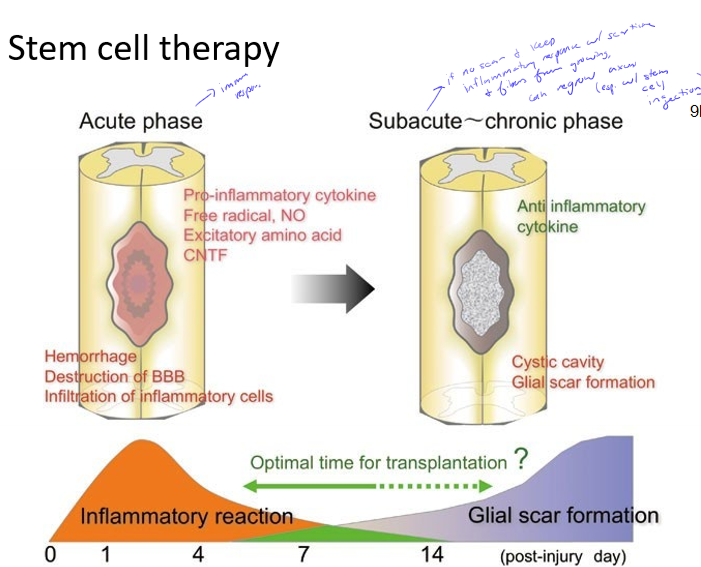
<ul><li><p>occur between acute and subacute phase</p></li><li><p>after inflammatory response but before scar forms, axons can regenerate before stuff gets in the way, especially if stem cells are injected</p></li></ul><p></p>
10
New cards
<p>Describe electrical stimulators after spinal cord damage and why this can help</p>

Describe electrical stimulators after spinal cord damage and why this can help

  • even if axons are cute, many neurons below point of damage still function

  • can stimulate nerves despite damage to other parts of the body
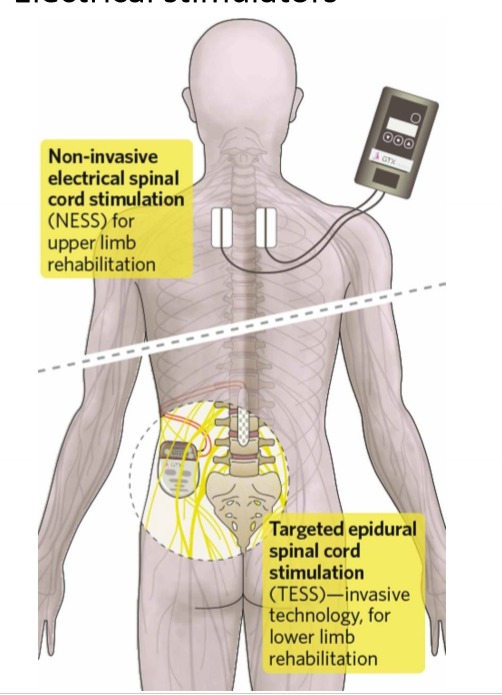
<ul><li><p>even if axons are cute, many neurons below point of damage still function</p></li><li><p>can stimulate nerves despite damage to other parts of  the body</p></li></ul><p></p>
11
New cards
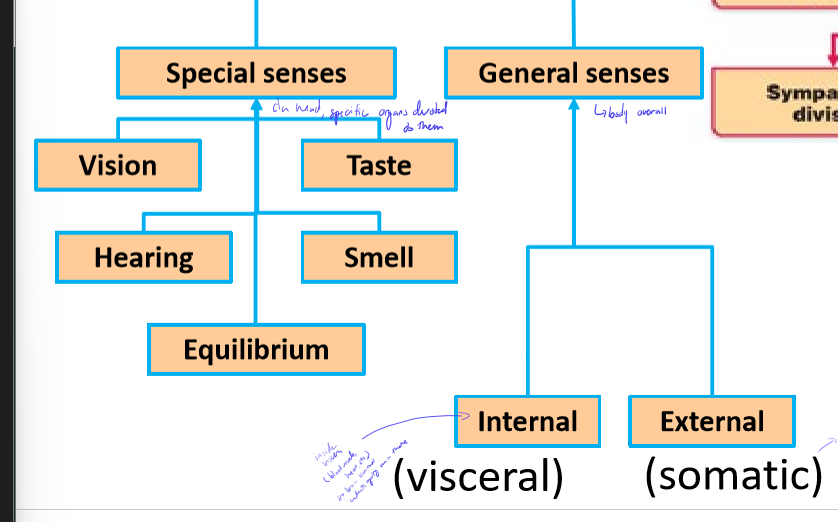
<p>What are internal (visceral) and external (somatic) afferent inputs?</p>

What are internal (visceral) and external (somatic) afferent inputs?

  • visceral - signals from inside viscera, ex. blood vessel, heart

  • somatic - signals associated with skin ex. touch, temperature, pain
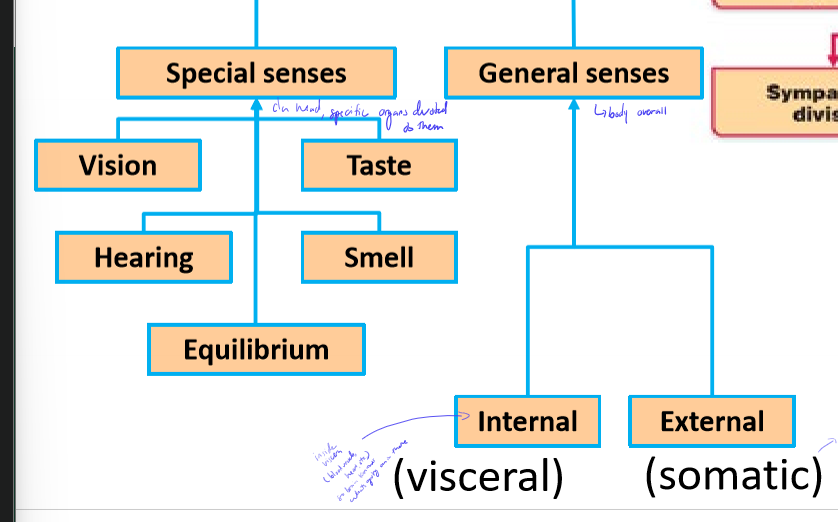
<ul><li><p>visceral - signals from inside viscera, ex. blood vessel, heart</p></li><li><p>somatic - signals associated with skin ex. touch, temperature, pain</p></li></ul><p></p>
12
New cards

What is white matter in the CNS?

nerve, root, ramus

13
New cards

What are rami? Describe the dorsal and ventral ramus

  • branch like bundles of motor and sensory nerves after it exits the spinal cord

  • dorsal - to back

  • ventral - to front of body

<ul><li><p>branch like bundles of motor and sensory nerves after it exits the spinal cord</p></li></ul><ul><li><p>dorsal - to back</p></li><li><p>ventral - to front of body</p></li></ul><p></p>
14
New cards
<p>Describe the structure of a nerve from deepest to most superficial</p>

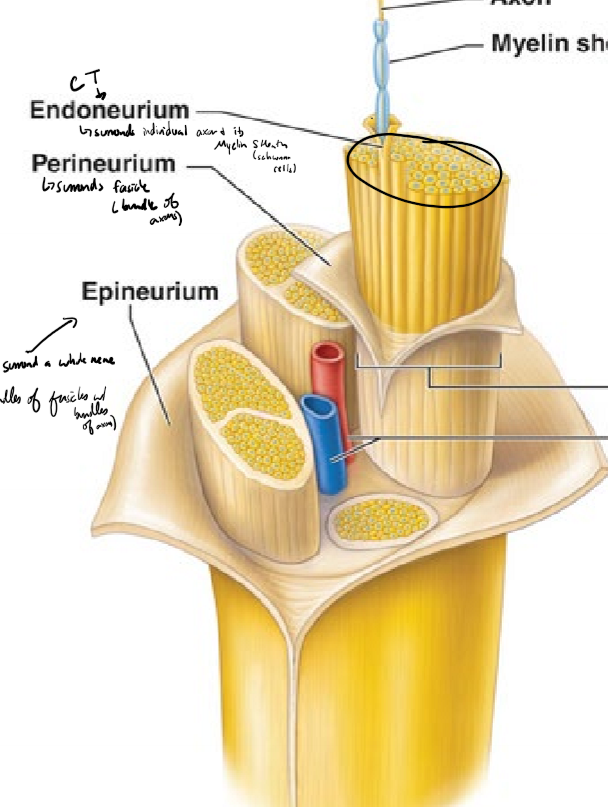
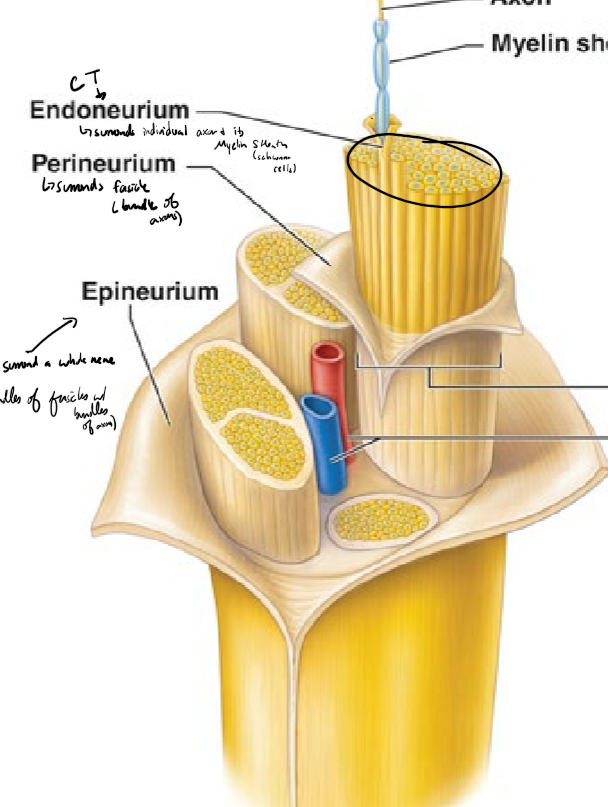
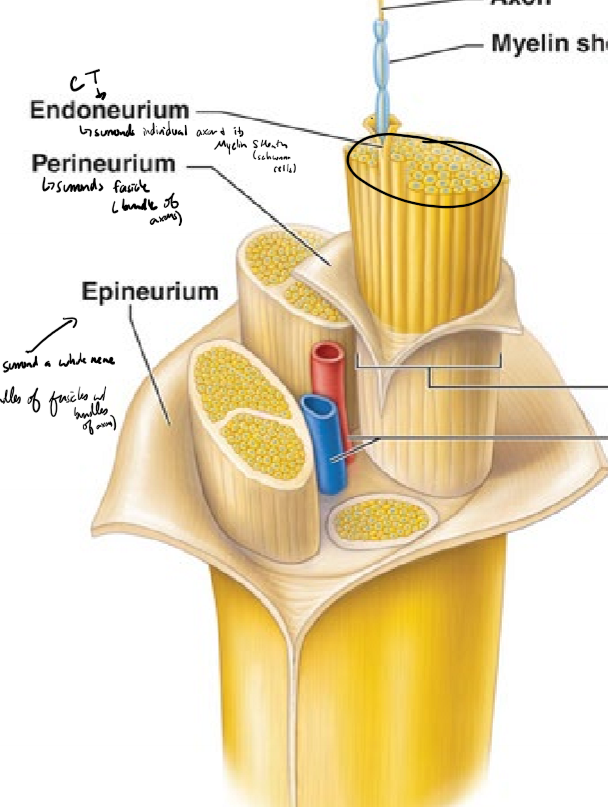
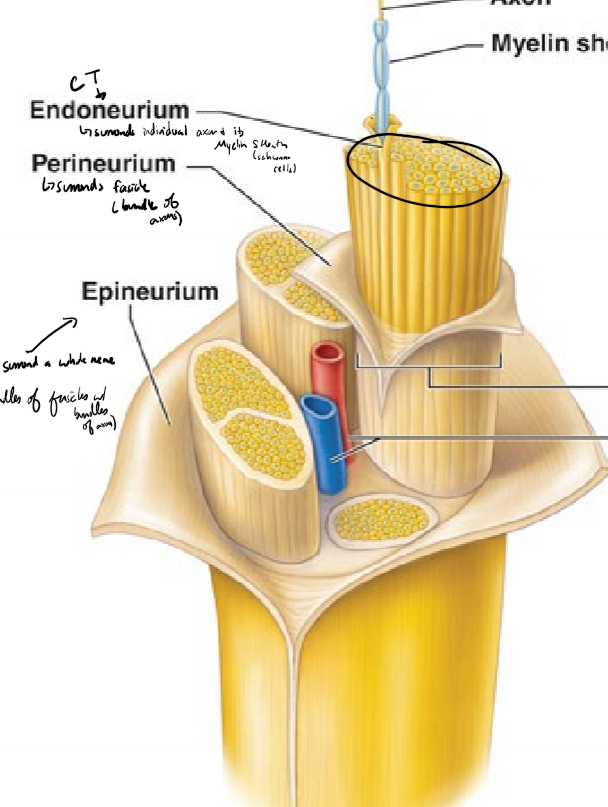
Describe the structure of a nerve from deepest to most superficial

  • axon surrounded by a myelin sheath (schwann cells)

  • endoneurium surrounds individual axons and their myelin sheath

  • perineurium surrounds fascicles (bundles of axons)

  • epineurium surrounds a whole nerve (bundles of fasicles)
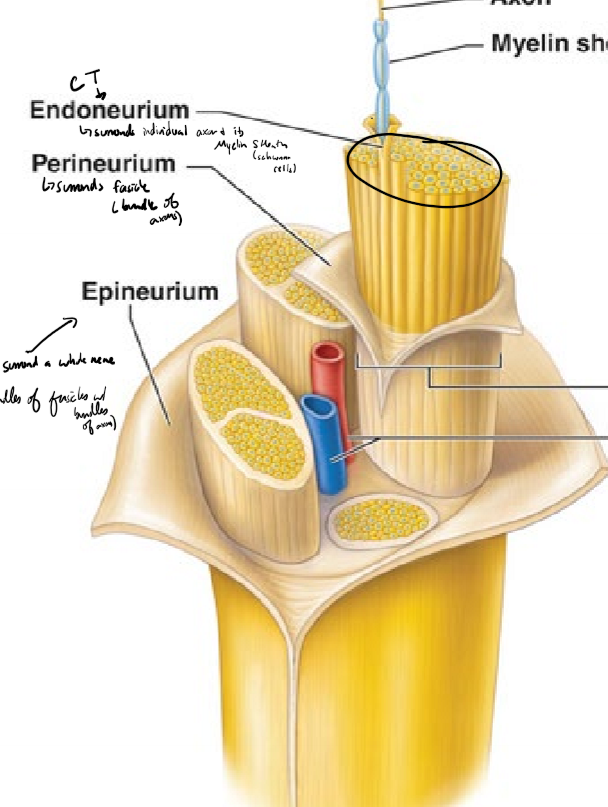
<ul><li><p>axon surrounded by a myelin sheath (schwann cells)</p></li><li><p>endoneurium surrounds individual axons and their myelin sheath</p></li><li><p>perineurium surrounds fascicles (bundles of axons)</p></li><li><p>epineurium surrounds a whole nerve (bundles of fasicles)</p></li></ul><p></p>
15
New cards
<p>What is a fasicle?</p>

What is a fasicle?

group of axons bundled together
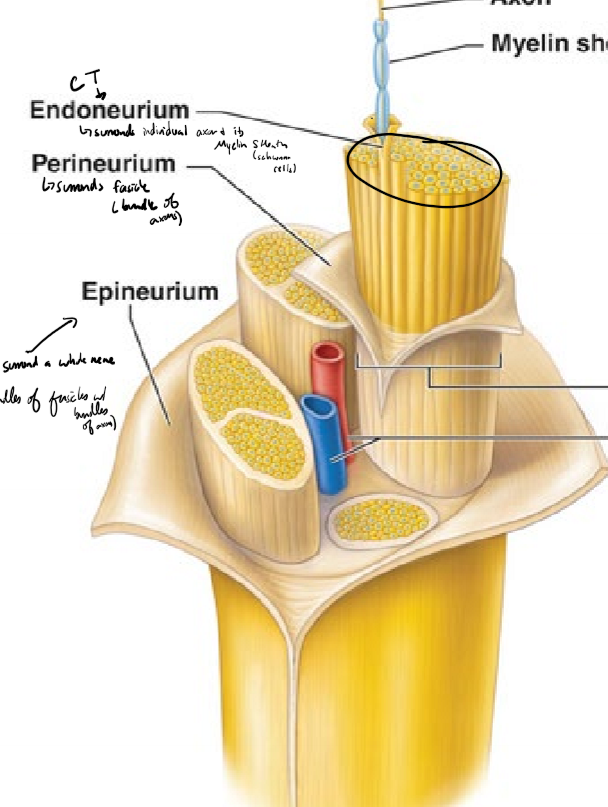
<p>group of axons bundled together</p>
16
New cards
<p>What do the endoneurium, perineurium, and epineurium surround? What kind of tissue are they?</p>

What do the endoneurium, perineurium, and epineurium surround? What kind of tissue are they?

  • endonerium surronds an individual axon and its myelin sheath

  • perineurium surrounds a fascicle (bundle of axons)

  • epineurium surrounds a whole nerve

  • connective tissue

<ul><li><p>endonerium surronds an individual axon and its myelin sheath</p></li><li><p>perineurium surrounds a fascicle (bundle of axons)</p></li><li><p>epineurium surrounds a whole nerve</p></li><li><p>connective tissue</p></li></ul><p></p>
17
New cards
<p>Describe cranial nerves</p>

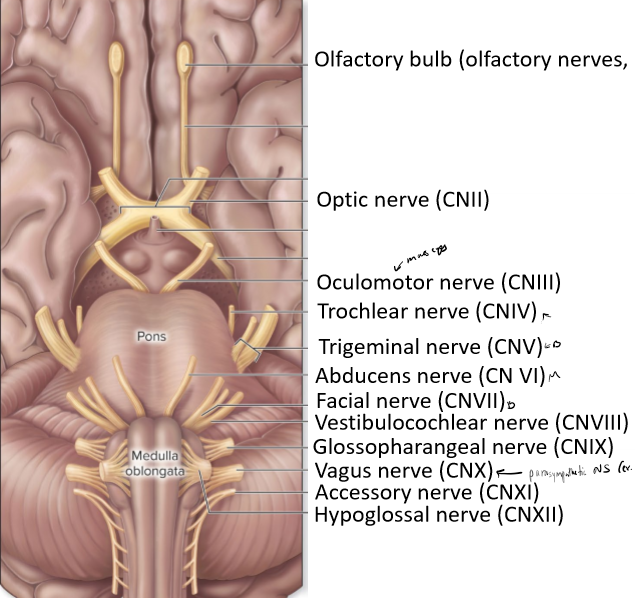
Describe cranial nerves

  • nerves coming off the brain

  • can be only sensory, only motor, or both

  • most connect to the brain stem

  • most are involved with structures in the head and neck
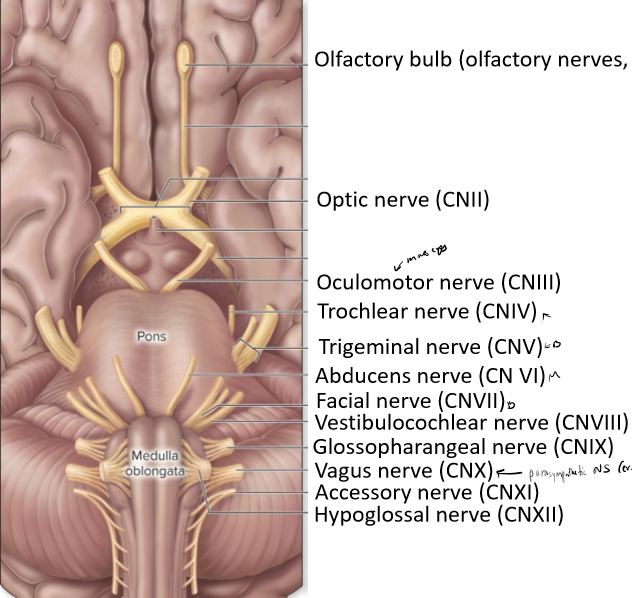
<ul><li><p>nerves coming off the brain</p></li><li><p>can be only sensory, only motor, or both</p></li><li><p>most connect to the brain stem</p></li><li><p>most are involved with structures in the head and neck</p></li></ul><p></p>
18
New cards
<p>Describe spinal nerves</p>

Describe spinal nerves

  • nerves coming off spinal cord

  • mixed nerves, both sensory and motor fibers
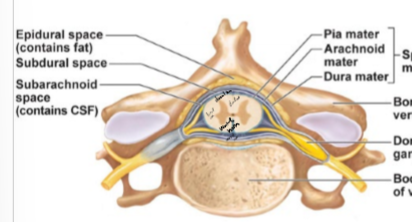
<ul><li><p>nerves coming off spinal cord</p></li><li><p>mixed nerves, both sensory and motor fibers</p></li></ul><p></p>
19
New cards
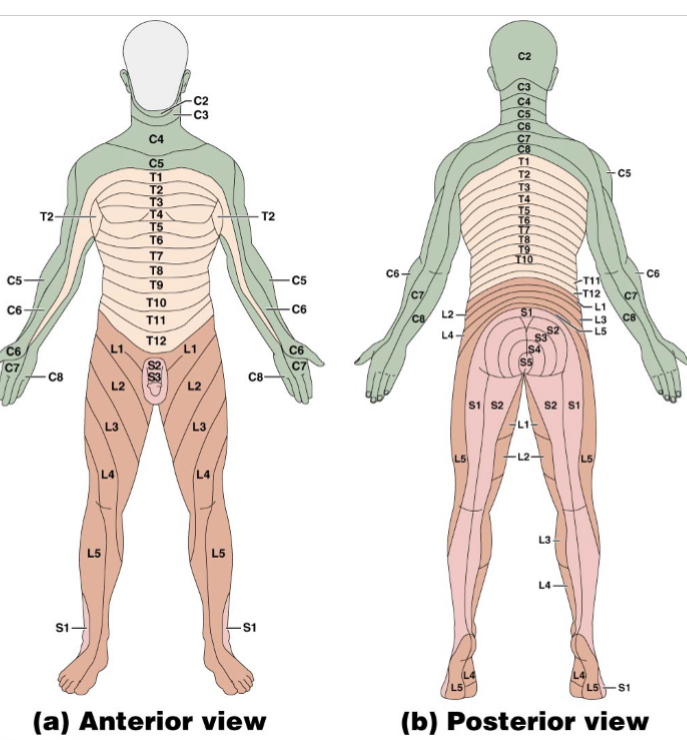
<p>What are nerve plexuses?</p>

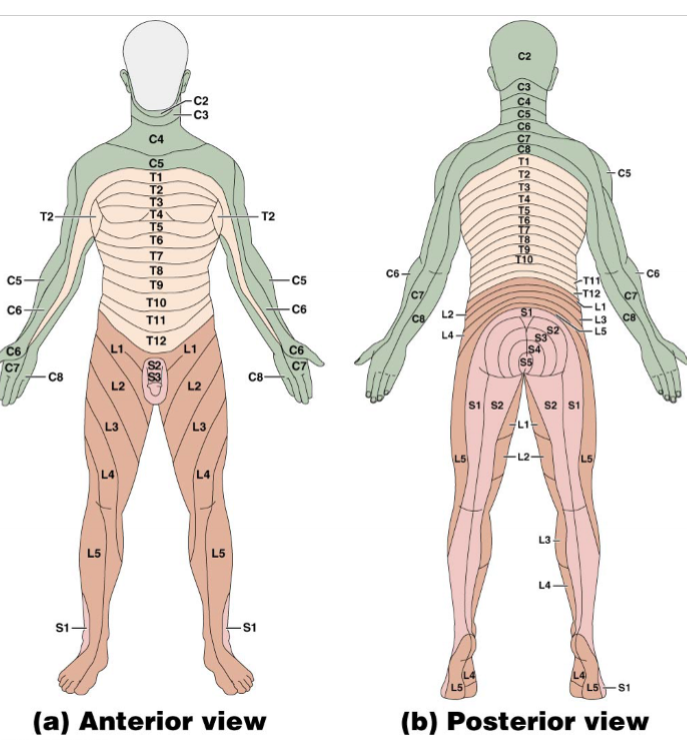
What are nerve plexuses?

  • branching and unbranching of axons (not necessarily synapses)

  • branch to get specific nerves at a specific spot to innervate

  • nerve roots generally map to parts of the body from superior to inferior
<ul><li><p>branching and unbranching of axons (not necessarily synapses)</p></li><li><p>branch to get specific nerves at a specific spot to innervate</p></li><li><p>nerve roots generally map to parts of the body from superior to inferior </p></li></ul><p></p>