all about sex
 Call Kai
 Learn
Learn Practice Test
 Spaced Repetition
 Match
Match Flashcards
 Knowt Play
1/18

There's no tags or description
Looks like no tags are added yet.
Name | Mastery | Learn | Test | Matching | Spaced | Call with Kai |
|---|
No analytics yet
Send a link to your students to track their progress
19 Terms
what is an essential feature of sexxual reproduction
the mixing of genes
Asexual reproduction does occur in multicellular eukaryotes
Less common than sexual reproduction
• A few species are exclusively asexual
• In some species there is an alternation of asexual
and sexual cycles and/or generations
• And some species have simultaneous sexual and
asexual forms
Trends of asexual
lineages in evolution of
multicellular eukaryotes
• All appear to have evolved from
a sexually reproducing ancestor
• Asexual lineages are short-lived
on an evolutionary timeframe
• In other words…sex must have
some evolutionary advantage!
what are the costs to
sexual reproduction
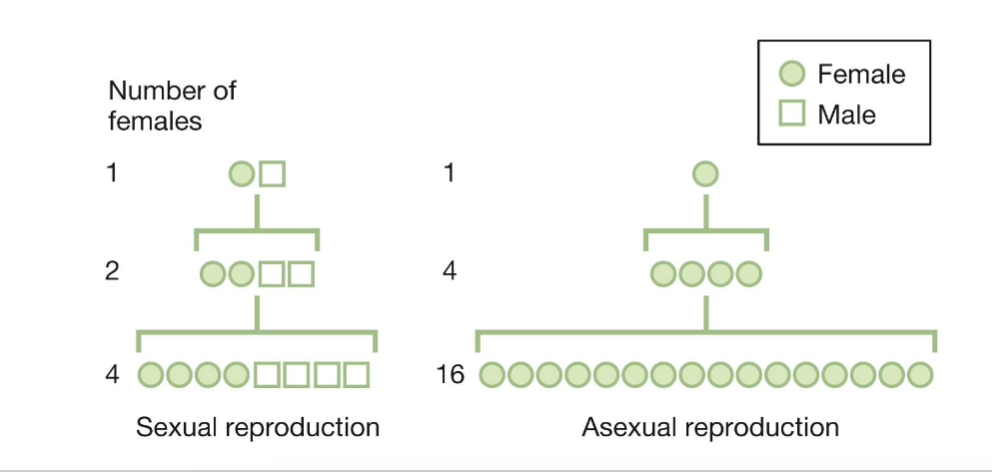
• Asexual female passes twice as many copies of genes to
offspring
• There is a cost to a population in males (half as many direct
offspring producers)
• John Maynard Smith termed this “the twofold cost of sex”
what are some costs of sexxual reproduction
• Sex can break up favorable gene
combinations
• Search for mates requires energy
• Courting mates takes time and energy, and
often causes vulnerability to predators
• Sexual reproduction can transfer parasites
and diseases
What is the red queen hypothesis?
• Advantages to sex in changing environments
• Organisms must constantly adapt and evolve
• Generates genetic variation (new combinations
of alleles)
• More variation within a population…
• Better chance of producing more fit, better
adapted, organisms
how do snails support the red queen hypothesis
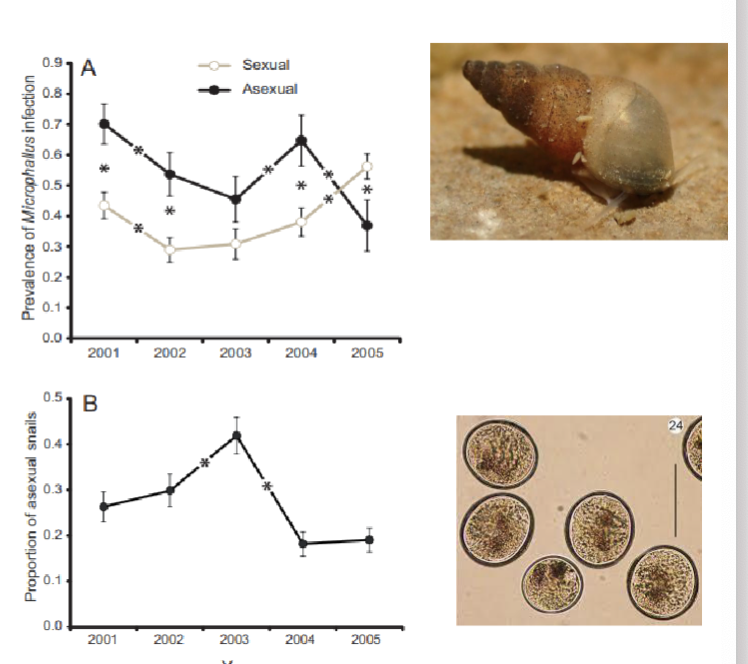
• Populations of Potamopyrgus antipodarum
have both sexual and asexual genotypes
• Populations exposed to higher densities of
Microphallus have higher frequencies of
sexually reproducing individuals
• Sexual females have lower infection rates
How does yeast strain support the red queen hypothesis
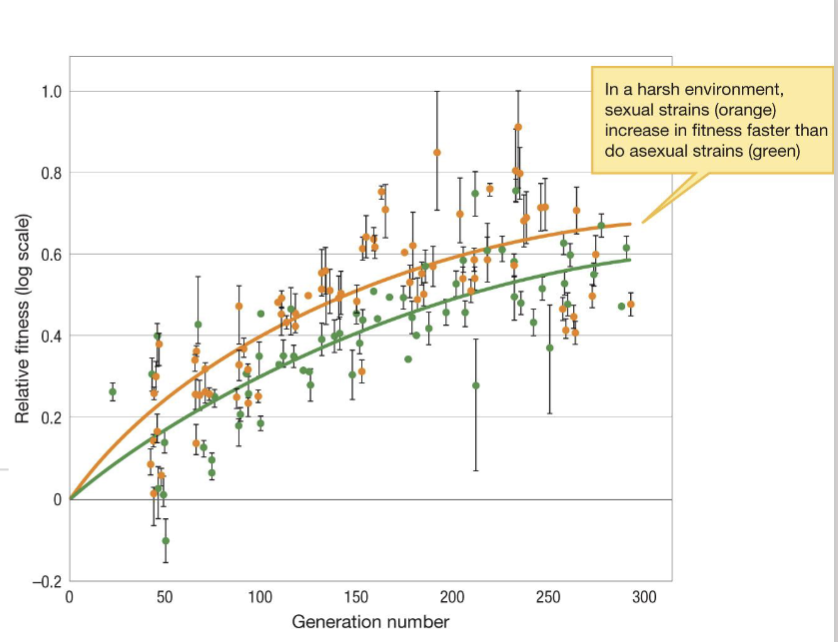
change in fitness of
yeast strains in a
harsh environment
-in a harsh environment, sexual strains (orange) increase in fitness rather than do asexual strains (green)
Describe how sex accelerates adaptive evolution
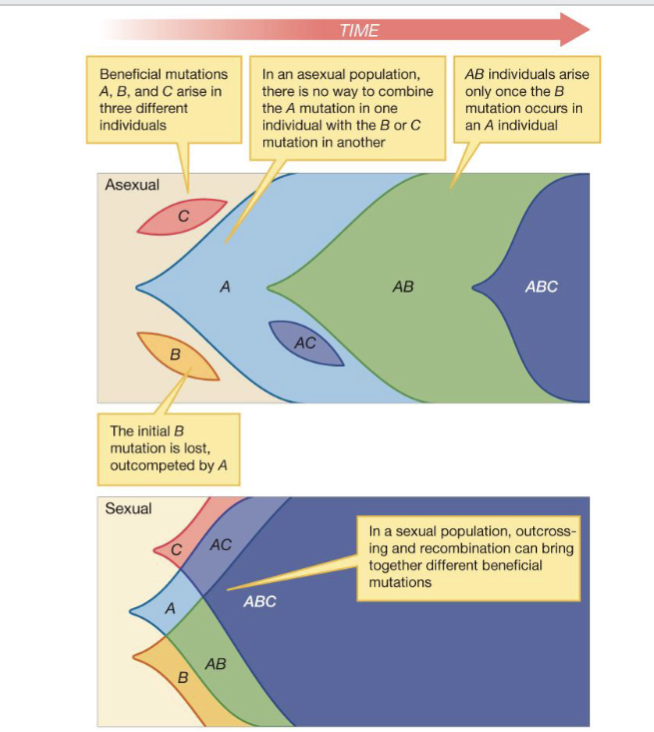
sexxual reproduction can combine beneficial mutations faster than asexual does
Describe simultaenous and sequential hermaphrodites
-Simultaneous hermaphrodites possess functional male and female reproductive organs at the same time, often exchanging sperm with partners (e.g., earthworms), while
-sequential hermaphrodites begin life as one sex and change to the other, usually prompted by size or social cues (e.g., clownfish)
What favors hermaphroditism?
reproductive reassurance
most animals are what?
gonochoristic and
often sexually dimorphic
Why are some plants dioecious (have separate sexes)?
-primarily to ensure cross-pollination, which increases genetic diversity and prevents the harmful effects of self-fertilization, known as inbreeding depression. This reproductive strategy allows for better adaptation to environmental changes and enables specialized energy allocation towards either pollen or seed production
But since plants cannot actively search for a
mate, they are hermaphroditic more often than
animals, can often self-fertilize, and won’t play
much of a role in the discussion about sexual
selection that follows
Describe Isogamy, anisogamy, and oogamy
-isogamy: fusion of gametes that are similar in size, shape, and structure. They are indistinguishable as male or female. Doesnt require specialized organs for gamete reproduction
-anisogamy: Sexual reproduction involving the fusion of 2 games that differ in size and form. Sperm is normally smaller. Enables higher motility for sperm alongside high investment from larger gamete
-oogamy: A specific type of anisogamy, where a large, non-mobile female gamete (egg) is fertilized by a small motile male gamete (sperm). Maximizes reproductive success by combining high mobility of sperm w high nutrient reserves in the egg.
Define primary and secondary sexxual traits
• Primary sexual traits: gonads and genitalia
• Secondary sexual traits: traits that differ
between the sexes but do not play a direct
role in reproduction
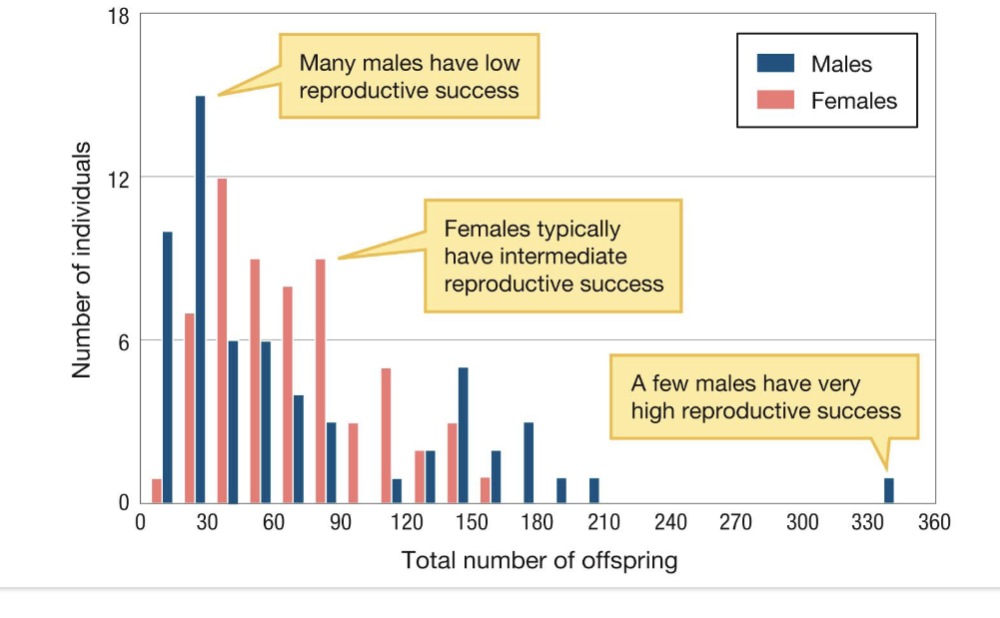
explain why Selection operates differently on males and females
• Ova (female gametes) require more investment and are a limiting
resource
• Drives competition among males
• Creates variation between success of males
• Males can continuously reproduce, reproductive constraints on females
• Since eggs are “expensive” and scarce, females tend to be more
discriminating
• There are obviously degrees of difference between species
• Fish where eggs are fertilized externally
• Mammals with long gestation period
Explain sexxual seletion
• Selection of traits that increase mating success
• Often leads to sexual dimorphism
• Two types: Intrasexual selection & Intersexual selection
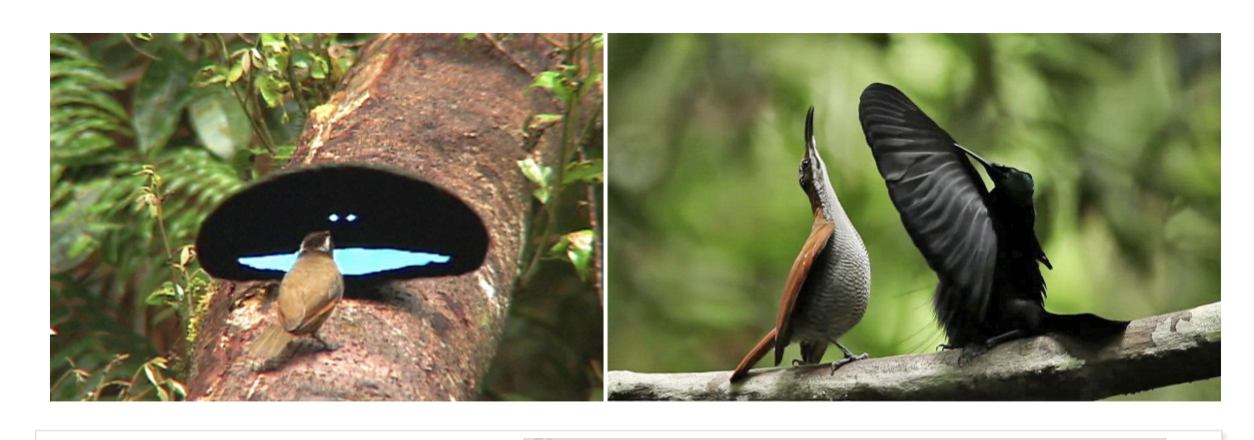
What is usually exaggerated in sexxual traits?
In both types (intrasexual and intersexual selection), it is usually the
male’s secondary sexual traits
that are exaggerated
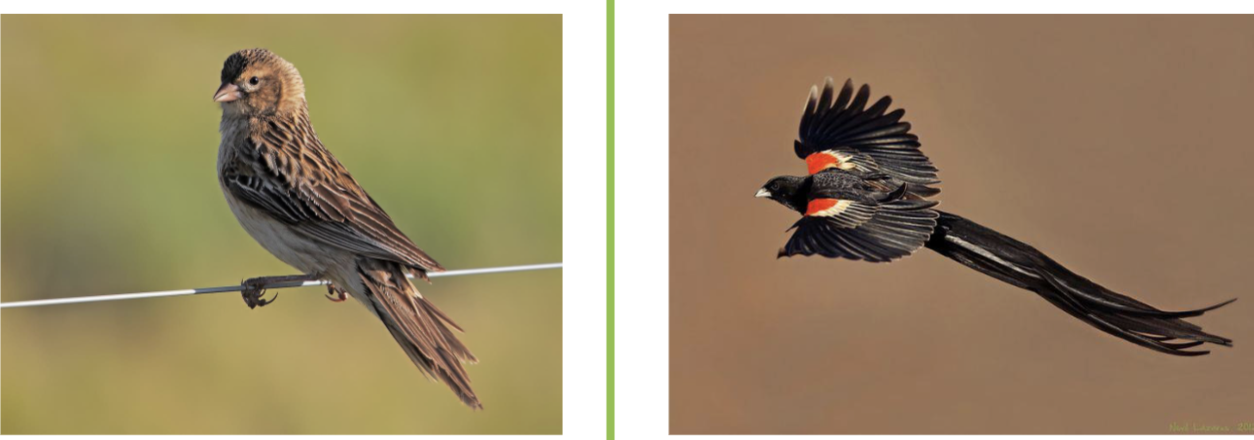
explain why Secondary sexual
traits experience a
tug-of-war
between their
effects on two
fitness components
• Survival and mating success
• Conspicuous male displays may attract
mates, but they also decrease male survival
because they may attract predator and/or
increase the male’s energy budget
• These traits evolve to a compromise that
maximizes a male’s total lifetime fitness
• Optimal value of the trait shifts if strength of
natural selection or sexual selection changes

