ID: W2L4 - Trait Theories of Personality
 Studied by 2 people
 Call Kai
 Learn
Learn Practice Test
 Spaced Repetition
 Match
Match Flashcards
 Knowt Play
1/20

There's no tags or description
Looks like no tags are added yet.
Name | Mastery | Learn | Test | Matching | Spaced | Call with Kai |
|---|
No analytics yet
Send a link to your students to track their progress
21 Terms
What is a trait
probabilistic summaries of behaviour
it doesn’t explain why someone does smth but instead it explains that someone just has a tendency to do it
Traits aren’t used to explain the reason why people engage in certain behaviours but they can still be used to make predictions about behaviour
only useful at the population/group level (not useful for predicting how a single individual will act in a scenario)
ex. could be used to predict how extroverts vs introverts will behave at a party
Explain the progression trait theories
Galton’s Lexical Hypothesis → Allport (cardinal, central, secondary) → Catell (16PF) → Eysenck (3 factors) → Five Factor Model
Explain the lexical hypothesis of traits
The lexicial hypothesis proposes that individual trait differences that are important would be common topics in people’s everyday language
the more synonyms there are for a trait, the more important that trait is
Also makes the incorrect assumption that the traits found consistently in one culture would be the same across other cultures
R: lexical = words (so think of how common words were, what would determine key traits to examine)
Explain Gordon Allport’s theory
collected large list of traits but no analytic tools to distill them into a smaller set of traits
he had his own approach to classifying traits which was subjective and individual:
Cardinal traits: single trait that dominated an individual's personality + strongly influenced behaviour
Central traits: 5-10 trait words that best describe an individual
Secondary traits: usually preferences only become applicable in specific scenarios
Ex. Mother Teresa
Cardinal trait = altruistic
Central traits = kind, social, giving, passionate, humble
Secondary traits = any specific preference or behaviour that only occurs in certain circumstances (ex. she likes Early grey tea)
R: Gordon Allport → ALLIMPORTANT trait = cardinal trait
Explain Raymond Cattell’s trait theory (different distinctions, 16PF questionnaire)
3 Different distinctions;
ability vs temperament traits'
ability = ability to rch your goals in different scenarios
temperament = how you actually go about achieving those goals
Common vs unique traits (self-explanatory)
surface vs source traits
Multiple surface traits make up source traits
Use factor analysis to get to the 16PF (16 Personality Factor) questionnaire
it lacked internal consistency
What is Q-data, T-data and L-data according to Cattell
3-types of data Catelll collected
Q-data = personality quesstionnaires
T-data = data from standardized tests
L-data = “life record” coming from real stats from the person’s life
Explain factor analysis using this diagram
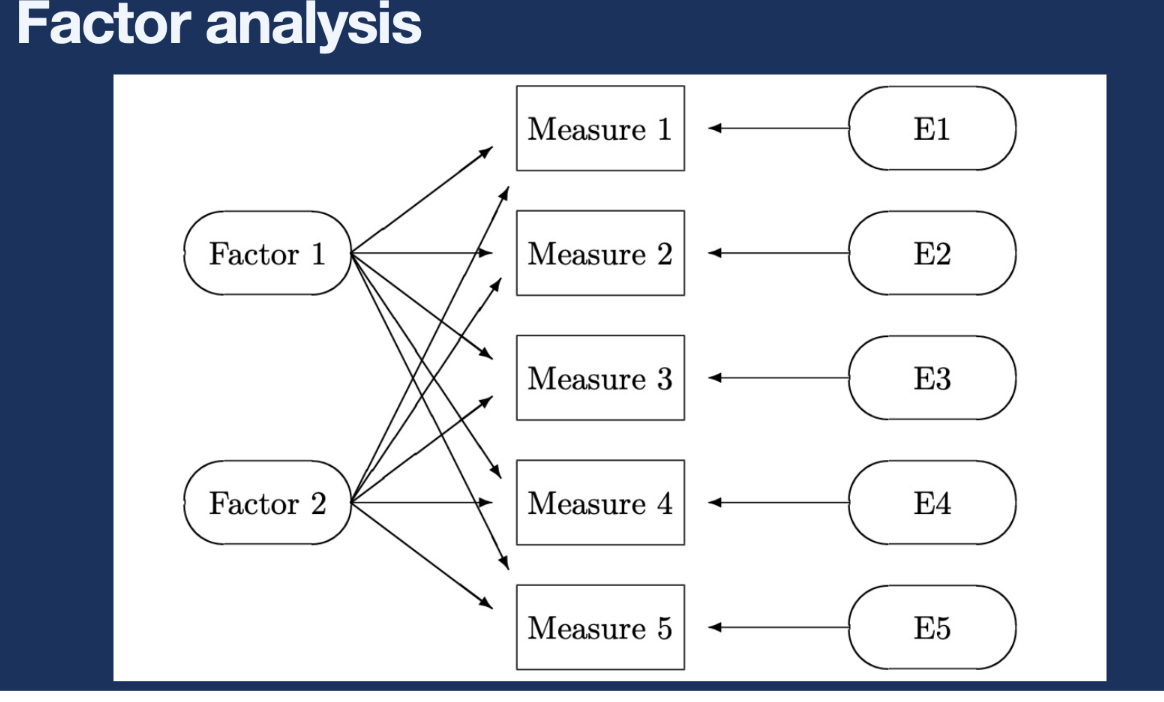
ex. of assessing student grades to see why some students do well in some areas but not others
Measures:
Measure 1 = geometry
Measure 2 = algebra
Measure 3 = calculus
Measure 4 = english writing
Measure five = English vocab test
Factors (what underlying variables could categorize the measures?)
Factor 1: Math ability (measures 1-3)
Factor 2: English language ability (measures 4-5)
Error:
maybe on the day of the geometry exam a student had a headache. Typically they have strong math ability but that day they did poorly on that measure. This would represent “error”
Break down Eysenck Theory
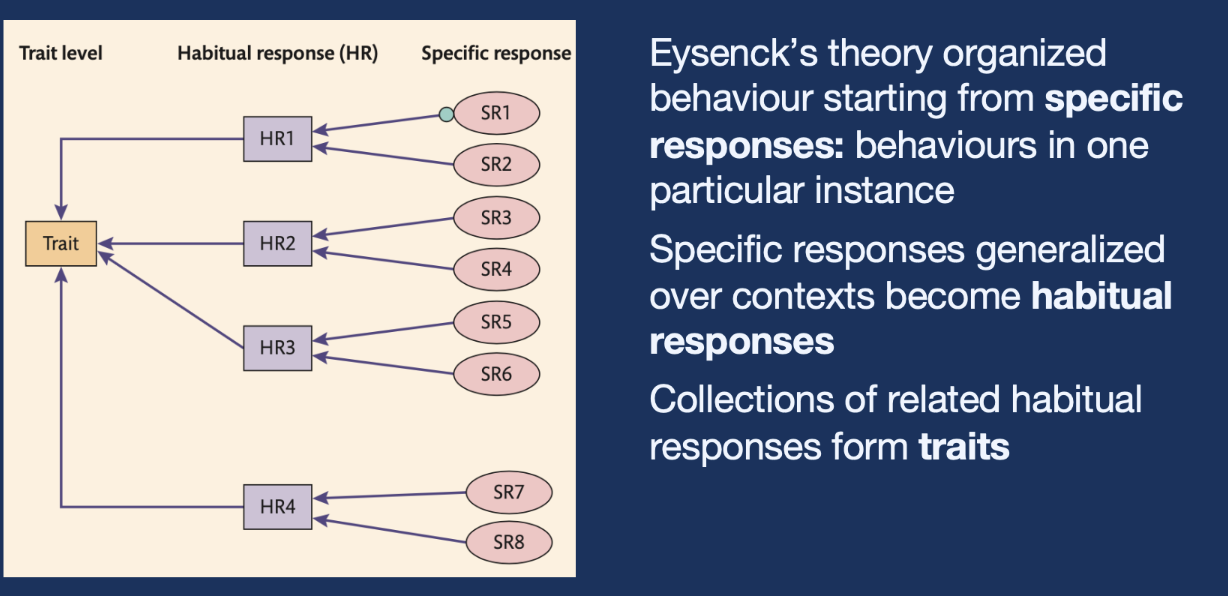
Specific response: only occurs in particular circumstances
Habitual response: specific responses that occur in several contexts become habitual traits
Trait: multiple habitual responses form traits
Eyesnk brings forth the idea of SUPERTRAITS.
R: Our eyes are our most SUPER trait, therefore Eyesnk = SUPERTRAITS
How did Hans Eysenck adjust Catell’s analytical 16PF questionnaire
Eysenck cut it down from 16 to 3 “supertraits”
Socialbility: scale of extraversion and introversion
Neuroticism: emotional instability
Psychopathy: insensitivity to others, hostility, and cruelty
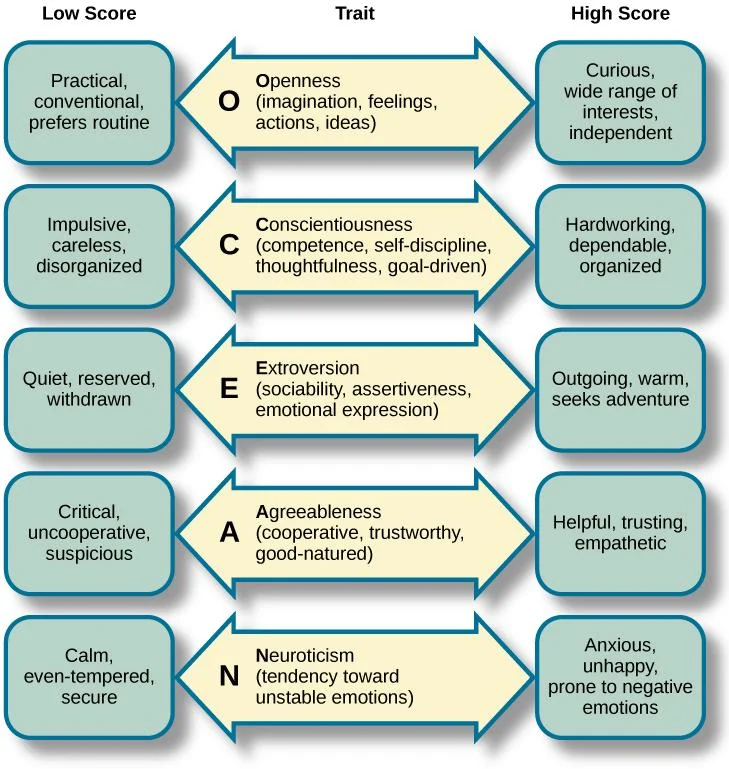
Explain the Five Factor Model (FFM)
it kept the ideas of the supertraits, but most research converged on five traits (instead of 3)
OCEAN
openness
conscientiousness (organized, responsible, goal-oriented)
extraversion
agreeableness
neuroticism
Explain how support for the FFM in different cultures depends on whether you use an “emic” or an “etic” approach
Emic: exploratory analysis
starts from scratch using trait adjectives in the native language of another culture
Etic: confirmatory approach
says that we have solved the factor structure. Then imposes it on to new cultures, simply translating the questionnaire questions
. This method supports the FFM more because of confirmation bias, in a sense.
If you're confident in what you’re looking for, that’s what you’ll find, but you’ll miss other nuances, suchas cultural differences like more importance placed on interpersonal relationships in collectivist cultures
R: etic is not ETHICAL in my mind because you are simply imposing Western values/traits on to other cultures
How does change affect people on different timescales (state vs trait variations)
State variations: variations within a person's personality over short periods (minutes to days) (ex. someone who is typically calm, becoming nervous before a speech)
Trait variations: variations and how variation unfolds across long periods (months to years) (ex. someone who is used to be egotistical becoming humble over many years)
Explain what the Bleidorn paper says
KEY MSG: Personality is dynamic. It is moderately stable but it can change across one’s lifespan
States that on avg people increase in psychological maturity regarding the Big-Five factors (i.e., higher conscientiousness, extraversion, openness and emotional stability)
Despite being changeable, traits are a strong predictor of future behaviour
R: when you BLEID you become unstable, therefore BLEIDORN paper = trait stability
What are the problems that the Bleidorn paper hopes to address in other psychological theories
Freud’s fixity: Sigmund Freud believes that traits are fixed. Bledorn proves that it is not.
Adler’s agency: Alfred Adler believes that people can change their personality as long as they have agency. Bleidorn challenges this and calls for more longitudinal data to prove it
Mischel situational dependency: Walter Mischel states that behaviour is too situation dependent for the existence of stable traits. Bleidorn challenges this by showcasing that traits can persist throughout specific situations
Explain mean-level change and rank-order stability
Mean-lvl change:
change in avg values of a trait within a general population (ex. the psychological maturity principle states that extraversion, openness and emotional stability go up as people age therefore that would be a mean lvl change)
Rank order stability:
stability of where someone ranks in the population over time (ex. if someone is in the 25th percentile of extraversion at 18, they will likely still be around there in 10 yrs because everyone else is experience mean lvl change alongside them)
there’s moderate rank order stability (0.4-0.6 correlation over 10 yrs)
Stability is lowest in adolescence and older adulthood
Explain the HEXACO model (sixth factor in Big Five)
proposes expanding Big 5 to 6 factors by adding honesty-humility (essentially splitting the agreeableness category)
HEXACO model is also more value-neutral meaning both very high lvls and low lvls of each factor can have negative effects
R: hexagon has six sides, therefore HEXACO = six factors
Explain the “One Factor” explanation
Basically states that all the positive Big Five traits are measuring people’s ability to adapt to societal expectations
Single factor = adaptibility to social expectations
Explan the Dark Triad/ Dark Tetrad
These are traits that are related to antisocialness
they don’t fit well into the Five-Factor Model
Psychopathy: selfishness and disregard for other people
Machiavellianism: manipulativeness for personal gain
Narcissism: big ego and a superiority complex
Sadism: pleasure from hurting others
What are the benefits and costs of using trait approaches
Benefits:
prediction, scientific empiricism (meaning an ability to study them), and an ability to connect with other disciplines
Costs:
it lacks in meaning, narrative, and theoretical basis
How do researchers use trait theories alongside cognition, development and environment
They use:
Traits for structure/understanding
Cognition, development, and environement for explanation
 Note
Note  Flashcards (34)