10.0 modified release formulaiton
 Studied by 0 people
 Call Kai
 Learn
Learn Practice Test
 Spaced Repetition
 Match
Match Flashcards
 Knowt Play
1/20

There's no tags or description
Looks like no tags are added yet.
Name | Mastery | Learn | Test | Matching | Spaced | Call with Kai |
|---|
No analytics yet
Send a link to your students to track their progress
21 Terms
oral emdications are designed to deliver immediate release/ conventional drug delivery
A typical example is taking paracetamol (acetaminophen) for headaches, where the tablet or capsule quickly disintegrates in the stomach, allowing the drug to be absorbed in the gastrointestinal tract and providing fast relief.
However a rapid onset of action may not be ideal,
modifying the drug release profile is required to slow down the release or extend the drug's effects (e.g., over 24 hours).
These advanced formulations are referred to as oral modified-release (MR) drug delivery systems.
modified release drug delivery from a solid oral dosage form, tablet/
pellet/
capsule
with specific aim to delivering drug at desired rates predefined time points or specific sites in the GI tract
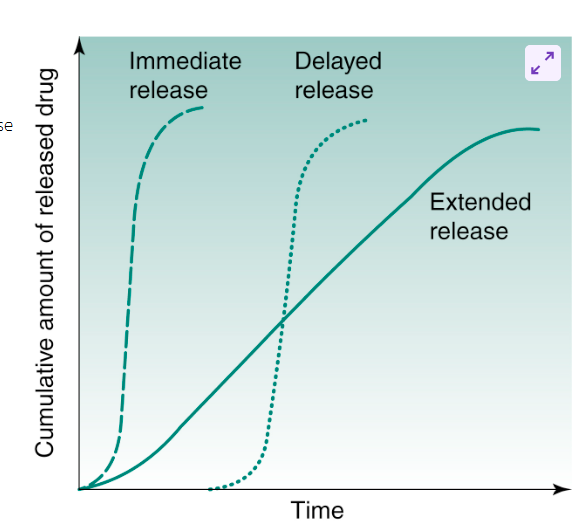
ooral tablers are classified based on drug release from table
immediate release
mofidied release
rapid release
prolonged release
delayed release
Rapid-release tablets are used for drug release and absorption, generally in the sublingual or buccal area.
They are manufactured to ensure ultra-rapid drug release, allowing the drug to pass from the oral cavity into the bloodstream without having to pass through the stomach, as with conventional tablets.
Prolonged-release dosage formulations allow a reduction in dosing frequency
y compared with when the drug is present in an immediate-release dosage form (i.e., drug plasma levels are sustained for longer periods).
These are also known as prolonged-release or sustained-release dosage forms and are also referred to as controlled-release dosage forms
Extended-release systems which are retained in the stomach are known as gastroretentive systems.
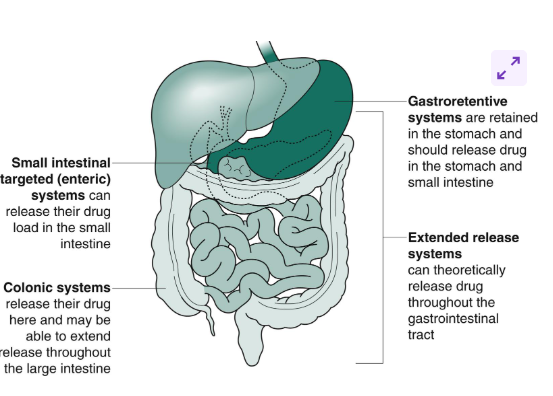
Delayed-release dosage forms release the drug at a time later than immediately after administration
(i.e., there is a significant lag time between a patient taking a medicine and the drug releasing from the dosage form).
Site-specific targeting is a type of delayed-release formulation
that aims to target specific regions of the gastrointestinal tract, such as the small intestine or colon.
For example, gastro-resistant dosage forms are designed to have a delayed-release mechanism,
which enables the release of a drug when exposed to a specific environmental pH.
A common example of this type of dosage form ensures that the drug is not released in the acidic stomach compartment
but in the higher-pH environment of the small intestine. Such products may also be known as enteric dosage forms.
clinical application of prolonged release oral drug delivery
keeping the drug in the theraputic range
reducing side effects
improving patient adherence3
keeping the drug in the theraputic range
When an immediate-release drug is ingested the plasma concentration will increase and then eventually decrease as the drug is metabolised.
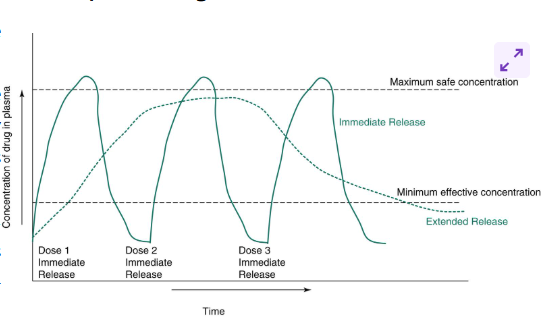
The plasma concentrations of drug will go through cycles of peaks and troughs.
An extended-release formulation can avoid the peaks and troughs, keeping the drug at therapeutic levels for a longer time
For many chronic illnesses, symptom breakthrough can occur if the blood concentration falls below the minimum effective concentration,
e.g., in depressive illness. This minimum level can also be critical for control of pain; consequently, drugs such as opioid analgesics are often given as extended-release preparations.
reducing side effects
Immediate-release formulations can often have a high maximum concentration in the blood (C max).
If C max is above the maximum safe concentration of the drug,
adverse events may be more likely.
Using prolonged-release formulations to reduce C max
reduce the incidence and severity of the side effects of some drugs.
Additionally, some drugs such as potassium chloride can be irritating to the gastrointestinal tract if delivered in an immediate-release bolus.
A slow, sustained release is required to minimise the occurrence of irritant concentrations.
imrpoving patient adherence
significant driver for developing a prolonged-release dosage form is the goal of achieving once-daily dosing
Once-daily dosing is considered to be more convenient for patients
and reduces the risk of missed doses throughout the day.
 Note
Note  Flashcards (97)