Human Origins UNIT 2 JHU
 Studied by 0 people
 Call Kai
 Learn
Learn Practice Test
 Spaced Repetition
 Match
Match Flashcards
 Knowt Play
1/107

Earn XP
Description and Tags
pls help.
Name | Mastery | Learn | Test | Matching | Spaced | Call with Kai |
|---|
No analytics yet
Send a link to your students to track their progress
108 Terms
viviparity
giving birth to live young
diurnal
active during daylight hours
conspecifics
members of the same species
sexual dimorphism
Differences in physical characteristics between males and females of the same species such as body size
What defines a primate?
--Five digit grasping hands and feet
--Nails instead of claws
--locomotion is hind limb dominated
--olfactory apparatus is decreased in day active primates
--vision is developed
--Relatively large brain
--Slow "life history"
--molars are unspecialized
brachiation
a method of movement that uses the arms to swing from branch to branch
binocular vision
2 eyes overlap so you can get the same image
stereoscopic vision
each eye sends signal to either hemisphere to create image depth
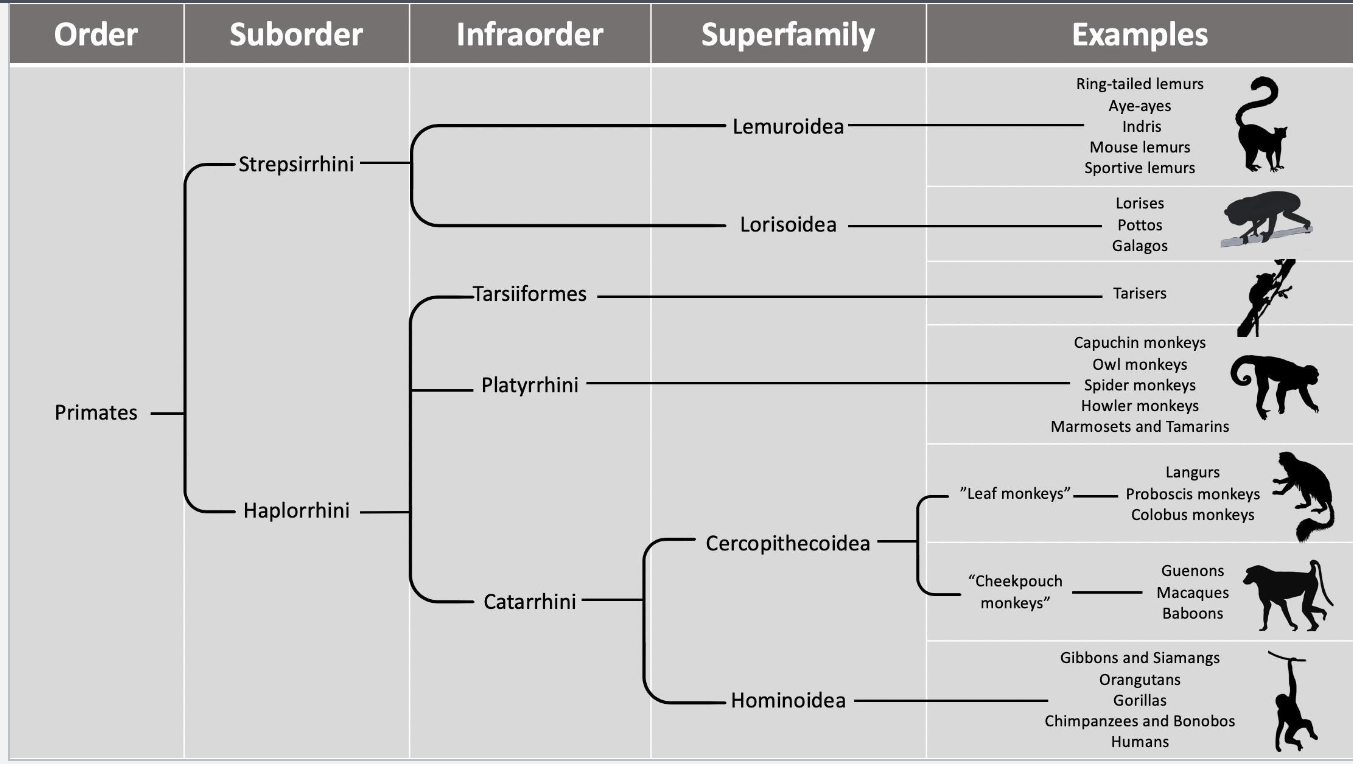
stepsirrhini ( breaks into..)
a semi order- then stepsirrhini sub order- then- leumuriformes (lemurs) and lorisiformes (lorisi)
Stepirrihini describe
nocturnal- they have the tapetum lucidum that helps them see at night,
they have enhanced olfaction, but a relatively small brain,
and tooth combes,
arboreal quadrupeds and female dominated
( wet nose primates)
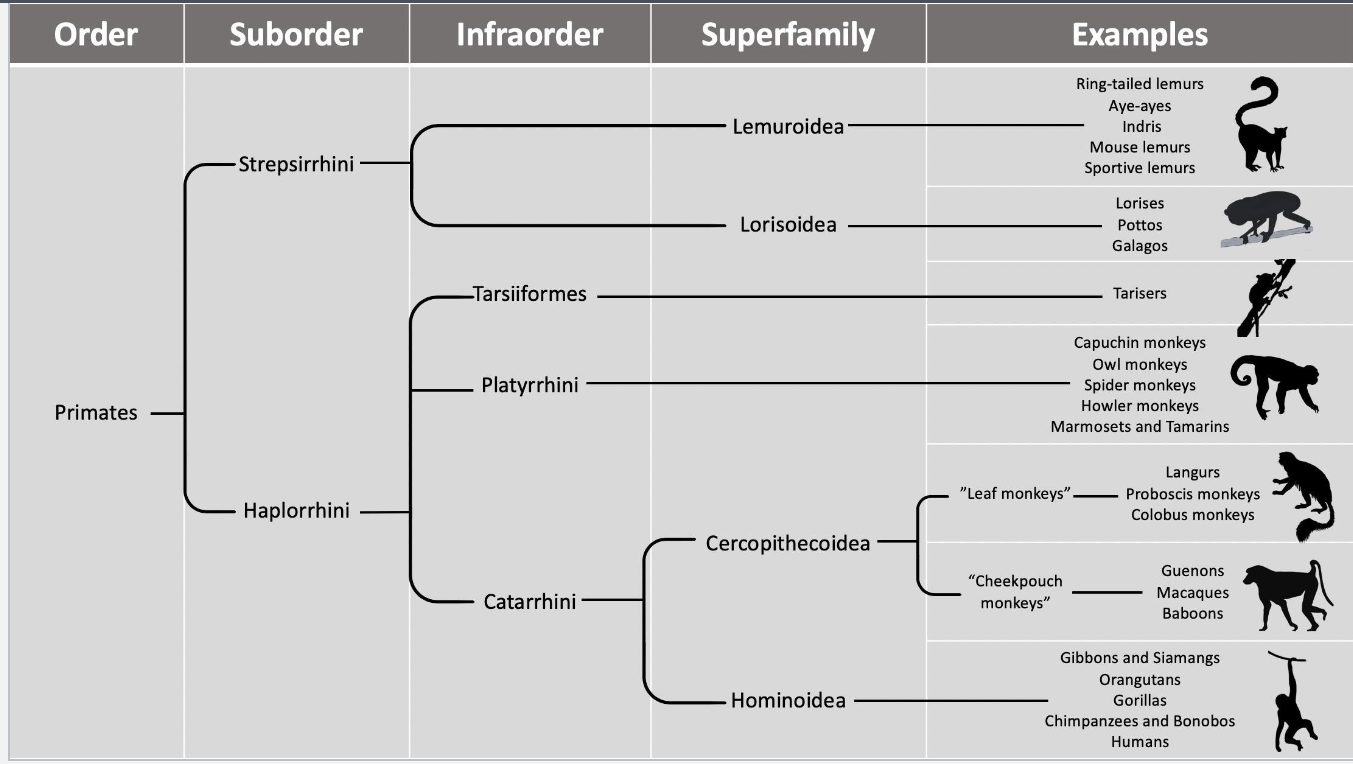
lorisiformes
Found in Africa and Asia
nocturnal
-arboreal
-enhanced olfaction
-infants nest while mothers forage
eat insects fruit and gum
Lemuroidea
Madagascar/ COmoro Islands
-nocturnal
-olfaction
-dental comb
-arboreal quadrupeds
-female dominance
-lemurs evolved in sisolation because of pangea
Haplorrihini Breakdown
into anthropoedia and Tarsiformes (tarsiers)
then Anthropoedia goes into Platyrrhini (new world ) and Catarrihini (old world)
then Catarrihini goes into Cercopithicoidea and homonidea
Homonidae goes into ponginae ( orangutan) and hominia (goriallas, chims, bonobos, and humans)
Cercopithicoidea goes into cercopithicae (baboons, macaques, and vervets) and colobinae
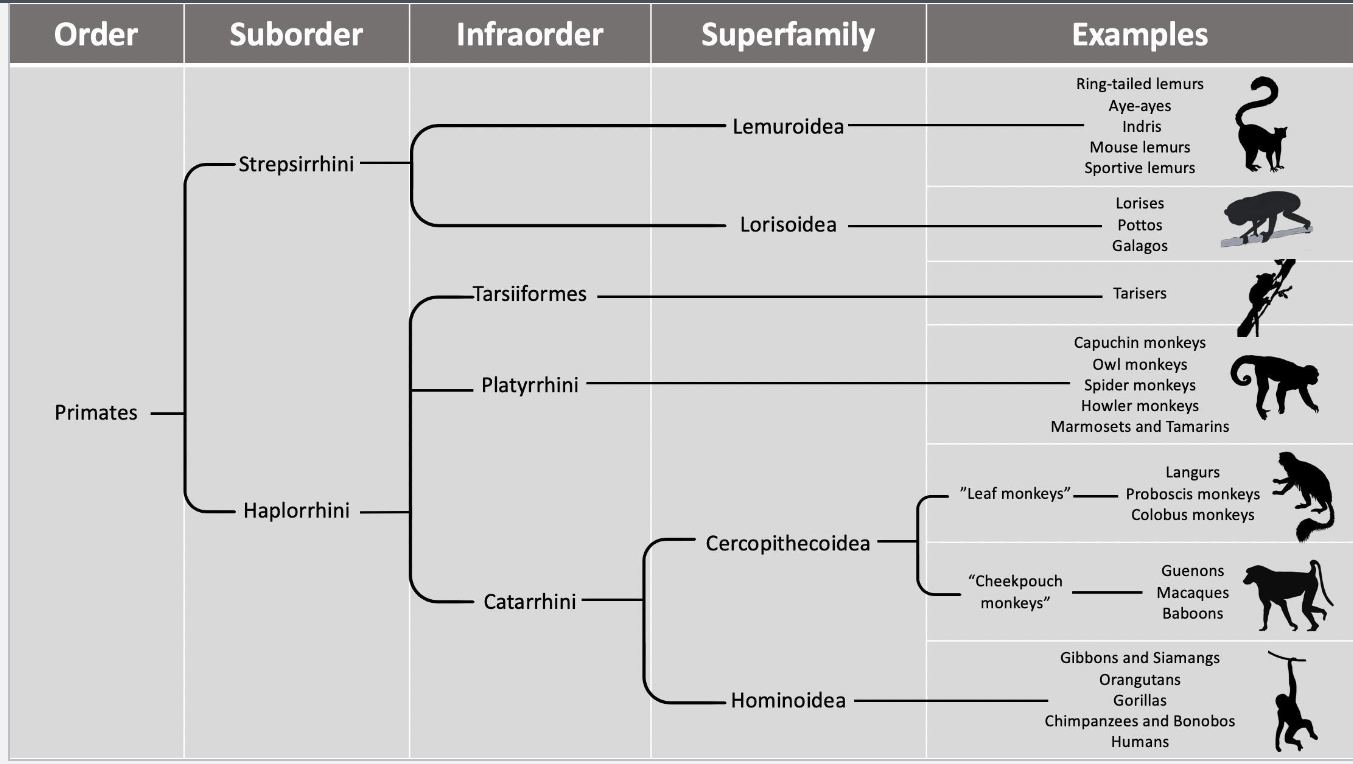
Tarsiformes
Tarsiers
-nocturnal
faunivores ( insects)
grooming claw
pair bonded families
give birth and leave child in nest
ONLY insects
Platyrrhini
flat noses
arboreal
prehensile tail
New World Monkeys (Central america and Mexico)
diurnal
(howler monkeys and spider monkeys)
Catarrihini
old world monkeys
monkeys, apes, humans
larger than platyrrhini
Cercopithicinae
after catarrhini
Asia and Northern Africa
cheek pouches
ominorous
arboreal
strong female bonds
dominance hierarchies
leaf monkeys (colobinae)
ie. macaques
Homonidea
After catarrihini too
Lesser apes, apes, and humans, and monkeys
Homonidea
humans and great apes
Ponginae (orangutan- solitary and eat fruit, use tools)
Hominae (gorillas chims banobos and humans)
Gorilla (largest, polygyny, moutain is leaf and lowland is fruit)
Chimpanzees ( Pantroglodyte- tool use and male coalition) (chimps and bonobos are polygynandrous)
Bonobos( Panpaniscus- female bonding, peaceful)
Humans ( Flexible social structure and culture/ language)
Large brains lead to
increased intelligence characteristics
ie. dolphins
Dentition
can tell us about age ( wear)
can help us with phylogenetic relationships
dental formula
2.1.3.3/1.1.33
top is inciscors, canines, premolars, and then molars ( maxilla)
bottom is the same but called mandible
gum diet
large inciscor
canine projected forward
long cecum
Insects/leaves diet
molars are well developed to chew
pointed cusps on molars to pierce body
short and simple guts
leaf eaters have enlarged LI and different thingies for cellulos
Frugivore
flatter cusps to crush fruit
long small intestine
large stomachs sometimes to hold more contents of leaves with fruits
hard seeds/ nuts
molars with thick enamel
prehensile
grasping tails
Amount of energy used is affected by..
basal metabolic rate ( increased body size increased metabolism)
Active metabolism ( additional calories needed when active)
Growth Rate ( need more energy to grow)
Reproductive effort
secondary compounds
toxins to protect yourself from eating
ie. alkaloids which go from stomach directly to cells
carbohydrates
simple sugars in fruits
fats
animal prey
protein
insects/leaves
vitamins/fats/oils
seeds
Size of the Eaters
Insectivores< frugivores< folivores
bigger animals need more quantity than quality
Where do primates live or stay arounnd
their home range and trees
small arboreal monkeys face less risk
ie. gibbons stick to their territories
What are common responses to predators
fleeing and alarm calls
Sociality ( benefits)
Most primate groups stay in groups due to predation
the individual is less likely to be hunted
larger groups can exclude smaller groups from resources
Costs for sociality
more competition for resources in the group→ dominance hierarchies
more time feeding ( having to wait for friends)
more infections
When is an outcome of a fight predictable
if there is stable differences in size/power of opponents
Solitary
males usually are individuals but can overlap w female territories
Polygyny
one male and many females
Pairs
two couples together
polygynandry
alll together (hoes)
Female reproductive success
female RS depends on females themselves- their age, experiences, or resources
strategy
a set of traits used to solve a rpoblem such as finding food
Mating effort
locating mates and gaining access to them
ie. courtship displays or competition
parenting effort
activities related to caring for offspring
Males vs. Females on ME and PE
females invest in PE and males in ME
males do not care as much about offspring vitality but female fitness is based on quantity of offspring
Developmental constraint ( ex)
if males can lay eggs, that could leave them sterile
Females bodies and effort due to pregnancy
The larger the animal the bigger the pregnancy and lactation
due to this effort, primates have smaller litters
females reproduce throughout their lives
Females need..
food to reach maturation
the more food the more babies and the earlier the maturation
interbirth
interval between births
dominance ranks created by..
dominance ranks are created by competition of food
the higher the ranking the more access to resources
cooperative breeding
everyone helps to take care of the babies, but only one female breeds (dom female)
How does being social help with RS?
more social people can have better protection from predators or getting food
you live longer and have less stress when it gets to it
What does sexual selection lead to?
it leads to more competitive males
it can also lead to outcomes that are not favored by natural selection
Intersexual selection
makes males more attractive since they are fighting for female attention
ie. the peacocks
““
intrasexual selection
competition among the same sex
leads to sexual dimorphism
such as for mates or for land
ie. this can leads to larger bodies and more aggression in children
Strength of selection varies with..
variation, which affects males more strongly
ie. males have a higher potential for variation because they are not limited by biological constraints such as gestation or bodies
If more females than men..
there is increased competition between males to monopolize them
this is polygynous groups where a lot of women one man
Sperm Competition when
in polyandrous groups
this is not important in polygynous or pair bonding because males dont really compete to have sex with women they know who theyre with
estrus
portion of time where females can reproduce
pair bonding (parental investment)
associated with more parental investment because males are sure those are their children
cooperative bonding
infants can be sired by different males but there is only one breeding female
males help with children which increases fertility in women
Polygyny ( PI)
male RS depends on if they can stay in their social group since they need access to females
other men can come in to have sex with the girls, and with more females there are more takeovers
followers can be let in to help protect the females and increase the percentage of kids that the dominant man is going to have
might let followers sire if they can stay on throne
Males in Polygyny
males usually invest more time in mating effort
EXCEPT gorillas - they take care of the babies even if they are not theirs
Polygynandry
males compete to get access to females that are sexually receptive
and very successful males sire a large amount of the children
large reproductive skew
ie. muriquis are an exception because not as much difference
males sometimes interact with offspring if it is theirs
Sexual Selection Infanticide Hypothesis
sexually selected males will kill the children of females if it is not theirs so that females will go back into estrus and can have their babies
Counteractions to sexual selection infanticide hypothesis
females will make friends w males that will protect them
have sex with too many men to confuse paternity
abort the child
Altruism
beneficial to others but costly to yourself
ie. grooming and alarm calls
Are warning calls a method of NS?
no, warning calls are only a method of group selection if there is there is increased genetic variation in a group
however, individuals have more variation which makes individuals the increased force for selection
mutualism
a cooperative action that helps both people
ie. a coalition where two more sub men work to guard a female
kin selection
natural selection will favor altruism if they are kin due to the passing on of your own genes
ie. warning calls for siblings
however, if you guys are siblings they is a large chance that they are also alarm callers, increasing the amount of alarm callers in a group which shows how that trait developed
Hamiltons Rule
rb>C
altruistic behaviors are more favored when the the relatedness of siblings times the benefit is higher than the cost of the behavior
altruism is limited to kin and the more kin the more costly it is considering you are going to be more altruistic
Kin Recognition
this can be done by phenotypic matching where you can recognize kin by how much they look like you
it can also be seen by how familiar and proximal they are to you
there are contextual cues to meet kin, which is seen by residence or time of conception or even similarity in age
paternal siblings can be harder to fin but are seen by age
Kin Biases
biases include social grooming, where the participant gets cleaned and the doer gets a social relationship
cost- exposure to pathogens and excessive time spent doing that
more w kin than not
coalitions- grouping together for attacks and support happen more w kin
important in macaques, vervets, and baboons.
maternal support usually leads to daughters winning and their rank is near their daughters
ie. red howler monkeys form coalitions
matrilineage
rank of maternal kin group
daughters and mothers are close since moms help daughters fight
mothers<older<younger
Kin Selection in cooperative breeding
all members care for offspring
males in these situations are more likely to be related because they live together and have kids
Kinship reduces—-
competition in females since dominant females are more likely to share men with their sisters/ offspring
Parent-Offspring Conflict
infants will get mad when parents leave them for other infants
kin selection explains this conflict because mothers are equally related to all infants, but infants are more related to themselves
mother will take care of the present child until cost of future child is less than benefits of present
Reciprocal Altruism
altruism is going to evolve if others are likely to help them back in the future
ie. grooming someone because they are likely to groom you
ie. protecting someone because they are willing to fight for you in the future
BUT there are 3 rules
1) the individuals have to interact often
2) they have to keep track of who helps them and who dont
3) they have to provide support to only those who help them
male relationships are based on-
kinship, not reciprosity
What advantages does having a large brain include?
overcome social/ ecological challenges
Social Brain Hypothesis
selection favors larger brains because primates have to deal with high social challenges.
hypothesizes that brains are going to be correlated with size of groups/ coalitions or the capacity to socially manipulate
Ecological Brain Hypothesis
ecological challenges lead to larger brains in primates because primates have to use their brains to forage/ find food
spatial knowledge and challenges while foraging
dyads
pairs
Third party relationships
relationships among other individuals not including yourself
Redirected aggression
attacking kin of the original attacker
ie. if man attack u, u kill man sister
DO monkeys know about others socially?
yes monkeys know about other monkeys dominance ranks and who they relate with most often
Theory of Mind
Primates are aware of the mental state of other monkeys
ie. chims are more likely to give alarm calls to monkeys they know do not know the predator than monkeys they know that do.
False beliefs- Do primates understand them?
False beliefs are things that people think are true but are not ( ie. flat earthers)
Primates understand this
ie. Dr. Krupenye study where man in monkey suit hides in little hut when human is watching and then switches when human is not
primates understand that the human wil expect him in the place where they saw him go.
Life History theory
This theory is about allocating energy and describes how primates have a “slow” life history
Allocating energy to reproduction means that that there is less for growth and maintenance
Senescence
aging
Why are primate lives not longer if NS acts?
There is a tradeoff between reproduction and living.
Characteristics that prolong life are not going to be favored if they mean less reproduction
aging is selected because traits that increase young reproduction/ fertility are picked.
also traits that occur after reproducing are not selected against
Traits of early reproduction
smaler body, smaller gestation, increased litter, and increased mortality
ie. think of a fly
also smaller bodies take less to be developed so more of them and younger
elephants take forever
Large animal characteristics (repreoduction)
large animals have longer juvenile periods that lead to more complex brains
they reproduce over linger periods of time
Short/ long continuum
Primates have longer/ slower life history
Ranking Life History
Monkeys have lower life history than stepsirrhines and great apes have slower life history than monkeys
If fast life history?
monkeys will have faster reproductive system.
If large animals get enough resources?
They will have longer lives and wait for maturation.
they need more food/ resources, but if they do then they will wait.
they optimize lifetime reproductive success
 Note
Note  Flashcards (20)