Chapter 4.1-4.3
 Studied by 0 people
 Call Kai
 Learn
Learn Practice Test
 Spaced Repetition
 Match
Match Flashcards
 Knowt Play
1/43

Earn XP
Description and Tags
Physcial, Chemcial & Biological Limnology
Name | Mastery | Learn | Test | Matching | Spaced | Call with Kai |
|---|
No analytics yet
Send a link to your students to track their progress
44 Terms
What percentage of the sun’s light makes it to earth
50%
Autotroph
-Self-producing
-primary producers
-Make inorganic matter organic
Lake
A large body of water in which currents are primarily driven by wind
Limnology
Study of inland waters
lakes (lentic systems) both freshwater and saline
reservoirs, rivers, streams, ponds, springs wetlands etc..
What latitudes are lakes found in
Most abundant in northern latitudes
Most abundant in North America
Lake Formation Mechanisms - Glaciation
Glacier lakes form when a glacier retreats and meltwater fills the whole
kettle hole lakes, great lakes
Lake Formation Mechanisms - Tectonism
Different plate boundaries → distinct lake basins
Deformation of earths crust: faulting, tilting, folding, and warping
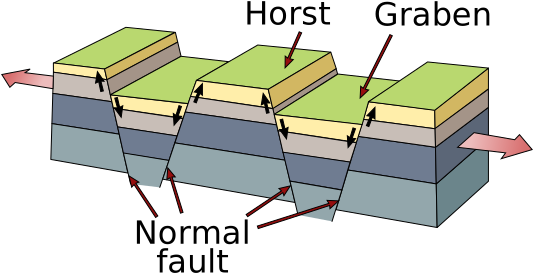
Graben Lakes
Oldest, largest, and deepest lakes
Divergent boundaries
An elongated plate that has dropped downward by faults relative to the blocks on either side
Lake Baikal - home of freshwater seal
African rift valley lakes
Lake Formation Mechanisms - Volcanic Activity
Indirectly caused by tectonic activity
Maar Lake: Ejected magma may leave behind fissures that hold water, tend to be shallower (in volcano lake terms)
when roof of crate caves in = larger caldera = crater lake
i.e Crater lake in oregon
Lake Formation Mechanisms - Riverine/Oxbow Lakes
Lakes made when rivers or streams are dammed
‘lakes produced by running water’
When a river erodes the outside banks and deposits sediment on inside banks and pinches away at loop → Oxbow lake
Laurentian Great Lakes were formed by
glaciation (great lakes)
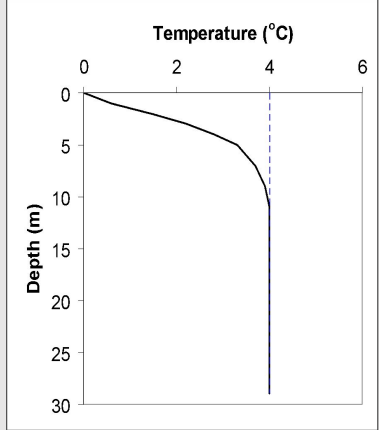
Seasonal Stratification - Winter
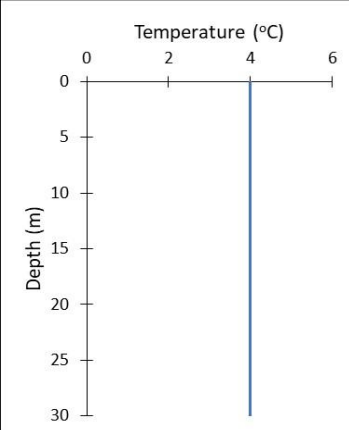
Seasonal Stratification - Fall/Spring
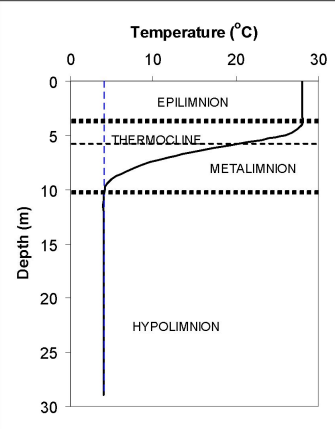
Seasonal Stratification - Summer
Epilmnion
top most layer in a thermally stratified lake
warmest and least dense layer
Thermo Stratification
Change in the temperature at different depths in the lake
Seasonal Stratification
In temperate regions where lake water warms up and cools through the seasons, a cyclical pattern of overturn occurs that is repeated from year to year
Storms can cause mixing during stratified periods
Thermocline (metalimnion)
the layer that separates the warm less dense epilimnion and the very dense cold hypolimnion
Hypolimnion
‘under lake’
coldest layer in summer & warmest layer in winter*
*temperate lakes bottom most/hypolimnion layer stays close to 4C throughout the year
Mixing Regimes: Holomictic
Holomictic lakes mix at least occasionally
5 Types of Holomictic Lakes: → if lake is deep enough for hypo
Poly-, Cold Mono-, Warm Mono-, Di-, Oligo-
Mixing Regimes: Meromictic
A lake whose water layers do not intermix
presentation says partial mixing?
Mixing Regimes: Polymictic
Tropical locations where temperatures don’t vary
Mixes throughout the year or continusously
Typically shallow
Mixing RegimesL Cold Monomictic
Mixes once in summer
Mixing Regimes: Warm Monomictic
Mixes once in winter
Mixing Regimes: Dimictic
Mixies twice annually
Great Lakes
Mixing Regimes: Oligomictic
Mixies less than once annually
Mechanisms for Mixing
 Note
Note  Flashcards (74)