Social Interactions & Solitude
 Studied by 0 people
 Call Kai
 Learn
Learn Practice Test
 Spaced Repetition
 Match
Match Flashcards
 Knowt Play
1/28

Earn XP
Description and Tags
Week 4 content
Name | Mastery | Learn | Test | Matching | Spaced | Call with Kai |
|---|
No analytics yet
Send a link to your students to track their progress
29 Terms
Social interactions and wellbeing
· In most countries, people who often spend time with friends are happier than people who rarely spend time with friends
· Folk & Dunn, 2025: “we examined the relationship between socializing and happiness across more than 80 daily activities by analysing 105,766 activity episodes from 41,094 participants”
o Participants consistently rated every common daily activity as more enjoyable when interacting with someone else (compared to doing them alone – day reconstruction method)
Methods for studying social interactions
· Retrospective self-report
o E.g., Who did you talk to today?
· Momentary self-reports (experience sampling; ESM, EMA) – try address memory issue
o E.g., Who are you talking to right now?
o E.g., Who did you talk to in the last hour?
· Continuous tracking (e.g., audio recordings)
o E.g., EAR (electronically activated recorder) smartphone app
o Intermittent recording (e.g., 30-50 sec of audio, 3-10x per hour)
Disadvantages of these methods
· Retrospective self-report
o Recall biases (might be better at remembering longer convos or convos w close others)
· Momentary self-reports (experience sampling)
o Recall biases, though lesser issue (usually ask about most recent hour or so)
o Only captures subset of interactions (the ones that occur at the moment of the report)
o Intensive for the participants
· Continuous tracking (e.g., audio recordings)
o Some aspects are subjective (e.g., quality), can’t be judged by observers
o Technology (doesn’t always work; not accessible to everyone; don’t always have reception or carry phone)
o Privacy issues (private moments; participants can consent, but not the people they talk to)
o Intensive for researchers (manually code each audio clip)
Day reconstruction method (Kahneman, Krueger, Schkade, Schwarz & Stone, 2004)
· Construct a diary, sequence of episodes
· Describe each episode
o When it happened, how long it was
o What they were doing
o Who with
o How they felt etc.
(pictures in lecture notes of these materials)
Results —> social interactions are the second most pleasant activity
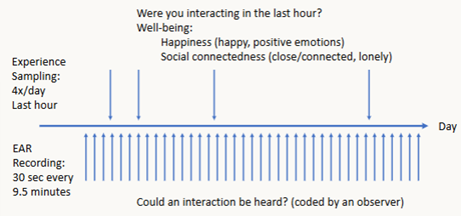
Quantity of interactions (Sun, Harris & Vazire, 2020)
Prompted at random times in a day - asking about interaction, happiness, social connectedness
Findings:
· Self-reports -> "every single participant tended to feel happier and more socially connected when they interacted in the past hour, compared to when they did not."
· Observer reports -> same patter, but smaller effects.
· The association did not differ for extraverts vs introverts.
Quantity of interactions (Ren, Stavrova & Loh, 2021)
· Looked at social contact frequency and happiness/life-satisfaction/affect
· Takeaway = there are diminishing returns.
o If you don't have many interactions, additional ones add to your well-being.
o At some point, additional interactions don't make much difference.
Overestimate how many social interactions other have (Whillians, Christie, Cheung, Jordan & Chen, 2017)
· First year students estimate time they spend on certain activities vs their peers
o Overestimate how often classmates socialize with new university friends
o Underestimate how often classmate spend time alone
§ May only see when they are out, social media etc.
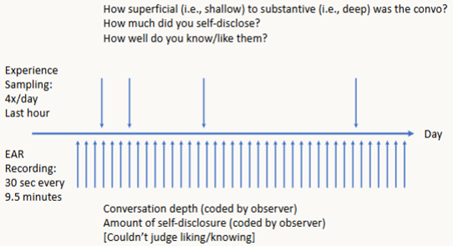
Quality of interactions (Sun, Harris & Vazire, 2020)
Same method as previously
· Participants reported feeling happier and more socially connected when
o They had deeper conversations
§ Self-reported, or as rated by EAR data observers
o They disclosed more
§ Self-reported, or as rated by EAR data observers
o They knew or liked their partner more
§ Self-reported
§ Can’t tell from audio how much people know/like each other
· Some, but "not much evidence that the quality of social interactions was differentially associated with overall well-being for introverts compared to extraverts"
Social connection and mortality (Berkman & Syme, 1979)
· At all ages, people were less likely to die if they had more types of connection
o Suggests diversity matters, relationship variability mattered in the outcome of this study
Social portfolio study (Collins, Hagerty, Quoidbach, Norton & Wood Brooks, 2022)
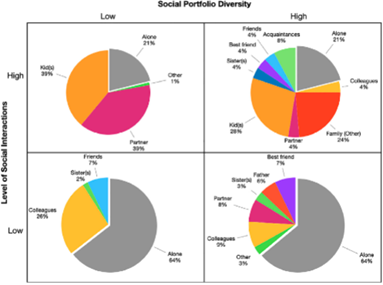
Diversity and wellbeing (Hagerty, Quoidbach, Norton & Wood Brooks, 2022)
· Preregistered data set - N = 578 Americans
· ATUS dataset - N = 19,197 Americans
· Sage dataset - N = 10,447 from 6 countries
· French experience-sampling dataset - N = 21,644 French users of mobile app
o People who interacted with a greater diversity of people reported higher well-being
Correlation
Key Points 1
· Humans (generally) enjoy social interactions
· Various methods to assess this, each with pluses and minuses
o Retrospective self-report (e.g., Day Reconstruction Method)
o Momentary self-reports (experience sampling)
o Continuous tracking (e.g., audio recordings; EAR
· Quantity, quality and diversity are all good for well-being
o Diminishing returns on quantity
o People think other people have more social interactions than they do themselves
Personality - big 5 (Zelenski, Sobocko & Whelan, 2014)
1. Openness
2. Conscientiousness
3. Extraversion
4. Agreeableness
5. Neuroticism
Personality
· Unsociable: content with low levels of social contact
o Preference for less interaction
o Associated with extraversion/introversion
· Shyness: not about social contact, but about experience of anxiety related to social interaction
o Fear of interaction
o Associated with neuroticism/emotional stability
· Some introverts are prone to negative emotions, and some are not (~50/50)
Introversion
· Are we just a bunch of traits?
o No, we're not. Remember, you're like some other people and like no other person.
· So, what is it that makes us different?
o It's the doings that we have in our life -- the personal projects.”
o He talks about “free traits” – how we can act in ways that aren’t in alignment with our traits, to achieve a goal
o “[Free traits are] where we enact a script in order to advance a core project in our lives. And they are what matters.
o Don't ask people what type you are; ask them, ‘What are your core projects in your life?’ ”
Introversion as personality
· Spend more time alone, but
· Enjoy social interactions about as much as extraverts
· Have friends and engage in social activities
· Have social skills equal to extraverts
o Context may obscure those skills
Social anxiety
· Social anxiety disorder (SAD) involves persistent and distressing anxiety in numerous social situations such as
o Giving presentation
o Performing in front of others
o Interacting with strangers
o Going on a date
o Small talk
o Eating or drinking in front of others
· To be diagnosed with SAD according to psychiatric criteria, you must endorse each of the following symptoms
o Marked persistent fear of social situations
o Feared social situations almost always elicit anxiety
o Fear is out of proportion to actual threat
o Situations are avoided or endured with intense anxiety
o The anxiety or avoidance causes impairment in important life areas
o Symptoms have been present for at least six months
Social anxiety and interactions (Goodman, Rum, Silva & Kashdan, 2021)
· Quality social interactions usually improve mood
o Do they for people with SAD?
· Experience sampling, 2 weeks, 5x/day, SAD vs. control
o Between-person analysis: SAD vs. controls
§ Participants with SAD reported lower positive affect and higher negative affect, in social and non-social situations
o Within-person analysis: with others vs. alone
§ Higher Positive Affect when with others vs. alone
§ People with SAD showed smaller difference in PA between social and non-social situations (diminished reward responding?)
Extraverts are happier
· Why?
o They spend more time in social situations
o Reward reactivity -> more likely to notice and respond to reward cues
o Higher set point -> report more Positive Affect even when alone
o Better at maintaining a good mood
Acting extraverted: Zelenski, Santoro, Whelan (2012)
· N = 127 undergraduates
· 3 sets of instructions on how to act during conversation
o “emphasize parts of your personality that are [introverted/extraverted adjectives] both in answers to the interview questions and in the way you present yourself during the interview, but do not lie.”
§ Act extraverted: act bold, talkative, energetic, active, assertive, and adventurous
§ Act introverted: act reserved, quiet, lethargic, passive, compliant, and unadventurous
o Control: “act as naturally as possible.”
· Interacted with an interviewer for 20min in a “get to know you” situation
· Reported their mood
o P's who acted extraverted reported higher Positive Affect than p's who acted introverted
o Regardless of whether they were dispositionally extraverted or introverted
Is it possible to become more extraverted? (Hudson, Briley, Chopik & Derringer, 2019)
· N = 377 participants were asked which personality dimensions they would like to work on changing
o N = 200 (53%) chose extraversion
· Website/game presented challenges designed to help improve on that personality dimension
o Brainstorm a list of questions to ask other people
o Go to a public place where people mingle and say “hello” to someone new
o Introduce yourself to someone new
o Introduce yourself to someone new and ask them at least two questions about themselves
· Participants chose >1 challenge/week
o At the end of each week, reported how many times they had completed each challenge they had accepted
· Results: successfully completed more (vs fewer) challenges predicted more positive growth in extraversion – help change personality
Key Points 2
· Sociability is associated with extraversion
· Shyness/social anxiety is associated with neuroticism
o Still benefit from having more social interaction
· Extraverts are happier
o But extraverts AND introverts are happier when they act extraverted
· People can become more extraverted
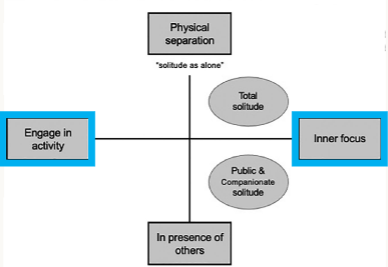
What is solitude? (Weinstein, Hansen & Nguyen, 2022)
· Interviewed 60 adults, aged 19-80
· "What comes to mind when you hear the word 'solitude'?"
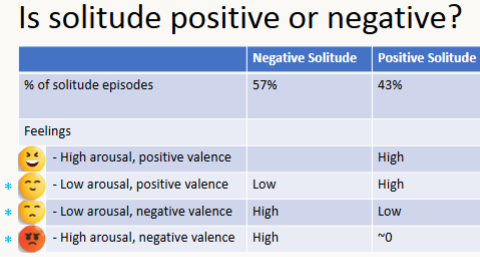
Is solitude positive or negative? (Lay, Pauly, Graf, Biesanz & Hoppman, 2018)
· 100 adults and 50 UG students
· Experience sampling: 3x/day for 10 days
· Alone or with others
· Mood (affect)
Emotion circumplex, clustering
How solitude feels depends on how you think about it
· Rodriguez, Pratt, Bellet, & McNally (2023)
o Told people about the benefits of solitude (or not)
o Made them sit in silence for 10min
o Experimental group significantly more relaxed and content
How do we perceive people who seek solitude? (Ren & Evans, 2020)
· Are people who prefer solitude excluded by others (i.e., ostracized)?
o We exclude people who break social norms
o We may deem people who prefer solitude as irrelevant, invisible
· Ostracized
o In general, others
§ Leave me out of their group
§ Keep me out of the loop on information that is important to my close relationships
§ Treat me as if I am invisible
§ Give me the cold shoulder treatment
§ Physically turn their backs to me when in my presence
§ Treat me as if I’m in solitary confinement
§ Do not look at me when I’m in their presence
§ Ignore me during conversation
· People are more willing to ostracize target individuals who have a high (vs low) preference for solitude
If so (seeking solitude), then why?
· Might expect not to enjoy interacting with someone who prefers solitude (self-interested)
· Might expect a person who prefers solitude to not enjoy interacting with them (other regarding)
· When they thought the other person was high in preference for solitude: they thought they would enjoy interacting less; they thought the other person would enjoy interacting less
Key Points 3
· Solitude varies in terms of physical separation and inner focus
· Solitude can be positive or negative
o Clusters - calm vs. bored
· Solitude gives us
o Positive things: competence, autonomy, self-growth, interpersonal connection, self-care
o Negative things: disrupted well-being, alienation
· We think people who seek solitude
o Won't be fun to spend time with; won't want to spend time with us
o And so, we ostracize them
Final points
· Extraverts and introverts enjoy and benefit from social interactions
· Solitude can be positive or negative
· We all need to find a balance between social interaction and solitude that works for us
 Note
Note  Flashcards (129)