ALL SP - L9-14
 Call Kai
 Learn
Learn Practice Test
 Spaced Repetition
 Match
Match Flashcards
 Knowt Play
1/169

There's no tags or description
Looks like no tags are added yet.
Name | Mastery | Learn | Test | Matching | Spaced | Call with Kai |
|---|
No analytics yet
Send a link to your students to track their progress
170 Terms
Prosocial Behaviour
Behaviour intended to help someone else.
Cooperation
Two or more people working together towards a common goal that will benefit all involved.
Egoism
Behaviour motivated by the desire to obtain personal rewards.
Norm of Social Responsibility
A norm that those able to take care of themselves have a duty and obligation to assist those who cannot.
Diffusion of Responsibility
The effect of other people present on diminishing each individual’s perceived responsibility for helping; one explanation for the bystander effect.
Bystander Effect
The findings that the presence of more bystanders will decrease the likelihood of any one person giving help.
Negative-State Relief Model
The theory that most people hate to watch others suffer, so the ultimate goal of their help is not to aid the person in need for his or her sake, but to reduce the helper’s own distress.
Empathy-Altruism Model
The theory that feelings of empathic concern lead to a motive to help someone in need for his or her own sake.
Social Dilemma
A form of interdependence in which the most rewarding action for each individual will, if chosen by all individuals, produce a negative outcome for the entire group.
Trust
The expectation that others will act pro-socially during a social interaction.
Social Value Orientation
Stable differences in the ways people act in social dilemmas (such as competitive or prosocial).
Altruism
Behaviour intended to help someone else without any prospect of personal rewards for the helper.
Aggression
Behaviour intended to harm someone else.
Conflict
A perceived incompatibility of goals between two or more parties.
Instrumental Aggression
Aggression used as a means to an end, to control other people, or to obtain valuable resources.
Hostile Aggression
Aggression that is driven by anger due to insult, disrespect, or other threats to self-esteem or social identity.
Frustration-Aggression Theory
A theory holding that any frustration - defined as the blocking of an important goal - inevitably triggers aggression.
General Aggression Model
A theory that person and situation factors influence people’s cognition, affect, and arousal, which in turn influence interpretations of the situation and decisions about aggression.
Realistic Conflict Theory
The theory that intergroup hostility arises from competition among groups for scarce but valued material resources.
Relative Deprivation Theory
The theory that feelings of discontent arise from the belief that other individuals or other groups are better off.
Social comparison determines how satisfied or dissatisfied people are with what they have.
Vicarious Retribution
A member of your in-group was attacked, so you attack a member of an out-group (offending group) even if it wasn’t the same person who attacked.
Coalition Formation
Occurs when two or more parties pool their resources to obtain a mutual goal they probably could not achieve alone.
Reactive Devaluation
Perceiving a proposed solution to a conflict negatively simply because the out-group offers it.
Negotiation
The process by which parties in conflict communicate and influence each other to reach agreement.
Superordinate Goals
Shared goals that can be attained only if groups work together.
What are the different models explaining pro-social behaviour?
Helping Kin (Kin Selection) → An evolutionary strategy that promotes the survival of one’s genes present in relatives, even when that means a cost to the self.
Group Selection → Altruism beneficial at the group level - A group with altruists (people willing to sacrifice themselves for the group) has an advantage over a group with (mostly) selfish individuals.
Reciprocal Helping/Altruism → People also generally help genetically unrelated others. Evolutionary benefit from helping unrelated others if favour is repaid.
What are the two dimensions associated with pro-social behaviours?
Pro-social thoughts and feelings, such as a sense of responsibility.
The self-perception that one is helpful and a competent individual.
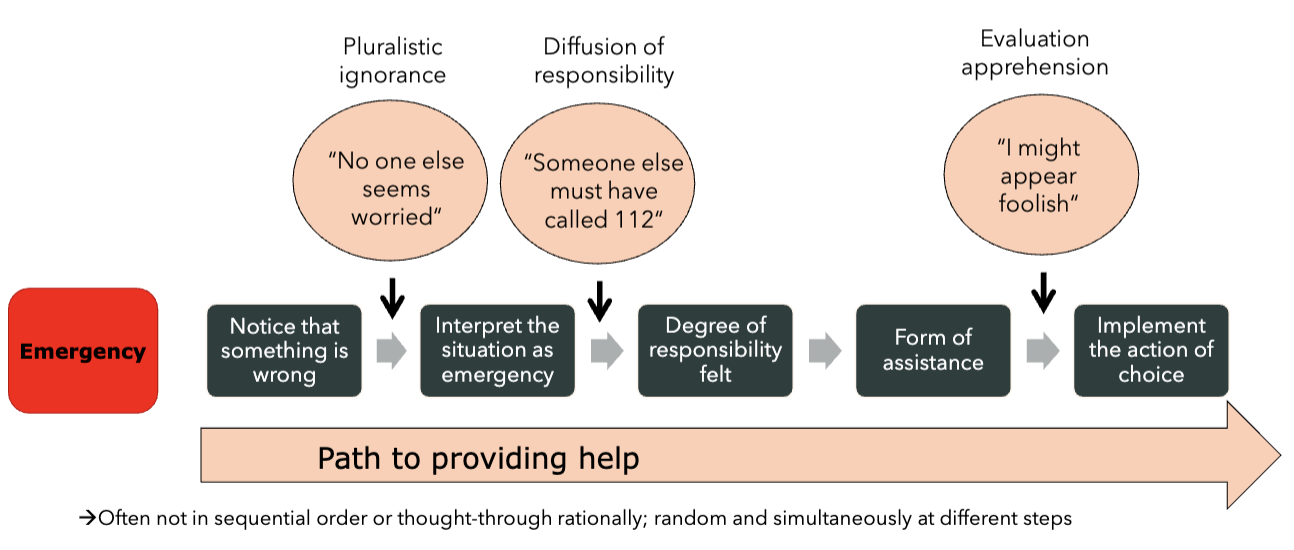
Theory of Emergency Response
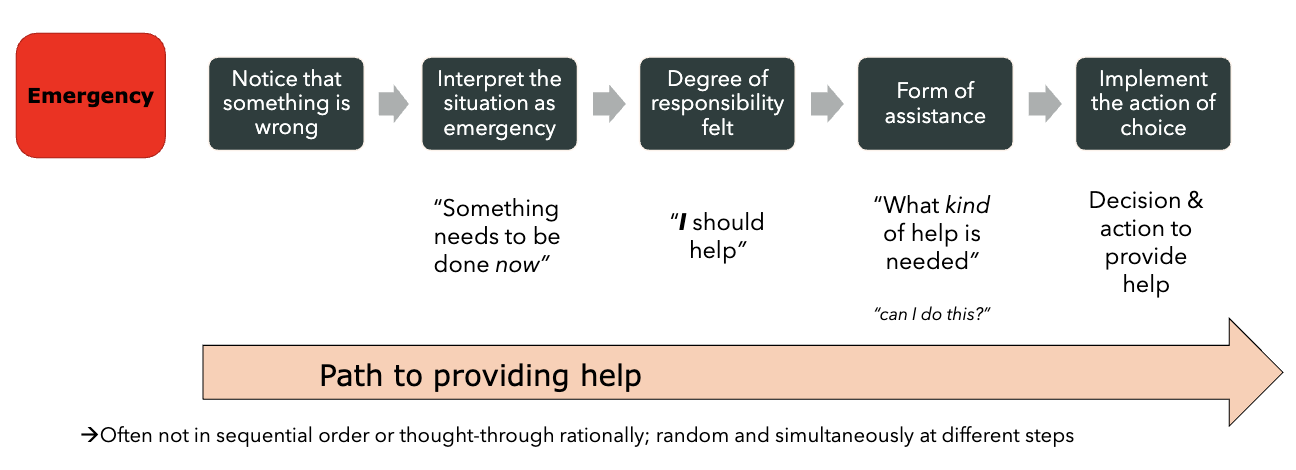
But…
Notice something is wrong
Interpret situation as an emergency
Degree of responsibility felt
Form of assistance
Implement action of choice
Arousal: Cost-Reward Model
If arousal, there is a calculation as to whether helping would be beneficial. If so, help is given, if not, no help is given. Depends how costly it is to help!
Exception: high emotional arousal!
Two types of emotions when witnessing need for help
Personal Distress (anxiety, fear, alarm).
Empathetic Concern (compassion, sympathy).
Belief in a Just World
The idea that people get what they deserve → Good things happen to good people and bad things happen to bad people.
3 Bystander Influences
Pluralistic Ignorance
Diffusion of Responsibility
Evaluation Apprehension
3 Strategic Motives to Out-Group Helping
Impression Formation → Make good impression of in-group.
Meaning and Existence → Restore purpose to in-group after threat to group identity.
Power and Autonomy → Exert power over out-group.
Types of Helping
Dependency-Oriented → Provides full time solution and does not rely on skills of helped.
Autonomy-Oriented → Is limited in degree and duration to the transfer of specific tools or instructions from helper to helped.
2 Characteristics of Social Dilemmas
Each individual receives a higher payoff for not doing the group’s best interest.
All individuals are better off if they cooperate.
How to stimulate pro-social behaviour?
Perspective Taking → Promotes empathic concern.
Recategorisation (of social identity) → Bias in pro-social behaviour towards out-group members can be reduced when in-group members recategorise themselves within a superordinate group.
3 Key Dimensions of Group Processes Impacting Helping
Salience of social identities (student, European, etc).
Boundaries of social identities (who is out/in-group).
Content of social identities (group norms/values).
What is interpersonal vs intergroup aggression?
Intergroup Aggression: Intergroup aggression is directed toward another person because they are viewed as a member of a competing, threatening, or different out-group.
Interpersonal Aggression: Interpersonal aggression is directed from one person to another based on personal conflict.
Is aggression a necessary consequence of evolution?
Is it necessary? No.
Is it a consequence of evolution? Yes → A way to gain status and resources or even mates.
Does aggression escape like “steam from a valve” (Catharsis)?
No!
Aggression causes more aggression and anger, not less! Aggression provides no sense of relief.
What is the role of alcohol in aggressive behaviour? (What is alcohol myopia?)
Alcohol is a factor in 2/3 of murder cases.
Alcohol Myopia: Alcohol hinders the assessment of the consequence of behaviour.
Influence of alcohol on aggression is partly explain by the influence of the expectation → what people think they are drinking also predicts aggression.
Relation of aggression to frustration?
Frustration-Aggression hypothesis states that frustration commonly triggers aggression.
Relation of aggression to cost and benefit balance?
Possibility of punishment can deter aggression.
If violence is the only means available for obtaining a resource, then violence it is!
Relation of aggression to different types of threat?
Physical threat/self defence
In response to threat of self-esteem (insecure = higher probability of violence)
Relation of aggression to self-esteem & narcissism?
Insecure = higher probability of violence
High narcissism = strong link to aggression.
Relation of aggression to modelling & reinforcement?
Aggression of others can be a model for one’s own behaviour (especially when strongly identifying with the model).
Stronger effect of modelling for aggression if no aversive effects and if rewards!
Relation of aggression to norms & inter-individual differences?
Aggression is a stable trait → people see others as more provocative (in an aggressive way lol).
Social norms have an impact as well.. :(
Relation of aggression to sex, gender, and identification with gender norms?
Men are generally more aggressive than women with different types of aggression.
Testosterone may explain gender differences (more in men, and linked to aggression).
Masculine traits and conformity to gender role norms predicts aggression.
What are the different routes described in the general aggression model?
Cognition → Increased accessibility and priming = stronger aggression.
Affect (Emotion) → Emotional response to frustration causes aggression.
Arousal → More arousal triggers stronger aggressive response.
What is the hostile attribution bias?
A cognitive tendency to interpret ambiguous, neutral, or accidental social situations as having malicious or harmful intent.
What is desensitisation?
Habituation: Repeated exposure to violent stimuli weaken impact on psychological and physiological factors.
Why is cyberbullying more intense than face to face bullying?
Anonymity
Invisibility of targets
Availability of targets
Ease of contacting like-minded people
Wider group of bullies
No (traditional) supervision
Effects seem more extreme: more distress, psychological problems, depression, and even suicides.
What factors predict Intimate Partner Violence (IPV)?
History of verbal violence
Alcohol
Norms
Hostile sexism, interdependence & power
What is the relationship between IPV, hostile sexism, and relationship interdependence?
Relationship interdependence might be perceived as a loss of power, which could lead to aggression..
^ Particularly for men high in hostile sexism (in which a central conviction is that women would pursue power by getting control over men).
Is IPV a form of intergroup aggression?
Yes.
Refer to intergroup aggression definition.
What is the difference between realistic conflict theory, relative deprivation, and fraternal deprivation? ← Causes.
MATERIAL - Realistic conflict theory (RCT) explains intergroup conflict via actual competition for scarce, material resources.
COGNITIVE - Relative Deprivation (RD) focuses on perceived injustice compared to others.
GROUP - Fraternal Deprivation is a specific type of RD where individuals feel their group is unfairly disadvantaged compared to others.
What is the integrated threat theory?
Realistic (safety/resources - insecurity) and symbolic (identity/values - contempt). threats can escalate conflict.
What is bounded generalized reciprocity?
Dependence on in-group members makes group members allocate more resources to the in-group rather than the out-group.
Is discussion with the in-group a good solution for conflict?
Eh… Depends! Think group polarization!
Is more contact with the out-group always a good solution for conflict?
Maybe not... You see your in-group as more positive and that behaviour is situational, while out-group behaviour is more dispositional…
Also, think reactive devaluation!
How does attribution bias play a role in escalating conflict?
Bias attributions → Same behaviour is seen differently.
In-group: situational
Out-group: dispositional
Does impression of the out-group during conflict become more or less complex?
Less complex → becomes more simple!
Role of norms in reducing conflict?
Extend norms of in-group to the out-group!
Role of empathy in reducing conflict?
Stimulate empathy for out-group!
Role of meditation in reducing conflict?
yo.. should work……..
Role of shared goals in reducing conflict?
it helps!
3 Core Values
Egoistic → Promoting Self
Altruistic → Promoting Others
Ecological → Promoting Nature
Consumerism vs Materialism
Consumerism: An ideology and social system where the ongoing acquisition of goods and services is promoted for wellbeing and social participation.
Materialism: A value orientation in which possessions and wealth are central to life satisfaction, personal success, and identity.
Higher materialism → lower wellbeing, lower prosocial behavior
Two Components of Happiness
Positive affect
Frequency of experience of positive feelings, moods, and emotions such as joy
Life satisfaction (more cognitive)
Satisfaction with one’s life
Feeling life is close to an ideal
3 Ways of Boosting Happiness
Aerobic Exercise
Nurture Social Relationships
Practice Acts of Kindness
Zero Sum Games vs Non-Zero Sum Games
Zero Sum → To become a winner, there must be a loser.
Non-Zero Sum → Multiple winners and losers.
Human-Nature Philosophies
Master (Techno-optimism) → Nature exists for human use. Economic growth and technology can solve any environmental problem.
Steward → We have a responsibility to care for nature on behalf of God and/or future generations.
Participant → Humans are part of nature and share in its health or illness.
Connect back to values!
Sustainability
A balanced system.
Environmental Sustainability → Stable ecosystem, resources, and toxins.
Ecosystem → The community of interactions between living organisms and with other materials.
How can public opinion shift rapidly? - Tipping Point: Causes
When the perception of the norm changes → Private beliefs may become public → Culture shift!
Why is it so hard to predict tipping points?
Incoherence
Inconsistency (over time)
Sudden change
Lack of insight
Social Signalling, not. true beliefs
The Four I’s - Threats Ihat Get Our Attention
Intentional
Immoral
Imminent
Instantaneous
What is the theory of Emergency Response? (5 Things!)
Notice the problem
Interpret the problem as an emergency
Feel personally responsible to act
Know what to do
Do it
Psychological Barriers to the Theory of Emergency Response:
Notice the problem:
a) Lack of information or comprehension
b) Low perception of threat (four I’s)
c) Rejection of conflicting information
Interpret the Problem as an Emergency
a) (a-c) above.
b) As the question becomes more verbal and elaborate (issue vs.emergency): motivated reasoning
Feel Personally Responsible To Act
a) Self-interest
b) Free riding
c) Belief in a just world
Tragedy of the Common
A type of social dilemma.
A social dilemma is a broad conflict between individual self-interest and collective long-term benefit.
Tragedy of the commons specifically describes how shared, finite resources are depleted by individuals acting in their own self-interest.
Free Riding
Individual benefit without effort.
How to reduce free riding? (Name a few)
Individual performance can be evaluated
Expect to be punished for poor performance
Individual effort is necessary for success
The task is important to you
The group is small
The group is cohesive
Belief in a Just World
We have a need to believe the world is a predictable and just place where people get what they deserve.
Leads to the is-ought problem
Belief in a just world is a barrier to action because it reduces the perception of a problem and the acceptance of responsibility.
Classic Model of Climate Change Mitigation
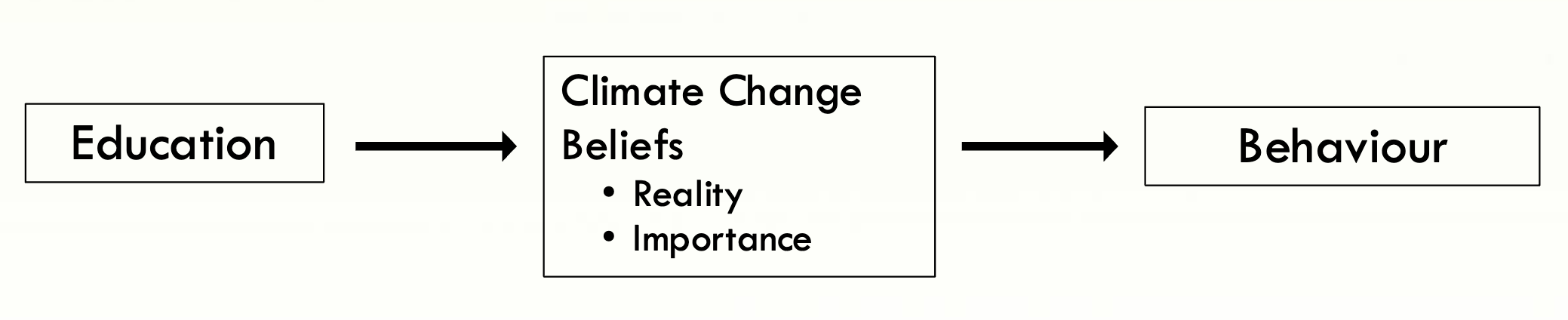
The above model doesn’t really work… So the below would be much better.
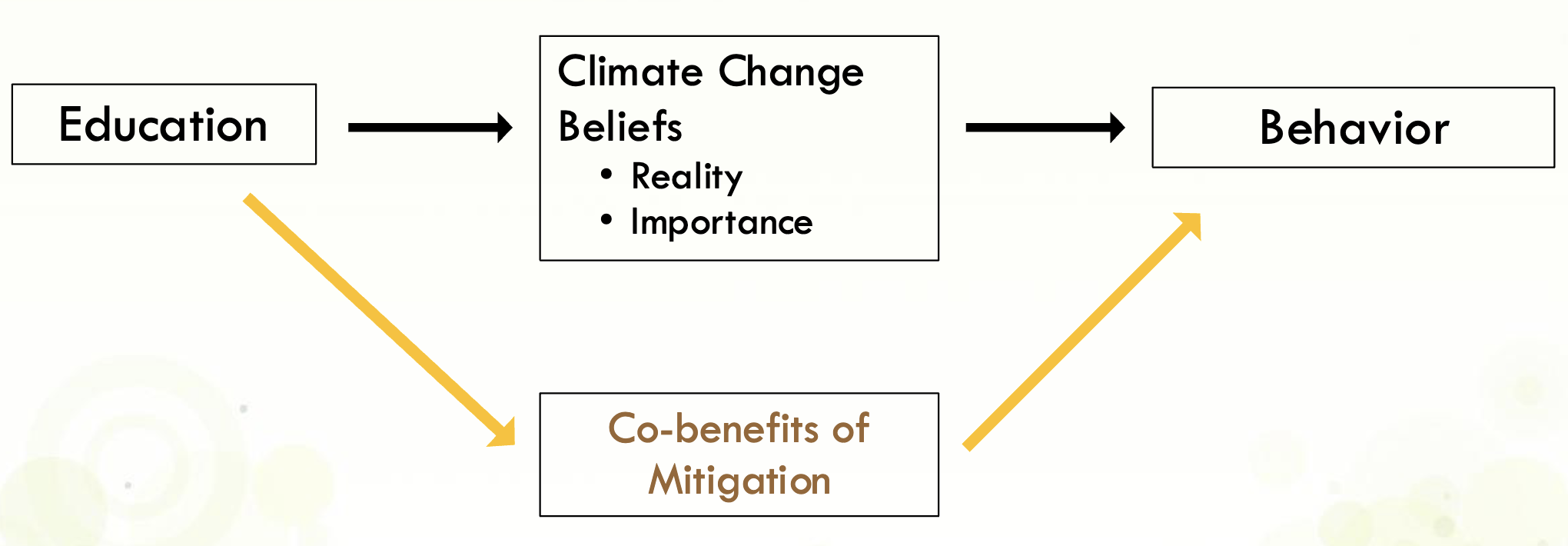
3 R’s of Climate
Reality → Scientists are convinced human-caused climate change is occuring. Harmful climate change impacts are already happening and will get worse.
Risk → Out climate may get worse than expected and there may be surprises.
Response → The sooner we react, the better. We can still do things.
Identity Signalling
We are motivated to feel good about ourselves and groups, the behaviours we do signal our reputation and ideas about ourselves.
Green-to-be-Seen
People who do “green” behaviour will do said behaviour so that it is seen to present their identity as an environmentalists.
Two Main Climate Change Strategies
Adaption → Fix our vulnerabilities to a world that has been changed by climate change: Health programs, promoting adaptation, relocation, upgrading buildings and infrastructure.
Mitigation → Stop climate change from occurring: Renewable energy, sustainable transportation, carbon sinks, energy conservation.
Reducing food waste is both!
Potential Exam Question
You install air conditioning in your home to keep cool during summer, is that adaptation or mitigation?
Answer: Adaptation
What proportion of scientists agree that climate change is a result of human activity?
100% (Some argue between 97-100%).
Descriptive Social Norms
Social norms (mental representations) that people actually do. It describes their actions, thoughts, and feelings.
Injunctive Social Norms
Social norms (mental representations) that people should do, think, and feel.
Conformity
The convergence of individuals’ thoughts, feelings, and behaviour towards a social norm.
Private Conformity
When people accept and conform to something internally.
Public Conformity
When people accept and conform to something publicly, but do not accept or conform it privately.
False Consensus Effect
The tendency to overestimate everyone’s agreement with your own characteristics, opinions, and behaviour.
Informational Influence
In ambiguous situations, people are more likely to conform because they believe the group holds information that they do not.
Normative Influence
People conform to fit in.
Reference Group
People accepted as an appropriate source of information for a judgement because they have relevant attributes that make them worthy of such a judgement. For example, on Asch’s line test, following the opinion of those with good eyesight.
Group Polarization
The process by which a group’s initial average becomes more extreme in either direction after communicating in a group.
Pluralistic Ignorance
Occurs when everyone publicly conforms, believes others privately conform, but nobody actually privately conforms.

