Biological Rhythms
 Studied by 1 person
 Call Kai
 Learn
Learn Practice Test
 Spaced Repetition
 Match
Match Flashcards
 Knowt Play
1/18

There's no tags or description
Looks like no tags are added yet.
Name | Mastery | Learn | Test | Matching | Spaced | Call with Kai |
|---|
No analytics yet
Send a link to your students to track their progress
19 Terms
Biological rhythm
Is a change in the body processes or behaviour in response to cyclical changes within the environment
Disruption of biological rhythms has been shown to lead to disrupted sleep patterns, increased anxiety and decreased alertness and vigilance
Biological rhythms are governed by 2 things
The body’s internal biological clocks, which are called endogenous pacemakers
And the external changes in the environment known as exogenous zeitgebers
3 types of biological rhythms
Circadian rhythms - A body rhythm which occurs across a 24 hour period E.g. the sleep-wake cycle
Infradian rhythms - Cycles that take longer than 24 hours to complete E.g. the menstrual cycle
Ultradian rhythms - Cycles that take less than 24 hours to complete E.g. the stages of sleep
Control of circadian sleep-wake cycle
The sleep-wake cycle is controlled through the interaction of endogenous pacemakers and exogenous zeitgebers
In humans, the endogenous pacemakers involved in the sleep-wake cycle are the suprachiasmatic nucleus (SCN) and the pineal gland which releases the hormone melatonin
The main exogenous zeitgeber involved in the sleep-wake cycle is light. Other zeitgebers include meal times and daily routines (e.g. alarm clock)

How the Circadian sleep-wake cycle works
In the evening, sensory neurons in the eyes detect falling light levels and send a message to the SCN. This triggers the pineal gland to release melatonin, a hormone which causes sleepiness
In the morning, sensory neurons in the eyes detect increasing light levels and send a message to the SCN. This inhibits the pineal gland from releasing melatonin leading to wakefulness
Siffre’s research
Siffre spent several months living in a cave deprived of natural light
He continued to fall asleep and wake up on a regular schedule, however his ‘free-running’ biological rhythm settled at 25 hours
When he left the cave he thought the date was a month earlier than it was as he felt he had experienced fewer days ( came out in September and thought it was August)
This shows the importance of the exogenous zeitgeber of light to entrain the endogenous pacemaker to a 24 hour rhythm. In the absence of light the EP maintain a regular sleep wake cycle, but free runs at 25 hours
Morgan (1955)
Bred hamsters so that they had circadian rhythms of 20 hours rather than 24
SCN neurons from these hamsters were transplanted into the brains of normal hamsters, which subsequently displayed the same abnormal rhythm of 20 hours
This shows that the transplanted SCN had imposed its pattern onto the hamsters, demonstrating that the SCN is the main endogenous pacemaker to control the sleep-wale cycle
Folkard et al (1985)
12 people lived in a dark cave for 3 weeks. They went to bed when the clock said 11:45 and got up when it said 7:45
The researchers gradually sped up the clock so a ‘day’ only lasted 22 hours
Only one of the participants was able to adjust to this new regime, suggesting that the free-running circadian rhythm is not easily overridden by exogenous zeitgebers other than light
Limitation: Use of case studies and small samples
One limitation of the research into sleep/wake cycle is that the studies tend to involve small groups of Ps and often take an idiographic approach
The people involved may not be representative of the wider population, limiting the extent to which meaningful generalisations can be made regarding the sleep wake cycle
As a result they can ignore individual differences as sleep/wake cycles can vary from person to person
Duffy et al (2001) revealed that some people have natural preferences for going to bed early and rising early (known as larks) whereas others prefer the opposite (owls). This means it is difficult to use the research data to discuss anything more than averages, which may be meaningless
Practical application of research: Shift work
Research into circadian rhythms has given us a better understanding of the adverse consequences that can occur as a result of them being disrupted.
For example people who work night shifts experiencedesynchronisation of their sleep-wake circadian rhythm and experience a period of reduced concentration (a circadian trough) at about 6am meaning mistakes and accidents are more likely.
Research has also suggested a relationship between shift work and heart disease.
Therefore research into the sleep wake cycle has economic implications in terms of how best to manage worker productivity.
Drug Treatments
Circadian rhythms co-ordinate a number of the
body’s processes such as heart rate, digestion
and hormone levels.
This has had an effect on pharmokinetics (the
action of drugs on the body and how well they
are absorbed). There are certain peak times
during the day or night when drugs are likely to
be at their most effective. This has led to the
development of guidelines to do with the
timing of drug dosing for a range of medications
Menstrual Cycle
Governed by monthly changes in hormone levels which regulate ovulation.
Typical cycle takes approximately 28 days (24-35 days is considered normal)
During each cycle rising levels of the hormone oestrogen cause the ovary to develop an egg and release it (ovulation)
After ovulation, the hormone progesterone helps the womb lining grow thicker, readying the body for pregnancy
If pregnancy does not occur, the egg is absorbed into the body, the womb lining comes away and leaves the body (the menstrual flow)
Research evidence that menstrual cycle is affected by exogenous factors
Stern and McClintock (1998) studied 29 women with irregular periods.
Pheromones were gathered at different stages of their cycle via a cotton pad in their armpit which they wore for 8 hours.
The pads were rubbed on the upper lip of the other women. 68% of the women experienced changes to their cycle which brought them closer to the cycle of their 'odour donor.
There is an evolutionary advantage of menstrual synchrony
For our ancestors it may have been an advantage for all women of the group to menstruate at the same time as they could all get pregnant at the same time
This would mean that new-borns could be cared for collectively
However, the validity of this perspective has been questioned
If too many females were fertile at the same time within a social group this would produce competition for the highest quality males. Therefore, the avoidance of menstrual synchrony would appear to be the most adaptive
The Stages of Sleep
Psychologists have identified five distinct stages of sleep that together span around 90 minutes – a cycle that continues throughout the night
Each of these stages is characterised by a different brainwave activity which can be monitored using an EEG
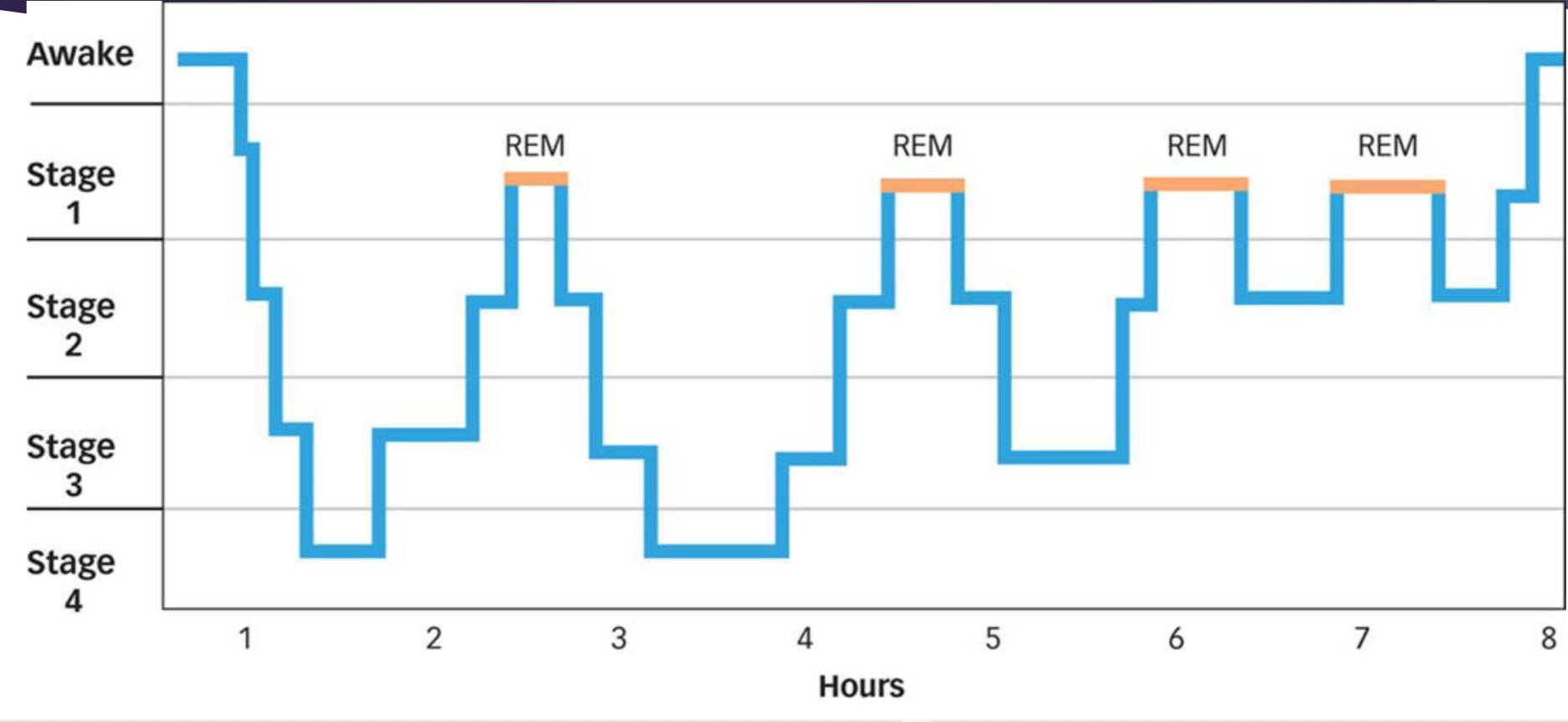
The Stages
Stage 1 and 2 : are the beginning of sleep.Brain waves start as alpha and progress to theta waves. A person can easily be woken during this stage
Stages 3 and 4: are deep sleep. These stages last for about 30 minutes. The EEG displays very slow delta waves. Breathing and pulse rates are slow and it is difficult to wake the person up
REM sleep: Rapid eye movement — our eyes move rapidly under the eyelids.There is lots of brain activity, can look similar to wakefulness. This is where dreams occur and we have muscular paralysis to stop us acting out our dreams
Evidence to support the distinct stages of sleep
Dement and Kleitman (1957) monitored the sleep patterns of nine adult participants in a sleep lab.
Brainwave activity was recorded on an EEG.
REM activity during sleep was highly correlated with the experience of dreaming, brain activity varied according to how vivid dreams were, and the participants woken during dreaming reported very accurate recall of their dreams
This suggests that REM sleep is a distinct component of the ultradian sleep cycle
However there may be individual differences
The problem with studying sleep cycles is the differences observed in people, which makeinvestigating patterns difficult
Tucker et al. (2007) found significant differences between participants in terms of the duration of each stage, particularly stages 3 and 4 (just before REM sleep)
This demonstrates that there may be innate individual differences in ultradian rhythms, which means that it is worth focusing on these differences during investigations into sleep cycles
Sleep studies tend to lack ecological validity
Sleep research often suffers from low ecological validity because the conditions in which data are collected do not reflect how people naturally sleep
These controlled settings also remove everyday influences like partners, noise and personal routines, meaning the sleep recorded may not represent typical behaviour
 Note
Note  Flashcards (50)