4.7 Organic chemistry
 Call Kai
 Learn
Learn Practice Test
 Spaced Repetition
 Match
Match Flashcards
 Knowt Play
1/99

Earn XP
Description and Tags
Completed flash card set
Name | Mastery | Learn | Test | Matching | Spaced | Call with Kai |
|---|
No analytics yet
Send a link to your students to track their progress
100 Terms
What’s an organic compound?
A compound that contains at least one Carbon atom - typically bonded to hydrogen and sometimes oxygen.
What is crude oil?
Crude oil is a finite resource found in rocks.
What is crude oil?
It is the remains of ancient biomass consisting mainly of plankton that was buried under mud.
It is a finite resource found in rocks
What is crude oil made up of?
Crude oil is a mixture of a very large number of compounds. Most of the compounds in crude oil are hydrocarbons. Most of the hydrocarbons in crude oil are alkanes.
What is a hydrocarbon?
A molecule made up of carbon and hydrogen atoms only
What are most of the hydrocarbons in crude oil and why?
Alkanes
Alkanes only have single (covalent) bonds, which are very stable and hard to break, making alkanes unreactive and therefore more likely to accumulate over time
In comparison to alkenes which have a C=C double bond, making them more reactive as the bond breaks more easily, making them less likely to accumulate as they are more likely to react into other molecules
What is a homogolous series?
A group of compounds with the same functional group: has similar chemical and physical properties.
What is meant by ‘functional group’
A functional group is a specific group of atoms that all compounds in a homologous series share that is responsible for the compounds’ chemical properties and reactivity characteristics
What is the general formula for the homogolous series of alkanes?
CnH2n+2
What are the first four members of the alkanes?
Methane, ethane, propane, butane
What are alkanes?
Alkanes are a type of hydrocarbon.
They are saturated hydrocarbons as they only have single covalent bonds.
What is the general formula for alkanes?
CnH2n+2
What is the process by which the many compounds of crude oil can be separated?
Fractional distillation
Why is crude oil separated?
To produce fractions of different hydrocarbons
Different hydrocarbons have different uses, so separating them allows them to be used for their specific uses.
Describe fractional distillation of crude oil
Purpose: to seperate crude oil into fractions based on boiling point
Crude oil is heated until it vaporises (this breaks the intermolecular forces between hydrocarbons)
The vapour enters the fractionating column which is hottest at the bottom and coolest at the top
Long chain hydrocarbons with high boiling points condense nearer to the bottom where it is cooler
Short chain hydrocarbons with low boiling points condense nearer to the top where it is hotter
Different fractions are collected at different levels of the column
Each fraction has hydrocarbons with similar chain lengths and boiling points
What do the different fractions of fractionally distillated crude oil contain?
Molecules with similar number of carbon atoms (chain length and boiling point).
This is because molecules with a larger amount of carbon atoms (longer chains) have lower boiling points so condense together at lower fractions, whereas molecules with a smaller number of carbon atoms (shorter chains) have higher boiling points so condense together at higher fractions.
What determines the properties of hydrocarbons?
Size of the molecule (chain length)
Types of bonds (whether its saturated or unsaturated)
Define feedstock
A raw material used in an industrial process to create a new product
What is the petrochemical industry?
The industry that uses fractions of crude oil to make useful chemicals and products.
Describe the uses of the fractions of crude oil
They can be processed to produce fuels and feedstock for the petrochemical industry.
Many of the fuels which we depend on are produced from crude oil:
petrol
diesel oil
kerosene
heavy fuel oil
liquefied petroleum gases
Many useful materials which we depend on are produced by the petrochemical industry:
solvents
lubricants
polymers
detergents
Why is there a vast array of natural and synthetic carbon compounds?
Because it can form families of similar compounds.
This is possible because carbon can form chains and rings linked by covalent carbon-carbon bonds.
How does boiling point, viscosity, volatility and flammability change with increasing molecular size of hydrocarbons and why?
As the hydrogen carbon chain increases, and the molecule gets larger:
boiling point increases
Bigger molecules have stronger intermolecular forces (more electrons), so more energy (heat) is needed to seperate them
viscosity increases
Longer molecules get tangled and flow less easily as they get stuck going past eachother, making them thicker
volatility decreases
Longer molecules have stronger intermolecular forces (more electrons), so require more energy to vaporise
flammability decreases
Less flammable, hider to ignite. This is because combustion occurs in the gaseous state, so as their boiling point is higher, they don’t evaporate into vapour as easy, so therefore don’t burn easily.
(As their volatility decreases)
What is combustion in general?
An exothermic reaction where a fuel reacts with oxygen to release energy.
It can be complete (if there is enough oxygen) or incomplete (if there is limited oxygen).
Describe complete combustion of hydrocarbons
Combustion is the chemical reaction where a fuel reacts with oxygen to release energy.
Complete combustion occurs when there is enough oxygen.
Hydrocarbon + oxygen → carbon dioxide + water
A lot of energy is released (more than incomplete combustion) (as more bonds are formed (more carbon-oxygen bonds are formed as all the carbon forms carbon dioxide) which releases energy).
Features: clean flame, no soot
This is because in complete combustion there is enough oxygen for the hydrocarbon to react fully and all of the carbon to form carbon dioxide, therefore no solid carbon (soot) is formed, meaning that the flame is also clean.
Describe incomplete combustion of hydrocarbons
Combustion is the chemical reaction where a fuel reacts with oxygen to release energy.
Incomplete combustion occurs when there is limited oxygen.
Hydrocarbon + oxygen → carbon monoxide + carbon (soot) + water
Less energy is released compared to complete combustion, as less bonds are formed (which releases energy) as not all the carbon forms carbon-oxygen bonds.
Features: smoky flame, soot
In incomplete combustion there is limited oxygen, so not all of the carbon atoms form carbon dioxide; some form carbon monoxide and some remain as carbon (soot). Soot causes a smoky flame.
Write a word equation and a balanced equation for complete combustion of a hydrocarbon
Hydrocarbon + oxygen → carbon dioxide + water
Why are shorter hydrocarbons more useful?
More flammable so better used for fuels
Less viscous, flow easily to be pumped
How can hydrocarbons be made into more useful molecules?
By breaking them down (cracking them) into smaller molecules
Describe the two methods of breaking hydrocarbons down into smaller molecules
Steam cracking:
The hydrocarbon is vaporised and mixed with steam at very high temperatures
This causes thermal decomposition to occur, so it is broken down into smaller molcules
Catalytic cracking:
Vaporised and passed over a very hot catalyst
This weakens the hydrocarbons’ bonds and allows them to break down into smaller molecules
What are the products of cracking?
Alkanes and alkenes
What are alkenes?
Alkenes are a type of hydrocarbon.
They are unsaturated hydrocarbons as they have at least one carbon-carbon double bond.
Why are alkene molecules described to be unsaturated?
They contain two fewer hydrogen atoms than the alkane with the same number of carbon atoms
What is the general formula for alkenes
CnH2n
What is more reactive alkanes or alkenes and why?
Alkenes are more reactive.
This is because the carbon-carbon double bond is weaker, so it breaks and allows it to react more easily.
How to test if a substance is an alkene or alkane?
Add the substance to bromine water (which is orange).
If an alkene is present, the bromine will go from orange to colourless as the carbon-carbon double bond reacts with bromine.
If alkane is present the bromine water will remain orange as no reaction occurs as they are less reactive (as they don’t have this C-C double bond).
What are the uses of smaller hydrocarbons from cracking and why?
Used as fuels
This is because they have lower boiling points, so vaporise more easily to mix with oxygen (for combustion) and make combustion more efficient as this also makes them more flammable.
Give uses of alkenes
Make polymers
The double bond can break and join many alkene molecules together in addition polymerisation
Chemical feedstock to make other chemicals
More reactive as double bond can open up
Give examples of why cracking is useful
Make alkenes for chemical feedstock and polymers
Making more efficient fuels and petrol
What are the first four molecules of the homogolous series of alkenes?
Ethene, propene, butene and pentene
Cannot be methene as methene only has one carbon atom and an alkene needs at least two carbon atoms to form a carbon-carbon bond.
What is the functional group of alkenes?
C=C
Generally, what determines the reactions of organic compounds?
Functional groups
How do alkenes react with oxygen?
They react with oxygen in the same way as other hydrocarbons, but they tend to burn in air with smoky flames due to incomplete combustion.
In air they combust incompletely as they have a higher proportion of carbon to hydrogen than alkanes and therefore require a very large amount of oxygen that is not supplied in air.
Complete:
alkene + oxygen → carbon dioxide + water
Incomplete:
alkene + oxygen → carbon monoxide + carbon + water
Do alkenes combust completely or incompletely in air and why?
Incompletely.
They need very large amounts of oxygen to combust completely as they have a higher proportion of carbon to hydrogen compared to alkanes. There is not enough oxygen in air for this.
What substances do alkenes react with?
Oxygen
Hydrogen
Water
Halogens
How do alkenes react with hydrogen?
Give the conditions
Hydrogenation - convert double bonds to single bonds
Alkene + H2 → Alkane
Nickel catalyst
60 degrees
How do alkenes react with water?
Hydration
They can react with steam to form alcohol
Alkene + H2O → Alcohol
Phosphoric acid catalyst
300 degrees 60 atm
(As alcohol’s functional group is OH)
What are the conditions needed for alkenes to react with water?
300 degrees (steam)
60 degrees
Phosphoric acid catalyst
Forms alcohol
How do alkenes react with halogens?
Form haloagenoalkanes
No catalyst
Room temperature and pressure
Eg. bromine water (orange to colourless when reacted with an alkene)
Draw fully displayed structural formulae of ethene (alkene) and the products of its addition reaction with hydrogen

Draw fully displayed structural formulae of ethene (alkene) and the products of its addition reaction with water

Draw fully displayed structural formulae of ethene (alkene) and the products of its addition reaction with a halogen

What is the functional group for alcohols?
OH
What are the first four members of the homogolous series of alcohols?
Methanol, ethanol, propanol, butanol
Draw ethanol
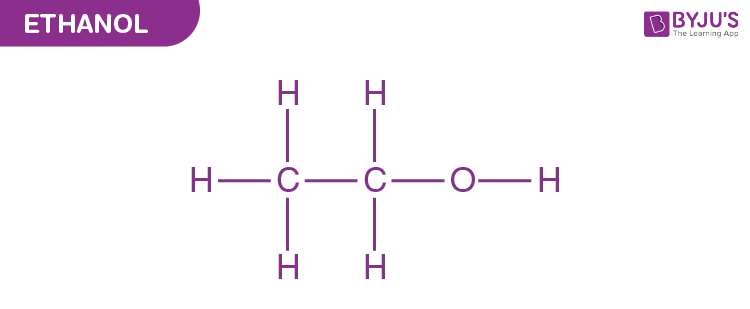
Name what alcohols react with
Sodium
Fizzes
Air
Burns
Water
Dissolves
Oxidising agent
Describe what happens when an alcohol reacts with sodium (with an example)
alcohol + sodium → alkoxide + hydrogen
eg. ethanol + sodium → sodium ethoxide + hydrogen
As hydrogen is produced bubbles of the gas are given off (fizzing)
The alkoxides are salts
Describe what happens when an alcohol is burned in air
When an alcohol is burned in air, this is a complete combustion reaction (as it already has oxygen in its structure)
alcohol + oxygen → carbon dioxide + water
Does alcohol react with water? What happens
Alcohols do not react with water and instead dissolve in water to create a colourless, neutral solution (pH of 7)
What’s an oxidising agent?
In terms of oxygen: provides oxygen to a substance in a chemical reaction
In terms of electrons: causes a substance to lose electrons by gaining the electrons that the substances loses
Describe what happens when an alcohol reacts with an oxidising agent (with an example)
Alcohols are oxidised to produce carboxylic acids and water is formed
alcohol + oxygen → carboxylic acid + water
ethanol + oxygen →ethanoic acid + water
Give the main uses of the first four alcohols
Methanol:
solvent, fuel, chemical feedstock
Ethanol:
solvent, fuel, alcoholic drinks
Propanol:
solvent, fuel, antiseptic in hand sanitiser
Butanol:
Solvent, fuel, chemical feedstock
They can all be used as solvents, fuels and chemical feedstock
How are aqueous solutions of ethanol produced? give the formula
When sugar solutions are fermented using yeast
sugar → ethanol + carbon dioxide
Fermentation occurs in warm conditions in a mixture of water, sugar and yeast.
Described the conditions required for the fermentation of sugar (using yeast) to produce ethanol
Anaerobic conditions (no oxygen)
Temperature between 25 and 40 degrees (as not to denature enzymes
Must have a sugar source (sugars dissolved in water and mixed with the yeast)
Time (the reaction is very slow)
What is the functional group for carboxylic acids?
COOH
What are the first four members of the homogolous series of carboxylic acids?
Methanoic acid, ethanoic acid, propanoic acid, butanoic acid
Give the formula for ethanoic acid
CH3COOH
What happens when carboxylic acids react with carbonates?
carboxylic acid + metal carbonate → metal salt + carbon dioxide + water
ethanoic acid + sodium carbonate → sodium ethanoate + carbon dioxide + water
Fizzing and bubbling as carbon dioxide is released
What happens when carboxylic acids dissolve in water?
Carboxylic acids are partially ionised in water (as they are weak acids) forming weakly acidic solutions.
Give a use of carboxylic acids
In food - vinegar
Describe the reaction of carboxylic acid with alcohols
Esterification
carboxylic acid + alcohol → ester + water
ethanoic acid + ethanol → ethyl ethanoate + water
Sulfuric acid catalyst
What are esters?
Compounds formed from when carboxylic acids react with alcohols; they have fruity smells and are used in perfumes and flavourings.
What are carboxylic acids?
They are weak organic acid compounds that contain the COOH functional group
Give the name of an ester
Ethyl ethanoate
What is the functional group of an ester?
COO
C=O
|
O
Define polymerisation and what are the two types?
Polymerisation is a process where small simple molecules (monomers) join together repeatedly to form long chain molecules (polymers)
addition polymers
condensation polymers
What type of polymerisation do alkenes undergo?
Addition polymerisation
In addition polymers, what are the monomers?
Alkenes
Describe addition polymerisation
Monomers: small, unsaturated molecules that all have C=C double bond
When the C=C double bond breaks, it allows the carbon atoms to form new bonds and the many alkene molecules join together, forming a long chain
No other molecules are bonds
As no other molecules are produced, the repeating unit has the same atoms as the monomer.
How to draw the displayed formula of a monomer vs polymer
Monomer: draw it, put brackets around it and an n in front of it
Polymer: draw it, put bracktes around it, have bonds coming outside of the brackets, have an n behind it
Describe condensation polymerisation
A reaction with
monomers with two functional groups
Case 1: two different monomers, each with two functional groups
Case 2: one type of monomer with two different functional groups
each monomer has two functional groups
the two functional groups react together and join to link the monomers
and a small molecule (usually water) is released
For every new bond between molecules, a small molecule is lost
Give the ester functional group
COO
Describe the formation of poly(ester)
Poly(ester) is formed by condensation polymerisation
(Remember esters are formed by reacting carboxylic acids and alcohols)
As condensation polymerisation needs two different monomers with two functional groups, dicarboxylic acids and diols are needed
Eg. ethanediol + hexanedioic acid →poly(ester) + water
Case 1: two different monomers with two functional groups
ethanediol OH - CH2 - CH2 - OH
hexanedioic acid HOOC - CH2 - CH2 - CH2 - CH2 - COOH
form an ester and water, continue to add monomers on the end forms polyester
ester linkage CO2
the original functional groups go on the end of the monomer (if not asked for a polymer presentation)
Answer (- 0 - linkage - 0 - linkage -)n + H20 n
Describe the two types of condensation polymerisation reactions
Polyester, ester linkage (-COO-)
Poly(ester) (ester linkage) is formed by condensation polymerisation
Diol OH reacts with dicarboxylic acid’s COOH to form COO and H2O
Amino acid, polypeptide linkage (CONH)
(C=O and C-N-H)
As amino acids have two different functional groups (amine group NH2 and carboxylic acid group COOH)
Form polypeptides (chains of same amino acid)
Describe the formation of polypeptides
Amino acids have two different functional groups
Amino acids have an amine group: NH2
Amino acids have a carboxylic acid group: COOH
They react by condensation polymerisation:
The NH2 and COOH functional groups react to form polypeptide linkage (CONH (double bond between C=O)
And a molecule of water is released
What do amino acids react to produce (and why) and by which process?
They react by condensation polymerisation to produce polypeptides (because there is only one type of amino acid)
How many different functional groups do amino acids have in a molecule?
Two different functional groups
Carboxylic acid COOH
Amine group NH2
Name the naturally occuring monomers
Amino acids! → form polypeptides and proteins
What is the simplest amino acid?
Glycine!
H2N-CH2-COOH
amine group, joiner, carboxylic acid group
Difference between protein and polypeptide:
Both made of amino acids
Polypeptide: chain of amino acids
Protein: a polypeptide that has folded into a complex 3D shape
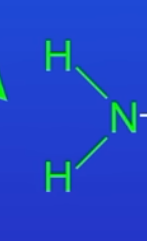
Name and draw the amino acid your supposed to know and name its functional group/s
Glycine
Smallest, simplest amino acid
Amino group is NH2 and carboxylic acid group is COOH
Middle is CH2
Therefore H2NCH2COOH
What is DNA and what does it do?
Deoxyribonucleic acid is a large molecule (polymer) essential for life
encodes genetic instructions
for the development
and functioning
of living organisms and viruses
Describe the structure of DNA
DNA molecules are made up of two polymer chains made from four different monomers called nucleotides, in the form of a double helix.
Name naturally occuring polymers important for life
DNA (nucleotides)
proteins (amino acids)
starch (sugars)
cellulose (sugars)
What are alkoxides?
Alkoxides are salts formed when alcohols react with highly reactive metals (eg. sodium)
alcohol + sodium →alkoxide + hydrogen
Alkoxides: salt
Hydrogen bubbles given off
Give some specific uses of alkanes and alkenes
Alkanes: fuels, lubricants
Alkenes: polymers, chemical feedstock
Describe polypeptide linkage
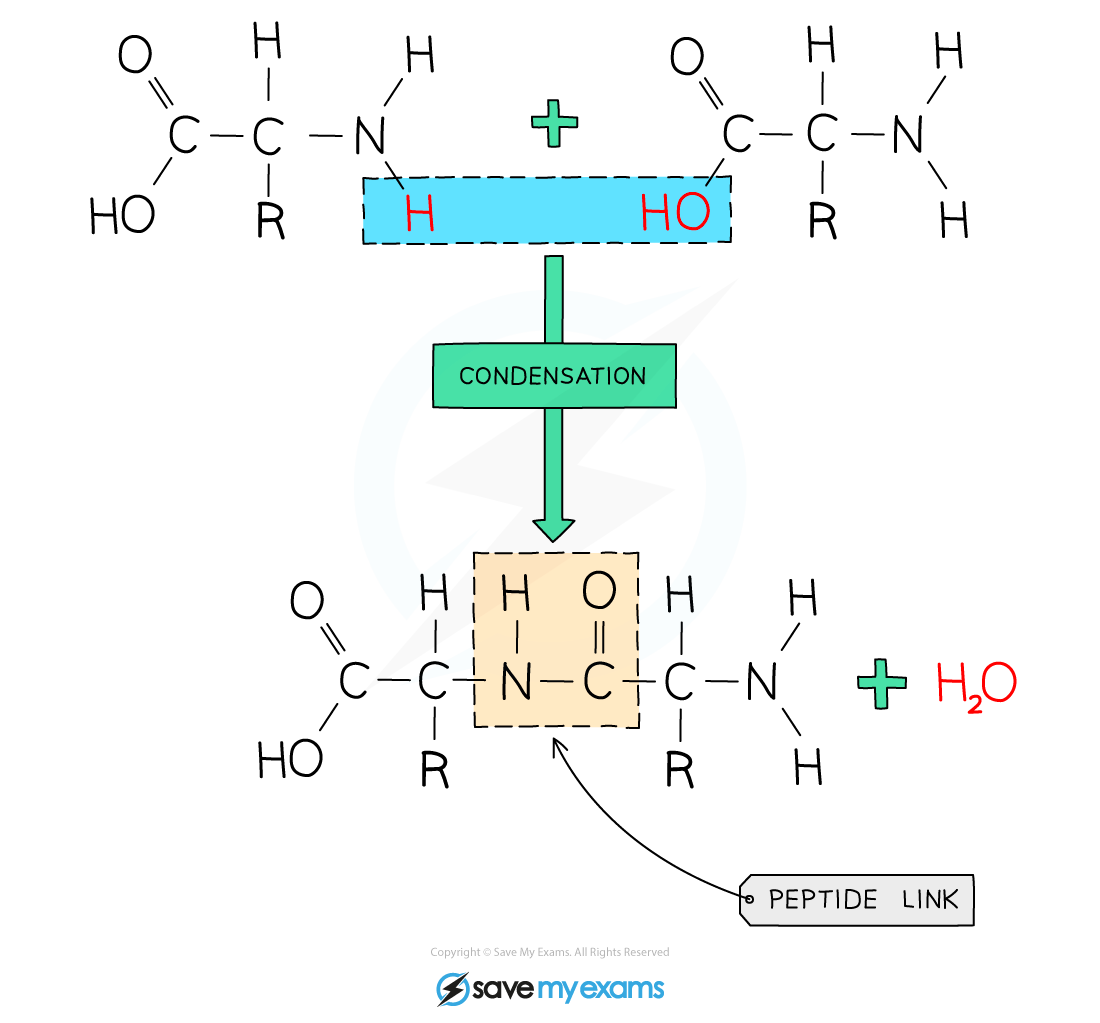
C= O
NH
Describe how you would draw the (whole) polymer molecule glycine
One end has amine group, one end has carboxyl group
One peptide linkage between each (H-C-H) monomer
Describe how you would draw the (short) glycine polymer
Compare ethane with ethene.
You should refer to:
their structure and bonding
their reactions.
Structure and bonding
• both are hydrocarbons
• both contain two carbon atoms (per molecule)
• ethane contains six hydrogen atoms (per molecule)
• (but) ethene contains four hydrogen atoms (per molecule)
• both have covalent bonds
• ethane contains a single C—C bond
• (but) ethene contains a double bond
• both contain C—H bonds
• both small molecules
Reactions
• both react with oxygen in complete combustion reactions
• to produce water and carbon dioxide
• both react with oxygen in incomplete combustion reactions
• to produce water, carbon monoxide and carbon
• incomplete combustion is more likely with ethene
• ethene decolourises bromine water
• (but) ethane does not decolourise bromine water
• ethene is more reactive (than ethane)
• ethene can react with hydrogen (to produce ethane)
• ethene can react with water (to produce ethanol)
• ethene can react with halogens (to produce halogenoalkanes)
• ethene can undergo addition reactions
• ethene can polymerise (to produce poly(ethene))
What do carboxylic acids react with?
Carbonates
Carboxylic acid + carbonate →carboxylate salt + water + carbon dioxide
Alcohols
Carboxylic acid + alcohol →ester + water
Dissolve in water to form weak acids