Multivariable calculus lecture 13 & 14

0.0(0)
studied byStudied by 0 people
call kaiCall Kai
learnLearn
examPractice Test
spaced repetitionSpaced Repetition
heart puzzleMatch
flashcardsFlashcards
GameKnowt Play
Card Sorting

1/9

encourage image

There's no tags or description

Looks like no tags are added yet.

Last updated 8:33 PM on 12/16/25
Name
Mastery
Learn
Test
Matching
Spaced
Call with Kai

No analytics yet

Send a link to your students to track their progress

10 Terms
1
New cards
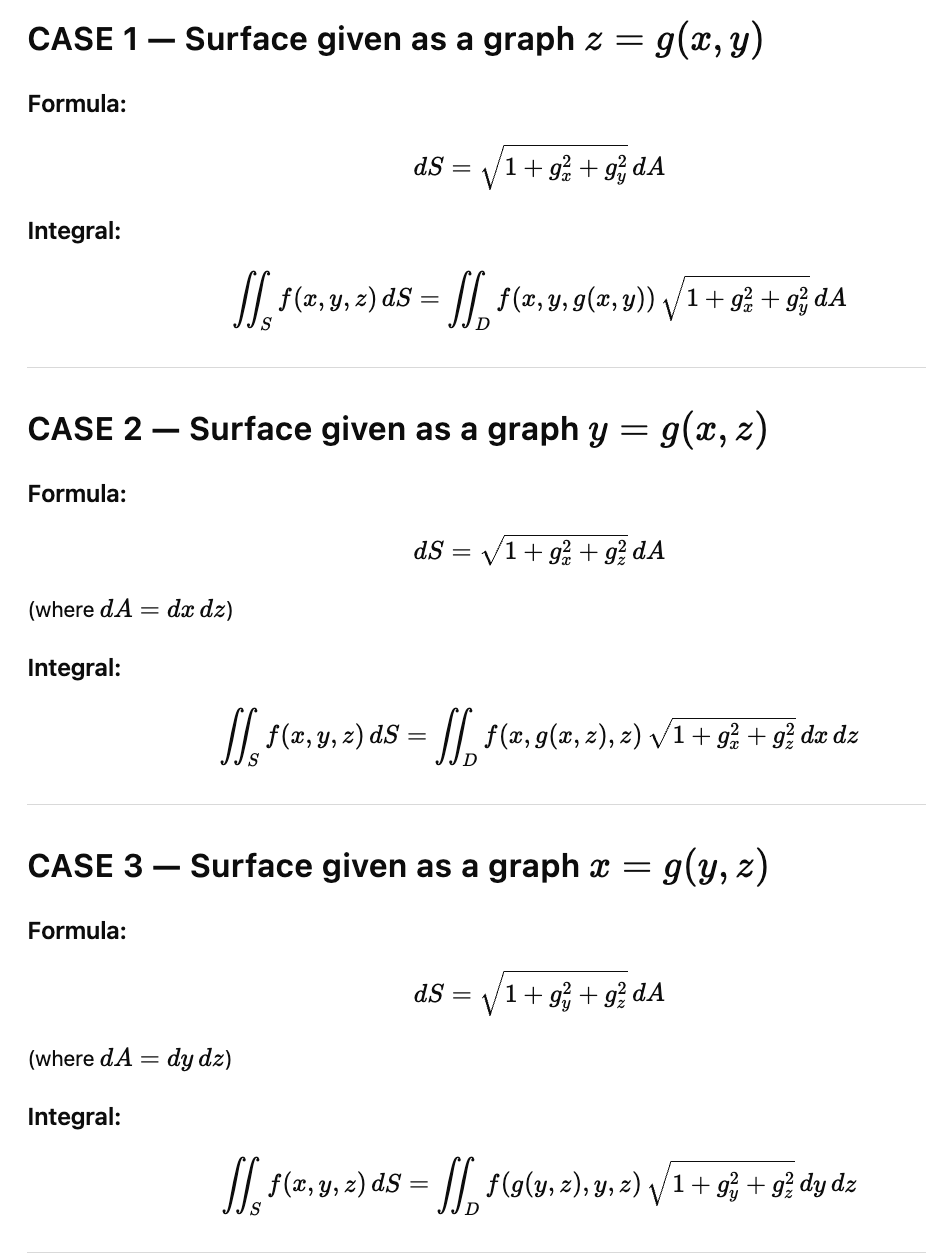
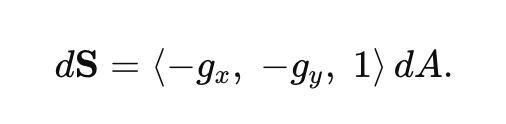
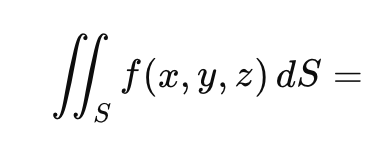
<p>Surface integral of a scalar function</p><p>Graph surfaces like z=g(x,y)</p><ol><li><p>parametrize using free variables</p><ol><li><p>eg. r(x,y) = <span>⟨x,y,g(x,y)⟩</span></p></li></ol></li><li><p>dS = _______</p></li><li><p>integrate: _______</p><ol><li><p>3 formulas (depending on how u define variables for surface)</p></li></ol></li><li><p>SA = remove ___</p></li></ol><p></p>

Surface integral of a scalar function

Graph surfaces like z=g(x,y)

  1. parametrize using free variables

    1. eg. r(x,y) = ⟨x,y,g(x,y)⟩

  2. dS = _______

  3. integrate: _______

    1. 3 formulas (depending on how u define variables for surface)

  4. SA = remove ___

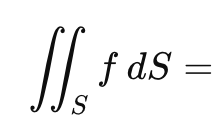
“f”

<p>“f”</p>
2
New cards
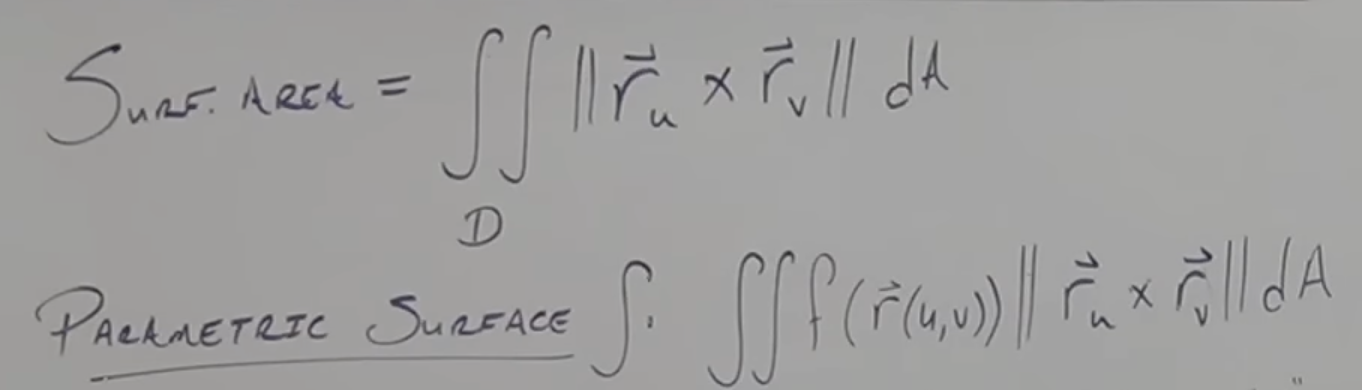
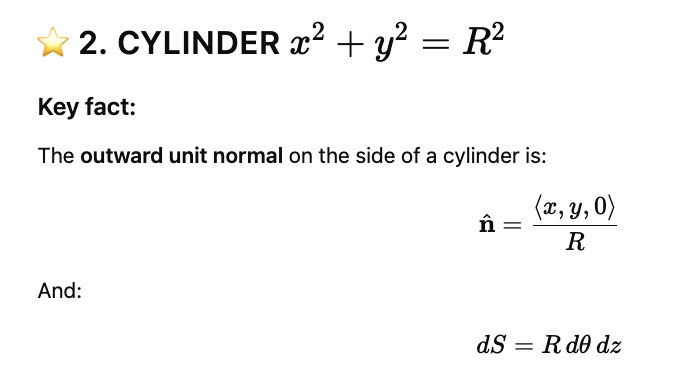
<p>Surface integral of a scalar function</p><p>Case B: Surface given implicitly (not solvable for one variable) </p><ol><li><p>General rule: _____</p></li><li><p>Sphere of x²+y²+z²=a²:</p></li><li><p>Cylinder of x²+y²=r²</p></li></ol><p></p>

Surface integral of a scalar function

Case B: Surface given implicitly (not solvable for one variable)

  1. General rule: _____

  2. Sphere of x²+y²+z²=a²:

  3. Cylinder of x²+y²=r²

<img src="https://knowt-user-attachments.s3.amazonaws.com/b4c7cb4f-184d-4391-b145-353f2cd44e9b.png" data-width="100%" data-align="center"><img src="https://knowt-user-attachments.s3.amazonaws.com/26412193-5b13-44e7-9411-87a74f97feeb.png" data-width="100%" data-align="center"><img src="https://knowt-user-attachments.s3.amazonaws.com/79fbe2ce-689f-4e28-83ea-b01df1c19f96.png" data-width="100%" data-align="center"><p></p>
3
New cards

2 ways to parametrize surfaces

  • if one variable is defined with other two variables (eg x=√(y²+z²)): make the other two variables __ and _

  • if not (eg. x²=y²+z²), parametrize _____

u, v

one side

<p>u, v</p><p>one side</p><p></p>
4
New cards
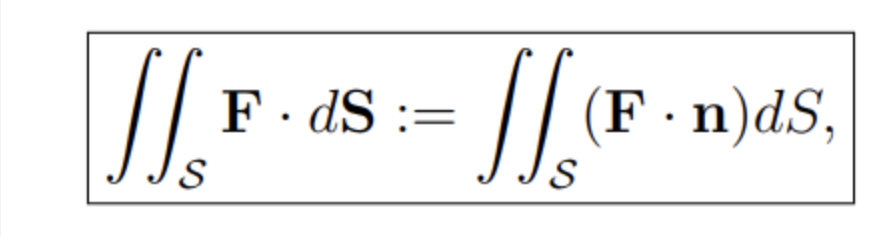
<p>Flux Integrals / Surface Integrals of Vector Fields</p><p>For graph surfaces like z=g(x,y): F dot n = ______</p><p>orientation for normal is outward</p><p>if surfaces oriented in neg direction (downward, neg x or y direction): multiply negative 1 * normal vector</p><ol><li><p>find integrand in terms of x&amp;y</p></li><li><p>find region and integrate</p></li></ol><p></p>

Flux Integrals / Surface Integrals of Vector Fields

For graph surfaces like z=g(x,y): F dot n = ______

orientation for normal is outward

if surfaces oriented in neg direction (downward, neg x or y direction): multiply negative 1 * normal vector

  1. find integrand in terms of x&y

  2. find region and integrate

PQR dot picture above

5
New cards

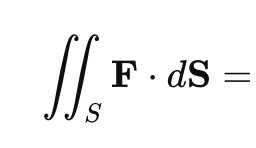
Flux if S is a simple closed surface (like sphere): divergence theorem
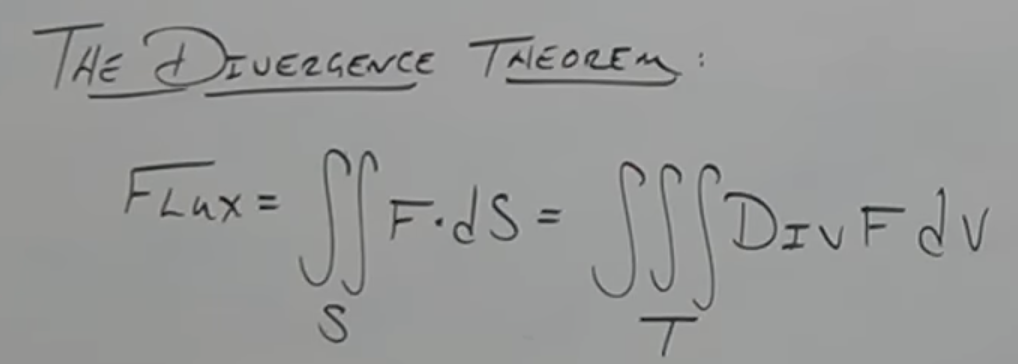
knowt flashcard image
6
New cards
<p>Flux Integrals / Surface Integrals of Vector Fields</p><p>For parametrically defined surfaces</p><p>for spheres</p><p>for cylinders</p>

Flux Integrals / Surface Integrals of Vector Fields

For parametrically defined surfaces

for spheres

for cylinders
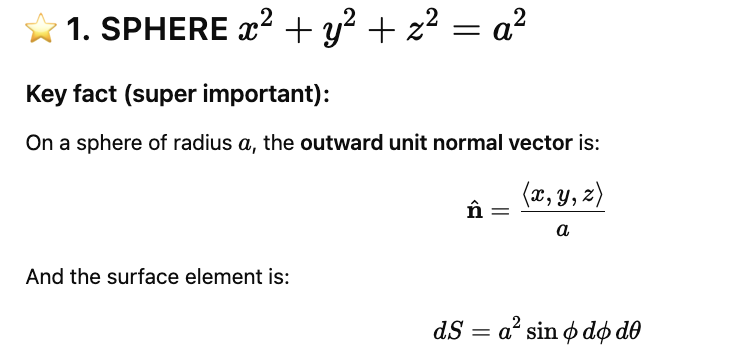
<img src="https://knowt-user-attachments.s3.amazonaws.com/a5aeffdb-51dc-4149-9fd2-dc16d9b4a181.png" data-width="100%" data-align="center"><img src="https://knowt-user-attachments.s3.amazonaws.com/59ab8c93-2d21-4f04-a779-cf073d117b9f.png" data-width="100%" data-align="center"><p></p>
7
New cards

plane intercept form

x/a+y/b+z/c =1

8
New cards

Stoke’s theorem:

deals with line ∫ of simple closed curves over non-conservative vector fields ON ANY SURFACE

knowt flashcard image
9
New cards

How to use stoke’s theorem

  1. find ____

  2. treat that as __ for a flux integral, find _ of surface and do dot product

  3. find ___ and integrate

curlF, F, n, region

10
New cards

sphere volume

sphere SA

4/3πr³

4πr²