Developing as a Learner
 Studied by 0 people
 Call Kai
 Learn
Learn Practice Test
 Spaced Repetition
 Match
Match Flashcards
 Knowt Play
1/11

There's no tags or description
Looks like no tags are added yet.
Name | Mastery | Learn | Test | Matching | Spaced | Call with Kai |
|---|
No analytics yet
Send a link to your students to track their progress
12 Terms
piaget - cog. dev.
Piaget – Theory of Cognitive Development
believes bio. readiness (esp. dev. of relevant brain ideas) is essential part of cog. dev. → argues children learn dev. appropriate skills by interacting w/ physical/social environment when they are bio. ready (4 stages)
1. Sensorimotor Stage (0-2)
are egocentric (inability to understand others POV) w/ no object permanence (ability to understand smth is there when it can’t be seen)
simple/innate reflexes → dev. of reflexes → object permanence
4 months: no object permanence, hidden object doesn’t exist
8-12 months: hidden object exists where hidden
18-24 months: hidden object exists even if moved
2. Preoperational Stage (2-7)
remain egocentric until end of stage
speech dev → symbolic thinking (rp, can form ideas but only focus on one aspect) → able to understand conservation of matter (smth remains the same in quantity despite change in appearance)
3. Concrete Operational Stage (7-12)
now can apply theory of mind
major turning point; logical thinking dev. (need concrete e.g.) → problem solving generally random → able to understand cons. at abstract level
4. Formal Stage (12-20)
cognitive development ‘complete’
abstract logical thinking dev.→ symbolic thinking dev. (using hypothetical e.g.), adults engage in systematic problem solving
piaget & inhelder
[A] investigate when children are no longer egocentric + can apply TOM particularly in transition from preoperational → concrete operational
[P] 4-7 y.o. presented w/ 3D model of 3 mountains. child sat on one side while doll placed on another, child asked to describe what doll could see from its perspective/shown pics of possible views and asked to select right one
[F] 4-6 y.o. consistently chose their own perspective, demonstrating egocentrism typical of the preoperational stage. ages 7+ able to describe the doll’s perspective, indicating TOM shown in the concrete operational stage.
[C] supports Piaget’s theory that children move from egocentrism in the preoperational stage to perspective-taking in the concrete operational stage as their cognitive abilities develop with age (so they dev sequentially + move thru universal fixed stages)
[E] provides strong evidence for stages, but is culturally limited + relies on tasks that may not fully represent real-world interactions. younger children may have misunderstood the task lacked familiarity with 3D models, weakening validity of results
piaget TEACUP
T → can test distinct stages but it’s difficult to get clear results in younger children and certain concepts are abstract
E → supported by observations of children in certain studies BUT other studies suggest Piaget underestimated children’s abilities. biological support for stages
A → applicable to education systems to understand when children are ready to learn certain things (how to structure education) BUT not always this uniform, diff. learning curves for diff. people + cultural factors
C → somewhat – difficult to measure if children act on egocentrism or something else (abstract), but are quite clearly defined. also quite rigid, doesn’t allow for transitions between stages
U → doesn’t take into account differences in education, which could lead to differences in stages (esp. culturally diff. education systems)
P → can help predicate when children are generally ready to perform certain age-appropriate tasks BUT doesn’t take into account individual differences; each child different
vygotsky - cog. dev.
argued social interaction w/ MKO led to dev., and that it precedes learning, not leads to it
zone of proximal dev. → diff. between what learners can do alone and what they can can’t. zone helps learner reach a skill/understanding that they can’t perform alone
more knowledgeable other → helper in ZPD; ppl w/ better understanding of req. skill/knowledge (parents/siblings/teachers/peers) help bridge the gap
argued importance of play → allows children to take on diff. roles, which extends their cog. abilities (learn thru conflict resolution, problem solving, fantasy)
contrast piaget + vygotsky
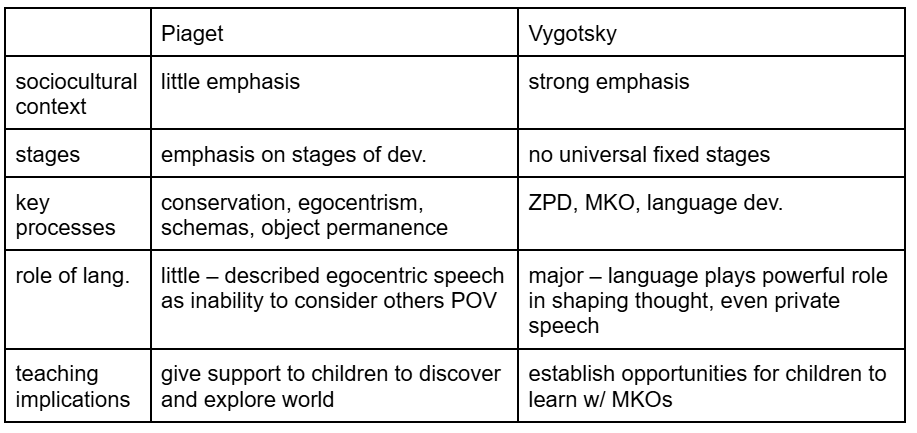
nichols ADD
brain dev. skill-learning hypothesis (neuroplasticity)
learning + personal experiences shape brain development
majority of brain dev. between birth–adolescence thru myelination, neural pruning, neural growth/inc. connectivity
human brain adapts/develops throughout lifetime
brain is plastic = ability to create new neural pathways based on environmental stimulation (social interactions, learning opportunities, personal experiences)
learn new skill → neurons form new neural pathways (causing brain to change structurally)
stop skill → neural pruning, brain eliminates unused pathways (use it/lose it)
draganski
[A] investigate whether learning new skill causes structural changes in brain, supporting S-L hypothesis
[P] Adult Ps w/ no prior juggling experience randomly assigned to ½ conditions: juggling group (learned for 3 months) and control group. MRI scans taken before training, after 3 months of training, 3 months after stopping training
[F] Ps in juggling condition demo. inc. grey matter vol. in brain areas associated w/ visual motion processing after training. after stopping → grey matter vol. dec. but remained higher than baseline. no sig. changes in control group
[C] adult brain ‘plastic’ and can change structurally in response to learning new skills. but are use-dependent and neural networks pruned when skill practising ceased. → supports S-L hypo.
[E] field experiment (IV manipulated under nat. conditions) → limited internal val. as researchers couldn’t control variables when Ps in home environ.
exp. → causal. repeated measures to control P Vs. use of control group (baseline) helped establish the role of learning skills in dev. brain
S-L eval.
E to support role of learning on brain dev. and explains how skills can be improved at any age (which BM does not)
ignores biological factors on learning, as ability to form neural pathways changes with age/bio. brain dev.
does not explain age-related ‘periods’ of brain dev. → why learning lang is easier as child vs adult
explains individual + cultural diff. in cog. abilities as a result of neuroplasticity
brain maturation theory (genetic mechanisms)
children have ‘critical periods’ of dev. supported by genes at fixed times
continues to dev. from birth → 20s
brain begins to dev. few weeks after conception → splits into 3 areas: hindbrain, midbrain, forebrain (by 9 wks)
during fetal dev. → brain becomes more wrinkled to fit inside skull (gyrification). by birth → midbrain hidden inside folds of forebrain
newborns have functioning nervous system (can breathe, suck/move, grasp, visual system, core consciousness that reacts to sensory exp.)
after birth, back-to-forward dev. → stem + hindbrain most active areas initially, control base instincts e.g. sucking necessary for survival
cerebral cortex develops last bc responsible for higher lvl cog. functioning (dev. thru exp./learning) → why babies can’t perform intricate/abstract thinking
chugani
[A] investigate glucose metabolism patterns in dev. brain to determine whether brain maturation influences brain dev.
[P] analysis PET scans to determine areas of brain activity by measuring glucose metabolism in diff. regions. cross-sectional design, compare scans of infants/toddlers
[F] baby’s brain dev. neural connections back to front (frontal cortex w/ HL functioning last). glucose metabolism of newborn 30% lower than adults
3-10 yrs activity/Ngrowth 2x of adults. ‘window of opportunity’, critical period of learning. metabolic rates dec. to adult lvls by 16-18
[C] brain dev. follows maturational sched. with diff. regions dev. at fixed times. offering bio. support for brain dev.
[E] large sample size → brain maturation more gen./universal BUT independent samples → possibility of unknown P diff. (personal history/environ.) → P variability may influence validity of findings
PET scans obj. → inc. validity
no control over P Vs
brain maturation eval.
E with clear biological links to support (thru PET scans + MRIs)
not susceptible to researcher/participant biases
explains universal developmental mechanisms across cultures/individual differences
useful for understanding why certain behaviours arise at specific ages (e.g. inc. risk-taking during adolescence)
HOWEVER assumes infants pre-wired, but can’t isolate role of learning + neuroplasticity bc they alr have hours of experience prior to taking brain scans
thus overly deterministic
cannot explain individual diff. in behaviour/dev. within same age groups
neuroplasticity + maturation not exclusive → brain dev. result of interaction between the two
 Note
Note  Flashcards (81)