tropical storms (excuding case studies)
 Call Kai
 Learn
Learn Practice Test
 Spaced Repetition
 Match
Match Flashcards
 Knowt Play
1/22

There's no tags or description
Looks like no tags are added yet.
Name | Mastery | Learn | Test | Matching | Spaced | Call with Kai |
|---|
No analytics yet
Send a link to your students to track their progress
23 Terms
what are tropical storms
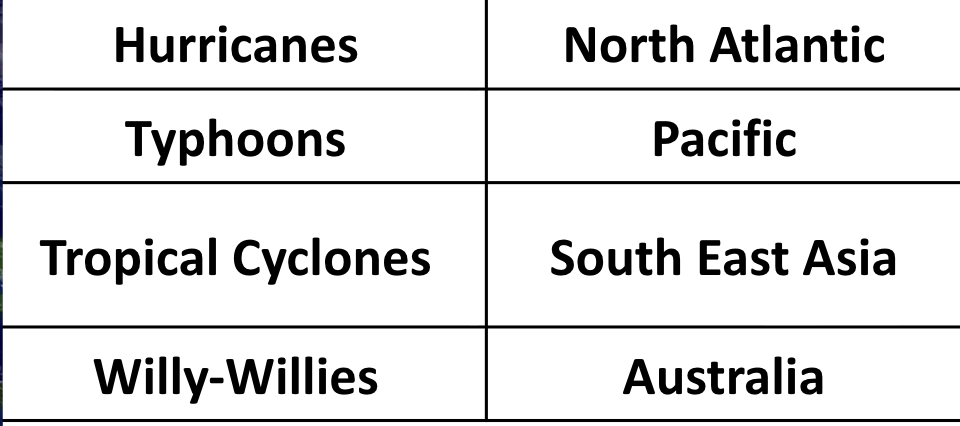
Tropical storms are intense, destructive low pressure weather systems. They occur either side of the equator. Tropical storms are named according to their location
what is the spatial distribution of tropical storms
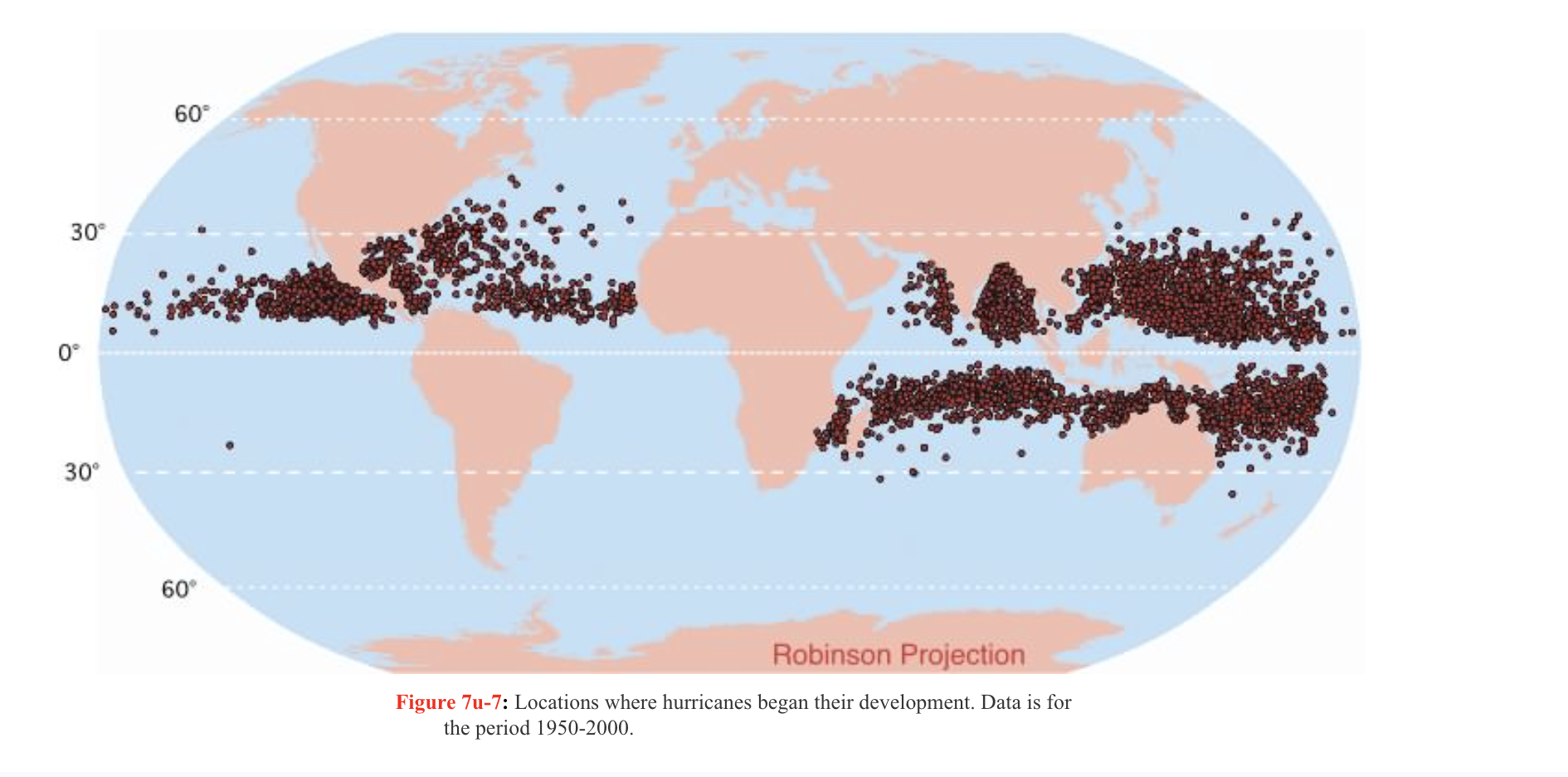
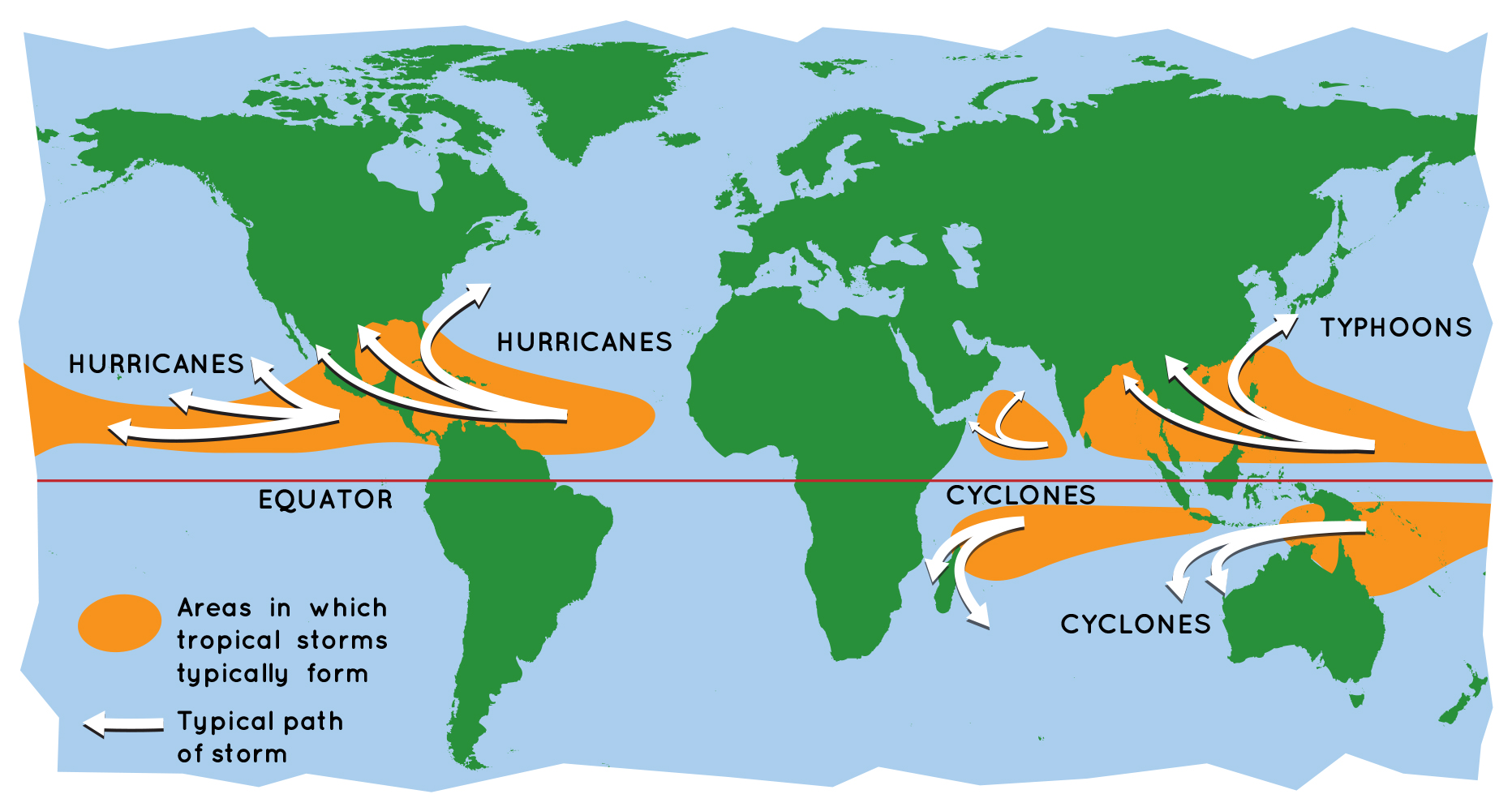
Tropical storms occur between 5o and 20o degrees north and south of the Equator. Once generated, they tend to move westwards and are at their most destructive:
In the Caribbean Sea/ Gulf of Mexico area where they are known as Hurricanes (11% of all tropical revolving storms)
On the western side of Central America (eastern Pacific) (17%)
In the Arabian Sea/ Bay of Bengal area where they are known as cyclones (8%)
Off southeast Asia where they are known as typhoons ( a third of all storms occur here every year)
Off Madagascar (southeast Africa) (11%)
Off North-western and north eastern Australia (20%) and given the local name willy-willies.
what did Musk (1988) say were the key conditions necessary for tropical storm formation
Musk (1998) identified the key conditions which lead to the formation of tropical cyclones:
Oceans: TS get their energy and moisture from the ocean, so can only form and develop over ocean areas.
High temperatures: a sea surface temp over 27°C is needed for tropical cyclones to form – this is usually only found in low latitudes during the summer.
Atmospheric Instability: cyclones are most likely to form in areas of intense instability, where warm air is being forced to rise, such as the ITCZ.
Rotation of the Earth: a certain amount of ‘spin’ is needed to initiate the rotation of a tropical cyclone. Coriolis is weakest at the equator, hence cyclones do not normally form between 5°N and 5°S.
Uniform wind direction: winds from different directions at altitude prevent the cyclone from gaining height and intensity.
Note that all of these factors occurring together does not necessarily mean a tropical cyclone will develop – the mechanisms of formation are not fully understood.
what are characteristics of tropical storms
what causes the tropical storm’s rotation
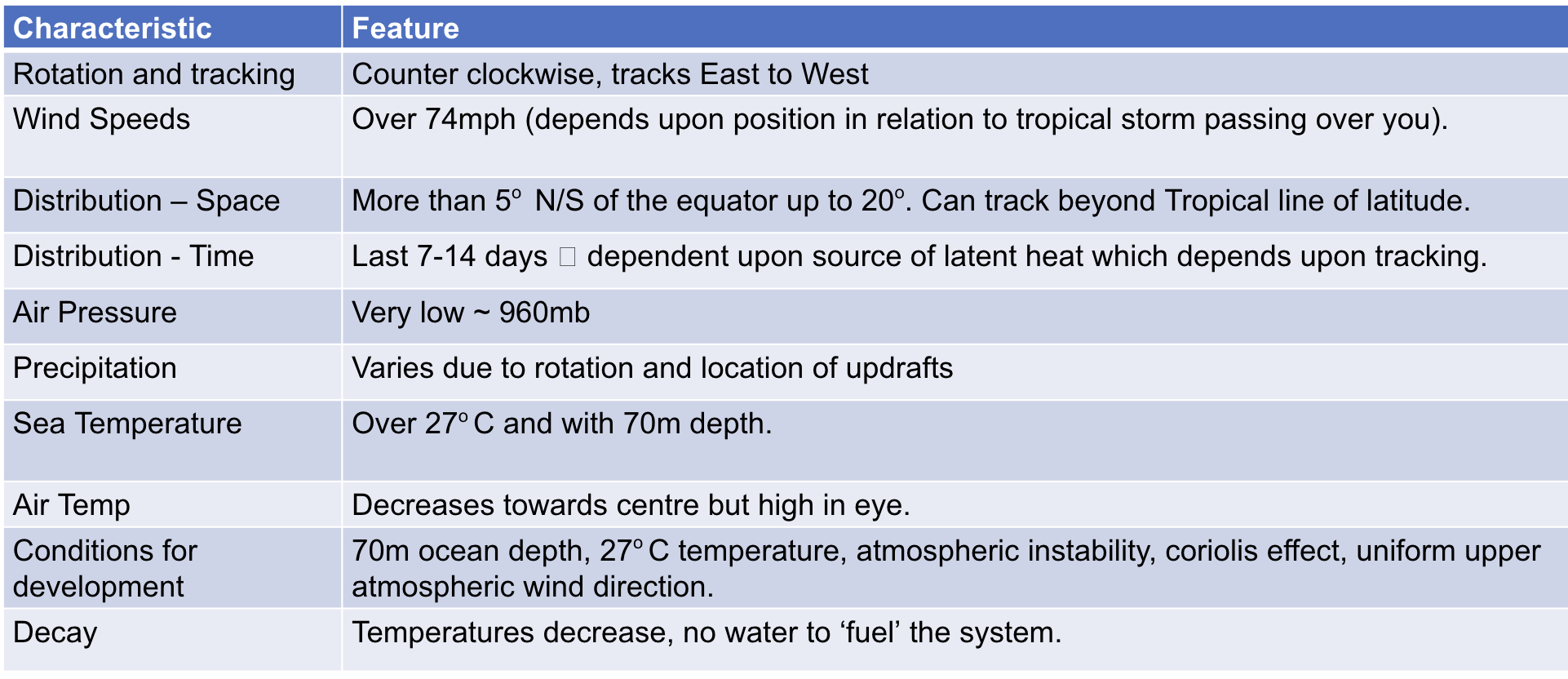
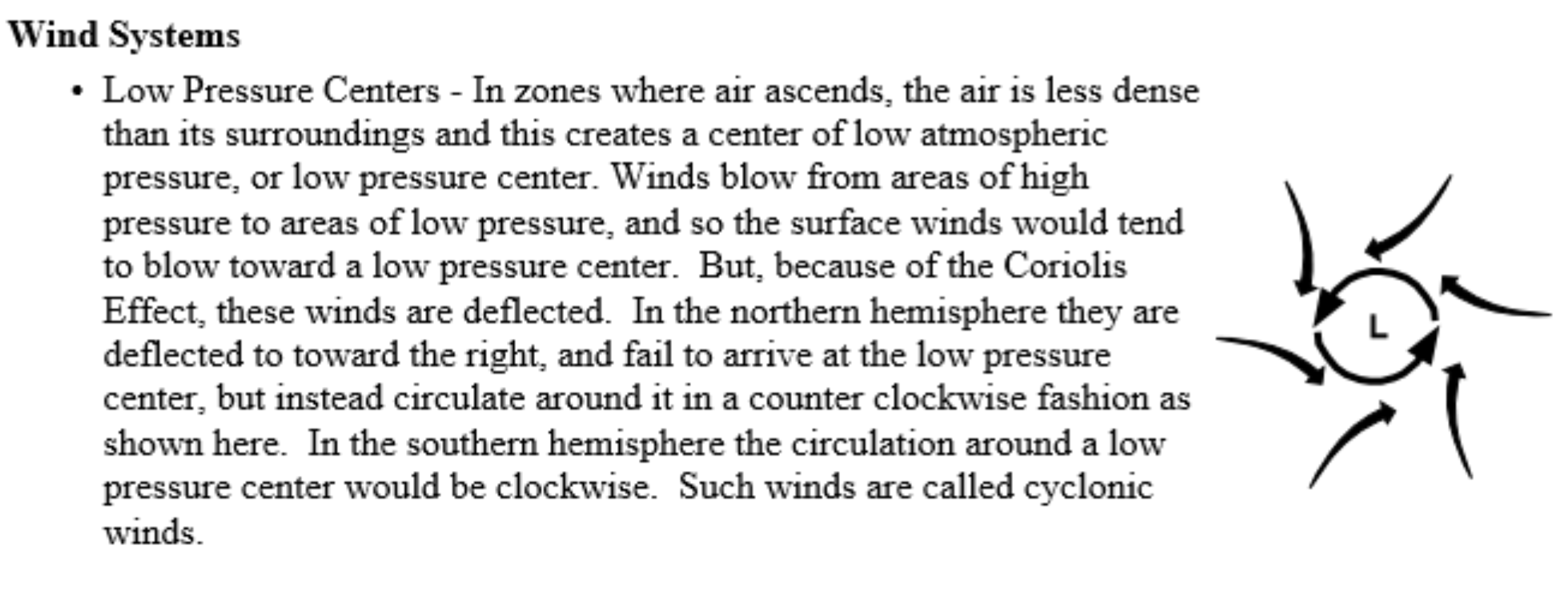
the Coriolis effect - caused by the earth’s rotation
this means that tropical storms spin in different directions depending on the hemisphere it is in
in the northern hemisphere, storms spin anticlockwise
in the southern hemisphere, storms spin clockwise
the coriolis effect is 0 at the equator, so storms cannot form or cross the equator within 5 degrees of it
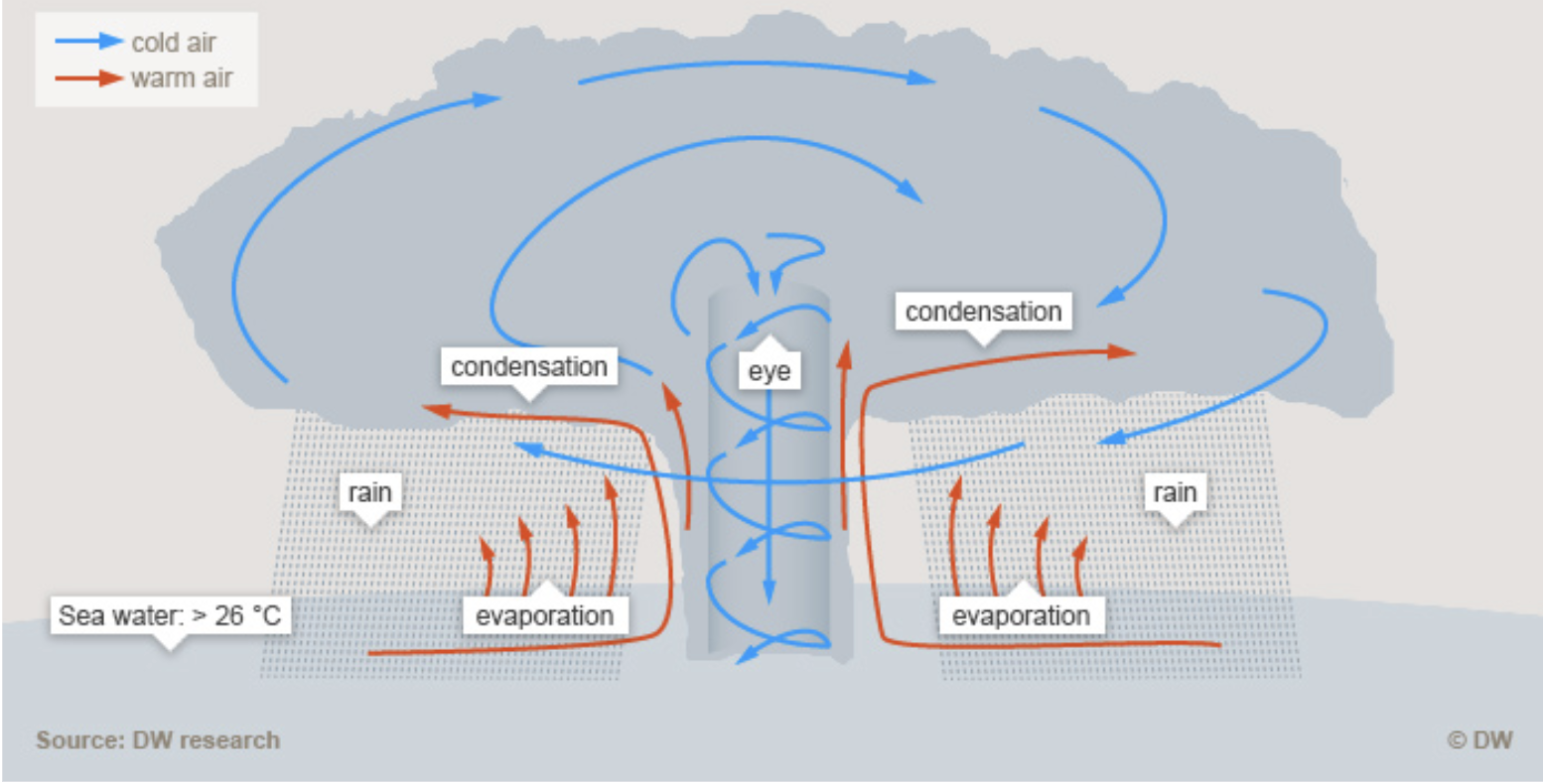
what is the structure of a tropical storm
how does global atmospheric circulation affect tropical storm formation
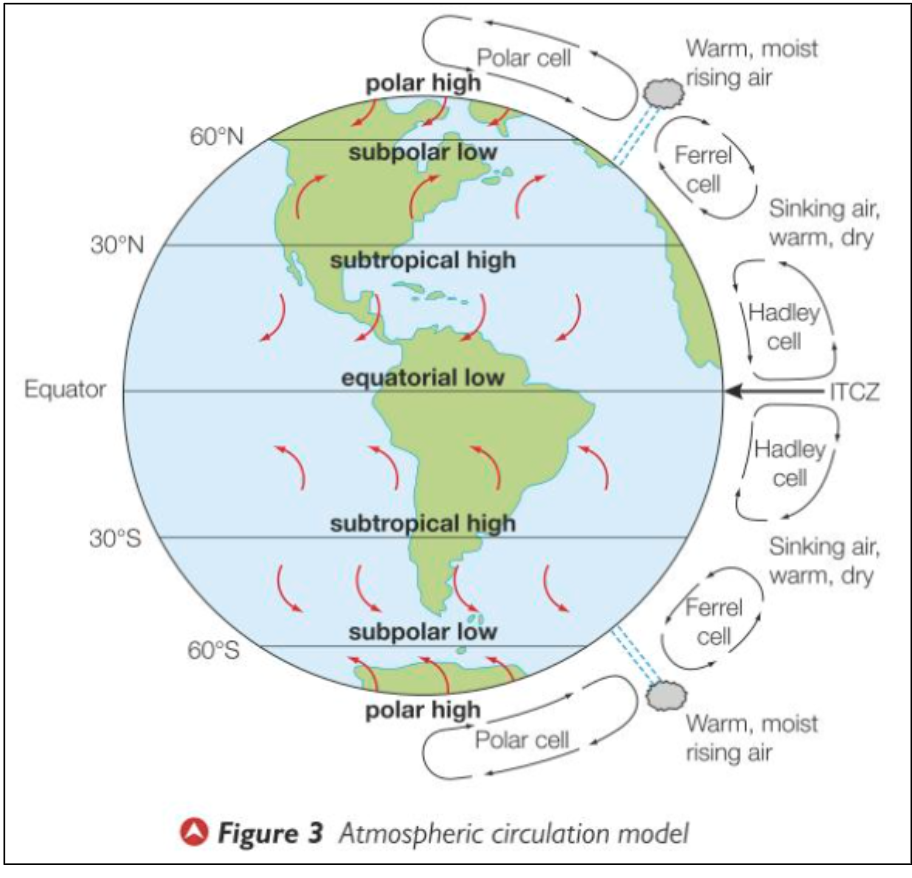
The driving force behind cloud formation and precipitation is the global atmospheric circulation model (Figure 3).
Simplified to suggest the presence of three interconnected cells, the atmospheric circulation model identifies latitudinal zones of rising and falling air.
At the Equator, for example, high temperatures result in high rates of evaporation.
The warm moist air rises, cools and condenses to form towering banks of cloud and heavy rainfall in a low pressure zone called the ITCZ (Inter-Tropical Convergence Zone).
In the mid latitudes, cloud formation is mostly driven by the convergence of warm air from the Tropics and cold air from the Arctic.
Strong upper-level winds (the jet stream) drive these unstable weather systems across the mid latitudes.
what role do wind systems play in tropical storm formation
how is tropical storm magnitude measured
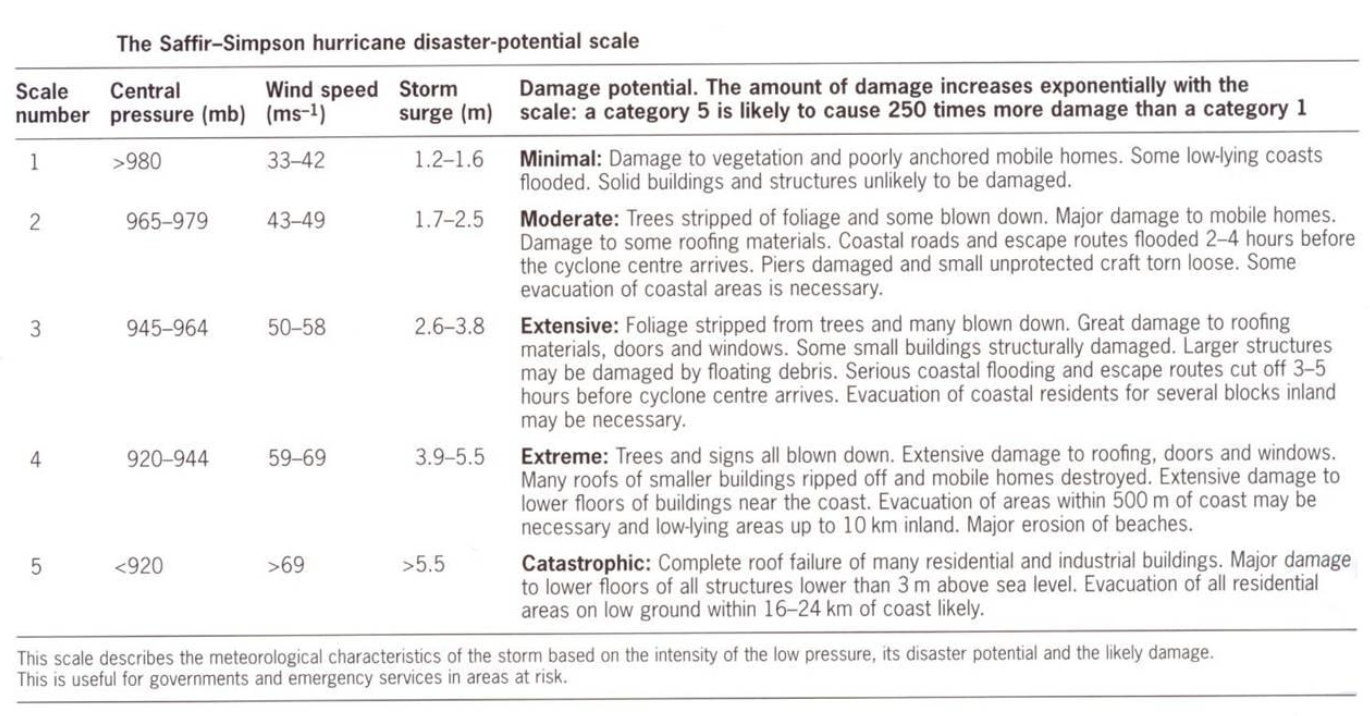
Tropical revolving storms are measured on the Saffir-Simpson scale, a five-point scale based upon central pressure, wind speed, storm surge and damage potential.
Despite being widely used, particularly in the North Atlantic region, it is of limited value in
assessing impact, as it does not take into
account rainfall, or the area affected by a
storm.So, a low-category cyclone that hits a densely populated urban area can be a far more damaging event than a high-category storm that makes landfall in a remote region.
what do scientists suggest about the magnitude of storms in the future
research suggests that a new cat-6 should be introduce - sustained winds of 192mph or more. A new study finds that hurricanes are becoming so strong due to the climate crisis that categorisation needs to expand. Under the cat-6 threshold, 5 storms in the last decade would have been categorised at this strength
how is the frequency of tropical storms expected to change
Frequency: (source Oxford)
Currently, there is no clear evidence that the numbers or intensity of storms are increasing as global temperatures increase.
In the last two decades there have been several years with a high number of tropical storms but the pattern is quite erratic - 2006, 2007 and 2009 recorded low numbers.
There is also no evidence that hurricanes are becoming more intense (higher magnitudes).
Scientists would argue that a longer time period of study is necessary to see any long-term trends.
There is some logic in expecting a warmer atmosphere to hold more moisture (and therefore result in more powerful storms), but this is countered by increased wind shear that acts as a negative feedback loop in nullifying tropical storm formation.
how do tropical storms form
Sequence of tropical storm formation.
The tropical revolving exists while there is a supply of latent heat and moisture to provide energy and low frictional drag on the ocean surface.
Once a tropical storm has started to form, it will soon develop its distinct and clearly defined rotation.
Warm, moist air rises rapidly in its centre, to be replaced by air drawn in at the surface.
A central vortex will develop as more and more air is drawn in and rises. Once the system reaches maturity, a central eye develops. This is an area 10 –15 km in diameter in which there are calm conditions, clear skies, higher temperatures and descending air. Wind speeds of more than 300 km/hour have been observed around the eye. The very centre of the storm (the eye) is often characterised by a column of dry, sinking air.
As the air rises, it rapidly cools. This leads to condensation and the formation of towering cumulonimbus clouds.
Sometimes a number of isolated thunderstorms will coalesce to form a single giant storm. When condensation occurs, latent heat is released, which effectively powers the storm.
A tropical storm continues to grow and develop as it is driven by the prevailing winds across the oceans.
Only when it reaches land/colder waters poleward and the supply of energy and moisture is cut off will the storm start to decay. Should it move back out over the ocean, it will become reinvigorated.
what affects how vulnerable people are to a tropical storm
The vulnerability of people to storm events depends upon a range of factors, both physical and human:
The intensity of the storm
Speed of movement, the length of time over the area
Distance from the sea
Physical geog of the coastal area- width of the coastal plain or size of delta, and location of any mountain ranges relative to the coast
The preparations made by a community
Warnings and community response
how has tropical storm intensity been changing
In an article published in the journal Science in 2005, climatologists examined the changes in tropical cyclone number, duration and intensity since 1970, the period when satellite data became available. They found that although the overall number of cyclones across the world had decreased, with the exception of those that occurred in the North Atlantic Ocean, there was a great increase in the number and proportion of very strong cyclones.
what are the impacts of storm winds
They can often exceed 150 km/hr (over 250 km/hour in a scale 5 event). Such high winds can cause structural damage to buildings (even collapse) and roads, bridges, etc. They can bring down electricity transmission lines and devastate agricultural areas. The huge amounts of debris that are flung about are a serious threat to peoples’ lives.
what are the impacts of storm heavy rainfall
It is not unknown for rainfall to exceed 200 to 300 mm, bringing about severe flooding, landslides and mudslides. If there is high relief near the coastal area, rainfall could increase to over 500 mm/day.
what are the impacts of storm surges
High sea levels result when the wind- driven waves pile up and the ocean heaves upwards as a result of the lower atmospheric pressure. These storm surges can have a devastating effect on low-lying coastal areas such as river deltas where the flooding can extend a long way inland. Storm surges cause the majority of deaths in such events and agricultural areas can suffer for a long time as soil is contaminated by sea water.
what are the main impacts of tropical storms
wind, rain, storm surge
how can tropical storms be managed
Mitigation – actions aimed at reducing the severity of the event and its impacts
Preparedness – actions aimed at increasing people’s awareness of the hazard
Prevention – actions aimed at preventing the event from happening
Adaptation – accepting hazards and changing our behaviour
how can tropical storms be responded to via preparation
modern data gathering techniques means that prediction of tropical storms is increasingly sophisticated
In USA
weather bureaux e.g. National Hurricane Centre, Florida - use data from weather satellites for a real-time view of the location, trac, size and strength of a hurrcane
also gather data using weather balloons and adapted aircraft
investigate potential hurricanes
use historical data - a supercomputers compare it to current data to predict the and strength of storms
allows evacuation of vulnerable areas
it is essential that warnings are correct - state of georgia estimates that evacuation costs $2.3 million per kilometre of coastline
if there are false alarms, people might become complacent and refuse future advice
hurricane drills can be practised e.g. Project Safeside in Florida - hurricance awareness program with precautionary drills for use in schools
In SE Asia/South Asia/Pacific
erratic path of storms - not always possible to give more than 12-18 hours of warning
in less developed areas with poor comms, there is insufficient evacuation time
Cyclone Preparedness Progam in Bangladeshi (formed by Bangladesh government, UN, Red Cross, Bangladesh Red Crescent Society)
awareness campaign about cyclone warning symbols e.g. posters, leaflets, films, theatre, public discussions
early warning system using modern weather radar stations that transmit weather updates and identify potentially dangerous storms before landfall
building storm shelters - 4000 in 2020 with plans for 1400 more
ongoing replanting of mangrove forests to protect inland coastal areas
encouraging emergency packs with food preparation so people can live in storm shelters for a while
there has been a dramatic fall in storm deaths in Bangladesh - in 1970 over 300,000 killed by 1 storm, in 2019 2.1 million were relocated to storm shelters ahead of Storm Bulbul and only 8 died despite widespread damage
how can tropical storms be responded to with mitigation
In the USA, the Federal Emergency Management Agency (FEMA) has a handbook with suggestions on how to reduce damage to infrastructure, for example, by making roads, bridges, public buildings, parks and beaches as resilient as possible. For homeowners, it has produced a factsheet with advice on how people can protect their homes from flood and wind damage, from waterproofing all external walls to securely fixing down roofs to the rest of the building. They highly recommend taking out specialist insurance.
can tropical storms be prevented
No
there have been lots of attempts e.g. cloud seeding, cooling with icebergs, bombs - but the sheer size of storms overwhelms
NASA estimated during its lifetime the avg Atlantic hurricance can expand as much energy as 10,000 nuclear bombs
how can tropical storms be responded to with adaptation
With the growing frequency of extreme events (such as tropical storms) due to climate change, humans will increasingly have to adapt both their lifestyle and environment to live with these storms.
land use planning to identify areas at greatest risk and limit certain types of development there, directing population away, having special evacuation plans and post-disaster development
building sea walls, breakwaters and flood barriers, houses on stilts
but sea walls are often considered too expensive
retrofitting structures so they are wind resistant
in poorer areas, the need for land usually outweighs planning considerations to retrofitting buildings in high risk areas is important
e.g. in 1994, some homes in Dominica were retrofitted and the next year they all withstood the impact of Hurricane Marilyn
insurance - in richer areas
in poorer areas, aid is important following a cyclone events, both short term andlong term
generally in the past, poorer areas lost more lives whereas richer areas lost by property/monetary value
now, fewer lives are lost but the different in lost property value is still huge in monetary terms

