Dental Sciences & Prev Dentistry- Ch 11- COMPLETE/WITH TERMS
 Call Kai
 Learn
Learn Practice Test
 Spaced Repetition
 Match
Match Flashcards
1/82

Earn XP
Name | Mastery | Learn | Test | Matching | Spaced | Call with Kai |
|---|

83 Terms
Angle’s classification
A system developed by Dr. Edward H. Angle to describe and classify occlusion and malocclusion
Anterior
Toward the front
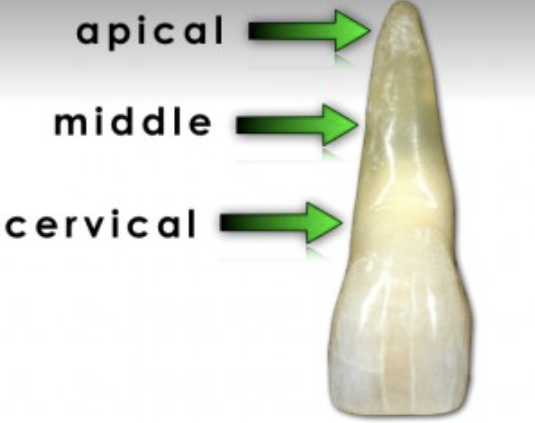
Apical third
division of the root nearest the tip of the root
Buccal surface
tooth surface closest to the inner cheek
buccolingual division
lengthwise division of the crown in the labial or buccolingual direction, consisting of the facial or buccal/labial third, middle third, and lingual third
centric occlusion
maximum contact between the occluding surfaces of the maxillary and mandibular teeth
cervical third
division of the root nearest the neck of the tooth
concave
curved inward
contact area
area of the mesial or distal surface of the tooth that touches the adjacent tooth in the same arch
convex
curved outward
curve of spee
curvature formed by the maxillary and mandibular arches in occlusion
curve of wilson
cross-arch curvature of the occlusal plane
deciduous
the first dentition of 20 teeth; often called “baby teeth”, “milk teeth”, or “primary teeth”
dentition
natural teeth in the dental arch
distal surface
the side surface of the tooth away from the midline
distoclusion
class 2 maloclussion, a dental condition where the lower teeth are positioned behind the upper teeth
embrasure
triangle space in a gingival direction between the proximal surfaces of the two adjoining teeth in contact
facial surface
tooth surface closest to the face.
labial surface
tooth surface surface closest to the lips
functional occlusion
contact of the teeth during biting and chewing movements
incisial surface
the chewing surface of the anterior teeth, the incisor teeth
interproximal space
the space between adjacent tooth surfaces
labioversion
a dental malocclusion where an anterior tooth, particularly a maxillary incisor or canine, is positioned or angled abnormally toward the lips
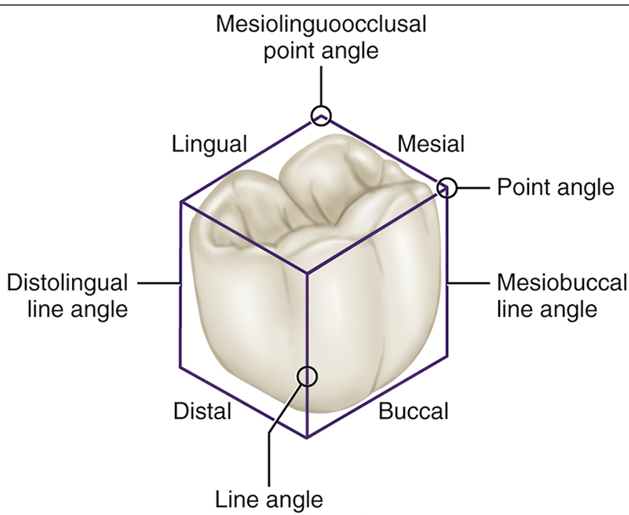
line angle
junction of two surface walls
lingual surface (palatal surface)
tooth surface (both maxillary and mandibular teeth) closest to the tongue
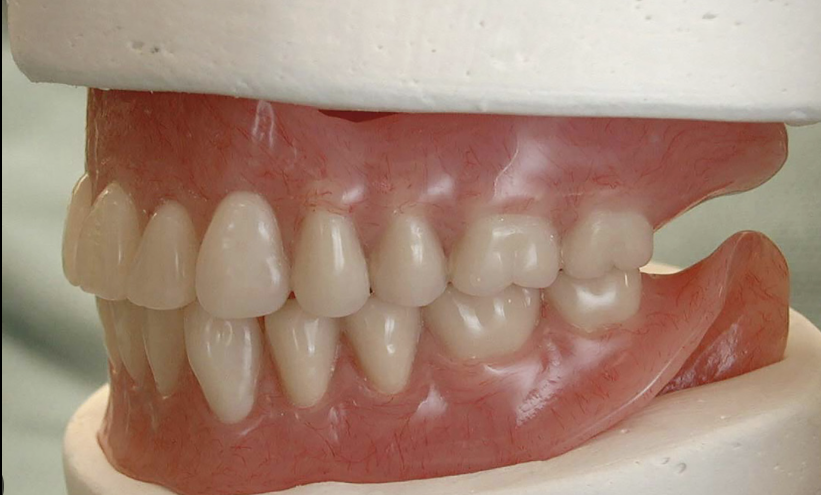
Malocclusion Class 3
the maxillary incisors are behind the mandibular incisors
malocclusion
a misalignment of the teeth and jaws, resulting in an improper bite.
mandibular
lower jaw
maxillary
upper jaw
mesial surface
surface of the tooth toward the midline
mesioclusion (class 3)
a dental condition where the lower teeth are positioned further forward than the upper teeth when the jaws are closed
mesiodistal division
the lengthwise division of a tooth's crown into three equal sections—the mesial third, middle third, and distal third—running from the front (mesial) to the back (distal) of the tooth
Middle third
division of the root in the middle
mixed dentition
a mixture of permanent teeth/primary teeth, occurs between 6-12
nasmyth’s membrane
residue from epithelial tissue on the crowns of newly erupted teeth that may become extrinsically stained
neutroclusion
Class I malocclusion, is a condition where the upper and lower teeth are in the correct general alignment, with the upper incisors slightly overlapping the lower ones, but some individual teeth are still in an abnormal position.
occlusal surface
the chewing surface of the posterior teeth
occlusion
natural contact of the maxillary and mandibular teeth in all positions
occlusocervical division
crosswise division of the crown that is parallel to the occlusal or incisal surface, consisting of the occlusal third, middle third, cervical third.
permanent dentition
set of the permanent 32 teeth
point angle
the angle formed by the junction of three surfaces
posterior
back teeth
primary dentition
set of milk teeth, primary teeth, set of 20
proximal surfaces
surfaces next to each other when teeth are adjacent in the arch
quadrant
4 imaginary sections in the teeth to count them.
permanent dentition - 8 in each quadrant
primary dentition- 5 in each quadrant
sextant
6 imaginary sections in the teeth, (maxillary only) 2 posteriors and 1 anterior. 5 in posterior, 6 in anterior
succedaneous teeth
permanent teeth that replace primary teeth
Primary Dentition
The first set of teeth that develop in children, typically consisting of 20 teeth. Primary dentition begins around six months of age and usually lasts until the child is about six years old. (“Deciduous Dentition” is the older term for Primary Dentition)
Mixed Dentition
— generally occurs between the ages of 6 and 12 years
Both primary and permanent teeth are present during this period
The — period begins with the eruption of the first permanent tooth, which is a permanent mandibular first molar
This period ends with shedding of the last primary tooth
Permanent Dentition
The final, or adult, dentition
This period begins with shedding of the last primary tooth
Growth of the jawbones slows and eventually stops
There is very little growth of the jaw overall during this period because puberty has passed
Dental Arches
Structures that support the arrangement of teeth in the upper and lower jaws, consisting of the maxillary (Upper jaw) and mandibular arches (lower jaw).
What is Occlusion
When the upper and lower jaws come together. Example: when biting or chewing.
Quadrants
The four sections of the mouth, each containing a set of teeth, typically referred to as the upper right, upper left, lower right, and lower left quadrants.
How many teeth does each quadrant hold? (Permanent Dentition)
8
How many teeth does each quadrant hold? (Primary Dentition)
5
Sextants
dividing the dentition into six parts
•Maxillary right posterior
•Maxillary anterior
•Maxillary left posterior
•Mandibular right posterior
•Mandibular anterior
•Mandibular left posterior
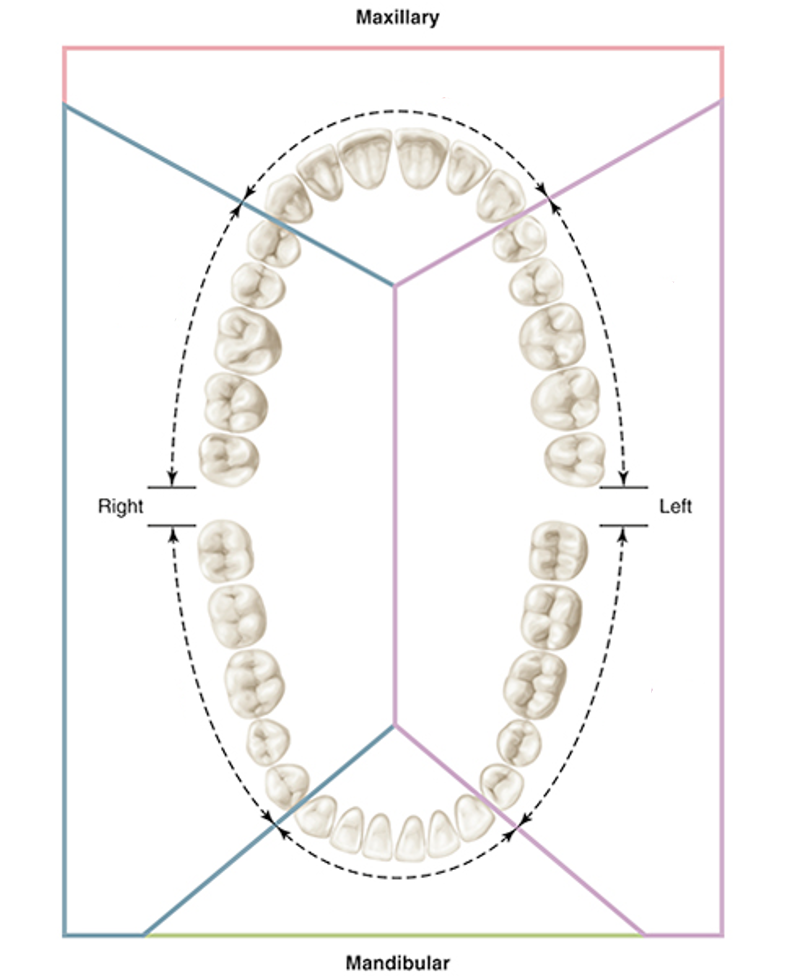
Anterior Teeth
They are the incisors and canines. These are aligned to form a smooth, curving arc from the distal canine on one side of the arch to the distal canine on the opposite side.
Posterior Teeth
They are the premolars and molars, the posterior teeth are aligned with little to no curvature. These teeth appear to be in an almost straight line.
Four types of teeth
incisors, canines, premolars, molars
how many incisors do permanent dentitions have?
8 in total
4 in the anterior upper jaw, 4 in the anterior lower jaw
how many canines do permanent dentitions have?
4 in total
positioned between the incisors (front teeth) and the premolars (back teeth)
how many premolars do permanent dentitions have?
8 in total
located just behind the canines and before the molars, 4 per jaw
how many molars do permanent dentitions have?
12 in total
Located in the back of the mouth, behind the premolars.
6 on the upper jaw and 6 on the lower jaw, 3 in each quadrant.
The 12 molars include the first, second, and third molars, with the third molars also known as wisdom teeth.
Types of teeth primary dentitions have
The primary dentition has:
•Incisors - 8 total - 2 each quadrant
•Canines - 4 total - 1 each quadrant
•Molars - 8 total - 2 each quadrant
Which of the following is the preferred term for bicuspid?
premolar
Which of the following anatomic features of the teeth help to maintain their position in the dental arch and protect the tissues during chewing?
cementum, periodontal ligament, and ename
The meaning of dentition
the number, kind, and arrangement of teeth (as of a person or animal)
Contours
Curved surface of teeth.
Facial and Lingual contours
The normal contour of a tooth that provide the gingiva with stimulation for health, protecting from damage caused by food.
mesial/distal contour
provide where contact and embrasure form
Contact
When the mesial or distal surface touches the adjacent tooth in the same arch.
Contact serves to prevent food from being trapped between teeth, stabilize dental arch, protects gingival tissue from trauma during mastication.
Height of contour
refers to the “bulge”, or wide point of the surface of the crown, mesial and distal surface are usually considered the height of contour on the proximal surface, facial and lingual surface also have height of contour
Embrasures
When two teeth in the same arch touch, their curves next to the contact area leaves spaces between called?
Angles and divisions of teeth (Line/Point angle)
Line and point angles are used only as descriptive terms to indicate specific locations.
Line angle: Formed by the junction of two surface teeth
Point angle: Angle formed by the junction of three surfaces at one point
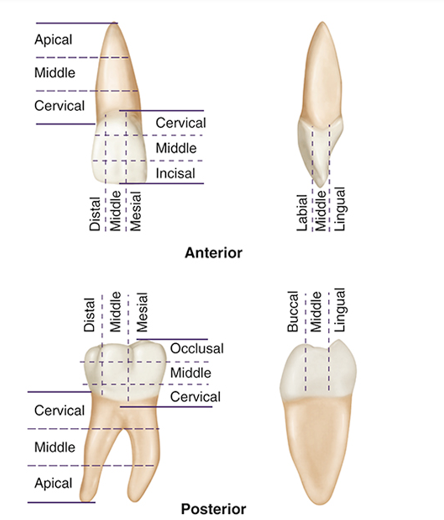
Division of thirds
Root of the tooth: Apical Third (top point), Middle Third, Cervical third (lower point)
Crown of tooth: Occlusocervical division (crosswise division parallel to occlusial surface)
Mesiodistal Division: Lengthwise division in a mesial-distal direction
Buccolingual Division: Lengthwise division in a labial or buccal-lingual direction
Occlusion
Malocclusion
—: The relationship of the maxillary and mandibular, how the jaw meet when they are fully close
—-: The abnormal or malpositioned relationship between the maxillary and mandibular teeth
Classes of Malocclusion
Class 1
Class 2
Class 3
—: Neutroclusion (Ideal bite BUT the teeth are imperfect)
—: Distoclusion (the lower teeth are positioned too far back compared to the upper teeth, leading to the upper teeth overlapping the lower ones)
—: Mesioclusion (the lower teeth are positioned further forward than the upper teeth, causing an underbite.)
Divisions of Class 2 malocclusion
Division 1: •Lips are usually flat and parted, with the lower lip tucked behind the upper incisors (Maxillary incisors are in labioversion)
Division 2: Maxillary incisors are not in labioversion (Maxillary central incisors are nearly normal anteroposteriorly, and they may be slightly in linguoversion)
Closure
Anterior teeth are not designed to fully support the occlusal forces on the entire dental arch
(as the jaw closes, the stronger posterior teeth come together first)
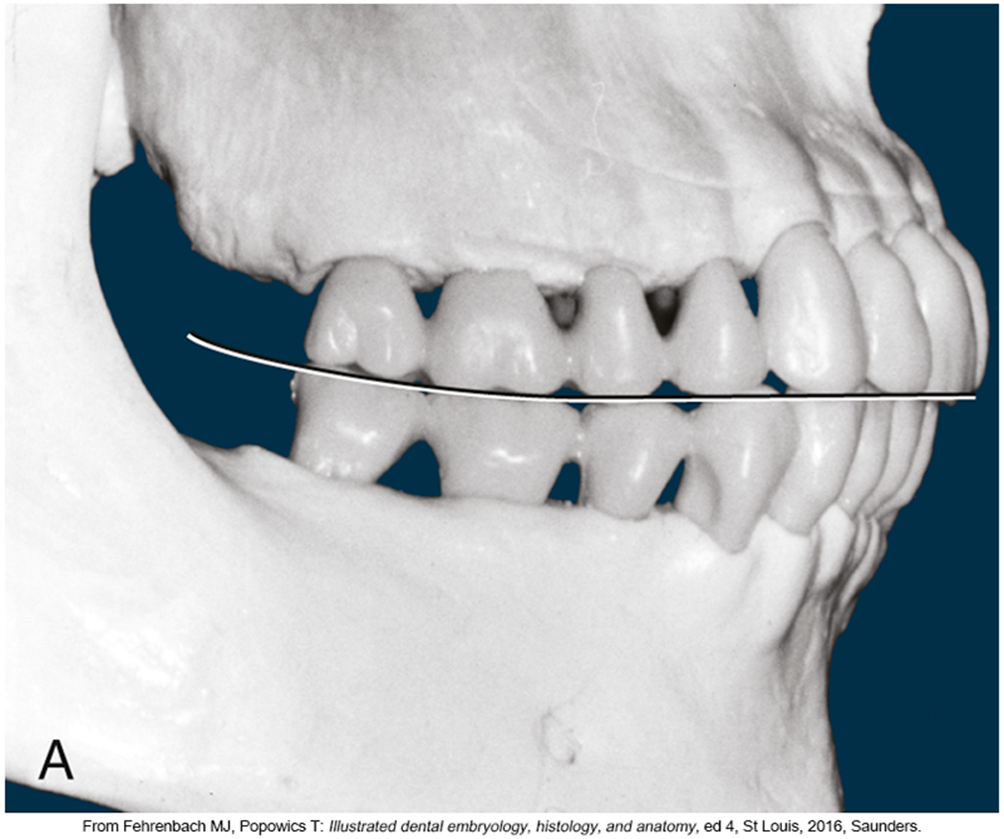
Curve of Spee
The imaginary line that’s on the buccal surface, from the posterior teeth to anterior
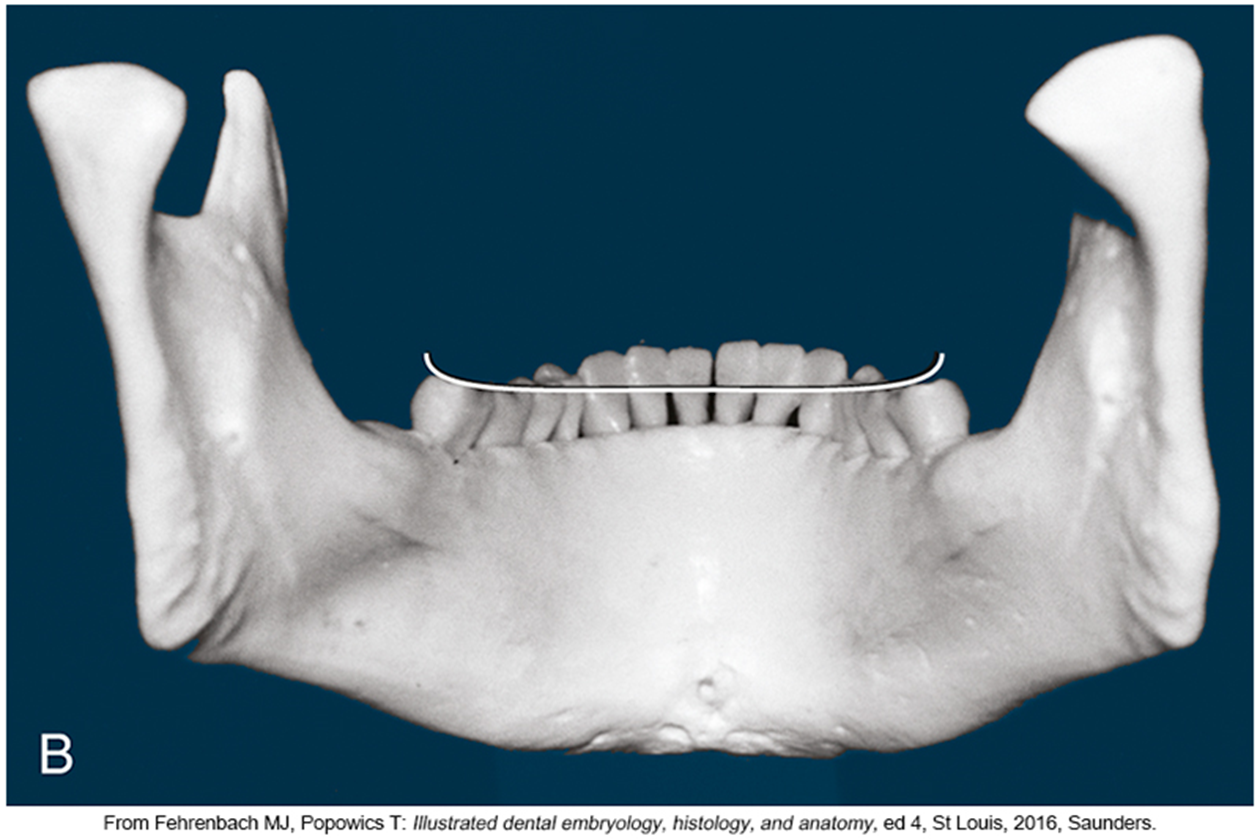
Curve of Wilson
A cross-arch imaginary line that curves inside the posterior occlusal plane. Connects by the occlusal surface of the left mandibular first molar.
tooth numbering systems
Universal/National System: What Americans use, goes 1 (right maxillary 3rd molar) all the way around to 32 (right mandibular 3rd molar)
International Standards Organization System: Uses a two digit tooth recording system. First digit indicates the quadrant, second digit indicates the tooth within the quadrant. Numbers go from the midline towards the posterior teeth.
Palmer Notation System: Uses the quadrant system, begins with number 1 on the anterior central incisor. (Example: Tooth 4, left maxillary side: L4. It would be the first premolar tooth)
Linguoversion
A tooth angled inward (towards the tongue) from its arch position.
 Note
Note  Flashcards (28)