MMG 2040 - chapter 7 Expression Vectors
 Call Kai
 Learn
Learn Practice Test
 Spaced Repetition
 Match
Match Flashcards
 Knowt Play
1/9

There's no tags or description
Looks like no tags are added yet.
Name | Mastery | Learn | Test | Matching | Spaced | Call with Kai |
|---|
No analytics yet
Send a link to your students to track their progress
10 Terms
Describe the necessary features of shuttle vectors
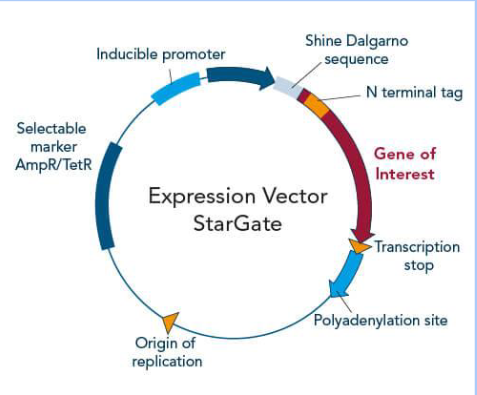
They need:
the origin of replication, selectable marker, gene of interest
promoters, transcription sequence, poly-a site, termination site
properties: origin for species 1 + selectable marker for species 1, origin for species 2 + selectable marker for species 2, mcs
Describe the induction/repression of the lacUV and tet promoter
lac promoter, laci repressor, IPTG inducer
lacuv is typically off until you add IPTG (the inducer)
This is useful for inducible expression in bacteria
Compare promoter systems
lacUV: This is useful for inducible expression in bacteria
lac promoter, laci repressor, IPTG inducer
lacuv is typically off until you add IPTG (the inducer)
inducible
T7: This is useful for very high protein production in bacteria
T7 promoter + T7 RNA polymerase (phage-derived)
Very strong transcription —> ex. producing a product
constitutive
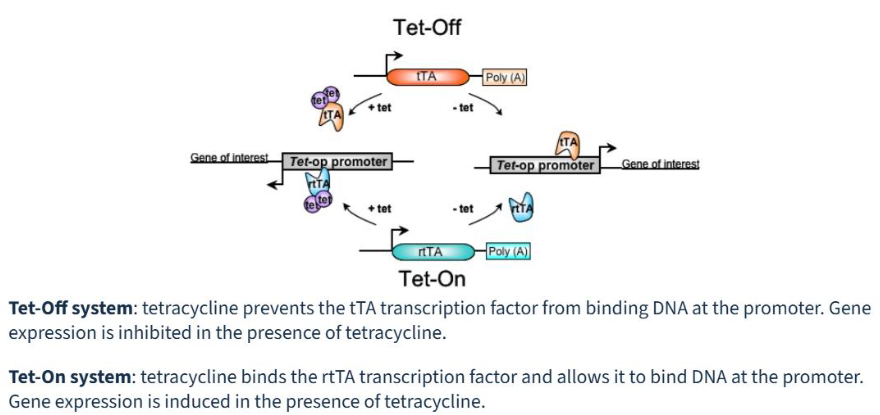
Tet-On/Tet-Off: this is useful for tight control in mammalian systems
Tetracycline promoter used to drive gene expression (unlike in bacteria)
Doxycycline added → transcription ON
Doxycycline added → transcription OFF
inducible
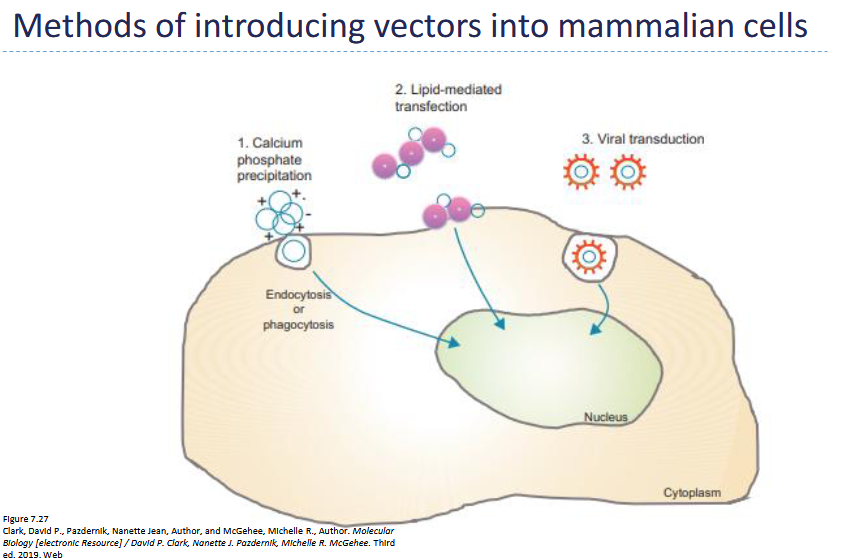
Name 4 methods of getting vectors into mammalian cell
1) Lipid-mediated transfection
2) Calcium phosphate
3) Electroporation
4) Viral transduction
Compare/contrast transient transfections and stable transfections
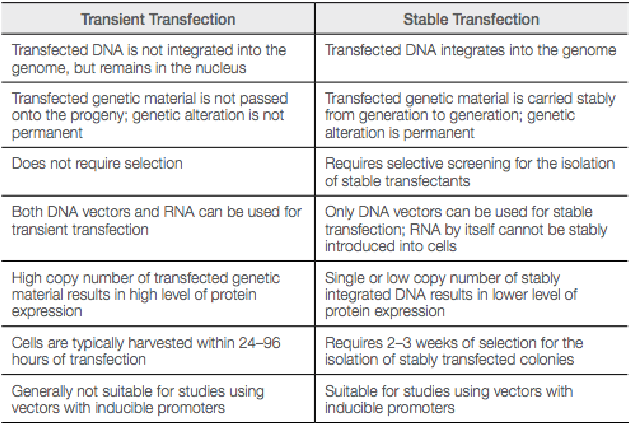
transient: not integrated in genome but remains in nucleus, not passed onto progeny/genetic alteration is not permanent, does not require selection, high copy number of material results in high level of protein expression, generally not suitable for studies using inducible vectors
both DNA/RNA vectors can be used
harvested 24-96 hrs after transfection
stable:integrated into genome carried stably from gen. to gen./genetic alteration is permanent, requires selective screening for stable transfectants, single/low copy number of integrated
Define transfection and transduction relative to mammalian expression vectors
transfection: Introduction of vectors, without using viruses, into mammalian cells
Transduction: Introduction of vectors into mammalian cells using viral-mediated delivery
Design a basic mammalian expression strategy
Bacterial or mammalian system?
Transient or stable?
Inducible or constitutive?
Viral or non-viral delivery?
lacUV
The lacUV5 promoter is a mutated promoter from the Escherichia coli lac operon very similar to the classical lac promoter,
it requires no additional activators and it drives high levels of gene expression
The lacUV5 promoter sequence conforms more closely to the consensus sequence recognized by bacterial sigma factors than the traditional lac promoter does
Due to this, lacUV5 recruits RNA Polymerase more effectively
leads to higher transcription of target genes
lacUV5 works independently of activator proteins or other cis-regulatory elements
While no activators are required, lacUV5 promoter expression can be regulated by the LacI repressor and can be induced with IPTG, which is an effective inducer of protein expression
Due to this control, the lacUV5 promoter is commonly found on expression plasmids
is used when controllable but high levels of a product are desired
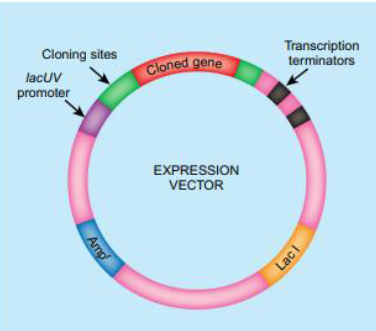
t7
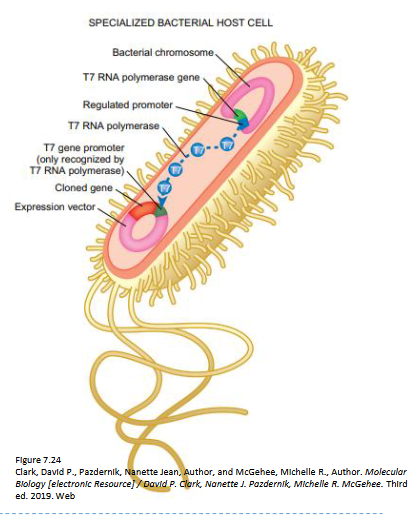
T7 expression vectors (commonly pET vectors) enable high-level protein production in E. coli by using T7 RNA polymerase to specifically transcribe a target gene
system is induced by IPTG, which triggers the expression of T7 RNA polymerase from the host genome
recognizes a T7 promoter on the plasmid to drive massive target gene expression
Vector Construction: The target gene is inserted into a plasmid (e.g., pET) downstream of a strong T7 promoter.
Host Cell: The vector is introduced into special E. coli strains that have the gene for T7 RNA polymerase integrated into their chromosome.
Induction: T7 RNA polymerase expression is controlled by an inducible promoter (typically lacUV5). The addition of IPTG relieves repression, producing T7 RNA polymerase.
Transcription: The produced T7 RNA polymerase specifically transcribes the target gene, leading to high-level protein overexpression.
Tight Regulation: To prevent basal expression (leakiness) of potentially toxic proteins, T7 lysozyme (a natural inhibitor) can be expressed, or the system can use Lac repressor binding
tet off/on
Tet-Off and Tet-On systems are inducible gene expression tools that use tetracycline or its derivative doxycycline (Dox) to control gene activity.
both relying on a transactivator protein binding to a Tetracycline Response Element (TRE) promoter
Tet-Off turns expression off when Dox is added
requires tTA (Tet-Off): Tetracycline-controlled Transactivator
The tTA protein binds to the TRE promoter, activating transcription of the target gene
Dox binds to the tTA protein, preventing it from binding to the TRE. Expression turns OFF
Useful for long-term studies where expression is usually needed, then turned off
Tet-On turns expression on when Dox is added
requires rtTA (Tet-On): Reverse Tetracycline-controlled Transactivator
The rtTA protein cannot bind the TRE. Expression is OFF
Dox binds to the rtTA protein, inducing a conformational change that allows it to bind the TRE. Expression turns ON
Often preferred for rapid response to Dox induction