Invenotry and COGS (ACC 2101)
 Call Kai
 Learn
Learn Practice Test
 Spaced Repetition
 Match
Match Flashcards
 Knowt Play
1/52

There's no tags or description
Looks like no tags are added yet.
Name | Mastery | Learn | Test | Matching | Spaced | Call with Kai |
|---|
No analytics yet
Send a link to your students to track their progress
53 Terms
Inventory
Items a company intends for sale to customers in the ordinary course of business. Also, merchandise inventory
Manufacturing Companies
Companies that sell the inventories they produce rather than sourcing their goods from another supplier
Raw Materials Inventory
Components that will be part of the finished product
Work in Process Inventory
Products that haven’t been fully produced yet
Overhead
The total costs including raw materials, labor, and indirect manufacturing goods
Merchandising Companies
Companies that act as a middleman of storing and moving goods from the manufacturer to the consumer
Wholesalers
They simply sell inventories/goods to retailers and other professionals, but they do not directly sell their products to the public. Ex: Sysco suppling food to resteraunts, schools, etc.
Retailers
They purchase inventory from manufacturers and wholesalers in order to directly sell this inventory to the general public. Ex: Amazon, McDonalds, Costco, Lowes, etc.
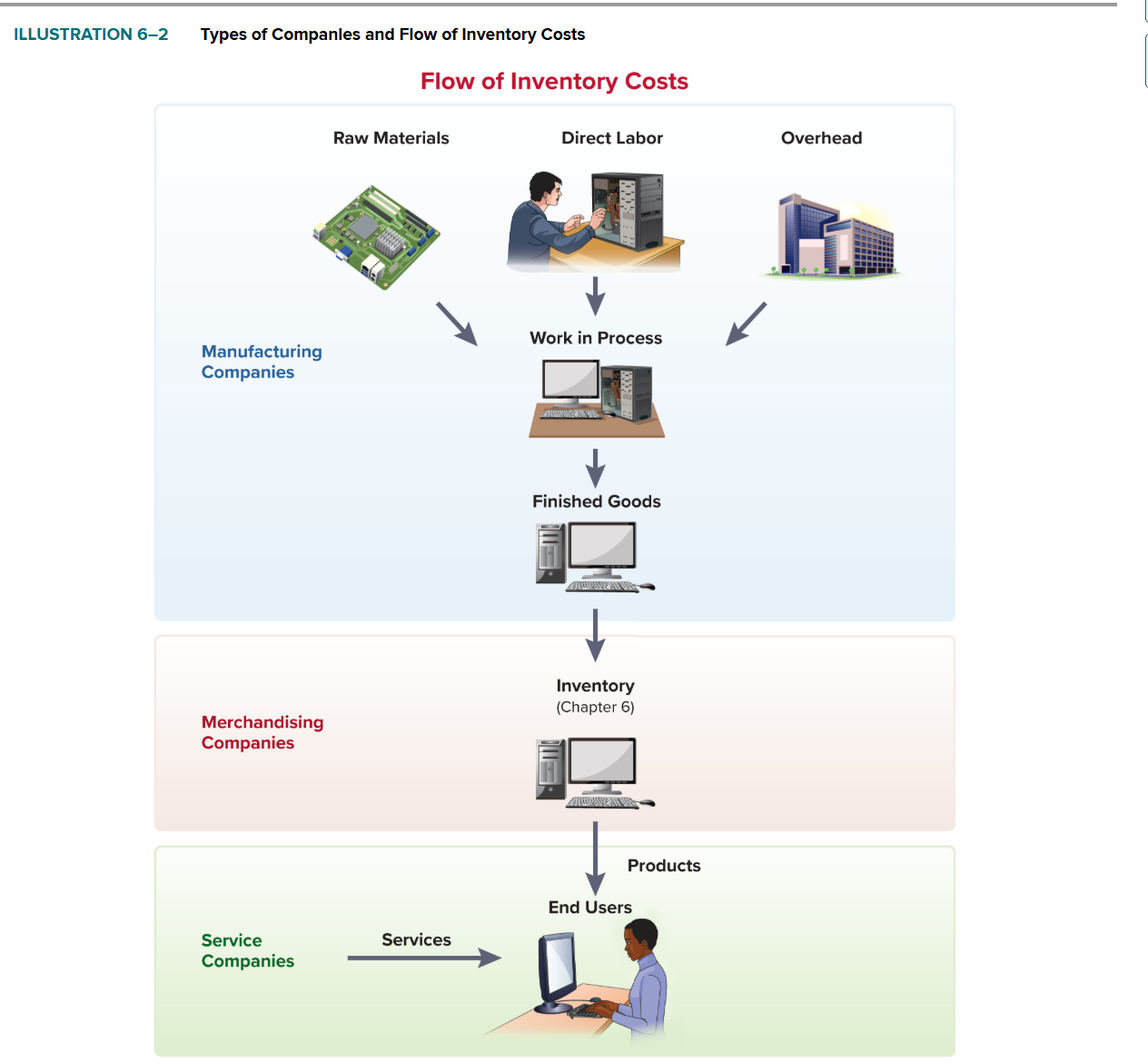
What are the steps of the inventory process?
Inventory Flow Raw materials → Production (labor + overhead) → Finished goods → Merchandising company → End user
Key Players
Manufacturers – produce goods from raw materials
Merchandising companies (wholesalers & retailers) – buy finished goods and sell them
End users – final consumers
Cost of goods sold (COGS)
Cost of the inventory that was sold during the period. Also, cost of sales, cost of revenues, or cost of products sold
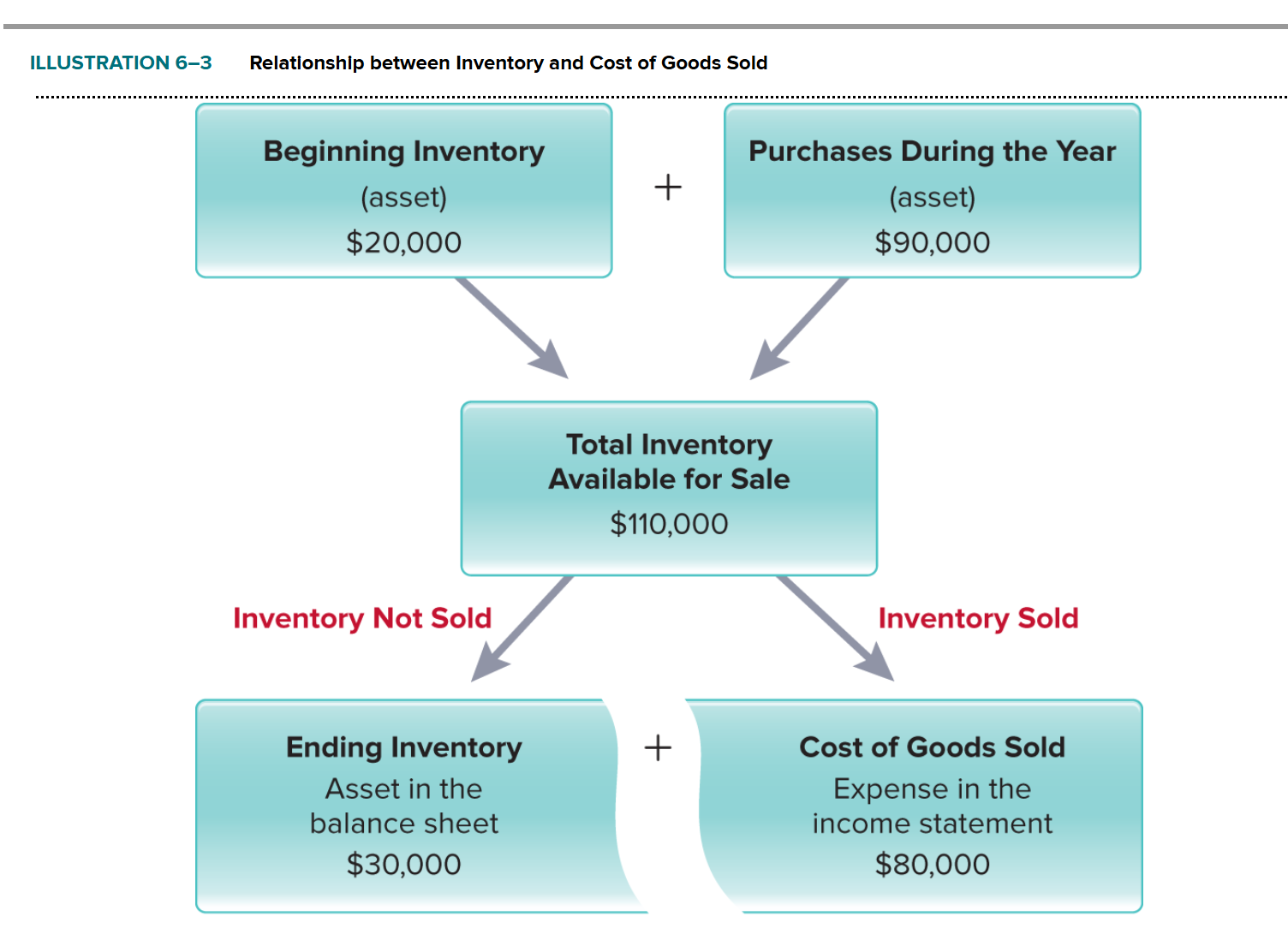
Cost of goods sold (COGS) Formula
Beginning Inventory + Purchases - Ending Inventory
Total Costs of Inventory Formula
Beginning Inventory + Purchases
What is Ending Inventory?
It is the amount of inventory that hasn’t been sold yet
Why is inventory reported in the balance sheet?
B/c it’s a current asset and represents the cost of inventory that has not been sold yet at the end of the period.
Why is Cost of Goods Sold (COGS) in the income statement?
B/c it is an expense that represents the cost of inventory sold during the period.
A company has $500,000 worth of goods available for sale. By year-end, $380,000 worth has been sold. What amount appears on the balance sheet, and what appears on the income statement?
Balance Sheet: $500,000 - $380,000= $120,000. What’s leftover?
Income Statement: $380,000. How many goods/services have actually been sold?
Multiple-step income statement
An income statement that reports multiple levels of income (or profitability).
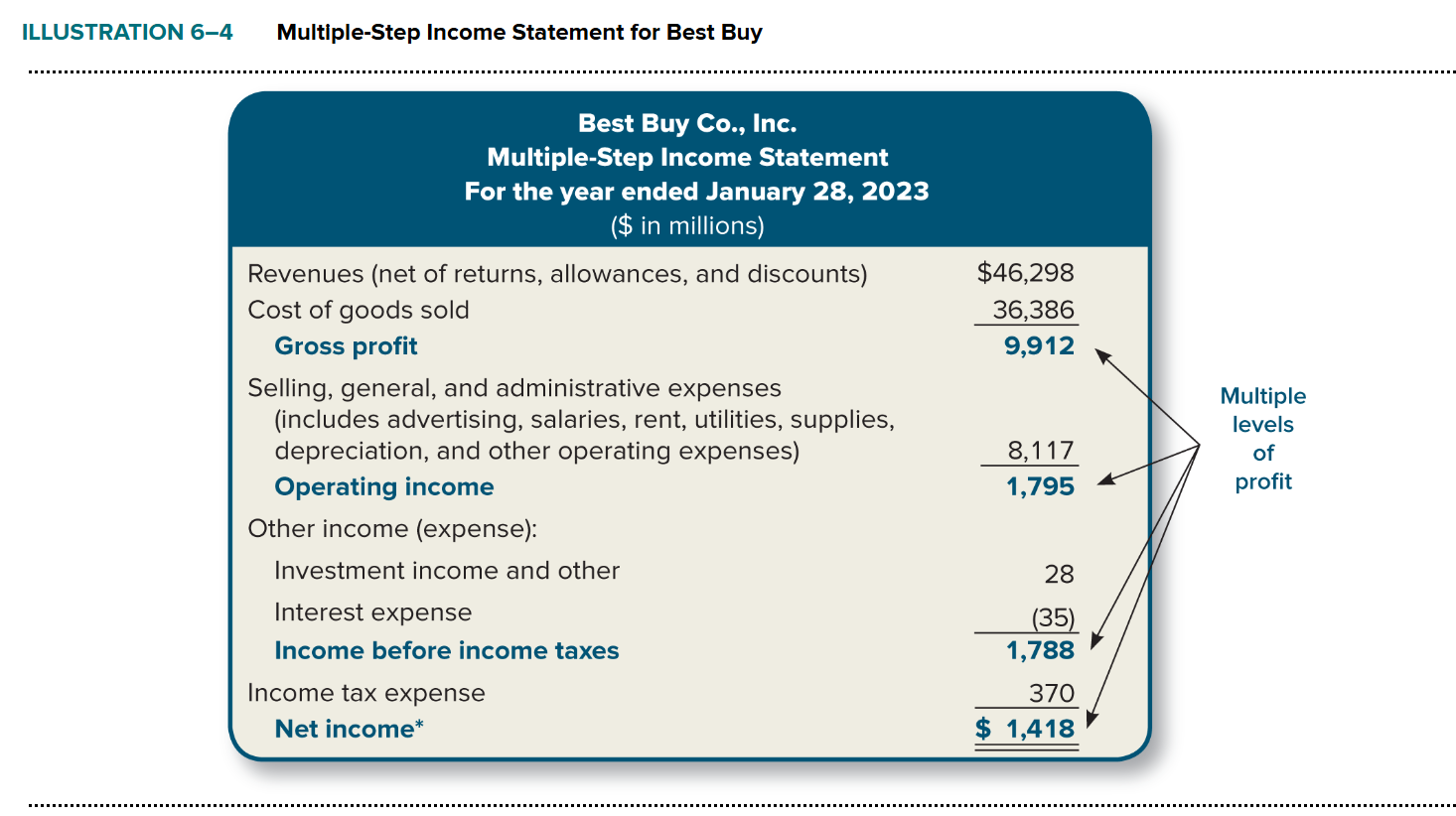
Gross profit
The difference between net sales and cost of goods sold
SG&A
Selling, General, and Administrative expenses
Operating income
Gross Profit − SG&A Expenses = Operating Income
Income Before Taxes
Operating Income + Other Income/Expense = Income Before Taxes
Net Income
Income Before Taxes − Income Tax Expense OR Revenues - Expenses
Specific identification method
Inventory costing method that matches or identifies each unit of inventory with its actual cost.
First-in, first-out method (FIFO)
Inventory costing method that assumes the first units purchased (the first in) are the first ones sold (the first out)
Trivia Company reports a gross profit of $100, income tax expense of $15, selling, general, and administrative expenses of $35, nonoperating revenues of $10, and nonoperating expenses of $15. What is the company’s operating income?
A. $45
B. $30
C. $50
D. $65
D. $65
Last-in, first-out method (LIFO)
Inventory costing method that assumes the last units purchased (the last in) are the first ones sold (the first out).
Weighted-average cost method
It assumes that all your inventory gets "mixed together" into one big pool, and every single unit is treated as having the same average cost — regardless of when it was purchased or what you actually paid for it.
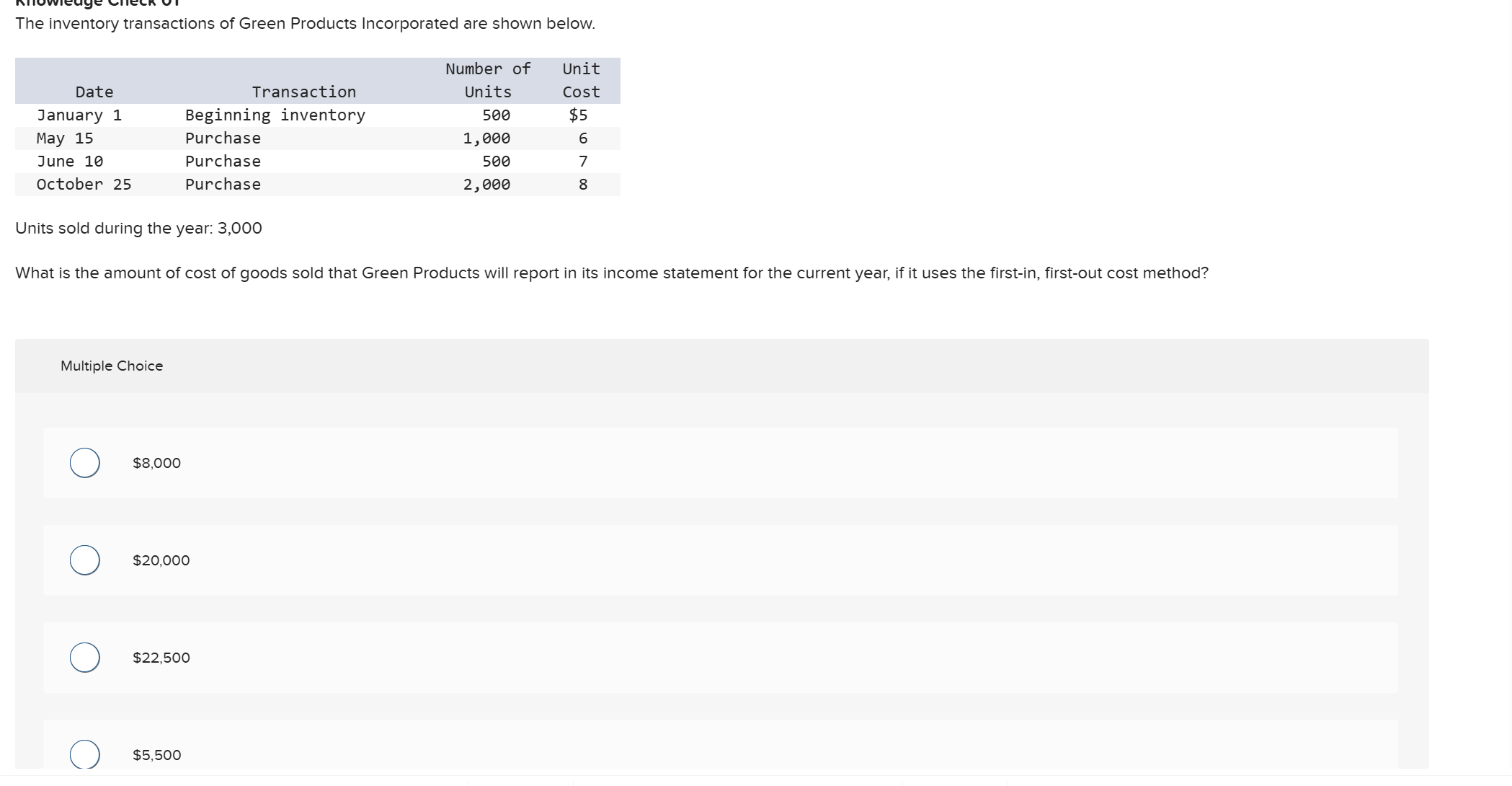
How to find the COGS using the FIFO (first in first out) method in the income statement for the current year?
Multiply the # of units and the costs, and then sum up everything.
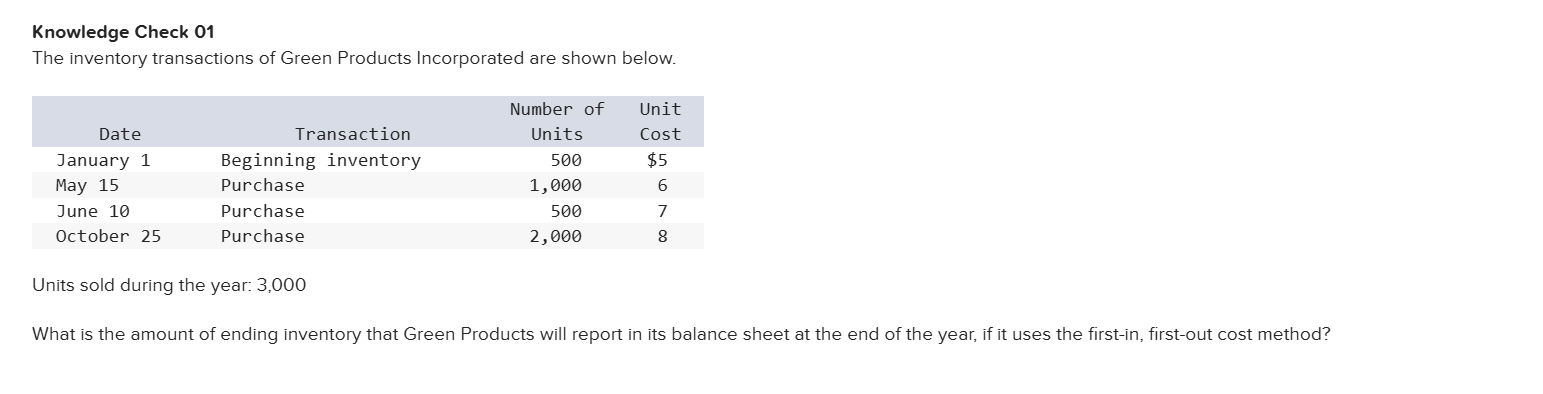
What is the amount of ending inventory that Green Products will report in its balance sheet at the end of the year, if it uses the first-in, first-out cost method?
Step 1: Find total units available
500 + 1,000 + 500 + 2,000 = 4,000 units
Step 2: Find ending inventory units
4,000 − 3,000 sold = 1,000 units remaining
Step 3: Under FIFO, remaining units come from the most recent layer (October 25)
Layer | Units Remaining | Unit Cost | Total |
|---|---|---|---|
October 25 | 1,000 | $8 | $8,000 |
The answer is $8,000.
Quick tip: Notice that COGS + Ending Inventory should always equal the total cost of goods available for sale. You can use this as a check:
Total available = (500×$5) + (1,000×$6) + (500×$7) + (2,000×$8) = $2,500 + $6,000 + $3,500 + $16,000 = $28,000
COGS $20,000 + Ending Inventory $8,000 = $28,000 ✓
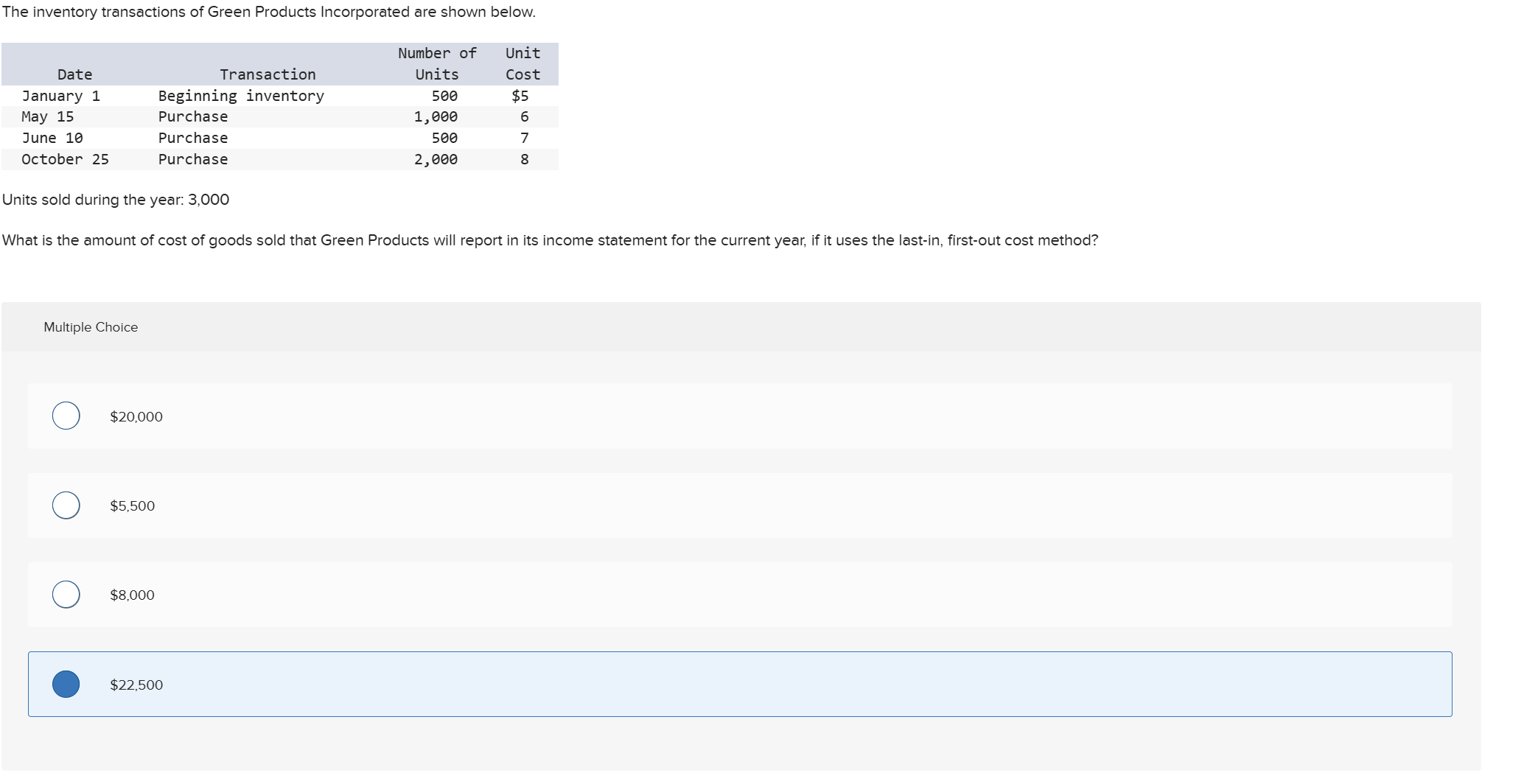
What is the amount of cost of goods sold that Green Products will report in its income statement for the current year, if it uses the last-in, first-out cost method?
Under LIFO (Last-In, First-Out), you sell the newest inventory first. So work through the layers from most recent → oldest:
Layer | Units Used | Unit Cost | Total |
|---|---|---|---|
Oct 25 (newest) | 2,000 | $8 | $16,000 |
June 10 | 500 | $7 | $3,500 |
May 15 | 500 | $6 | $3,000 |
Total | 3,000 | $22,500 |
Note you only need 500 of the 1,000 May 15 units to reach 3,000 total.
The answer is $22,500 ✓ (which matches the selected answer)
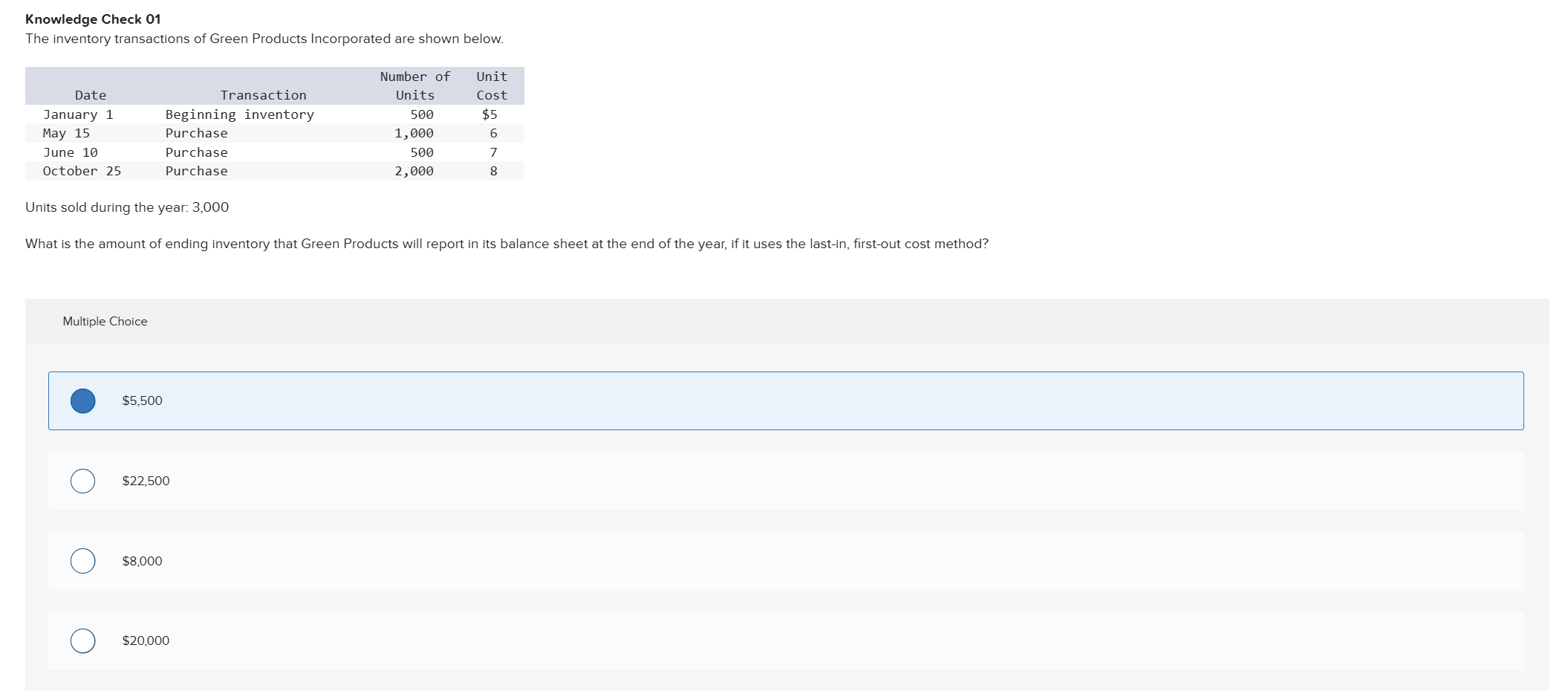
What is the amount of ending inventory that Green Products will report in its balance sheet at the end of the year, if it uses the last-in, first-out cost method?
Under LIFO, those remaining units come from the oldest layers:
Layer | Units Remaining | Unit Cost | Total |
|---|---|---|---|
Jan 1 (Beginning) | 500 | $5 | $2,500 |
May 15 | 500 | $6 | $3,000 |
Total | 1,000 | $5,500 |
The answer is $5,500 ✓
Weighted-average cost method Formula
COGS for sale / # of units avalible for sale
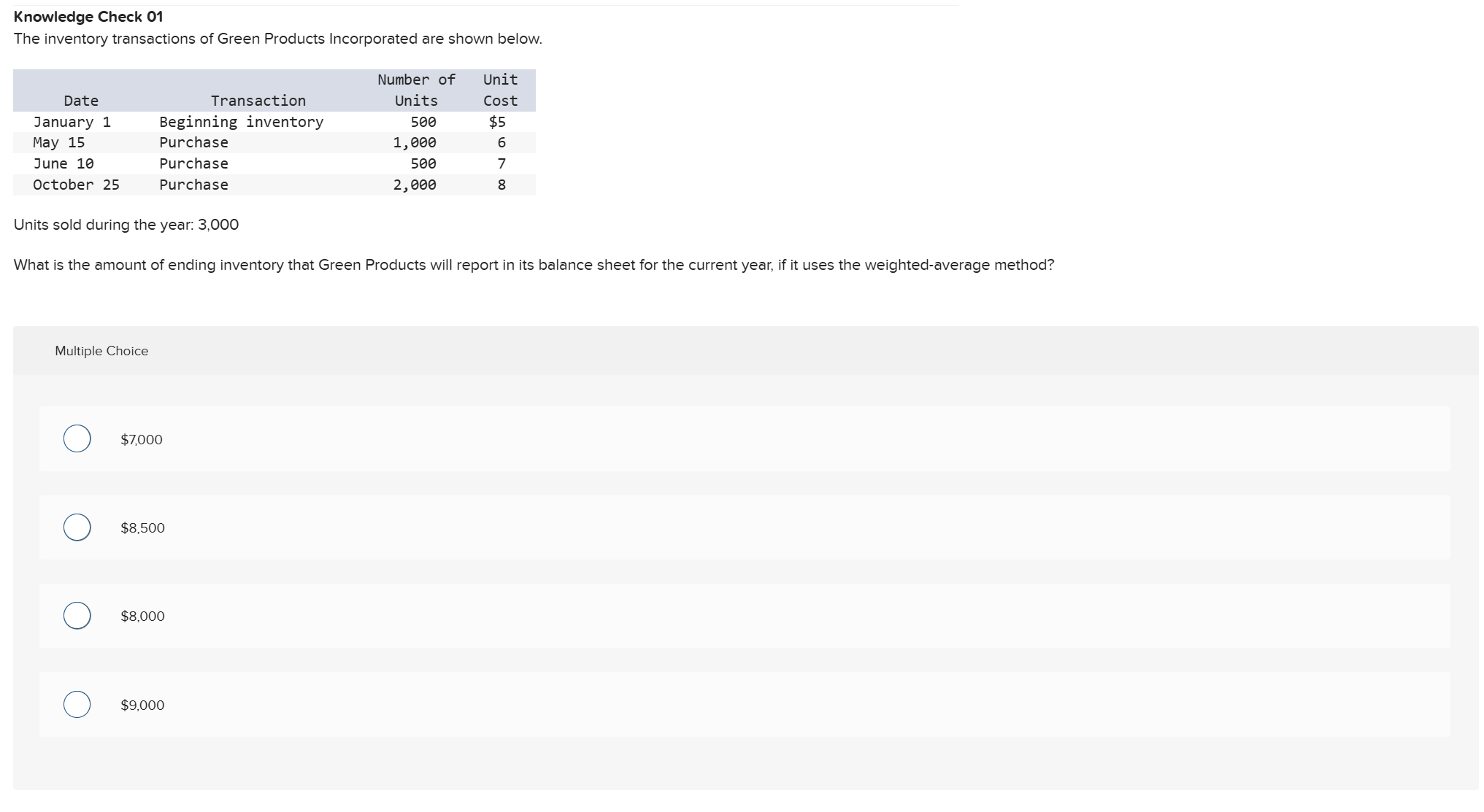
What is the amount of ending inventory that Green Products will report in its balance sheet for the current year, if it uses the weighted-average method?
A. $7,000
B. $8,500
C. $8,000
D. $9,000
Step 1: Calculate total cost of all inventory available
Layer | Units | Unit Cost | Total |
|---|---|---|---|
Jan 1 | 500 | $5 | $2,500 |
May 15 | 1,000 | $6 | $6,000 |
June 10 | 500 | $7 | $3,500 |
Oct 25 | 2,000 | $8 | $16,000 |
Total | 4,000 | $28,000 |
Step 2: Calculate weighted-average cost per unit
$28,000 ÷ 4,000 units = $7.00 per unit
Step 3: Apply to ending inventory units
1,000 remaining units × $7.00 = $7,000
The answer is $7,000.
Accountants often call FIFO the balance-sheet approach because _____
A. the amount of ending inventory appears in the balance sheet
B. the amount it reports for cost of goods sold more realistically matches the current costs of inventory needed to produce current revenues
C. the amount it reports for ending inventory better approximates the current cost of inventory
D. it better approximates actual cost of goods sold for most companies, because most companies' actual physical flow follows FIFO
C. the amount it reports for ending inventory better approximates the current cost of inventory
Which of the following is true of a period of falling inventory costs?
A. LIFO will result in lower tax payments than FIFO.
B. LIFO will report higher cost of goods sold than FIFO.
C. FIFO will report higher ending inventory than LIFO.
D. LIFO will report higher gross profit than FIFO.
D. LIFO will report higher gross profit than FIFO.
Here's the logic for falling prices:
Under LIFO, you sell the newest (cheaper) units first → lower COGS
Lower COGS means higher gross profit
Under FIFO, you sell the oldest (more expensive) units first → higher COGS
Higher COGS means lower gross profit
LIFO conformity rule
IRS rule requiring a company that uses LIFO for tax reporting to also use LIFO for financial reporting.
Perpetual Inventory System
An inventory system that is being continually updated to reflect inventory purchases and sales.
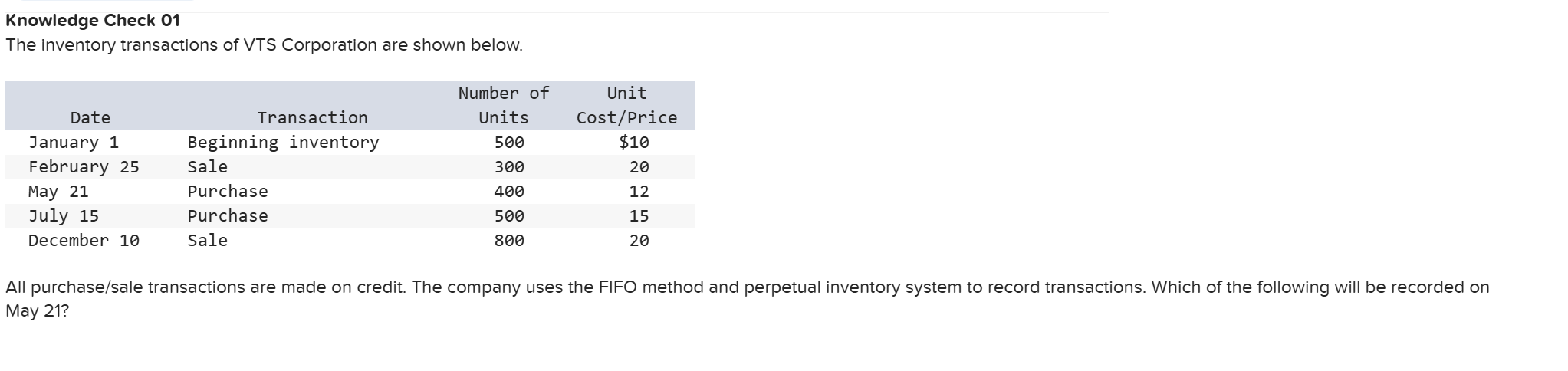
All purchase/sale transactions are made on credit. The company uses the FIFO method and perpetual inventory system to record transactions. Which of the following will be recorded on May 21?
A. Debit to Sales Revenue for $4,800
B. Credit to Cost of Goods Sold for $4,800
C. Credit to Accounts Payable for $4,800
D. Credit to Cash for $4,800
C. Credit to Accounts Payable for $4,800
FOB (Free On Board) Shipping Point
Title passes when the seller ships the inventory
What are Freight charges on incoming changes from suppliers called?
Freight in
Cost of Freight In Formula
Balance of Inventory + Cost of Freight In
A supplier offers a company terms 3/10, n/30 for a $10,000 purchase on account on January 1. The company uses a perpetual inventory system to record transactions. If the company makes the payment on January 10, the entry to record the payment will include a:
A. Debit to Accounts Payable for $9,700
B. Credit to Inventory for $300
C. Credit to Cash for $10,000
D. Debit to Accounts Payable for $300
Payment Within Discount Period (3/10, n/30)
First, decode the terms:
3/10 = 3% discount if paid within 10 days
n/30 = full amount due within 30 days
January 10 is within the 10-day window, so the company takes the discount.
Discount = $10,000 × 3% = $300 Cash paid = $10,000 − $300 = $9,700
The journal entry would be:
Account | Debit | Credit |
|---|---|---|
Accounts Payable | $10,000 | |
Cash | $9,700 | |
Inventory | $300 |
A company that returns items that were previously purchased on account will debit
Accounts Payable
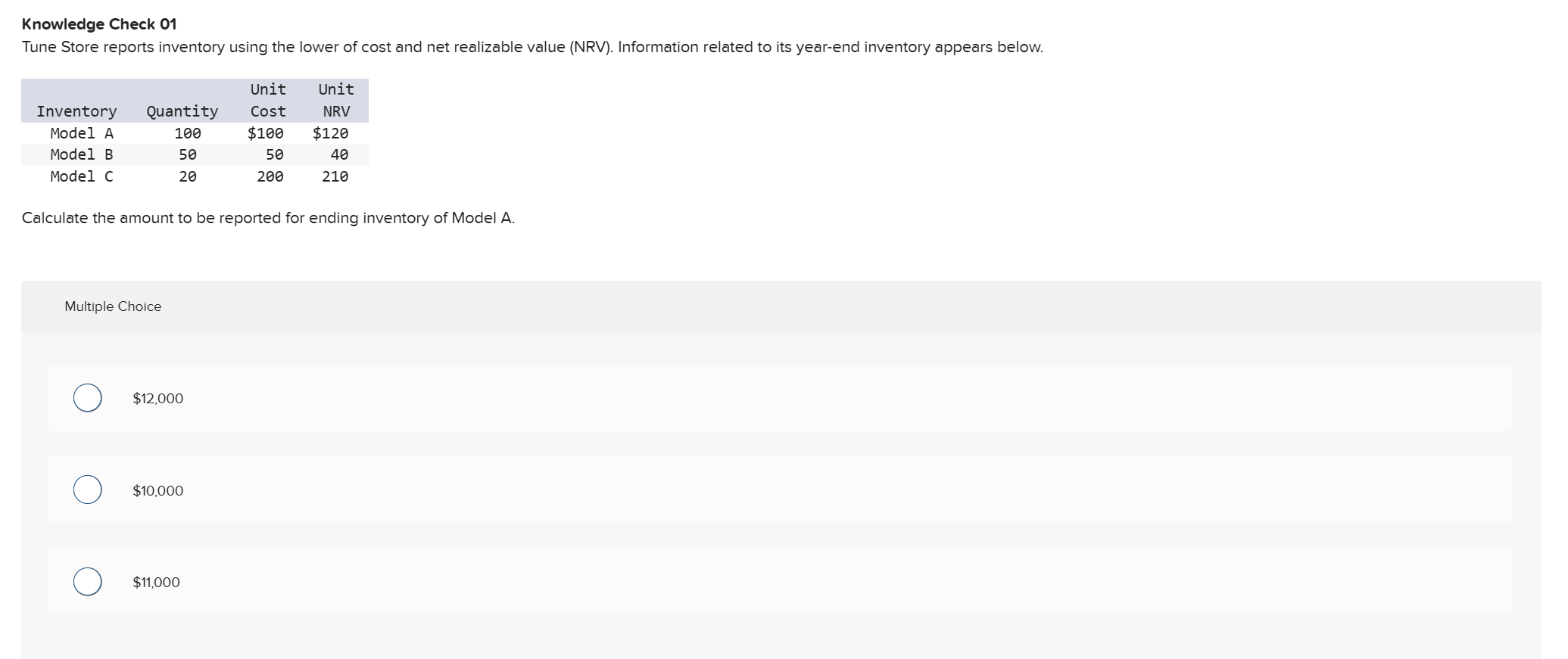
Calculate the amount to be reported for ending inventory of Model A.
Apply the rule: report at the lower of cost or NRV.
Unit Cost = $100
Unit NRV = $120
Lower = $100 (cost)
Since cost is lower, report at cost:
100 units × $100 = $10,000
The answer is $10,000
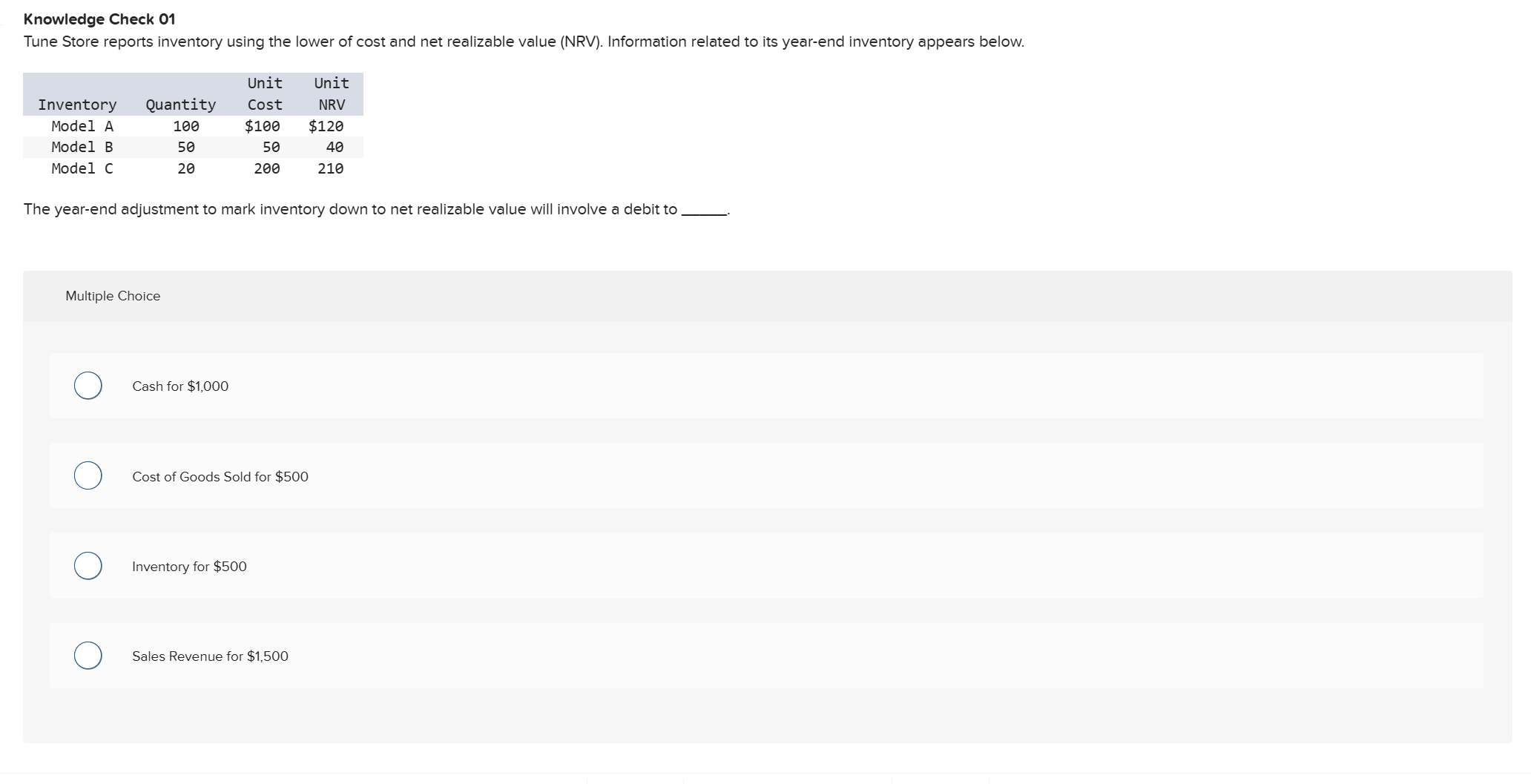
Tune Store reports inventory using the lower of cost and net realizable value (NRV). Information related to its year-end inventory appears below.
Model | Qty | Cost | NRV | Write-down per unit | Total Write-down |
|---|---|---|---|---|---|
Model A | 100 | $100 | $120 | None | $0 |
Model B | 50 | $50 | $40 | $10 | $500 |
Model C | 20 | $200 | $210 | None | $0 |
Only Model B needs a write-down: 50 × $10 = $500
The journal entry is:
Account | Debit | Credit |
|---|---|---|
Cost of Goods Sold | $500 | |
Inventory | $500 |
Inventory turnover ratio Formula
COGS / Average Inventory
Average Inventory Formula
Beginning Amount of Inventory + Ending Amount of Inventory / 2
Average Days in inventory Formula
365 Days / Inventory Turnover Ratio
Gross Profit Ratio Formula
Gross Profit / Net Sales
A company has total sales revenue of $500,000 for the year. Sales discounts, returns, and allowances total $50,000 and the cost of goods sold is $300,000. What is the company's gross profit ratio?
A. 44.44%
B. 40%
C. 60%
D. 33.33%
Step 1: Calculate Net Sales
$500,000 − $50,000 = $450,000
Step 2: Calculate Gross Profit
$450,000 − $300,000 = $150,000
Step 3: Calculate Gross Profit Ratio
$150,000 ÷ $450,000 = 33.33%
What types of inventory do manufacturing businesses hold?
Raw materials
Work In Progress
Finished Goods
What type of inventory do Merchandising businesses have?
Goods
Periodic Inventory System
A periodic system that adjusts the record of sales and purchases at the end of the reporting period

