EOSC 114 - Storms + Waves units
 Call Kai
 Learn
Learn Practice Test
 Spaced Repetition
 Match
Match Flashcards
 Knowt Play
1/30

There's no tags or description
Looks like no tags are added yet.
Name | Mastery | Learn | Test | Matching | Spaced | Call with Kai |
|---|
No analytics yet
Send a link to your students to track their progress
31 Terms
types of lightning: cloud to ground
negative (-) charge most common, can also be positive (+)
leaders moves too fast ot be seen by eye or cameras
to make a spark in air, you need approximately 3 billion volts / km
more powerful, esp +
types of lightning: cloud to cloud
doesnt touch the ground
jumps from cloud to cloud
types of lightning: intra-cloud
occurs within a single cloud, doesnt touch ground
might not see visible bolt, sometimes looks like a flash within a cloud
lightning safety
30/30 rule: if 30 sec or less btwn when u see light flash + hear thunder, move indoors
if stuck outdoorsL avoid: small stuctures, metallic objects nearby, trees, water, open fields
thunderstorm clouds
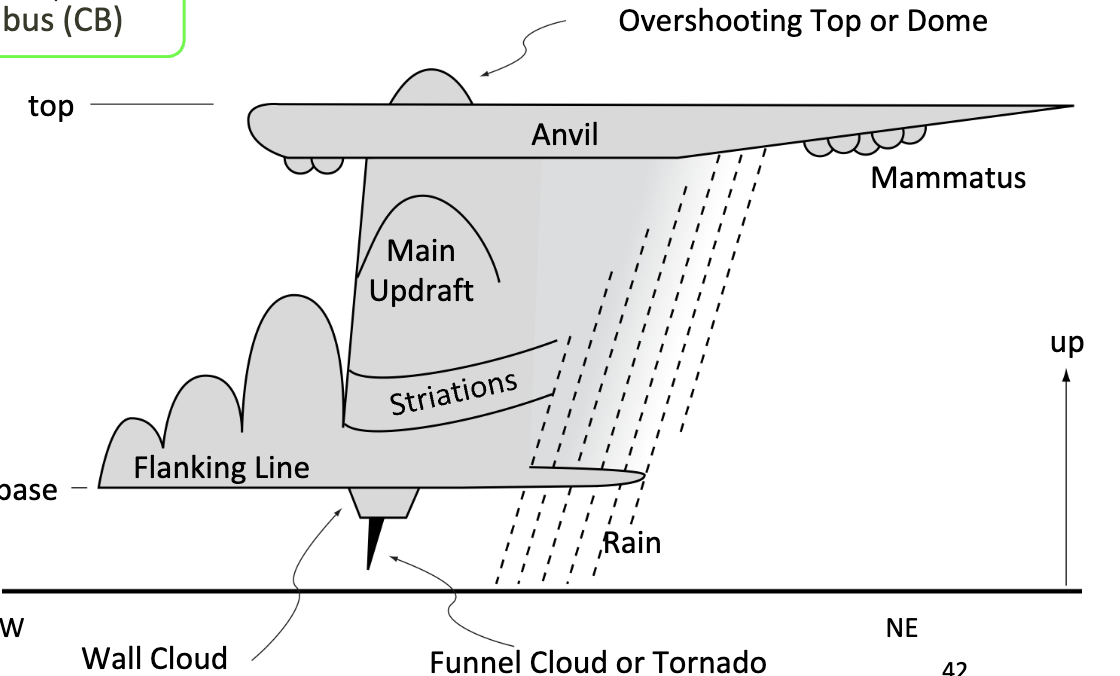
thunderstorm evolution of cells
made of large cells evolving abt 15-45 min
most ts has 2+ cells, each in diff evo stage (called multicell ts)
sometimes v large rotating single cell ts forms (called supercell ts)
supercell types
low precipitation
can produce lots of hail
classical
rainy downdraft, rain-free updraft
high precipitation
rainy updraft
thunderstorm life cycle
cumulus stage (updraft, no rain, no anvill)
mature stage (up & down drafts, heavy rain, crisp anvill)
storm hazards
rain downpours
downbursts & gust fronts (of air)
haboobs (sand storms)
squall lines
line of thunderstorms
tornado outbreaks often associated with this
often forms along cold fronts
mammatus clouds
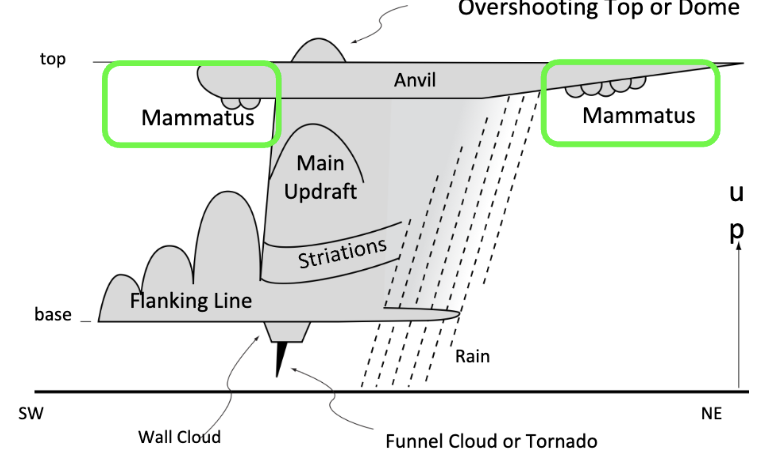
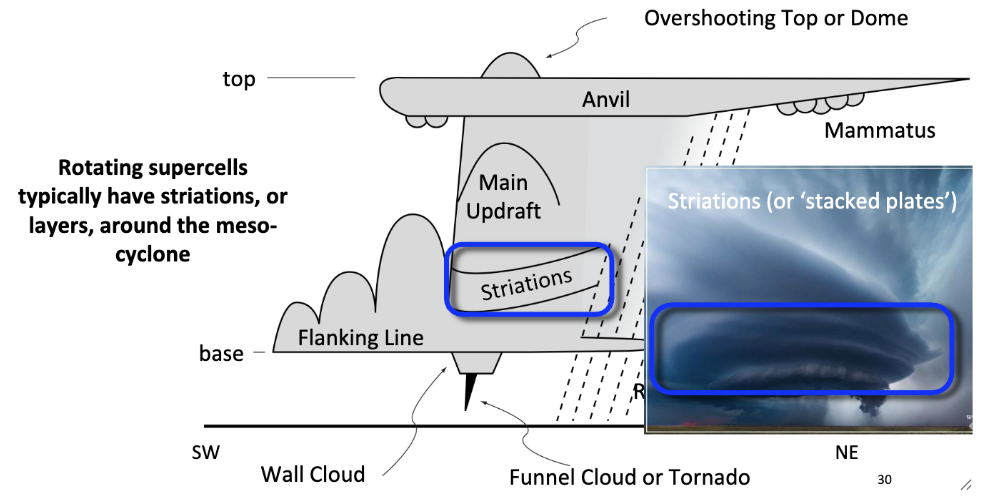
cloud striations
virga clouds
related to downbursts
storm can create dense air where rain falls; due to evaporative cooling of ‘virga’: precipitation that evaporates before it reaches the ground
haboobs and arc clouds
related to downbursts & gust fronts
haboobs - if dry ground
arc clouds - if moist air
downbursts & gust fronts
downbursts - falling air from storm
Downdraft speeds of 20 to 90 km/h.
Horizontal wind speeds near ground of up to 250 km/h.
Microbursts are small diameter (≈ 1 km) downbursts.
gust fronts - leading edge of cool air
can form shelf cloud
marks sudden wind shift
moves ahead of storm
humidity - saturation - latent head
humidity - moisture in air, converts to latent heat
latent heat - energy produced when water vapour condenses to liquid
saturation - when air becomes saturated it has 100% moisture + cannot hold more, trigger point where energy gets released
advection + adiabatic cooling
advection - movement of air by wind
Can continuously feed a storm system = longer lasting storm
adiabatic cooling - as air rises, pressure drops → air expands → cools
Cooling leads to condensation
heat cannot leave the system
best thunderstorm viewing
off to the side of the storm path
preferred side is to the southeast of the storm (at X)
look at the storm toward northwest
resulting supercell storm looks like the sketch at upper left
fujita scale
meausres tornadoes based on amt of damage to buildings
EF0 = v weak, might break few windows
EF5 = extreme, destroy entire buildings like GONE
tornado evolution
from supercell (rotating thunderstorm)
3 stages
developing (dust whirl, funel cloud, not connected to ground yet)
mature (fully formed, at strongest)
dissipating (rope)
tornado outbreaks
6 tornadoes in 1 day and 1 region
or many tornadoes in a week
mesocyclones
inside a supercell storm
rotating updraft
forces in atmosphere
buoyancy force - vertical (causes updrafts & downdrafts)
pressure-gradient force (PGF) (horizonal or vertical, depending on PGF)
acceleration
changes of velocity (v) during time interval (∆𝑡𝑡 ), where velocity has both speed and direction.
measured as velocity (m/s) change per time (s) = acceleration units of (m/s2)
hail
tiny crystals of ice swept into thunderstorms updraft (usually supercell)
collide w supercooled water - liquid w temp below freeezing
water freezes, ice grows
wave properties
crest = highest point
trough = lowest point
wave height = vertical disatance from crest to trough
amplitude (a) = H/2 (half of the height) above or below sea level
steepness = H/L (height divided by wavelength)
wave anatomy: motion
period (T) = time (in sec) btwn successive cycles (or time it takes 2 crests to past a fixed point)
frequency (f) = # of cycles per 1 second (in hertz; 1 Hz = 1 cycle per second); f = 1/T
celerity, c = L/T, wavelength per time perod (eg meters per second) often js called speed
rogue waves
created by constructive interference btwn 2 smaller waves
what is a seiche?
standing waves oscillating in a closed or semi-enclosed body of water (lakes, bays etc) - great lakes esp
has long wvlengths & periods
period of a seiche is
what direction do tornadoes move
SW to NE (in N. America)
continuity
Air molecules tend to spread themselves smoothly and evenly
They don't leave any gaps (i.e., they don't leave a vacuum)
They don't get bunched together

