Circulatory System - Single/Double
 Call Kai
 Learn
Learn Practice Test
 Spaced Repetition
 Match
Match Flashcards
 Knowt Play
1/21

There's no tags or description
Looks like no tags are added yet.
Name | Mastery | Learn | Test | Matching | Spaced | Call with Kai |
|---|
No analytics yet
Send a link to your students to track their progress
22 Terms
Circulatory System
network of cylindrical vessels that emanate from a pump - the heart
In vertebrates what does the circulatory system circulate
blood and lymph
Animals with no circulatory system
Sponges and Cnidarians: circulate water through their body or through a gastrovascular cavity.
sponges circulate ware through an incurrent pores and one excurrent pore
Pseudocoelomate invertebrates use the fluids of the body cavity.
General Characteristics of a Circulatory System
circulatory fluid - serves as a transport medium
vascular system; system of tubes through which the transport medium can flow
driving force; circulates the transport medium
Bulk/mass flow
method of transport in which an entire group of molecules is transferred from a region where they exert a large pressure to an area where of lower pressure - down a pressure gradient.
Open Circulatory System
most invertebrates (Insects)
heart pumps haemolymph through an aorta which branches into arteries, opening into a haemocoel - made up of series of open spaces called sinuses
blood then collects back from the haemocoel and passes through ostia back to the heart
fluid moves under low pressure (slow) facilitating efficient exchange of substances
Pros and cons of open circulation
PROS:
less energy than closed circulation
moves slowly - efficient exchange
CONS:
moves very slows (Ineffiecient for larger organisms)
Closed Circulatory System
blood is pumped by a heart through vessels under a high pressure and then back to the heart
all vertebrates and some invertebrates (echinoderms, cephalopod molluscs and annelids)
Advantages and Disadvantages of Closed Circulation
ADVANTAGES
Distribution of blood can be regulated based on demand
faster transport of nutrients
supports higher levels of metabolic activity
DISADVANTAGES
more energy than open circulation
COMPARISON between OPEN/CLOSED
OPEN | CLOSED |
respiratory pigment if present is dissolved in plasma (no rbc) | respiratory pigment may be dissolved in plasma but most is in RBC |
less efficient control of blood volume (cannot be regulated by contraction of vessel walls) | more efficient control (regulation by contraction/relaxation of smooth muscle cells lining blood vessels) |
Blood moves at a slower rate and l.p | blood moves rapidly at h.p |
exchange of gases happens between tissues directly | exchange of gas goes through capillary wall, then tissue fluid, then cell |
blood is directly in contact with tissues | not directly in contact with cells (enclosed in vessels) |
Single Circulation
found in fish
blood only passes through the heart once per circuit
passes from heart to gills (oxygenated) then from gills to the rest of the body
two chambered heart (only for deoxygenated blood)
Double Circulation
system where blood travels through the heart TWICE per complete circuit of the body
mammals, amphibians, birds, reptiles
PULMONARY AND SYSTEMIC CIRCUIT
deoxygenated blood goes to LUNGS via PULMONARY ARTERY, oxygenated blood comes back to HEART from PULMONARY VEIN, where it is then pumped to the rest of the body
Heart of Double Circulation Organisms
must be divided in two to keep oxygenated and deoxygenated blood separate
only mammals and birds show true 2x circulation
amphibians show the beginning of it and reptiles have an almost completely divided heart
Comparison between Single/Double Circulation
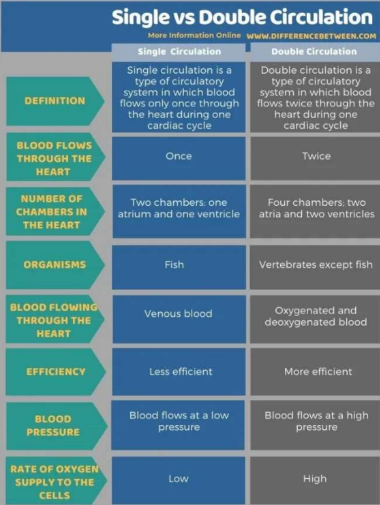
Disadvantages of Single Circulation
heart cannot pump at a high pressure
reduced blood pressure in girlls
slow rate of flow
limited rate of delivery of oxygen and glucose to tissues
Advantages of Double Circulation
blood enters lungs at a low pressure → more time for gas exchange
heart pumps blood to rest of the body at a high pressure
Describe the heart in insects
made of chambers separated by ostia where haemolymph enters the heart
each chamber has alary muscles which pushes haemolymph toward the aorta
Describe the open circulatory flow in insects
tubular heart pumps haemolymph to dorsal vessel
fluid spills out into sinuses
sinuses make up haemocoel where internal organs are suspended
accessory pumps carry haemolymph to the appendeges
ostia carry blood back to the heart when alar muscles are relaxed, back flow is prevented by valve-like structures
Rate of Haemolymph circulation is increased….
during activity when the animal needs most nutrients for fuel
its own movement ensures circulation
What does haemolymph transport
nutrients
OXYGEN IS INDEPENDENT OF CIRCULATORY SYSTEM
WHY HAEMOLYMPH IS CLEAR NO HAEMOGLOBIN
Closed Circulatory System in Annelids
Dorsal and Ventral Blood vessel
5 pairs of connecting vessles on the anterior end act as pumps
pushed blood to ventral vessel → pumps blood posteriorly (to the behind) until it re-enters dorsal vessel
smaller vessels from each of those 5 vessel pumps branch out to supply tissues of earthworm
Does earthworm blood contain haemoglobin
yes but it is contained in the plasma not erythrocytes

