Legal Unit 3 AOS 1 (1/2) Criminal justice system
 Call Kai
 Learn
Learn Practice Test
 Spaced Repetition
 Match
Match Flashcards
 Knowt Play
1/71

There's no tags or description
Looks like no tags are added yet.
Name | Mastery | Learn | Test | Matching | Spaced | Call with Kai |
|---|
No analytics yet
Send a link to your students to track their progress
72 Terms
Summary offence
a minor offence that is heard before a Magistrate in the Magistrates Court
eg. drink driving & minor assault
Considered to be less serious offences as these offences have a small impact on society. (The matter is also solved without a jury and just by the magistrate)
Less severe sanctions are imposed for summary offences eg. Fines or short terms of imprisonment.
Indictable offence
A serious offence that is heard before a judge and a jury in the County Court or Supreme Court of Victoria.
eg. sexual offences, drug trafficking & homicide offences (murder & manslaughter)
Considered to be more serious offences as these offences have a larger impact on society.
More severe sanctions such as longer terms of imprisonment
Indictable offence heard and determined summarily
A serious offence that is heard as a summary offence if the court and the accused agree.
The accused will usually choose to have an offence heard summarily, because it is quicker, cheaper and the maximum penalty that can be handed down is less than if it were heard as an indictable offence.
Indictable offences can only be heard summarily if; The indictable offence is punishable by a term not exceeding 10 years imprisonment, The accused agrees & The court determines it is appropriate.
The Magistrates' Court can only impose a maximum of two years' imprisonment for a single offence, and a maximum of five years' imprisonment for multiple offences.
The court must agree that the offence is appropriate to be heard summarily, and the accused must also agree.
Summary & Indictable offences features
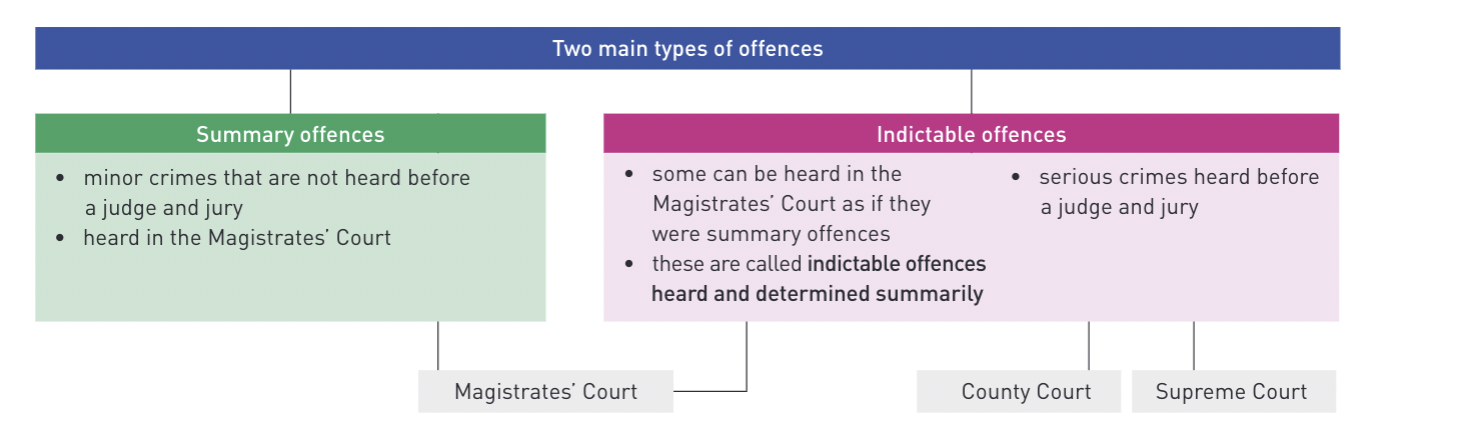
Differences between Summary & Indictable offences table
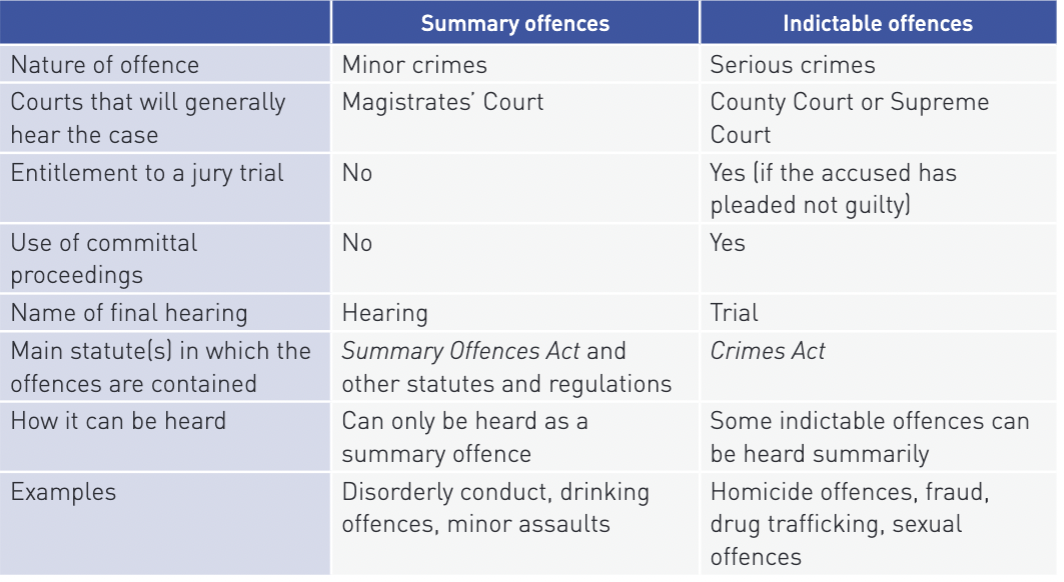
Key principles of the justice system
Burden of proof
Standard of proof
The presumption of innocence
Burden of proof
the responsibility of the prosecution to prove the facts of the case as they are the party initiating the case.
Lies on the prosecution as the prosecution is the party that initiates the case on behalf of the state and therefore, is required to prove the facts of the case.
Standard of proof
the degree or strength of the evidence required in order to prove a case in court.
The prosecution must provide evidence that proves that the accused is guilty beyond reasonable doubt which means there is no reasonable doubt that the accused is guilty from the evidence presented.
Beyond reasonable doubt
the standard of proof in criminal cases.
Requires the prosecution to prove there is no reasonable doubt that the accused committed the offence
Burden of proof & Standard of proof
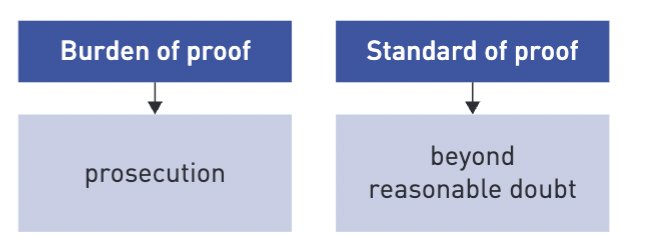
In a criminal case involving summary offences, the case is heard in the Magistrates' Court and a magistrate (not a jury) will decide on guilt. If the burden of proof is on the accused (e.g. the accused is relying on a certain defence), then the standard of proof is on the balance of probabilities.
Presumption of innocence
The right of a person accused of a crime to be presumed not guilty unless proven to be guilty beyond reasonable doubt in court.
protected by the right to silence, the right of an offender to appeal a wrongful conviction, the prosecution must prove their is enough evidence to secure a conviction and an accused persons’ prior criminal convictions cannot be revealed until sentencing
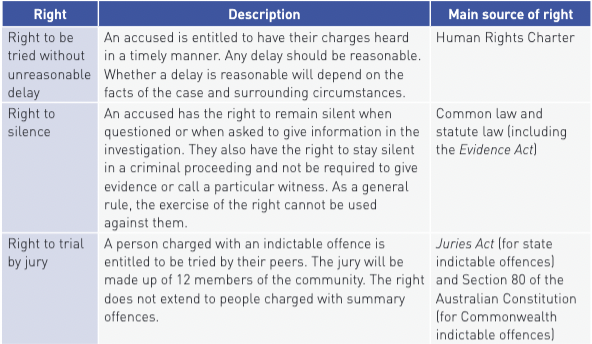
Rights available to the accused
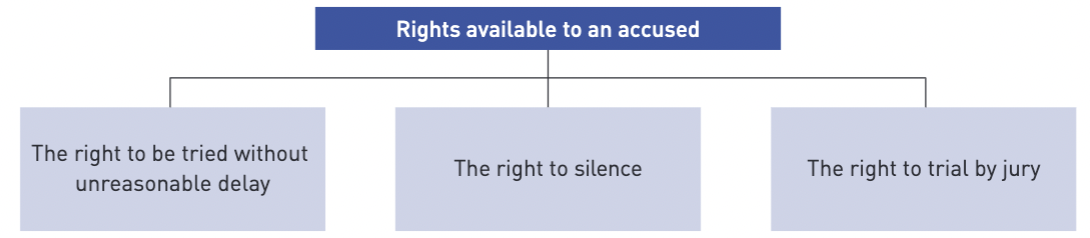
The right to be tried without unreasonable delay
An accused is entitled to have their charges heard in a timely manner and delays should only occur if they are considered reasonable.
The Human Rights Charter states that a person charged with a criminal offence is entitled to a guarantee that they will be tried without unreasonable delay.
The right recognises that there may be a delay in the case, but that delay must not be unreasonable.
The reasonableness of any delay will depend on factors such as the complexity of the case and the legal issues involved.
eg. it would be reasonable for the prosecution to need more time to prepare for a case involving multiple crime scenes, multiple crimes and multiple accused people with few or no witnesses, as opposed to a case where there was a single incident with multiple witnesses.
This right is supported by section 21(5) of the Human Rights Charter, which states that a person who is arrested or detained on a criminal charge has the right to be brought to trial without unreasonable delay.
The right to silence
Different types of protections given to an accused person so they are not obligated to say or do anything.
This right is upheld during questioning as the accused can refuse to answer questions as part of an investigation as well as, during criminal investigations and during trials as the accused is not required to give evidence and their silence will not be interpreted as a sign of guilt.
Right to trial by jury
A person charged with an indictable offence is entitled to be tried by their peers. jury consists of 12 people who are randomly selected from the community if they are eligible to form jury duty.
Australian constitution and victorian statute law upholds this right
Occurs when the accused pleads not guilty to an indictable offence
Jury trials make up a small proportion of court cases in Victoria as 95% of victorian cases are heard in the magistrates court and this court does not have a jury present in court
The 3 rights of the accused table
The rights of victims
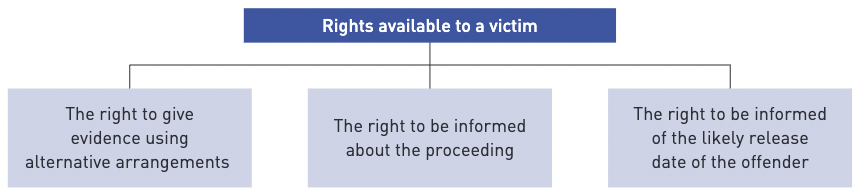
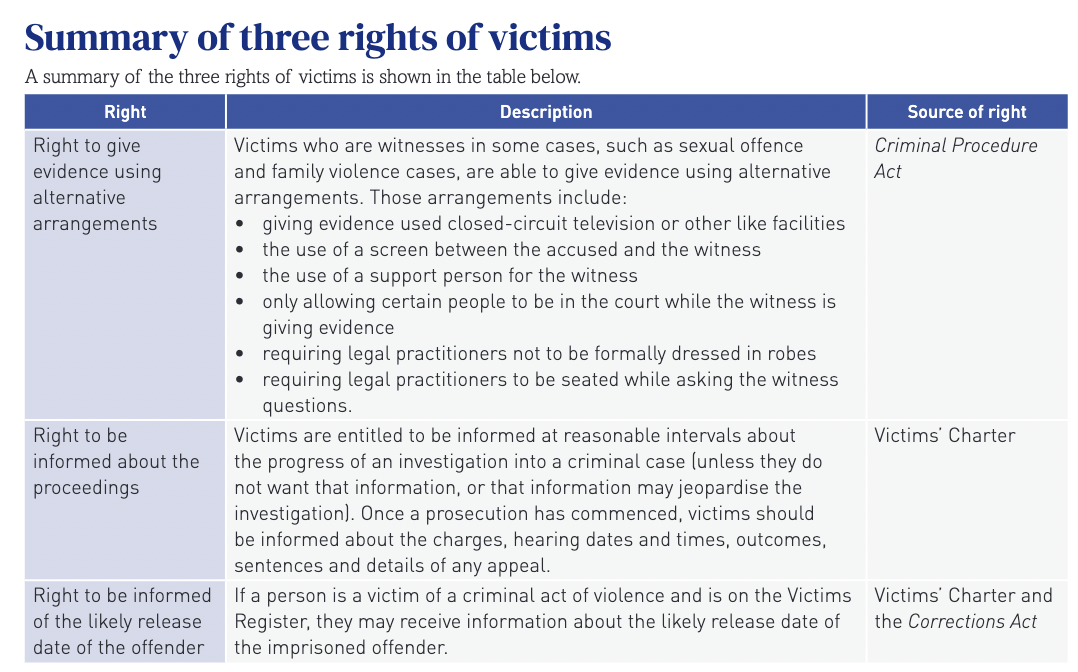
Right to give evidence using alternative arrangements
processes put in place by court to protect vulnerable witnesses when they are giving evidence in cases of sexual offences or family violence.
The objective of alternative arrangements is to help reduce trauma, distress and intimidation.
Alternative arrangements are for; sexual violence, family violence, an offence for obscene , indecent, threatening language or behaviour in public and an offence for sexual exposure in a public place cases
The right to be informed about proceedings
Victims are entitled to be informed about the progress of an investigation into a criminal case unless that information may jeopardise the investigation.
Victims should be informed about the charges, hearing dates and times, outcomes, sentences and details of any appeal.
The victims charter ensures that victims of the crime are knowledgeable about the case they are involved in.
The right to be informed of the likely release date of the offender
Victims of an offence can apply to be on the victims register which enables them to be notified about the likely release date of the offender at least 14 days before the release as well as the length of the sentence, the right to be told if the offender escapes from prison, and the right to make a submission if the imprisoned offender may be released on parole.
Rights of Victims table
The principles of justice
Fairness; all people can participate in the justice system and its processes should be impartial and open.
Equality; all people receive the same treatment regardless of their characteristics or attributes however, if the same treatment creates a disadvantage or disparity, adequate measures should be implemented to allow all to engage with the justice system without being disadvantaged.
Access; all people should be able to engage with the justice system and its processes on an informed basis.
Fairness
all people can participate in the justice system and its processes should be impartial and open
Impartial process; jury members, are independent and impartial. This means that people should not show bias towards or against either party, and the case must be decided based on facts and law, not on prejudices.
Open processes; Helps to ensure that institutions and people who administer justice can be scrutinised by the public and held accountable for their actions, decisions and practices. Allowing the community, media and victims to attend court hearings also enables people to be informed about the operations of the courts and helps ensure that justice can be 'seen to be done'.
Participation; involves the opportunity to prepare a defence, to examine witnesses, use a lawyer, use an interpreter, be tried without unreasonable delay, use of victim impact statements etc.
Equality
all people receive the same treatment regardless of their characteristics of attributes however, if the same treatment creates a disadvantage or disparity, adequate measures should be implemented to allow all to engage with the justice system without being disadvantaged.
Examples of measures; interpreters, different form of oath etc.
Formal equality (same treatment); all people are treated the same and given the same levels of support, regardless of their personal characteristics/attributes (eg. race, religion, gender identity or age). eg. anyone who contacted a (CLC) for advice would be entitled to the same information, advice or assistance, regardless of whether they could afford to pay for services.
Different treatment(substantive equality); if treating people in the same way could cause disparity or disadvantage, then special measures should be put in place to allow people to participate in the justice system without disparity or disadvantage, so that people do not suffer disadvantage simply because of who they are.
eg. if only formal equality was applied to a case with an accused person who does not speak English, then the court hearings for the accused person would be conducted in the same way as for every other person, meaning no interpreter or assistance would be provided. While this would achieve 'formal equality', the accused person would be at a disadvantage because they cannot speak English so to avoid this disadvantage, special measures such as an interpreter may need to be put in place.
Access
all people should be able to engage with the justice system and its processes on an informed basis
to engage in the system people must have the ability to participate in the system (this includes physical, intellectual & technological access)
physical access: people should be able to physically access the courts or legal representation. (more difficult for people in rural or remote areas or people with disabilities as they may not be able to physically attend).
technological access: if virtual or online methods are used to provide services or conduct court hearings, people should be able to engage with those methods (more difficult for people who are not able to use technology)
financial access: people should not be prevented from defending their case and using the criminal justice system because they do not have the financial means to do so. This can be particularly important for accused people who may need money to pay for a lawyer to defend them in court.
Informed basis; people should be able to understand their legal rights and the processes involved in their case and obtain enough information to make sensible decisions. Factors that may influence their ability to be informed are; education, legal representation & support services and their ability to access information.
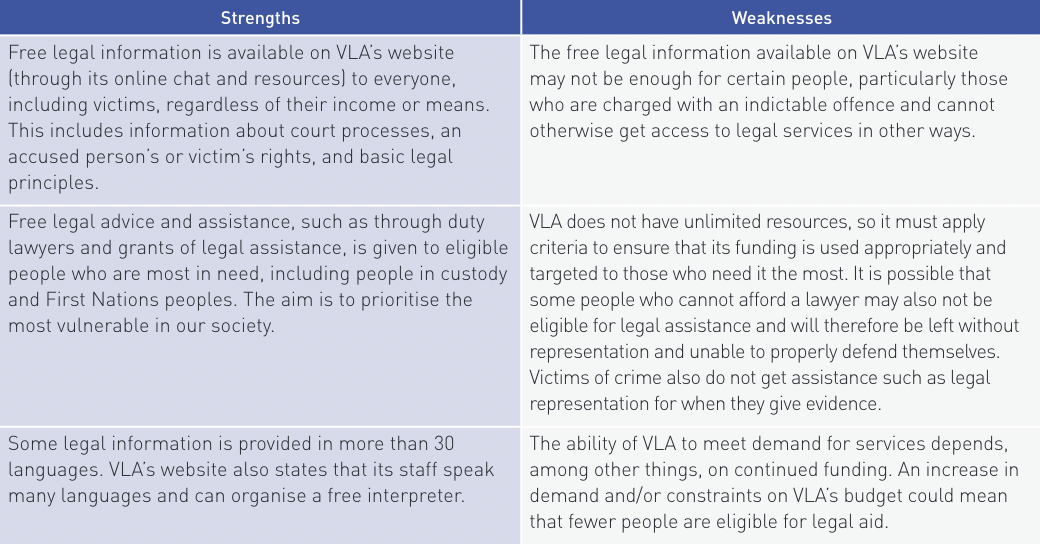
Victoria Legal Aid (VLA)
A government agency that provides free legal advice to all members of the community and legal representation for people who cannot afford to pay for a lawyer.
Prioritises people who need it most and cannot obtain legal assistance in any other way.
The role of Victoria Legal Aid (VLA) in assisting an ACCUSED - FDL
Free legal information to all people via its website and over the phone about the law, court processes and basic legal principles.
Duty lawyer services in the Magistrates court and children courts for those who meet the eligibility requirements
Lawyers for indictable offences for those who meet the means test and income test
The role of Victoria Legal Aid (VLA) in assisting the VICTIMS of a crime- FDF
Free legal information to all people via its website and over the phone about the law, court processes and basic legal principles.
Duty lawyers in the Magistrates court for victims who seek a personal safety intervention order (no income test is applied)
Free legal advice on how to make an application for financial assistance or seek compensation from the offender
Strengths & Weaknesses of VLA
Community Legal Centre (CLC)
An independent community organisation that provides free legal services including ongoing assistance, advice and information to people who are unable to pay for those services.
Some are generalist CLCs and some are specialist CLCs
The role of Victorian Community Legal Centres (CLCs) in assisting an accused- llvo
basic Legal information which includes some online information about criminal offences and where to get more assistance.
Legal advice and assistance with writing short letters and completing forms.
Help with applying for a grant of legal assistance from VLA.
Ongoing assistance with casework including legal representation or assistance. (Many CLCs do not offer assistance for indictable offences and each CLC has its own eligibility criteria eg. the type of legal matter).
The role of Victorian Community Legal Centres (CLCs) in assisting victims of crimes- DOL
Duty layers for victims of crime who are seeking family violence protection orders or personal safety protection orders.
Ongoing casework, assistance and legal representation including help with making applications and filling in forms.
basic Legal information about applying for financial assistance or facts sheets on family violence.
Generalist CLCs
Provide broad legal services to people in a particular geographical area.
eg. Peninsula CLC (helps anyone living on the Peninsula).
Specialist CLC
Provide legal services to a particular group of people.
(eg. Youth law for individuals under 25).
Strengths & Weaknesses of CLC’s
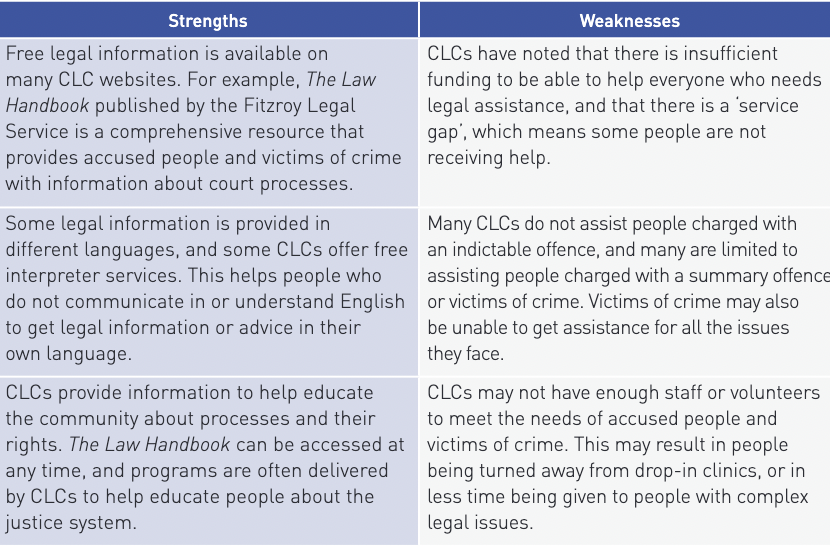
Differences between CLCs & VLAs
Many CLCs do not offer assistance for indictable offences whereas, VLA’s offer assistance for indictable offences
The eligibility for VLA is stricter than it is for CLCs
VLA is established by the government whereas, CLCs are an independent non profit organisation
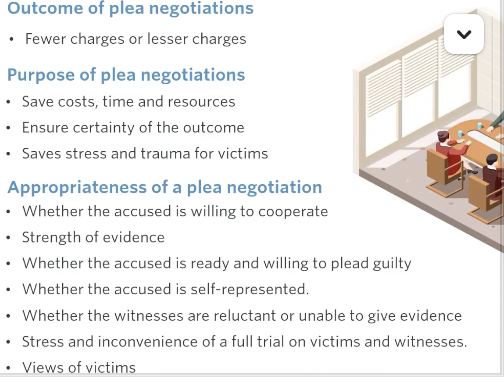
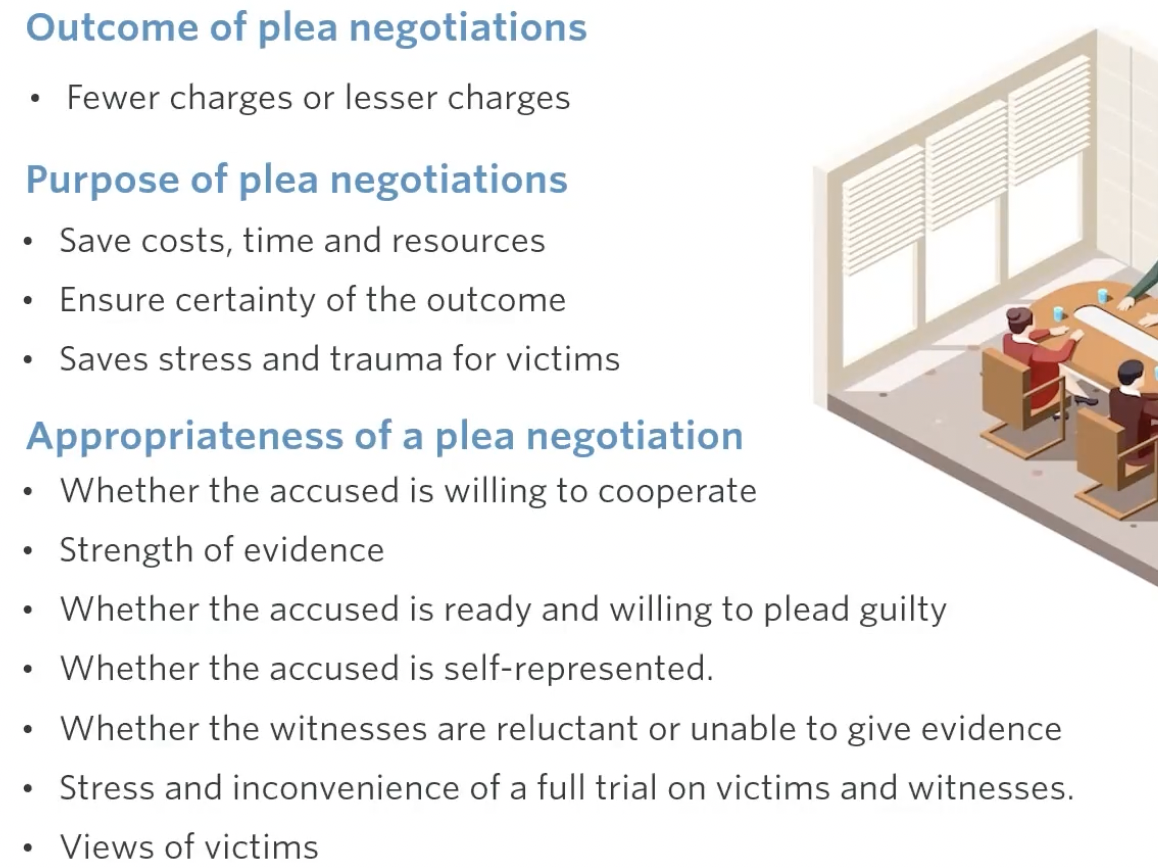
The purposes of plea negotiations
To ensure certainty of the outcome of a criminal case; In a plea negotiation, the accused may plead guilty to the charges, which ensures the certainty of the outcome that the accused is guilty which removes the risk of an acquittal. However, the charges must adequately reflect the accused's wrongdoing.
To save on costs, time and resources: If a plea negotiation results in an early guilty plea, it avoids the need for a trial or hearing and therefore saves the court and the prosecution's resources, and avoids the costs and time associated with a trial (or hearing).
To achieve a prompt resolution to a criminal case without the stress, trauma and inconvenience of a criminal trial (or hearing): An early resolution relieves victims and witnesses of the burden and trauma of having to give evidence, and may help victims move on from what has happened.
The appropriateness of plea negotiations
Whether the accused is willing to cooperate in the investigation or prosecution of co-offenders or offenders of other crimes- as this ensures the accused will be open to a plea negotiation
The strength of evidence including the strength of the prosecutions case and of any defences (eg. If prosecutor has strong evidence they may believe a plea negotiation is not necessary as they will believe that they will be likely to secure a conviction).
Whether the accused is ready and willing to plead guilty (if accused is not willing to plead guilty a negotiation will not be reached)
Whether the accused is self represented- accused may feel pressured to accept a plea if they do not have representation as they may be worried about receving a more severe penalty during trial if they lack knowledge in the criminal justice system
Whether the witnesses are reluctant or unable to give evidence- prosecutor may worry that witnesses will not testify, reducing the strength of their evidence and making them more open to a plea negotiation
The negative consequences of a full trial, including stress inconvenience on victims and witnesses- plea negotiation prevents witnesses from reliving traumatic experiences during the trial
The views of the victim- if victims are confident about the strength of the prosecutions case they may want to see justice served at a trial
Plea negotiations (in criminal cases)
Pre-trial discussions between the prosecution and the accused, aimed at resolving the case by agreeing on an outcome to the criminal charges laid. (also known as charge negotiations)
They can result in an agreement being reached between the two parties about the accused pleading guilty in exchange for some agreement by the prosecutor (e.g. to withdraw some charges).
Plea negotiations do not determine the sentence, because the prosecutor has no power to sentence an offender as only courts have that power.
Following plea negotiations, the accused will still need to be sentenced by a court.
The court will be informed of the charges the accused has pleaded guilty to, and will decide what sanction to impose.
Plea negotiations can happen at any stage (even before the charges have been laid).
Victims should be consulted before the plea negotiations, and the victims' views should be taken into account when deciding to enter into an agreement with the accused.
The agreement reached between the prosecutor and the accused following plea negotiations may be that;
The accused pleading guilty to fewer charges
The accused pleading guilty to a charge, but an agreement is reached about the facts on which the plea is based
The accused pleads guilty to a lesser charge eg. Manslaughter instead of murder
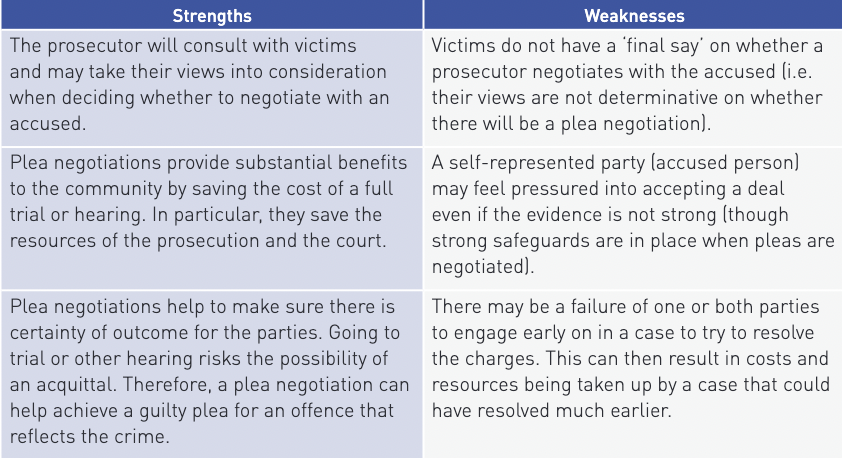
Strengths & Weaknesses of plea negotiations 1/2
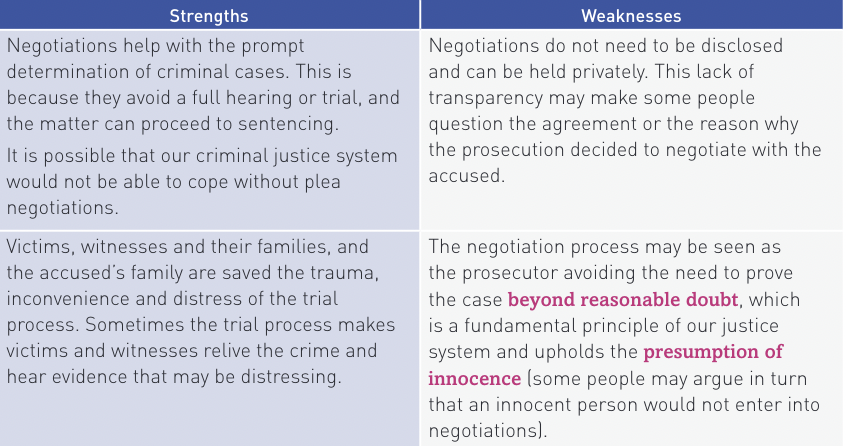
Strengths & Weaknesses of plea negotiations 2/2
Plea negotiations summary
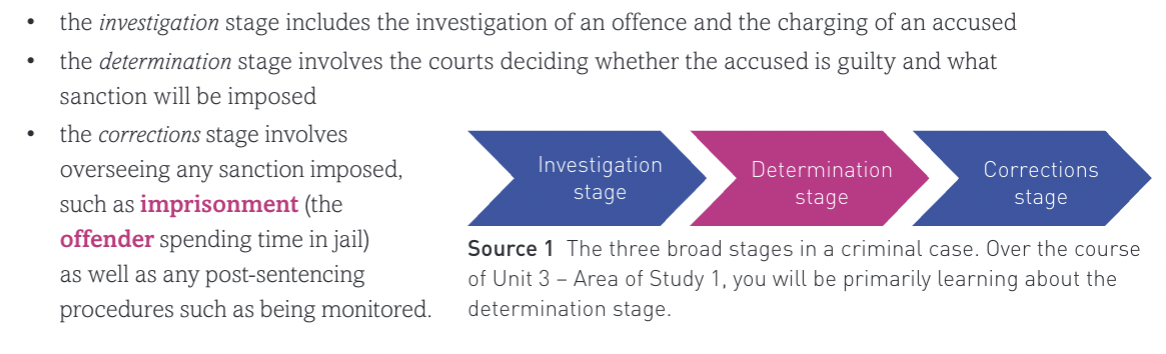
The main stages of a criminal case (IDC)
Criminal justice system
a set of processes and institutions used to investigate and determine criminal cases.
2 of the key purposes of the criminal justice system are to:
Decide whether an accused is guilty of an offence
Impose a sanction in cases where an accused has been found or pleaded guilty to committing an offence.
Legal aid
Legal advice, education or information about the law and the provision of legal services (including legal assistance and representation)
Sanction
a penalty imposed by a court on a person guilty of a criminal offence (e.g. a fine or prison sentence).
Imprisonment
a sanction that involves removing the offender from society for a stated period of time and placing them in prison
Offender
a person who has been found guilty of a criminal offence by a court.
Australian Constitution
a set of rules and principles that guide the way Australia is governed.
The Australian Constitution is set out in Commonwealth of Australia Constitution Act
Commonwealth offences
crimes that break a law passed by the Commonwealth Parliament
statute
Statute
a law made by parliament; a bill that has passed through parliament and has received royal assent (also known as legislation or an Act of Parliament)
Each state and territory has its own criminal justice system, as well as laws that establish:
what is considered a crime
the processes used to decide if someone is guilty
the maximum penalty that can be imposed for each specific crime.
Courts in Victoria
the Magistrates' Court
the County Court
the Supreme Court
Victoria also has specialist courts, including a Children's Court. This court hears criminal cases where a child (between the ages of 10 and 17 at the time of the offence) has been accused of committing a crime - except for certain serious crimes such as murder and arson causing death, which will be heard in the higher courts (i.e. the County Court or the Supreme Court).
The 2 Parties in a criminal case
The prosecution (the party prosecuting the case against an accused, and generally representing the community)
The accused (the person or organisation alleged to have committed a crime).
The victim is not a party to a criminal case and does not bring the court action.
Prosecution
the party that institutes criminal proceedings against an accused on behalf of the state. The prosecution team includes the prosecutor
Prosecutor
the representative of the prosecution who is responsible for conducting the criminal case and appearing in court
Office of Public Prosecutions (OPP)
the Victorian public prosecutions office that prepares and conducts criminal proceedings on behalf of the Director of Public Prosecutions
Director of Public Prosecutions (DPP)
the independent officer responsible for commencing, preparing and conducting prosecutions of indictable offences on behalf of the State of Victoria
Committal proceeding
the pre-trial hearings and processes held in the Magistrates' Court for indictable offences.
Committal hearing
a court hearing that is held as part of the committal proceeding in the Magistrates' Court.
At a committal hearing, the magistrate will decide whether there is sufficient evidence to support a conviction for the offence charged.
If the magistrate does find there is sufficient evidence, the accused is committed to stand trial and the case is then transferred to the higher court that will hear the case.If the magistrate does not find there is sufficient evidence, the accused is discharged and allowed to go free.
If further evidence is found in future, the accused can be brought before the court again, because the committal proceeding is not a trial, and no guilt has been decided.
The committal process has several important purposes, including:
ensuring that cases where there is inadequate evidence do not go to trial
finding out whether the accused plans to plead guilty or not guilty
ensuring a fair trial by making sure the prosecution's case is disclosed to the accused
giving the accused the opportunity to put forward a case at an early stage and possibly cross-examine witnesses.
Common law
court made law which is established by judges when interpreting statue laws.
Human Rights Charter
Upheld by statute law (the Charter of Human Rights and Responsibilities Act 2006 (Vic).
Its main purpose is to protect and promote human rights.
The right to silence is protected by common law, which has established:
an accused person has the right to remain silent
Silence is not interpreted as a sign of guilt therefore, no negative conclusions can be made from the fact that a person has not answered any questions or given any evidence.
Victim
a person who has suffered directly or indirectly as a result of a crime.
Victims' Charter
the Victims' Charter Act 2006 (Vic), which recognises the impact of crime on victims and provides guidelines for the provision of information to victims.
Depending on the crime, a victim can include:
a person who has suffered injury as a direct result of a criminal offence (often called the 'primary victim')
a family member of a person who has died as a direct result of a criminal offence
a family member of a person who is under 18 years of age or is incapable of managing his or her own affairs because of mental impairment, and that person has suffered injury as a direct result of a criminal offence
a child under the age of 16 years who has been groomed for sexual conduct, as well as that child's family.
Some of the objectives or key principles of the Victims' Charter are to:
recognise the impact of crime on victims
recognise that victims should be offered certain information during the investigation and prosecution process
help reduce the likelihood of secondary victimisation that may be experienced by the victim as a result of their interaction with the criminal justice system.
Alternative arrangements
measures that can be put in place for witnesses in certain criminal cases (e.g. as sexual offence cases) to give evidence in a different way (e.g. via video link)
Types of arrangements for witnesses
The witness may give evidence from a close-circuit television
Screens put in place to remove the accused from the victim
A support person to be beside the witness while they are giving evidence
Legal practitioner may be required to not be formally dressed in robes

