Anatomy 2nd Semester Midterm
 Call Kai
 Learn
Learn Practice Test
 Spaced Repetition
 Match
Match Flashcards
 Knowt Play
1/60

There's no tags or description
Looks like no tags are added yet.
Name | Mastery | Learn | Test | Matching | Spaced | Call with Kai |
|---|
No analytics yet
Send a link to your students to track their progress
61 Terms
Muscle fiber
Individual skeletal muscle cell
Sarcolemma
Cell membrane of a muscle fiber
Aponeurosis
Flat, sheetlike fiber that connects muscle to muscle
Perimysium
Strong fibrous membrane that wraps groups of muscle fibers
Fascicle
Unit of muscle fibers wrapped with perimysium
Skeletal muscle
Voluntary muscle
Smooth muscle
Visceral muscle
Peristalsis
Symmetrical squeezing of the walls of the digestive tract
Intercalated discs
Structures found only in cardiac muscle
Action potential
The electrical charge produced in nerve or muscle fiber by stimulation
Motor unit
A single motor neuron and all of the muscle fibers that it stimulates
Cross bridges
Connections between the heads of myosin filaments and receptor sites on the actin filaments
Abduction
Movement of a body segment away from the midline of the body
Origin
Muscle attachment to a relatively fixed structure
Adduction
Movement of a body segment closer to the midline of the body
Insertion
Muscle attachment to a bone that typically moves when the muscle contracts
Extension
Movement that returns a body segment from a position of flexion to anatomical position
Flexion
Forward movement of a body segment away from anatomical position
Tendinitis
Inflammation of a tendon
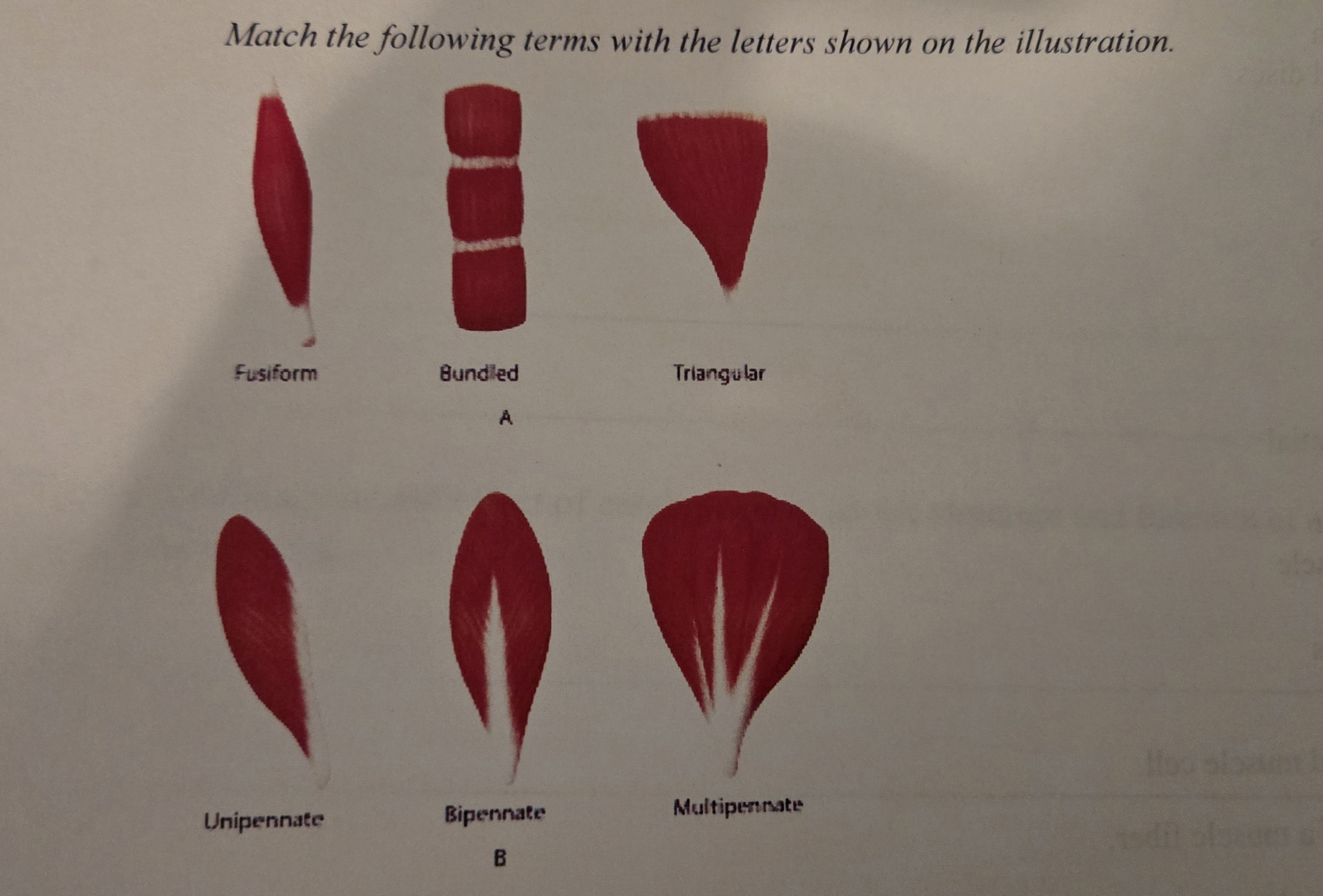
Parallel fiber arrangement
What is A?
Sternocleidomastoid
What is A?
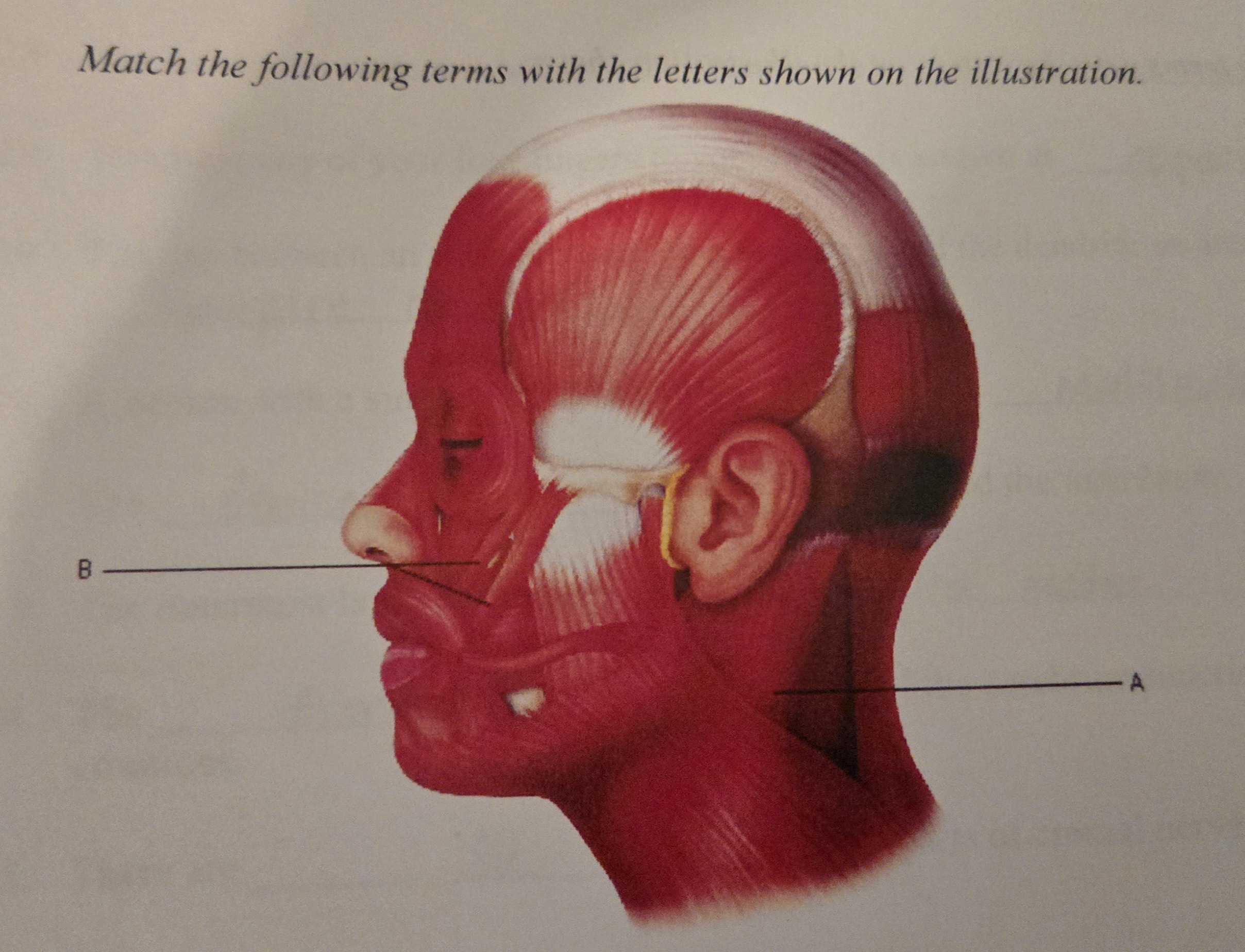
Zygomaticus
What is B?
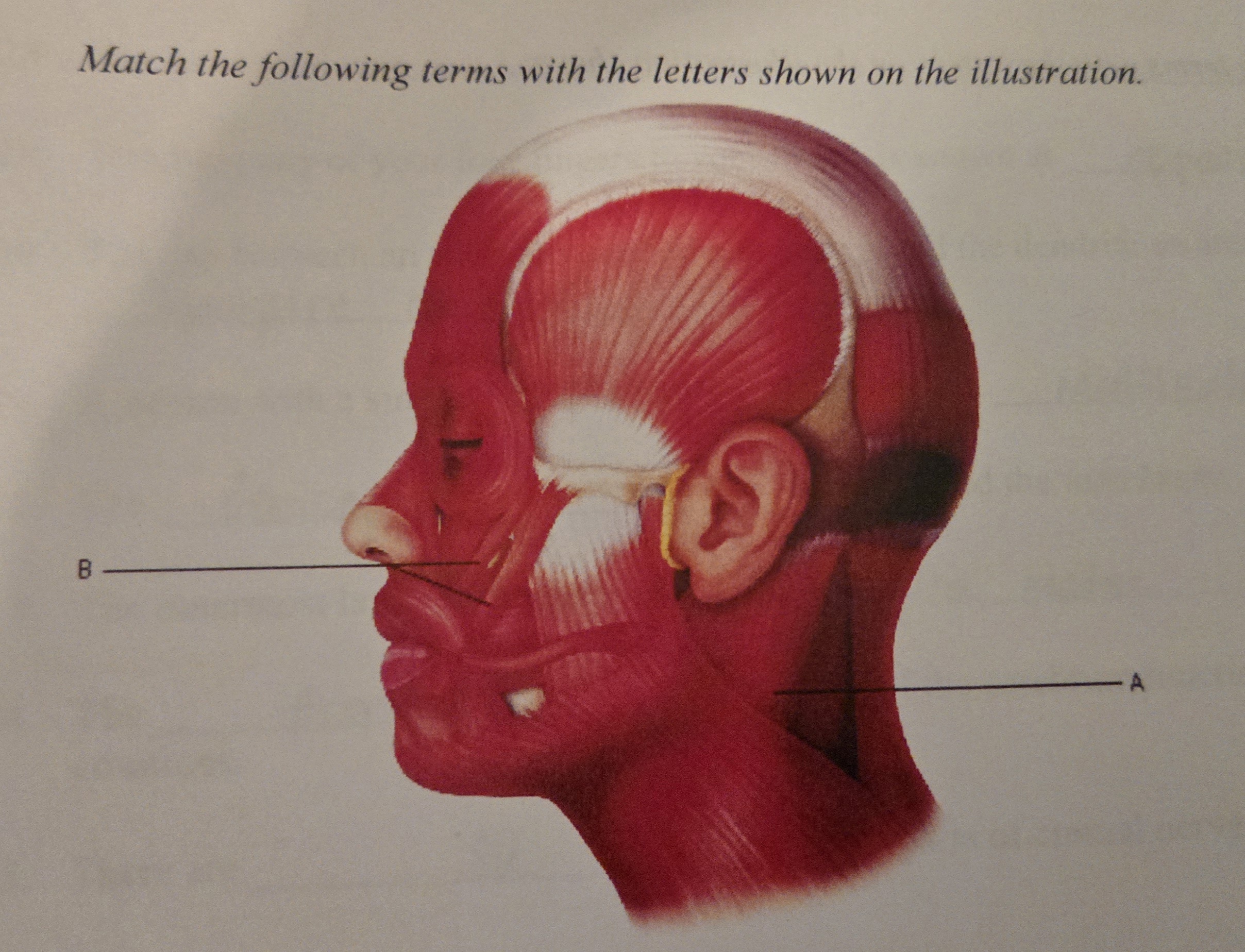
Sartorius
What is A?
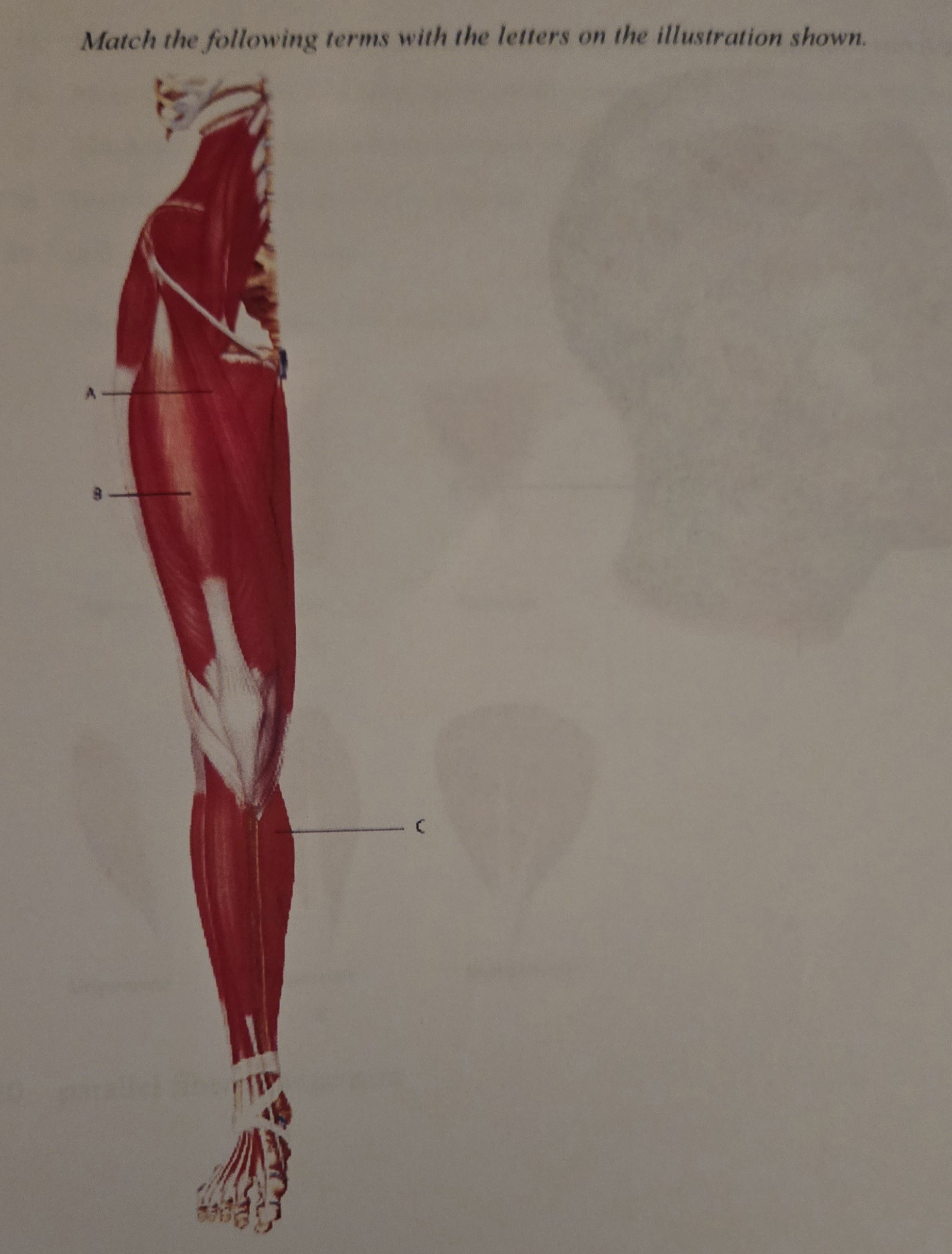
Rectus femoris
What is B?
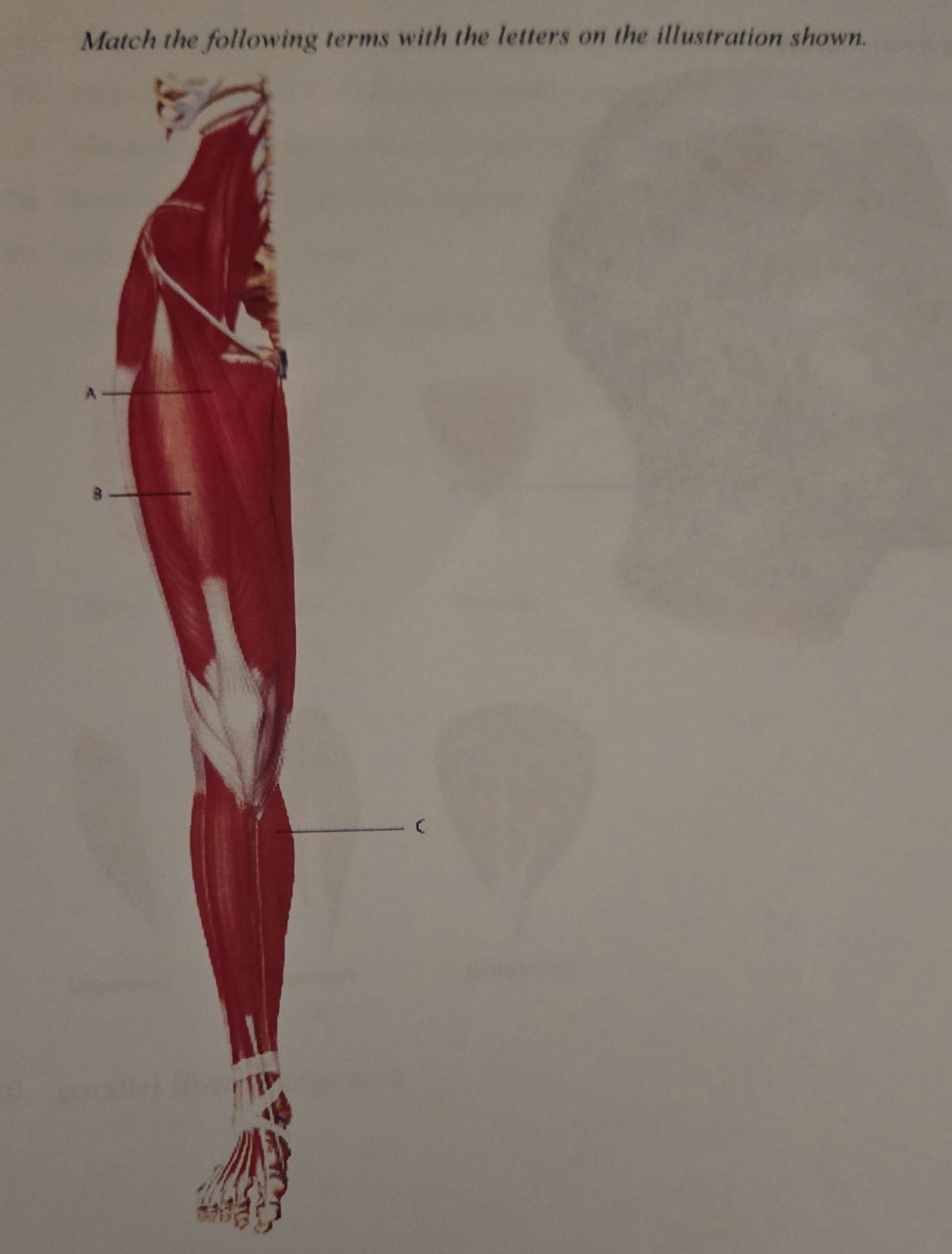
Gastrocnemius
What is C?
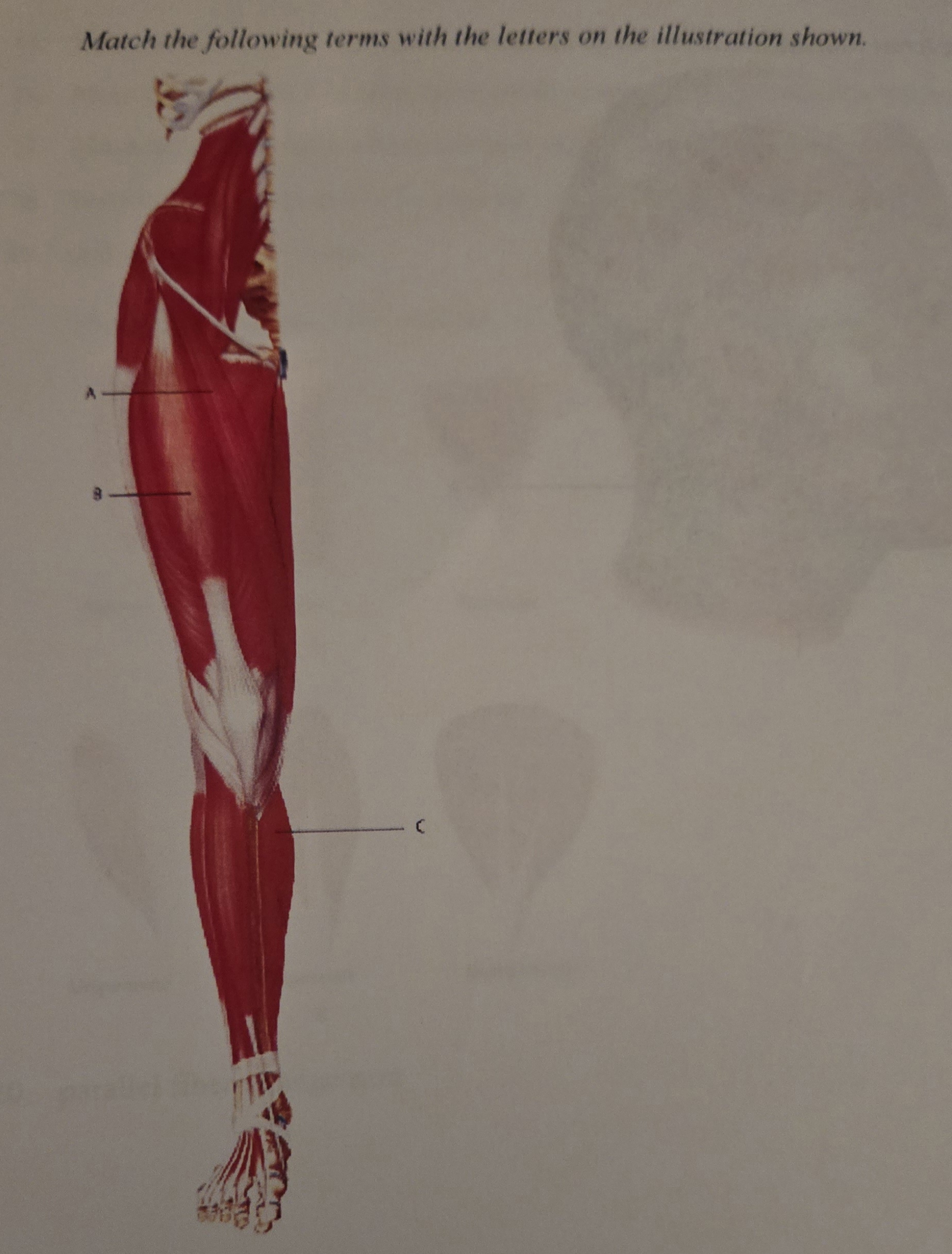
Concentric
_____ contraction results in shortening of a muscle
Tetanus
With high frequency stimulation the muscle develops a sustained, maximal level of tension called _______
Sarcomeres
The functional units inside a muscle fiber are the _________
Opposition
Touching any of your four fingers to your thumb is known as _______
Synaptic cleft
The gap between an axon terminal on one neuron and the dendrite on another neuron is the _______
Multipolar
A neuron with a single axon and multiple dendrites is a _________ neuron
Diencephalon
The _______ is also called the interbrain
Pia mater
The innermost layer of the meninges is the ________
Frontal
The ________ lobe of the cerebrum functions in memory, intelligence and emotions
12
There are ______ pairs of cranial nerves
Fusiform
Triangular
Bundled
Parallel muscle fiber arrangements
Zygomaticus
Frontalis
Temporalis
Muscle of the head or neck
Trapezius
Muscle in the upper back
Tennis elbow
Lateral epicondylitis is a condition known as ____
Astrocytes
The _____ protect neurons from harmful substances in the blood
Axon
Dendrite
Cell body
Parts of a neuron
Presence of myelin sheath
Diameter of axon
Body temperature
Factors in the speed of a nerve impulse transmission
Pons
Medulla oblongata
Midbrain
Parts of the brain stem
Hormones
Cannot pass through the blood-brain barrier
Trigeminal
Vagus
Facial
Cranial nerves
All muscle actions would be performed by consciously directed nerve activity, giving people greater control over their body
Pros of body organs being made up exclusively of voluntary muscle
People could decide when to move food through the digestive system
(Example) Pros of body organs being made up exclusively of voluntary muscle
People would be preoccupied with moving their muscles to perform essential functions that they currently take for granted because they require no mental effort
Cons of body organs being made up exclusively of voluntary muscle
Shortening of the biceps
Concentric contractions
Lifting a glass to drink from it
Example of concentric contractions
Cause no change in muscle length
Isometric contractions
Holding down a gas pedal while driving
Example of isometric contractions
Lengthen muscles
Eccentric contractions
Setting down a heavy box
Example of eccentric contractions
By performing automatic processes that are necessary for life
How the automatic nervous system keeps a person alive
Heart rate
Respiratory rate
Digestion
Examples of automatic nervous system processes
If a part of the brain controlling movement, sensation, or language is damaged or lost due to stroke or injury, other parts can compensate.
If one component or structure in the brain gets damaged, will the other structures compensate enough for the person to fully function normally?
Damage to the brain before or during birth, or in early infancy
Cause of cerebral palsy
Brain with an abnormal shape or structure
Effect #1 of cerebral palsy on the structure of cells, tissues, organs, and systems
Damaged nerve cells and brain tissues
Effect #2 of cerebral palsy on the structure of cells, tissues, organs, and systems
Motor function impairment
Effect #3 of cerebral palsy on the structure of cells, tissues, organs, and systems

