ISEN 281 Exam 1
 Call Kai
 Learn
Learn Practice Test
 Spaced Repetition
 Match
Match Flashcards
 Knowt Play
1/97

There's no tags or description
Looks like no tags are added yet.
Name | Mastery | Learn | Test | Matching | Spaced | Call with Kai |
|---|
No analytics yet
Send a link to your students to track their progress
98 Terms
If a product is manufactured by a factory at the quantity of 20,000 per year, the production range will be__________ production.
(A) low
(B) medium
(C) high
C.
Both steels and cast iron are iron-carbon alloys.
(A) True. (B) False.
A.
Both alloys and composites are created by combining multiple elements or substances. Which one of the following is among their differences?
(A) Alloys are not conductive while composites are always conductive.
(B) Alloys are typically homogeneous mixtures, where the components are blended at the atomic or
molecular level. Composites are heterogeneous, with distinct phases visible at the macroscale.
(C) Composites are usually created by melting and blending the components together, while alloys are not.
B.
Generally speaking, ceramic materials have __________ thermal conductivity than metals.
(A) lower. (B) higher.
A.
Generally speaking, metals have _____________ thermal conductivity than plastics.
(A) lower. (B) higher.
B.
Generally speaking, the melting point of ceramics is _______ than that of metals.
(A) lower (B) higher.
On Boeing 787 airplanes, which type of material is used the most?
(A) Metal. (B) Plastics.
(D) Ceramics. (C) Composites.
C.
On Boeing 787 airplanes, about ________________ of all materials used are composites (by weight)?
(A) 5%. (B) 25%.
(D) 50%. (C) 75%.
D.
Which statement best defines productivity?
(A) The ratio of actual output to maximum possible output.
(B) The ratio of output produced to the inputs used.
(C) The percentage of time a resource is utilized.
(D) The degree to which waste is eliminated in a process.
B.
Efficiency is best described as:
(A) Total output divided by total labor hours.
(B) Output per unit cost.
(C) Actual performance compared to a standard or ideal performance.
(D) The number of units produced per shift.
C.
A system produces the same number of units as before but uses fewer labor-hours. What happens to productivity and
efficiency?
(A) Productivity increases; efficiency must decrease.
(B) Productivity decreases; efficiency increases.
(C) Productivity increases; efficiency may increase.
(D) Productivity remains unchanged; efficiency decreases.
C.
Can yield strength of a material be greatly changed by manufacturing processes?
(A) Yes. (B) No.
A.
Can the ductility of a material be greatly changed by manufacturing processes?
(A) Yes. (B) No.
A.
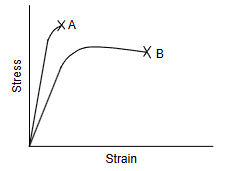
Which material has lower elastic modulus? (A) (B)
Which material has lower yield strength? (A) (B)
Which material has lower tensile strength? (A) (B)
Which material is less ductile? (A) (B)
Which material has lower toughness? (A) (B)
B,B,B,A,A
Generally speaking, as tensile strength increases, hardness _________________
(A) increases. (B) decreases.
A.
A material can have many fatigue strength values; there is a fatigue strength value for every number of loading cycles.
However, a material has just one endurance strength value.
(A) True. (B) False.
A.
When the applied load is below the endurance strength of a material, the material
______________________________________.
(A) will never fail regardless of the number of loading cycles.
(B) can still fail if the number of loading cycles is too high.
A.
Some athletes say that the pole they use in pole vaulting has too much deformation.
Which of the following mechanical properties should be changed?
(A) Elastic modulus (B) Yield strength
(C) Tensile strength (D) Ductility
(E) Toughness
A.
Typically, the hardness of the material is _____________ after annealing.
(A) increased (B) decreased
B.
A steel part is heated to above the Austenite temperature and kept at that temperature for a long time (say, five hours). It then is cooled down to room temperature at a given rate. You have all the diagrams for this steel. Which diagram would you use to find out the structure of this steel at the room temperature?
(A) Equilibrium diagram. (B) Time-Temperature-Transformation diagram.
(C) Continuous-Cooling-Transformation diagram. (D) Isothermal Transformation diagram.
C.
For steel parts, if a slower cooling rate is used in heat treatment, the parts will become _________.
(A) harder (B) softer
B.
Which one of the following material properties is the most important to determine whether
Chon and Roy could succeed in their attempt to escape? (Bars Return)
(A) Young’s modulus. (B) Yield strength. (C) Tensile strength.
(D) Toughness. (E) Hardness
A.
If the steel bars were heat-treated (in a way most favorable to Chon and Roy) before
installation, would their escape be easier? (Bars Return)
(A) Yes. (B) No.
B.
If the bars were made from aluminum instead of steel, would Chon and Roy’s escape be easier? (Bars Return)
(A) Yes. (B) No.
A.
Which one of the following material properties is the most important to determine whether
Chon and Roy could succeed in their attempt to escape? (Bars DON’T Return)
(A) Young’s modulus. (B) Yield strength. (C) Tensile strength.
(D) Toughness. (E) Hardness.
B.
If the steel bars were heat-treated (in a way most favorable to Chon and Roy) before installation, would Chon and Roy’s escape be easier? (Bars DON’T Return)
(A) Yes. (B) No.
A.
If the bars were made from aluminum instead of steel, would Chon and Roy’s escape be easier? (Bars DON’T Return)
(A) Yes. (B) No.
A.
Will you advise them to heat treat the steel bars using a faster cooling rate? (Bars DON’T Return)
(A) Yes. (B) No.
A.
Will you advise them to switch to aluminum? (Bars DON’T Return)
(A) Yes. (B) No.
B.
In manufacturing, inspection can be done in two ways: by attributes or by variables. Surface roughness measurement is done by ________________.
(A) attributes. (B) variables.
B.
Tolerance is usually ___________________.
(A) defined by product designers. (B) measured on products.
A.
Normal distribution can be presented as a bell-shaped curve. The location of the curve is determined by _______________.
(A) the mean. (B) the variance.
(C) both mean and variance. (D) other parameters instead of mean or variance.
A.
When we say that a process is in control, we imply that _________________.
(A) assignable causes do not exist, but chance causes exist.
(B) assignable causes exist, but chance causes do not exist.
(C) neither assignable causes nor chance causes exist.
(D) both assignable causes and chance causes exist.
A.
If we have a process that is in control, which causes of variation will cause the process out-of-control?
(A) Assignable causes. (B) Chance causes.
(C) Any of the two. (D) None of the two.
A.
“Tolerance” and “Variation” are two concepts we discussed when we talked about “measurement and gaging”. Which statement is NOT true?
(A) Tolerance is assigned while variation is measured.
(B) Tolerance is measured while variation is assigned.
B.
If we want to find out ways to improve a process, which option on the following list is the most suitable?
(A) SPC. (B) DOE. (C) both SPC and DOE.
B.
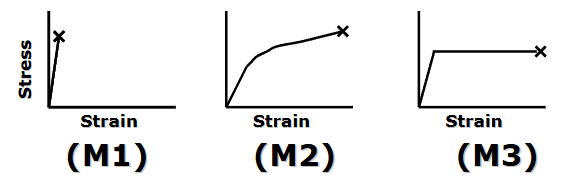
From the stress-strain curve, we can tell if a material will increase its yield strength after cold forming. Among the three materials shown above, which material(s) will have increased yield strength after cold forming?
(A) M1. (B) M2. (C) M3.
(D) M1 and M2. (E) M2 and M3.
B.
A mold is needed for __________ casting processes.
(A) all (B) some.
A.
The size of a pattern is __________________ the size of the part to be cast.
(A) smaller than (B) the same as (C) larger than
C.
A pattern is needed for _________ casting processes.
(A) all (B) some
B.
Which one of the following statements regarding sand casting is false?
(A) Sand casting is the most popular of the casting processes.
(B) Sand casting can produce very large parts.
(C) The dimension variation from casting to casting produced by sand casting is the least among all
casting processes.
(D) Patterns are always needed in sand casting.
C.
A pattern is __________ needed for sand casting.
(A) always (B) sometimes
A.
Which one of the following statements regarding investment casting is false?
(A) Investment casting is a complex process and tends to be rather expensive.
(B) Investment casting can produce very large parts.
(C) Extremely complex shapes can be cast as a single piece.
(D) Patterns are always needed in investment casting.
B.
Which one of the following statements regarding die casting is false?
(A) Die casting dies are usually made from tool steels and tend to be rather expensive.
(B) In die casting, to permit removal of the casting, the dies must open, separating into at least two
pieces.
(C) Die casting can typically produce parts with excellent dimensional precision and surface qualities.
(D) Patterns are always needed in die casting.
D.
Usually, patterns and molds in sand casting cost _________ than the dies in die casting.
(A) less (B) more
A.
Which process is preferable for small production runs?
(A) Sand casting. (B) Die casting.
A.
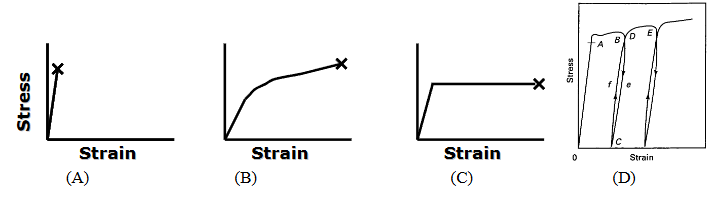
Among the illustrations below, which one is the most useful one to explain strain-hardening?
D.
Normally, the products of ___________ can only be obtained in standard shapes and sizes.
(A) rolling (B) extrusion (C) forging
A.
Which of the following forming processes is “like squeezing toothpaste out of a tube.”
(A) rolling (B) extrusion (C) forging
B.
In the segment of Lord of Rings movie, what manufacturing processes have you seen (circle all you have seen)?
(A) Machining (grinding). (B) Casting.
(C) Forming (forging). (D) Heat treatment (quenching).
(E) Welding.
A, B, C, and D
The forged parts are most likely to have ______________.
(A) isotropic grain structure (B) directional grain flow
B.
Which property has the least effect on forgeability?
(A) Material’s composition. (B) Crystal structure.
(C) Mechanical properties. (D) Density.
D.
________________ is more suitable for parts with complex shape.
(A) Open-die forging (B) Close-die forging
B.
________________ usually requires more expensive equipment. (Mentioned at 10:00- min in video)
(A) Open-die forging (B) Close-die forging
B.
Most parts forged by ________________ are small to moderate in size.
(A) open-die forging (B) close-die forging
B.
One major difference between isothermal forging and hot-die forging is the die temperature. For ________, the die-temperature keeps the same as the forging temperature of the material. But for the other, the die-temperature is lower than the forging temperature.
(A) hot-die forging (B) isothermal forging
B.
To be suitable for forging, the metal material must have sufficiently high ___________ (pick only one)?
(A) Elastic modulus (B) Yield strength (C) Tensile strength
(D) Ductility (E) Toughness
D.
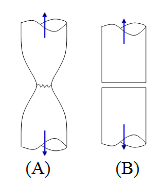
Which material has higher elastic modulus? (A) (B) (C) cannot tell
Which material has higher yield strength? (A) (B) (C) cannot tell
Which material has higher ductility? (A) (B) (C) cannot tell
Which material has higher tensile strength? (A) (B) (C) cannot tell
C,A,A,C
Which one of the following statements about rolling and forging is true?
(A) Rolling is a cold-working process while forging is a hot-working process.
(B) Rolling is a hot-working process while forging is a cold-working process.
(C) Both rolling and forging can be either a cold-working process or a hot-working process.
A.
The products produced by cold-working processes are ______ ductile than those by hot-working processes.
(A) more (B) less
B.
In bending, the metal is deformed ____________________
(A) beyond its yield strength but below its ultimate tensile strength.
(B) beyond its ultimate tensile strength.
(C) below its yield strength.
A.
In shearing, the metal is deformed ____________________
(A) beyond its yield strength but below its ultimate tensile strength.
(B) beyond its ultimate tensile strength.
(C) below its yield strength.
B.
Springback is associated with ___________
(A) shearing. (B) bending.
B.
Both piercing and blanking are shearing operations. The difference is that the piece being punched out becomes the _____________
(A) workpiece for piercing (scrap for blanking).
(B) scrap for piercing (workpiece for blanking).
B.
In the video “How It’s Made – Aluminum Cans,” the aluminum sheet is fed into to a press that punches out round pieces that will be formed into cans. This process is called _____________.
(A) blanking (B) piercing
A.
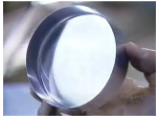
After the press punches out the disk, it also changes the disk into a cup as shown.
Technically speaking, this process (of transforming the disk into a cup) should be called
__________.
(A) bending (B) drawing
B.
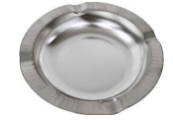
Which forming process would you choose to manufacture the ashtray as shown?
(A) Piercing. (B) Blanking.
B.
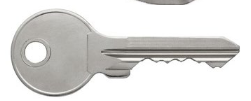
To manufacture the key as shown by forming processes, which one of the
following statements most likely is true?
(A) Both piercing and blanking operations are needed.
(B) Only piercing operation is needed.
(C) Only blanking operation is needed.
(D) Neither piercing nor blanking is needed.
A.
Which one of the following is not associated with casting?
Porosity.
Work hardening.
Shrinkage.
Melting.
Work hardening.
Casting is used _____________________
mainly in automotive industry.
in virtually every industry.
in virtually every industry.
Casting is usually the ________ way to shape a metal into a part.
slowest
quickest
quickest
Casting is used _____________________
mainly for production of large quantity parts.
for both prototyping and production of large quantity parts.
mainly for prototyping.
for both prototyping and production of large quantity parts.
Parts with thin sections are usually _______________ to cast.
easier
more difficult
more difficult
Centrifugal casting usually produces _________ casting than other casting processes.
denser
less dense
denser
Casting is only suited to ferrous metals such as cast iron.
False.
True.
False.
Sand casting is which of the following types of casting process?
Permanent Mold.
Expendable Mold.
Expendable Mold.
Which one of the following metals is commonly cast in permanent mold casting?
Magnesium
Nickel
Steel
Tungsten
Magnesium
Which one of the following is NOT an advantage of die casting over sand casting?
Larger parts can be cast
Which one of the following can achieve greater improvement on most mechanical properties of steels?
Adding more alloy elements.
Heat treatment.
Heat treatment.
Which one of the following represents the most common heat treatment processes?
Softening.
Hardening.
Hardening.
Generally speaking, as the carbon content increases, the hardness of the steel will ________.
decease
increase
increase
Which one of the following is NOT among the purposes of heat treatment?
To decrease strength and hardness.
To harden only the surface of a part without changing the interior properties.
To increase strength and hardness.
To alter the shape of a part.
To alter the shape of a part.
Which of the following orders represents the hardness order (from hardest to softest) of the structures?
Pearlite > bainite > martensite.
Martensite > pearlite > bainite.
Bainite > pearlite > martensite.
Martensite > bainite > pearlite.
Martensite > bainite > pearlite.
Generally speaking, heat treatment _________ reduce brittleness of metal materials.
can
cannot
can
Tempering is a heat treatment applied to hardened steels. It is best defined as ___ _____.
heating and soaking at a temperature above the austenitizing level followed by slow cooling.
heating and soaking at a temperature below the austenitizing level followed by rapid cooling.
heating and soaking at a temperature above the austenitizing level followed by rapid cooling.
heating and soaking at a temperature below the austenitizing level followed by slow cooling.
heating and soaking at a temperature below the austenitizing level followed by slow cooling
The alloying elements in steel increase its hardenability by moving the nose of the TTT curve ___________________.
downward
to the right
to the left
upward
to the right
Which one of the following furnace types are generally used for higher production rates?
batch
continuous
continuous
The most common method for measuring hardenability is ________________.
tensile test
Jominy end-quench test
Brinell hardness test
Rockwell hardness test
Jominy end-quench test
Manufacturing is classified as which one of the following industry categories?
Primary industry
Secondary industry
Tertiary industry
Secondary industry
Mining is classified as which one of the following industry categories?
Primary industry
Tertiary industry
Secondary industry
Primary industry
Products purchased by companies to produce products or provide services are called which one of the following?
Manufactured products
Capital goods
Consumer goods
Aassembled products
Final products
Capital goods
Ferrous metals include which of the following?
Copper
Aluminum
Nickel
Steel
Gold
Steel
Which one of the following engineering materials is defined as a compound containing metallic (or semi-metallic) and nonmetallic elements?
Ceramic
Composite
Alloy
Metal
Polymer
Ceramic
Which one of the following polymers can be subjected to multiple heating and cooling cycles without substantially altering its molecular structure?
Thermoplastic polymers
Elastomers
No answer text provided.
Thermosetting polymers
Thermoplastic polymers
Which one of the following manufacturing processes starts with a material that is in a fluid or semifluid state and solidifies the material in a cavity?
Machining
Pressing
Forging
Casting
Turing
Casting
Particulate processing of metals involves which one of the following steps?
Sintering
Adhesive bonding
Deformation
Melting
Forging
Sintering
Deformation processes include which one of the following?
Forging
Casting
Drilling
Sintering
Milling
Forging
Which one of the following operations is classified as material removal processes?
Forging
Brazing
Anodizing
Grinding
Sintering
Grinding

