Forces and Motion
 Call Kai
 Learn
Learn Practice Test
 Spaced Repetition
 Match
Match Flashcards
 Knowt Play
1/25

There's no tags or description
Looks like no tags are added yet.
Name | Mastery | Learn | Test | Matching | Spaced | Call with Kai |
|---|
No analytics yet
Send a link to your students to track their progress
26 Terms
explain what is meant by a scalar quantity. give 2 examples
a scalar quantity is a magnitude only. it can be described fully with a single numerical value e.g. distance, speed, time, mass, energy
explain what is meant by a vector quantity. give 2 examples
a vector quantity has both a magnitude and a direction e.g. force, velocity, displacement, momentum
which property of a distance-time graph can be used to calculate speed
gradient or slope
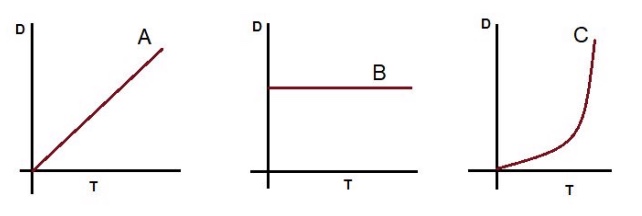
for the d-t graphs given below, decide which one is at a rest, which one is moving with a constant speed and which one is accelerating
a = constant speed
b = at a rest
c = accelerating
what is meant by acceleration? give its unit
acceleration is the change in velocity per unit of time. unit = m/s²
which property of a v-t graph can be used to calculate acceleration
gradient(slope)
which property of v-t graph can be used to calculate distance travelled
area under the graph
identify the types of forces acting on the objects
A = Weight
B = Air resistance
name 2 types of forces that always opposes motion
friction
air resistance (drag)
a) which type of force holds planets around the sun?
b) which type of force holds electrons around nucleus
a) gravitational force
b) electrostatic force
state the ways that a force can afect the body that it is being applied on
it can change the shape of the object (extension/compression)
it can change the speed of the object
it can change the direction the object is moving
state factors that affect the stopping distance
reaction time
initial speed
road conditions
tire conditions
weather conditions
driver’s conditions
mass of the car
state 2 factors that affect the air resistance acting on a falling object
surface area
speed
describe how a falling object reaches to terminal velocity
at first object falls under the effect of its weight accelerating with g. as it accelerates, air resistance opposing the motion increases therefore resultant force acting on the object decreases and since F=ma, acceleration decreases.
when air resistance becomes equal to weight, forces are baalnced so resultant force = 0 therefore a = 0 and object reaches to terminal velocity
state hooke’s law
extension is durectly proportional to the force applied
explain what is the difference between elastic and plastic behaviour
in elastic behaviour, object recovers its original shape when the forces causing the extension is removed
in plastic behaviour, there is a permanent deformation to the shape of the object
what is the Newton’s first law
if a stationary object’s resultant force is zero, the object will remain stationary. if a moving object’s resultant force is zero, the object will continue to move at a constant velocity (same speed and direction)
what is the Newton’s second law
an object’s acceleration is directly proportional to the resultant force acting on it, and inversely proportional to the object’s mass
what is the Newton’s third law
the forces that two objects exert on each other when they interact are equal and opposite
what is terminal velocity
the maximum velocity an object can reach when falling through a fluid. it occurs when the resistive forces equal the object’s weight
what is elastic limit
the force beyond which an object will no longer deform elastically, and will instead deform plastically
what are the types of forces
gravitational force (weight)
reaction force = when an object rests on a surface, the surface exerts a push force on the object
friction = occur when two surfaces move over one another (always oppose the motion of an object, causing it to slow down)
drag = type of frictional force that occurs when an object moves through a fluid (a gas or a liquid). the particles in the fluid collide with the object moving through it and slow its motion
air resistance = specific type of drag force and is therefore also a frictional force ( occurs when particles of air collide with an object moving through it and slows its motion
thrust = force produced by an engine that speeds up the motion of an object
upthrust = when an object is fully or partially submerged in a fluid, the fluid exerts an upward-acting push force on the object
electrostatic = force between two objects with charge
Like charges repel one another, and opposite charges attract one another
When an electron gets close to a positively charged ion, the ion exerts a pull force on the electron (attraction)
When an electron gets close to another electron, the electrons experience a push force from one another (repulsion)
magnetic = force between objects with magnetic poles
Like poles repel one another, opposite poles attract one another
When a north pole gets close to a south pole, they experience a pull force from one another (attraction)
When a north pole gets close to a north pole, they experience a push force from one another (repulsion)
tension = occurs in an object (like a rope or spring) that is stretched. When a pull force is exerted on each end of an object, tension acts across the length of the object
what is thinking distance
the distance travelled in the time it takes the driver to react to an emergency and prepare to stop
what is reaction time
a measure of how much time passes between seeing something and reating to it
braking distance
the distance travelled under the braking force in metres (m)
state factors that affect the reaction time
tiredness
distractions (using a mobile phone)
intoxication (alcohol or drugs)

