Calc 2 Chap 1.1 Formulas/ Processes to Memorize
 Studied by 0 people
 Call with Kai
 Learn
Learn Practice Test
 Spaced Repetition
 Match
Match Flashcards
 Knowt Play
1/19

Earn XP
Description and Tags
1.1
Name | Mastery | Learn | Test | Matching | Spaced | Call with Kai |
|---|
No study sessions yet.
20 Terms
(power rule)
∫xndx
((xn+1)/(n+1))+C , x≠-1
∫(1/x)dx
ln⏐x⏐+c
∫exdx
ex+C
∫sinxdx
-cox(x)+C
∫co(x)dx
sin(x)+C
∫(1/1+x2)dx
tan-1(x)+C
∫sec2(x)dx
tan(x)+C
∫sec(x)tan(x)dx
sec(x)+C
∫{1/√(1-x2)}dx
sin-1x+C
∫eaxdx
(1/a)eax+C
∫cox(ax)dx
(1/a)sin(ax)+C
∫sin(ax)dx
(1/a){-cos(ax)"}+C
Chain Rule
d/dx(f(g(x))
f’(g(x))*g’(x)
Steps to Substitution
look for the inside function (u)
Calculate du=(du/dx)dx
convert to an interval of u
integrate with respect to u
re write with respect to x
∫{1/(x2+a2)}dx
(1/a)tan-1(x/a)+C
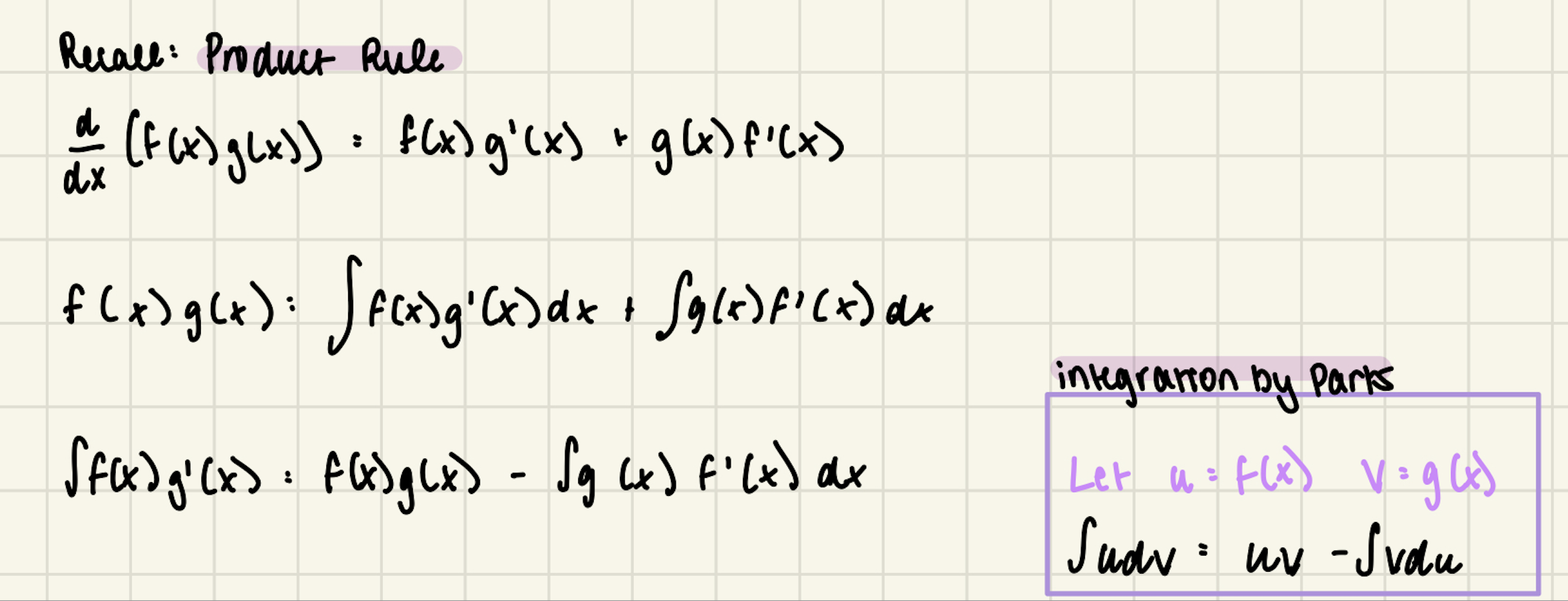
Product Rule
(d/dx){f(x)g(x)}
f(x)g’(x)+g(x)f’(x)
Integration by Parts formula
Let u = f(x), v=g(x)
∫udv=uv-∫vdu
How to get from the product rule to integration by parts
LIATE
a method for finding “u” in integration by parts, go in order
Log
Inverse Trig
Algebraic (x3,5x+x,√x)
Trig
Exponential (ex, 5x, lnx)
 Note
Note  Flashcards (51)