Critical Thinking & The Nursing Process
 Studied by 0 people
 Call with Kai
 Learn
Learn Practice Test
 Spaced Repetition
 Match
Match Flashcards
 Knowt Play
1/65

There's no tags or description
Looks like no tags are added yet.
Name | Mastery | Learn | Test | Matching | Spaced | Call with Kai |
|---|
No analytics yet
Send a link to your students to track their progress
66 Terms
Critical Thinking
aka “the process”
active, organized, cognitive process used to carefully examine one’s thinking and the thinking of others
Clinical Judgment
aka “the final decision”
the way nurses come to understand the problems, issues, or concerns of patients, attend to info, and respond in a concerned and involved way
How do you think critically and make clinical judgements?
(diagram)
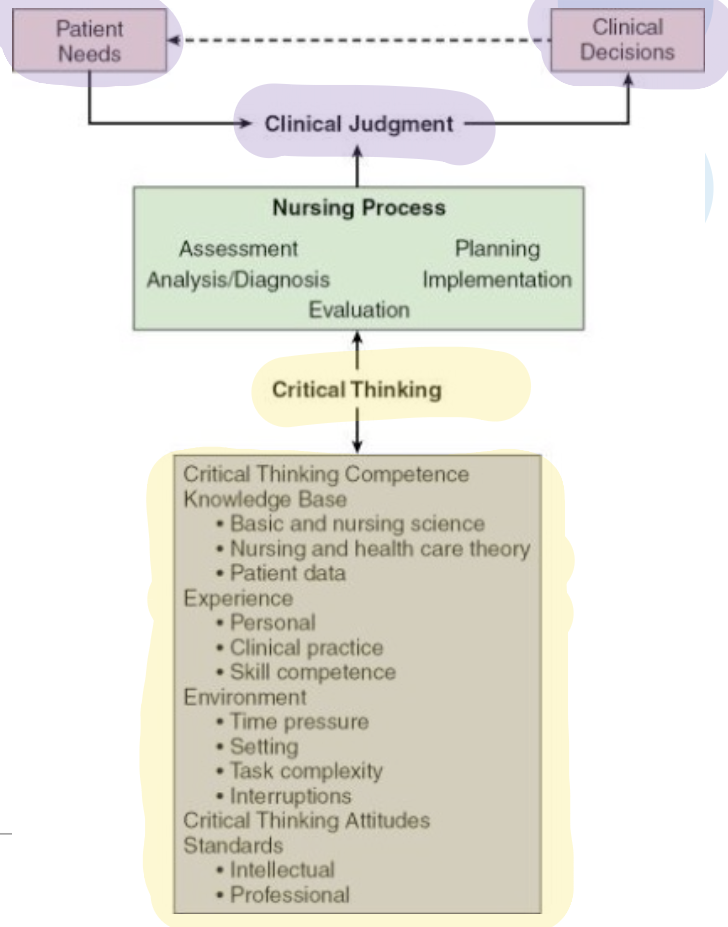
Nursing Process: ADPIE
A: Assessment (recognize cues)
D: Diagnosis (analyze cues and prioritize hypotheses
P: Planning (generate solutions)
I: Implementation (take action)
E: Evaluation (evaluate outcomes)
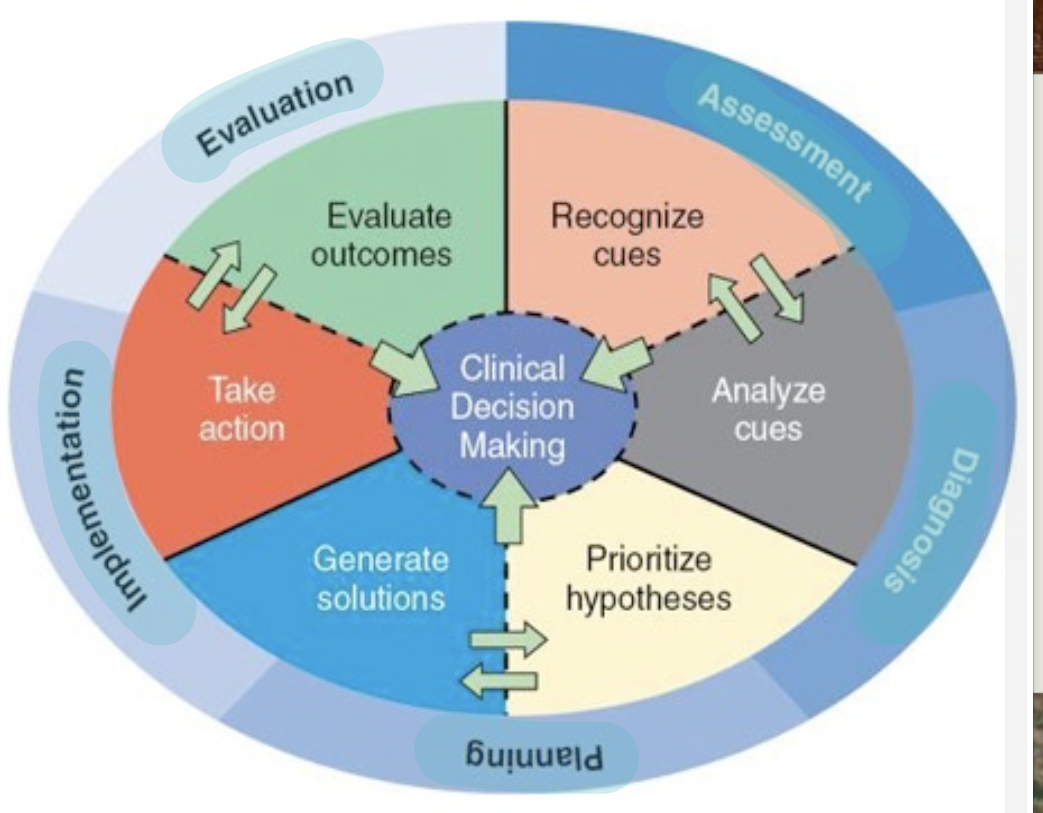
Which ADPIE: Looking at the stove, are my burners on? Is it plugged in? Is the power out?
Assess example
Which ADPIE: Realize I turned on the wrong burner.
Diagnose example
Which ADPIE: How do I fix this? What’s the goal?
Plan example
Which ADPIE: Turn on the correct burner.
Implement / Take action example
Which AIDPIE: Is my water heating now?
Evaluate example
ADPIE in Nursing
Assess: collect info
Diagnose: identify actual or potential problems
Plan: make a plan based on the problem
Implement: take action
Evaluate: did it work?
Assessment Definition
deliberate and systematic collection of patient info
info gathered tells us a lot about the patient
Assessment Purpose
helps establish a baseline
identify risk factors
individualize care
helps develop a nursing diagnosis
A: Recognizing Cues Process (3)
data collection
validation of data
interpretation of data
A: Data Collection Process
observation
interview
orientation phase
working phase
termination phase
examination
interpretation of data
Types of Data Collections and Definitions
subjunctive (what they say)
objective (what you see)
Components of Nursing Health History (10)
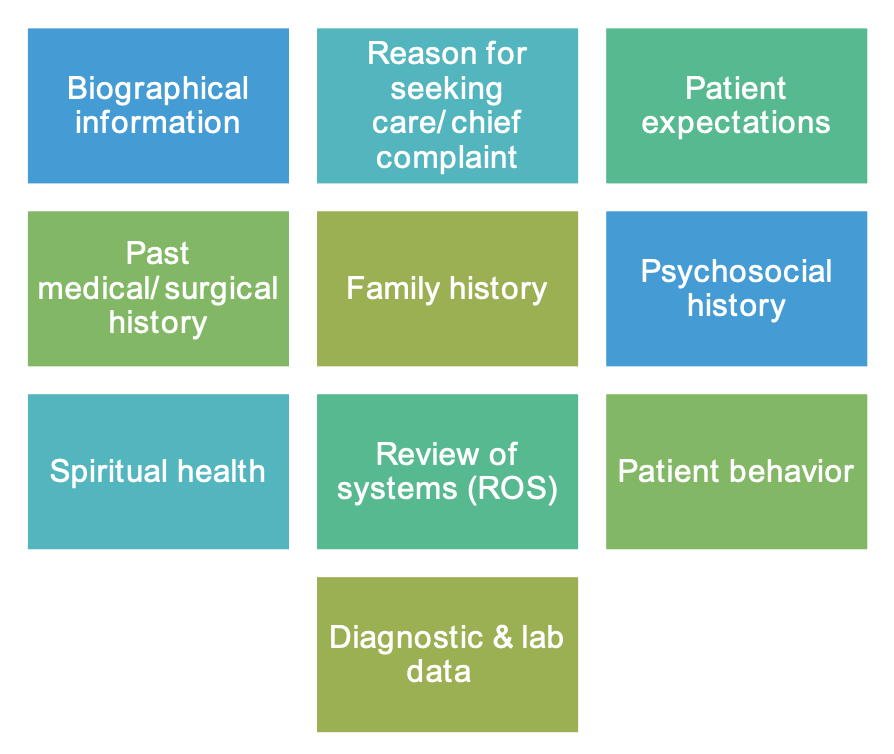
AIDPIE: Diagnosis Definition
the patient’s actual or potential response to a health problem that is used as the basis for outcomes and nursing interventions
analyze cues and prioritize hypotheses
Types of Diagnoses (2)
medical diagnosis
identifies the disease/condition based on a specific evaluation of physical sign/symptoms, medical history, diagnostic tests, and procedures
identified by physicians and APRNs
vs.
nursing diagnosis
a clinical judgement made by a nurse to describe a patient’s response or vulnerability to health conditions/ life events that licensed nurse is competent to treat
identified by nurses
defining characteristics =
= clinical signs/symptoms
Types of Problems (2)
actual problem
nursing diagnosis supported by defining characteristics
it’s actually happening
potential problems
something that we want to avoid
no defining characteristics are identified by the risk factors could lead to an actual problem
“risk for”
health promotion
readiness for enhanced
desire to improve
Diagnostic Process
assess: collect and validate info
cluster and sort data
identify concepts and themes based on defining characteristics
Steps for Determining the Nursing Diagnosis
identify general concept in Pocket Guide Category
skim nursing diagnoses to see if any match/stick out
look into all of those to determine which fits the patient BEST based on their assessment data
Nursing Pocket Guide Categories
(image)
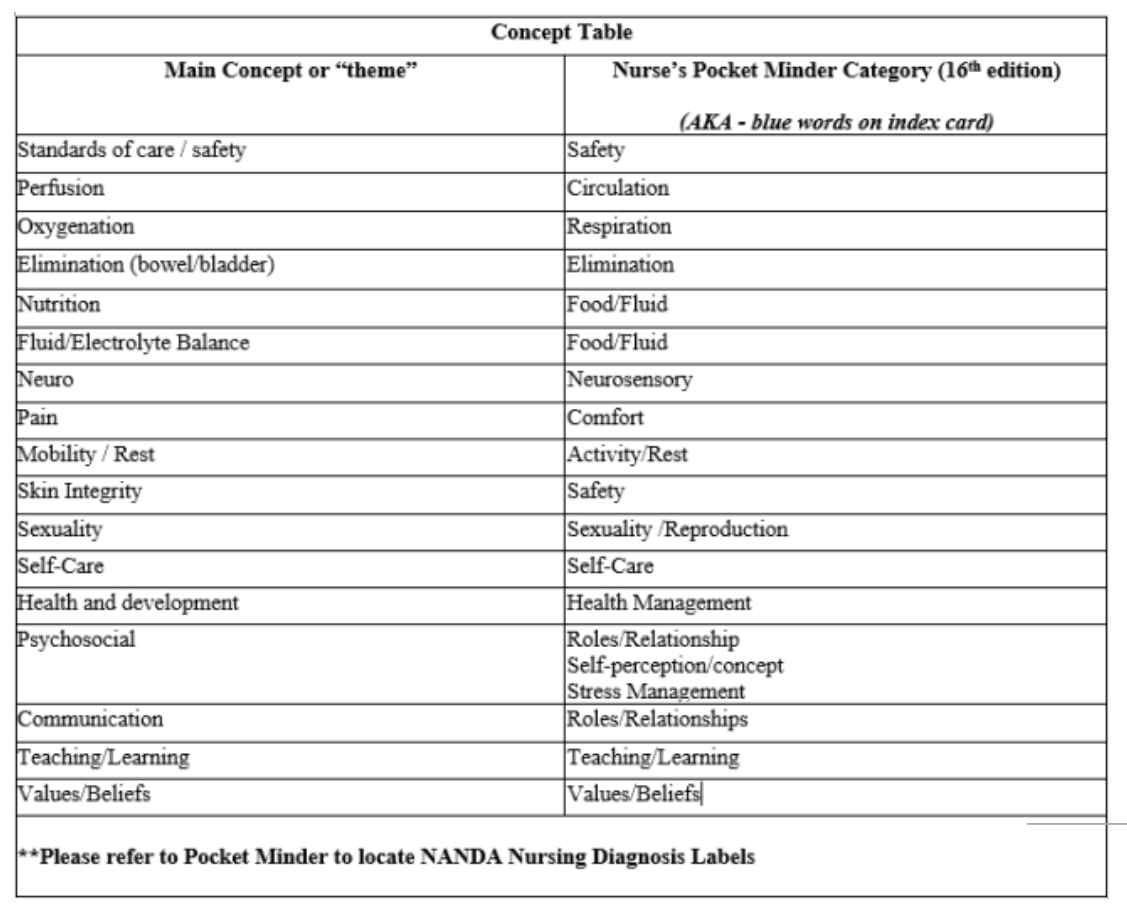
Dx/ Division + Definition
(example image)
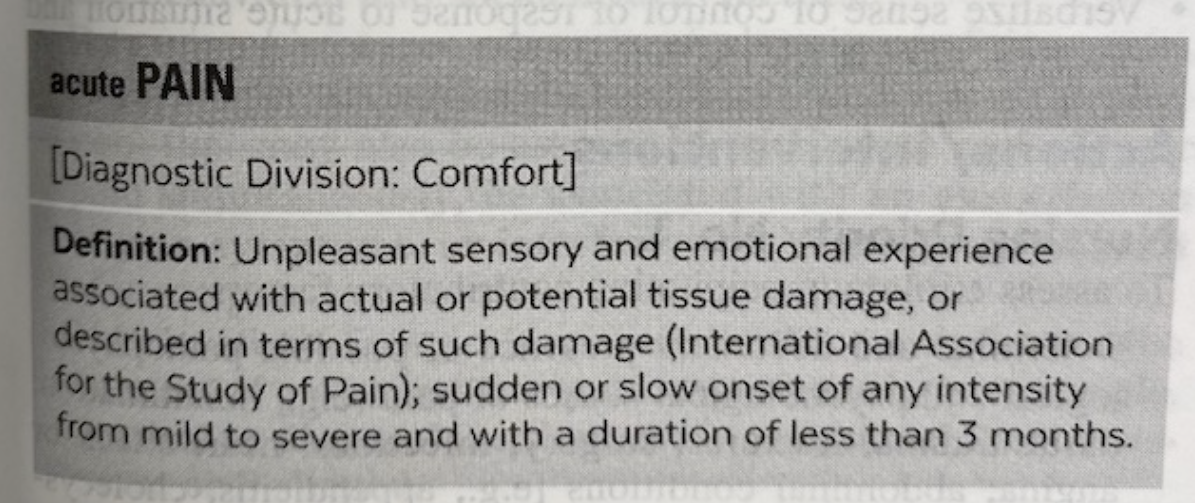
Etiology + Defining Characteristics
take the etiology and compare it to patients defining characteristics
etiology = related factors
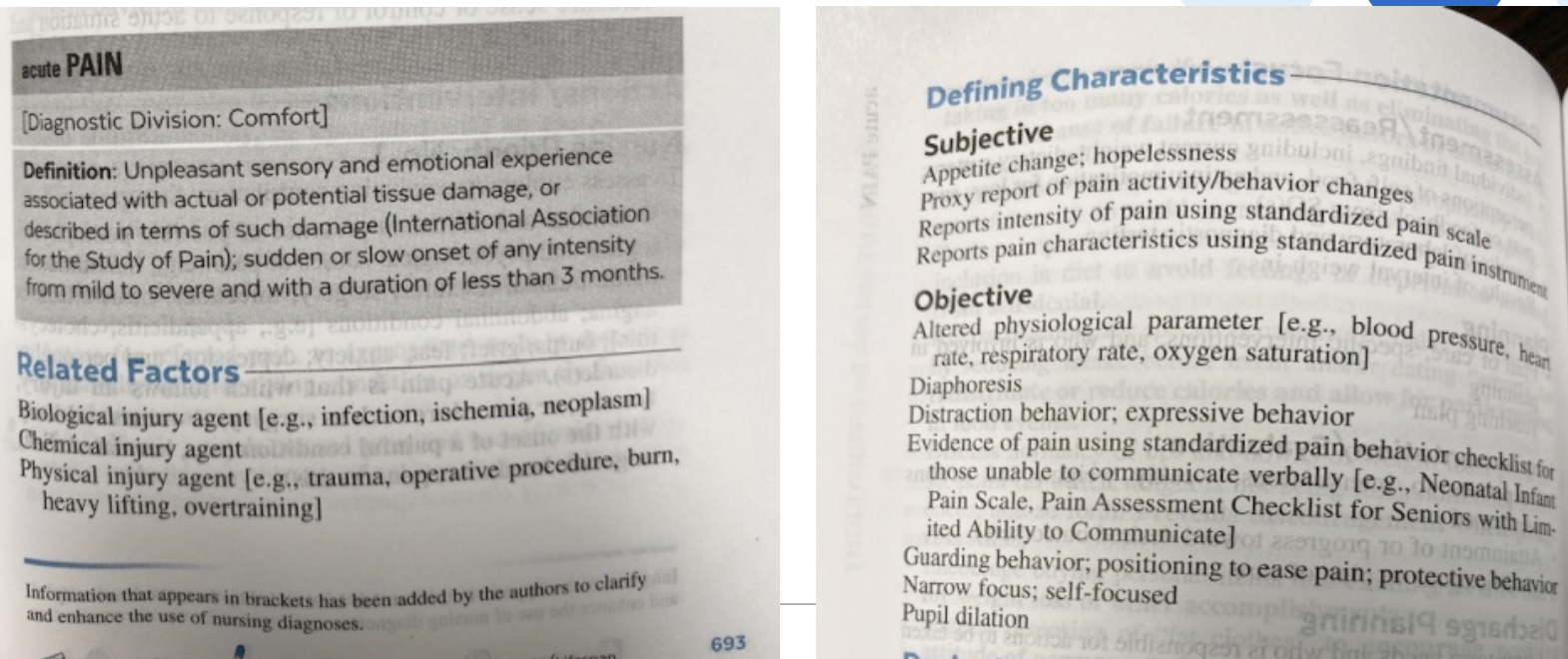
Rules & Tips to Identify the Nursing Diagnosis (7)
collect as much info as possible
cluster with care
identify
a patient’s response to a health problem
a related or risk factor that we can treat with a nursing intervention
a problem caused by the treatment or medical condition
don’t try and make it “fit”
one diagnosis per category/concept usually
only write nursing diagnosis as listed
CANNOT write verbatim (copied exactly) from Pocket Guide
3 Part Statement Components
Part 1: general concept + nursing diagnosis
Part 2: etiology of the problem (r/t)
cause
Part 3: defining characteristics (a/m/b)
signs and symptoms that prove the problem
Label parts of 3 part statement:
pain + acute pain
as manifested by (a/m/b) complaints of pain 9/10 on a 0-10 scale, laying in the fetal position on their bed, and groaning “oh, it hurts so much!”
related to (r/t) tissue inflammation secondary to appendicitis
Part 1: pain + acute pain
Part 2: related to (r/t) tissue inflammation secondary to appendicitis
Part 3: as manifested by (a/m/b) complaints of pain 9/10 on a 0-10 scale, laying in the fetal position on their bed, and groaning “oh, it hurts so much!”
“Secondary to…”
indicates that a nursing diagnosis (problem) arises as a result of a specific medical diagnosis or underlying physiological condition
included sometimes in 3 part statements
confirmed diagnosis
Label parts of 3 part statement:
related to (r/t) medication side effects secondary to chemotherapy
as manifested by (a/m/b) complaints of feeling sick to her stomach, states “I vomited less than 25% of meals
nutrition + nausea
Part 1: nutrition + nausea
Part 2: related to (r/t) medication side effects secondary to chemotherapy
Part 3: as manifested by (a/m/b) complaints of feeling sick to her stomach, states “I vomited less than 25% of meals
Label parts of 3 part statement:
as manifested by (a/m/b) tension headaches 3x/week, lashing out at friends and loved ones, reports feelings of being “overwhelmed” and “having too much to do in a short period of time”, consistently chewing nails
related to (r/t) sudden lack of social life, multiple exams and assignments, secondary to nursing school
psychosocial + stress overload
Part 1: psychosocial + stress overload
Part 2: related to (r/t) sudden lack of social life, multiple exams and assignments, secondary to nursing school
Part 3: as manifested by (amb) tension headaches 3x/week, lashing out at friends and loved ones, reports feelings of being “overwhelmed” and “having too much to do in a short period of time”, consistently chewing nails
Dissect 3 Part Statement:
Noncompliance related to negative side effects of prescribed treatment as manifested by not taking prescribed medicine.
(Identify problem, etiology, and defining characteristics)
Problem: noncompliant
Etiology: negative side effects of prescribed treatment
Defining Characteristics: not taking prescribed medicine
Dissect 3 Part Statement:
Constipation related to presence of hemorrhoids, immobility and routine use of codeine as manifested by no BM in 4 days.
(Identify problem, etiology, and defining characteristics)
Problem: constipation
Etiology: presence of hemorrhoids, immobility and routine use of codeine
Defining Characteristics: no BM in 4 days
Dissect 3 Part Statement:
Risk for infection related to invasive procedures (two peripheral IVs, one surgical incision) and malnourished state (weight of 102 lbs., albumin 2.4)
(Identify problem, etiology, and defining characteristics)
Problem: risk for infection
Etiology: invasive procedures (two peripheral IVs, one surgical incision) and malnourished state
Defining Characteristics: n/a
Make 3 Part Statement:
Our newly admitted patient reports 4-5 loose, liquid stools per day and cramping in their stomach. The patient states that when they have to go, they “have to go NOW”. Patient has hyperactive bowel sounds in all 4 quadrants and has been taking colace 3x/ day for the last week.
Part 1: Concept (elimination) + nursing diagnosis (diarrhea)
Part 2: r/t Colace use 3x day for the last week
Part 3: a/m/b 4-5 liquid stools/day, cramping in stomach, they have to go NOW, hyperactive bowel sounds in all 4 quadrants
Make 3 Part Statement:
Client states he hardly slept all night, roomate requires much nursing care around the clock. The roommates medication is scheduled for 12am, 6am, 12pm, 6pm. The client stated he’s too tired to go to physical therapy. He appears listless and uninterested in his surroundings.
Part 1: concept (activity/rest) + nursing diagnosis (sleep pattern, disturbed)
Part 2: r/t roommates nursing care around the clock / medication schedule for 12am, 6am , 12, 6pm
Part 3: a/m/b client states he “hardly slept all night: stated he’s “too tired to go to physical therapy”, appears listless and uninterested in his surroundings
Make 3 Part Statement:
Bob is an 89 year old man who has an unsteady gait, disoriented at times, voids 3-4 times during the night. He prefers to use the bathroom rather than use the urinal or bedside commode.
Part 1: concept (safety) + nursing diagnosis (falls, risk for)
Part 2: r/t unsteady gait, disorientation, voids 3-4 times during the night, prefers to go to the bathroom rather than use the urinal or bedside commode
Part 3: a/m/b none
ADPIE: Planning
setting patient centered goals and outcomes and creating nursing interventions
identifying goals + outcomes
outcome = big picture
goals = what can the patient do an show
creating nursing interventions
What can we do as nurses to help?
generate solutions
Maslow’s Hierarchy of Needs
(diagram)
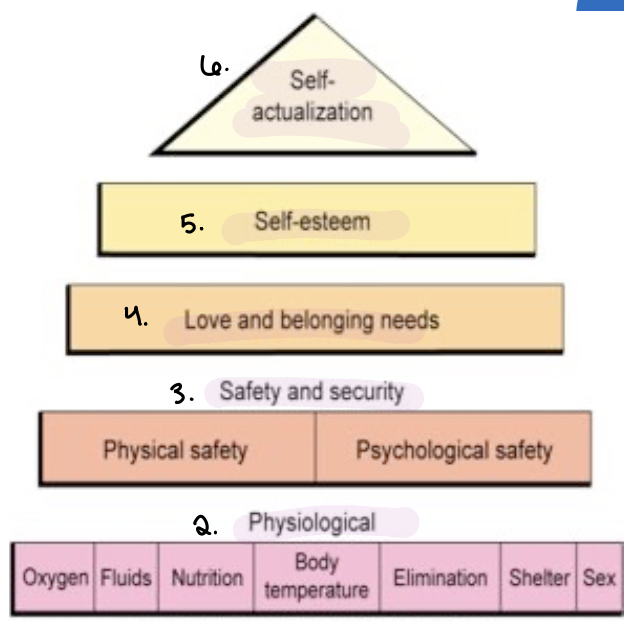
Prioritizing Situation
(diagram and 3ish questions to ask)
establishing priorities
What is the need?
risk vs. actual problem
prioritize current issues first
How urgent is the problem?
check ABC + P then Maslow’s Hierarchy of Needs
What kind of outcome will it be?
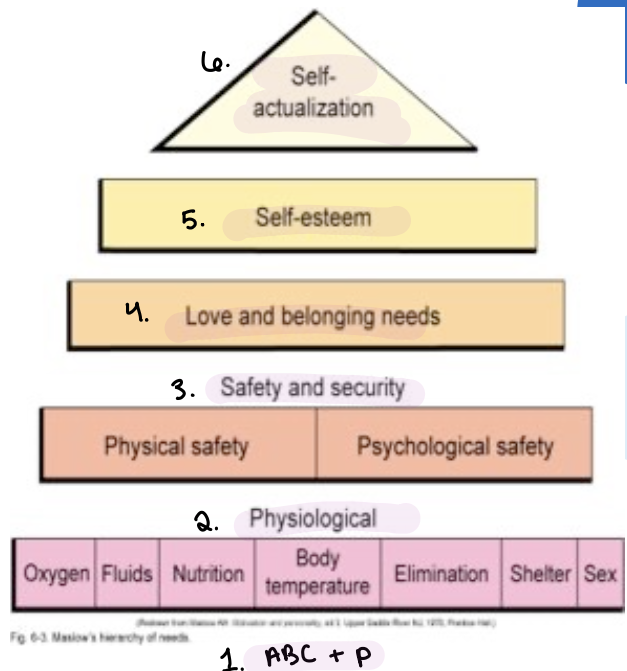
Besides, ABC+P and Maslows Hierarchy, what should be considered when prioritizing and planning care? (4)
What does the patient want?
Culture, values, and beliefs
Cost, resources, personnel, time
State law and hospital policy
Why is prioritizing in the planning process important?
safe patient care
time management
Types of Goals (2)
intermediate (short term, a specific date or time)
long term
Purpose of Goals
set clear direction for nursing interventions
measurement of success
motivating factor
Parts of a Goal Statement (4)
client behavior (action, “the patient will…”)
criteria of performance (how far/how much?)
conditions (if needed, like do they need assistance to complete goal)
time frame
Create one short and long term goal:
Part 1: pain + acute pain
Part 2: related to (r/t) tissue inflammation secondary to appendicitis
Part 3: as manifested by (a/m/b) complaints of pain 9/10 on a 0-10 scale, laying in the fetal position on their bed, and groaning “oh, it hurts so much!”
Short Term: The patient will verbalize/display a pain scale of less than 5/10 on a 0-10 pain scale by end of the shift
Long Term: The patient will demonstrate 2 methods of non pharmacological pain management (deep breathing and guided imagery) once by discharge.
ADPIE: Implementation Definition
treatments or actions that nurses perform to meet individual patient outcomes
taking action
Implementation Task
performing nursing and collaborative interventions needed to achieve the goals/overcomes necessary to support or improve health
nursing scope of practice
Methods of Implementation Types (2)
direct care
indirect care
Types of Interventions (5)
standard nursing interventions
clinical practice guidelines, care bundles
standing orders
NIC = nursing intervention classifications
standard of practice
QSEN = quality and safety education for nurses
independent nursing interventions
nurse initiated
based on scientific evidence based rationale
dependent nursing interventions
provider initiated (MP, NP, PA)
interdependent interventions
consults with interdisciplinary team
delegated
consider scope of practice
Nursing Interventions MUST be: (7)
safe
achievable
acceptable to clients values and beliefs
congruent with other therapies
based on nursing knowledge/evidence
within standards of practice
based on rational appropriate to the outcomes and situation
To Consider for Interventions (6)
desired patient outcomes
characteristics of the nursing diagnosis
research base knowledge for the intervention
Is it feasible?
cost, time, resources, etc.
Is it acceptable to the patient?
informed consent
competency of nurse
rationale and using resources
Writing Interventions (HAT Method)
H: How/Method
A: Action/Amount
T: Timing/Frequency
ask how often?
(always end with rationale and citation)
Example: Administer Percocet (hydrocodone/acetaminophen) 5/325 mg 2 tablets PO every 4 hours as needed for mild to moderate pain (treat pain). (insert citation)
When writing Interventions always use a ___ at the beginning.
(7 examples of ___)
VERB
examples
assess and document
encourage
administer
promote
consult (provider)
educate
What is wrong with this intervention statement?
Assess respiratory rate and quality, lung sounds.
needs time
no rational or citation
What is wrong with this intervention statement?
Administer Ancef q 4 hrs
how much?
how to administer?
no rational or citation
What is wrong with this intervention statement?
Administer cough medication
what kind?
when?
how to administer?
no rational or citation
Create an intervention statement:
3 part statement:
Part 1: pain + acute pain
Part 2: related to (r/t) tissue inflammation secondary to appendicitis
Part 3: as manifested by (a/m/b) complaints of pain 9/10 on a 0-10 scale, laying in the fetal position on their bed, and groaning “oh, it hurts so much!”
Short Term Goal: The patient will verbalize/display a pain scale of less than 5/10 on a 0-10 pain scale by end of the shift
Assess and document pain on a pain scale of 0-10 (0 being no pain an 10 being the most pain every hour or as needed (citation).
ADPIE: Evaluation Definition
determines whether a patient’s condition or well being improved after nursing interventions were delivered
What are we evaluating in the nursing process?
the goals/outcomes of patients
What does evaluation tell us?
clients response or progress
measures the need to modify or revise the car plan
quality of nursing care
Evaluation Process Steps (3)
examine the results
goal met, partially, or not?
identify errors
barriers?
correct errors + revise care plan
Components of Evaluation Statement if Goals NOT Met or Partially Not Met (5)
state whether the goal was not met or partially met
HOW do you know?
WHY was the goal not met/partially not met?
WHAT will you do to help them meet the goal?
“Will continue to monitor/promote ___.”
Components of Evaluation Statements if Goal Met (3)
state whether the goal was met
HOW do you know?
“Will continue to monitor/promote ___.”
Create an Evaluation Statement:
diagnosis: airway clearance, ineffective
goals, the patient will…
display resp 16-20/min, non labored by the end of shift
maintain an O2 sat of greater than 90% on room air by discharge
goals met in scenario
Respirations 18 per minute, non labored, Will continue to monitor.
O2 saturation at 97% on room air. Will continue to monitor
Create an Evaluation Statement:
diagnosis: airway clearance, ineffective
goals, the patient will…
display clear lung sounds upon auscultation by 4/4/2022
verbalize 2 relaxation techniques (meditation and yoga) by discharge
goals not met/partially met in scenario
Crackles noted to bilateral bases upon auscultation. Patient has been refusing to participate in breathing exercises and stated, “I just don’t understand how these will help me”. Will provide education regarding breathing exercises. Will continue to monitor
Client able to verbalize 1 relaxation technique (yoga) at this time. Unable to identify two due to distraction by favorite television show. Will reeducate when TV is turned off. Will continue to monitor
 Note
Note  Flashcards (37)