Host-Microbe Interaction and Immunology
 Call Kai
 Learn
Learn Practice Test
 Spaced Repetition
 Match
Match Flashcards
 Knowt Play
1/44

Earn XP
Description and Tags
These flashcards cover key terms and concepts related to host-microbe interactions, immunology, and microbiological applications.
Name | Mastery | Learn | Test | Matching | Spaced | Call with Kai |
|---|
No analytics yet
Send a link to your students to track their progress
45 Terms
Clinical Infection
Infections with observable signs and symptoms.
Subclinical Infection
Infection with a pathogen, but without symptoms.
Localized Infection
Infection confined to one area of the body.
Systemic Infection
Infection that spreads to different areas of the body.
Iatrogenic Infection
Infection that originates from a medical practitioner or health professional.
Exogenous
infection from external environment
Endogenous
infection from within the human host
Transmission Modes
Various ways infections can spread, including contact, vehicle, and vector transmission.
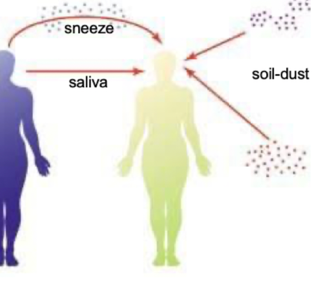
Respiratory-salivary route
Droplets – sneezing propels mucus droplets, transmitting virus to a new host
Saliva
Soil-dust
Water aerosols
Oral-Faecal route
personal transfer (direct)
food and water (indirect)
Sexual Transmission
genital-genital
genital-oral
genital-anal
blood and wounds (transmission)
Intravenous drug use
Injuries
Surgery
Needle pricks
Transfusions
Zoonoses
direct animal-human
animal-vector-human
human-vector-human
reservoirs of infectious agents
ANIMATE: healthy, active disease, convalescent
INANIMATE
What is epidemiology (+ 2 types)
Epidemiology is the study of the spread, frequency and distribution of disease
Descriptive epidemiology: data relating to location, ages, time, occupation to track disease
Analytical epidemiology: focuses on cause, transmission and prevention
Endemic
a disease present in a community all the time, only at low levels
Epidemic
wide spread disease witgina specific community or population that is only occasionally present
Pandemic
wide spread epidemic, not confined to a single location
SPoradic
widely scattered disease, occurring irregularly
Aetiology
The cause of a disease.
Outbreak of infection
occurrence in number of cases of disease over the expected in a given time in a given place
Morbidity
The number of individuals made ill by an infective agent.
Mortality
The number of deaths caused by an infective agent.
Incidence
The number of new cases of a disease over a specific period.
Prevalence
The number of cases of a disease at a given time, both old and new.
Control of epidemic diseases
- Prevent contamination of water supplies
- Proper treatment of water
- Proper sewage treatment
- Immunisaton – provides protection to an individual
- Educate the public
- Eliminate reservoirs of infection
Isolate diseased persons
Immunisation programs – creates herd immunity
Treat sick persons
What 3 factors affect the disease spread
- Virulence of the pathogen
- Pathogen transmission mode
- Population susceptibility – immunity
What are host defenses
Is the ability of the host to resist attack
Host mechanisms involved in preventing disease: can be targeting external (infection) or internal (cancer)
Lymph Capillaries
Responsible for transport of fluid and proteins, and provide a transport system for the cells of the immune system. Transports;
albumin
fluid leaked from blood capillaries
Lymph vessels
Collect fluid from tissues and bring it back to blood. Is ONE DIRECTION/BLIND ENDED
Lymph Organ - primary
Pluripotent Stem Cells
Production of immunocompetent (T cells and B cells)
Red Bone Marrow: Flat bones, epiphyses is where mature B cells and immature T cells are produced
Thymus: Immature T cells migrate and mature here
Lymph Organs: Secondary
Site of most immune responses
Lymphocytes reside and respond
Lymph nodes
Organs (capsules)
Lymph nodes, spleen
Tissues (no capsules)
Lymphatic nodules
Tonsils
Appendix
Peyer’s patches
Lymphocyte recirculation
B and T cells move from one location to another
Immune response
Immunization
A process that provides protection against infections.
Phagocytosis
The process by which a cell engulfs and destroys invading pathogens.
Innate Immune System
Non-specific defenses that do not require prior exposure to foreign agents.
Adaptive Immune System
Immunity that improves with repeated exposure to an antigen.
Natural Killer Cells
Cells that destroy virus-infected cells and cancer cells.
Antigens
Foreign objects that stimulate the generation of antibodies.
Antibodies
Specialized proteins produced by B cells that recognize and attach to antigens.
Active Immunity
Immunity that is developed in response to an antigen.
Passive Immune Mechanisms
Short-term immunity provided by the administration of antibodies.
Autoimmune Disease
When the immune system mistakenly attacks self-antigens.
Food Microbiology
The study of microbial impacts on food safety and spoilage.
Biochemical Oxygen Demand (BOD)
A measure of organic material in water based on the oxygen required for microbial degradation.
Waste Water Treatment
The processes used to remove contaminants from water.

