Research methods #2 (complete)
 Studied by 20 people
 Call Kai
 Learn
Learn Practice Test
 Spaced Repetition
 Match
Match Flashcards
 Knowt Play
1/56

There's no tags or description
Looks like no tags are added yet.
Name | Mastery | Learn | Test | Matching | Spaced | Call with Kai |
|---|
No study sessions yet.
57 Terms
What makes something a science ?
if it follows the scientific process
explain the scientific process diagram… (6 step)
observations
develop hypothesis
test hypothesis
analyse results
develop theory
repeat/modify
what are the 4 features of science?
theory construction and hypothesis testing
objectivity and the empirical method
replicability and falsifiability
paradigms and paradigm shifts
explain theory construction and hypothesis testing as a feature of science…
theory is an explanation for a phenomenon based on observations or empirical data (developed and modified through hypothesis testing)
hypothesis = testable statement making a specific prediction
What is objectivity and empirical method as a feature of science?
empirical evidence = gained through objective, real world experiments, observation and measurements.
objectivity = events and findings are not influenced by the individual experiencing them.
high levels of objectivity increase confidence in the results regardless of who carried out the investigation - can be used to construct theories
what is replicability and falsifiability as a feature of science?
replicability = ability to check and verify the results of a study by repeating the method of the study to assess if similar findings are achieved, increased confidence in theory building if the results occur once or more
falsifiability = a proposition or theory can only be considered scientific if it is possible to show it as false.
What did Karl Popper (1902-1994) argue about falsifiability?
argued it was not possible to prove a theory, only to disprove it.
swans —>
if a scientist only ever saw white swans, develop a theory that all swans are white, but would only take one black swan to disprove that theory.
concluded that no amount of evidence can prove a theory to be right as one piece of evidence can prove a theory wrong. Therefore the null hypothesis of an experiment is tested to show if theory is incorrect - studies can only ever support a theory, not prove it
what are paradigms and paradigm shifts as a feature of science?
paradigms are a theory that is accepted by the majority of scientists in a field change over time as more evidence accumulated paradigm shifts
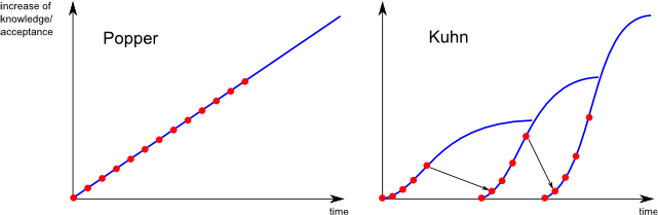
kuhn 1962 believed that science progresses in revolutions and called these revolutions paradigm shifts.
what are the three phases in science?
pre-science = variety of theories but not one generally accepted theory or paradigm
normal science = one theory (paradigm) remains dominant, despite occasional challenges
revolutionary science = disconfirming evidence accumulated until a theory/paradigm is overthrown, no longer maintained (paradigm shifts)
what are the two methods of analysis?
content analysis = statistical process that involves categorising and quantifying events and behaviour
frequency and numerical coding of themes - finding categories or codes
thematic analysis = method to identify patterns of meanings and themes in data
focus on finding recurrent themes in qualitative data.
What is coding and it’s importance in methods of analysis ?
the process of placing data into categories
potentially putting qualitative data into quantitative
breaks down data into manageable categories for analysis
What are the 5 steps of content analysis?
get to know the data (repeated reading and viewing)
identify important categories
work carefully through the data (eg re-reading transcripts to make sure details are not overlooked)
count/tally the number of occurrences of each of the identified categories
check reliability by
a) repeating content analysis (test-retest reliability)
b) use second researcher to carry out content analysis on the same data independently (inter-rater reliability)
what are the two ways of checking reliability of findings?
test retest reliability - repeat content analysis on 1 or more occasions using same data set under same conditions, at different times
inter-rater reliability - use more than one researcher to carry out content analysis independently on same data.
in both cases compare results of the two analyses, calculate the correlation coefficient (+0.8 is generally accepted as indicating high levels of reliability)
What is the procedure for thematic analysis? (4 steps)
use coding initially to analyse data
review the data/codes looking for emergent themes
support for themes comes from direct quotes from the data
validity of themes is checked by collecting a new set of data
what is an emergent theme?
a theme a recurrent idea which is descriptive or qualitative
what are the strengths of content/thematic analysis?
allow patterns in data to be analysed, and conclusions to be drawn
can be replicated to improve validity
what are 2 weaknesses of content/thematic analysis?
reducing data via coding can remove detail and reduce the richness of the data set
subjective judgment is needed to define categories and coding units
opens up the possibility of researcher bias = looking for patterns to support a belief
what is reliability?
consistency of a study or a measuring device within a study
refers to when a study produces similar results if replicated
*different from replicability as there is a focus on the ability of the research method to provide consistent results, as a pose to the ability for another researcher to obtain the same results*
What 3 ways can reliability in experiments be improved?
control investigation as much as possible keeping a constant environment (lab experiments with standardised procedures, standardised instruction)
operationalise variables
pilot test - to identify any problems
What 2 ways can reliability be improved in questionnaires?
questions may need to be re-written or removed if they are too complex or ambiguous - leads to confusion and incorrect results
Use more closed questions
What 3 ways can reliability be improved in Interviews?
use the same interviewer each time - constant environment
train interviewers to ensure questions are asked in the same way
Use structured interviews/scripts
What 3 ways can reliability be improved in observations/content analysis?
behaviour categories carefully operationalised and discussed to be clear on how to interpret different behavioural categories
record the data so that it can be reviewed
train observers/raters
what is validity and the two types?
concerns whether the test/measure/findings actually measures what it was intended to.
internal validity = ability of the study to test hypothesis it was meant to, what is going on in the study.
external validity = whether the findings of the study can be generalised beyond the study.
what are the 3 types of validity?
ecological
temporal
population
Define ecological validity…
the degree to which the findings can be generalised to other situations, places or conditions
usually whether the behaviour of a study accurately reflects the way behaviour would occur in normal circumstances
define temporal validity…
where findings from research at the time it was taken still accurately reflect what would occur at the current time
define population validity…
where the findings from research can be generalised from the sample to other populations
What are the two ways of assessing validity?
face validity - test appears to measure what it is supposed to
concurrent validity - whether one test of a variable correlates highly with the results of another test of the same variable
what 7 factors can threaten validity?
extraneous variables (variables other than the IV that impacts the DV)
investigator effects (effects of researcher on research outcome)
demand characteristics
social desirability bias
poor operationalisation of the variables
order effects
ppt differences
two ways to reduce
a. extraneous variables
b. Investigator effects
extraneous variables
all variables except IV should be constant
blind technique (ppts do not know what condition they are in)
investigator effects
standardise procedures - eg use the same investigator
double-blind technique (ppts/investigator now what each condition/group represents)
2 ways you can reduce…
a. demand characteristics
b. social desirability bias
demand characteristics
conduct field experiments
covert observations
social desirability bias
include lie scale
anonymity
how can you reduce…
a. ppt variables
b. order effects
c. poor opperalisation
ppt variables
RM design, each acts as own control
stratified sampling
order effects
counter balancing (reverse order of tests)
poor operalisation
clearly define variables and behavioural categories
What are descriptive/inferential statistics?
descriptive = describes the findings making it easier to interpret (mean, median, mode, range)
inferential = allow researchers to make inference (draw conclusions) about whole populations based on smaller samples
what is a statistical test?
statistical (inferential) tests are used to identify is results of a study were a genuine scientific outcome or due to chance factors
determines the likelihood that the difference or correlation a researcher has found had occurred by chance.
ie. Which hypothesis is most likely to be true
what do researchers do to start a statistical test?
write a experimental hypothesis of what they expect to find
write a null hypothesis stating there is no relationship between the variables/conditions
(then use statistical test to determine which hypothesis is more likely - accept or reject the null hypothesis)
what is the 4 step procedure of statistical tests?
collect data
identify appropriate statistical test to use
work out calculated value
compare to critical value to determine if result is significant
What are the three aspects research must be identified to determine which type of statistical test should be used.
is it a test of difference or correlation
if test of difference is it related = MP or RM, or unrelated = IG experimental design
What level of measurement is used for DV/co-variables (nominal, ordinal, interval)
What are the three levels of measurement?
what measure of central tendency is most appropriate for each?
nominal
data in categories and can be tallies, discrete form of data so is considered weak (mode)
ordinal
data is ordered in some way/numerical,does not have equal intervals in between each unit. involves subjective human judgement or is in rank order (mode+median)
interval
based on numerical scales (standardised), units of precise measurement like time or distances, objective form of data , most precise (mode+median+mean)
what mnemonic can you use to remember the order of statistical tests?
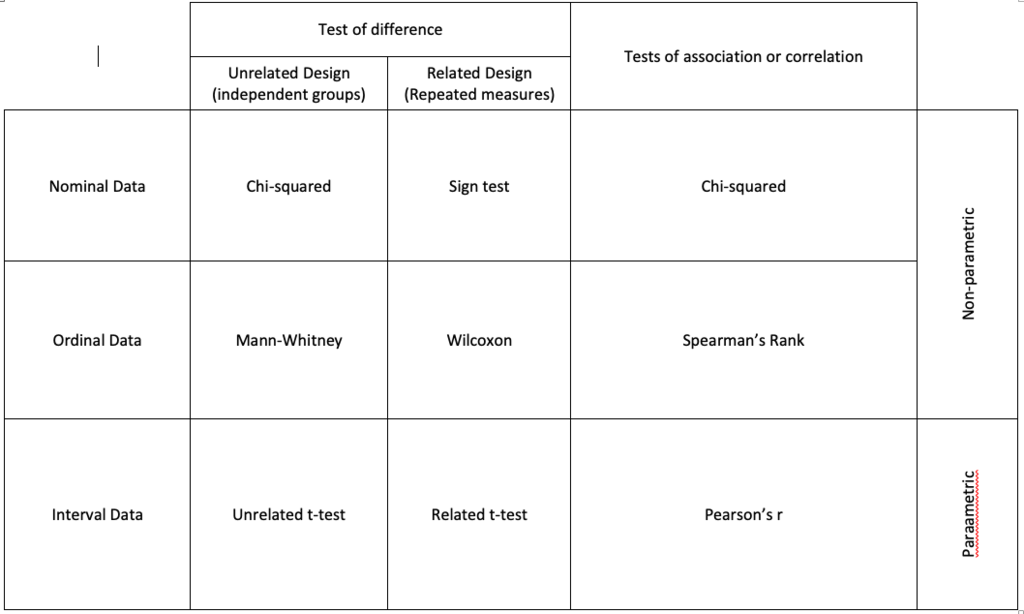
Carrots Should Come
Mashed With Swede
Under Roast Potatoes
what are the 8 statistical tests in order?
chi-squared
sign test
chi-squared (again)
Mann Whitney
Wilcoxon
spearman’s rho
unrelated t test
related t test
Pearson’s R
What statistical test may you have to find the calculated value in?
How is it found?
sign test
data is converted to + or -, any ppts that stay the same are ignored
count up +, - and same results (used to take away from the value of N)
the least frequent result (the one there are least of) is the calculated value (s)
What is the critical value and how can it be found?
to see if calculated value is significant must compare it to the critical value found in a table:
to find appropriate critical value you need to know :
significance level
direction of the hypothesis (one or two tailed)
value of N or df (N = number of ppts, Df = N-1)
what is a significance level?
what level of significance is generally used?
the point at which a researcher can claim to have discovered a significant difference between conditions in an experiment or a significant correlation
otherwise known as a confidence level
generally 0.05 or 5% is used probability of result occuring by chance is less than or equal to 5% (95% confident that real result has been found)
What are one and two tailed hypothesis?
one-tailed = directional
two-tailed = non-directional
What must be included in a statistical conclusion?
result is/isn’t significant
because calculated value of… is less/more than the critical value of …
for … df (degrees of freedom)
in one/two-tailed test
at… significant level
means the null hypothesis is accepted/rejected
How do you calculate N in the sign test?
any ppts who stayed the same are disregarded
eg N = number of ppts - those who had no change
how is the df calculated in the chi-squared test?
create a contingency table
df = (number of columns -1) x (number of rows-1)
What does the calculated value in chi-squared represent?
The calculation compares the expected value with the observed value.
what are type 1 errors?
FALSE POSITIVE
concludes results are significant when they are due to chance factors (not significant)
rejected null hypothesis when it should have been accepted
chances of making type 1 error are the same as the significance level
what are type 2 errors?
FALSE NEGATIVE
concludes results are not significant when they are, real difference/association/correlation has been overlooked
accept null hypothesis when should have been rejected
Very difficult to predict the likelihood of type 2 errors
How can type 1 and 2 errors be minimised?
type 1
replication - for a false positive to occur twice in unlikely
increase significance level eg. from 0.05 to 0.01
however this may increase likelihood of type 2 errors so 0.05 is used as strikes a balance between the risk of making either errors
type 2
increase sample size - larger sample = lesser likelihood that it will differ substantially from the population
(neither can ever be fully prevented)
What is peer review and its purpose?
When psychological research is subject to independent scrutiny by other psychologists that are experts in the field.
important in scientific process = ensures research papers published in a scientific journal have integrity/can be taken seriously by other researchers.
ensures quality and relevance of research
ensures accuracy of findings
used to evaluate proposed designs for research funding.
What is the 4 step process of peer review?
work is considered - in terms of validity, ethics, errors, significance, originality and improvements
reviewer makes suggestions for revisions - or rejects manuscript
author makes revisions - and the reviewer accepts the new revisions or rejects the manuscript
editor makes final decision - whether to accept/reject research report based on the reviewers comments/recommendations, decides if it should be published.
What are the 3 problems with peer review?
conservative - research that contradicts other research less likely to get published
lack of objectivity/anonymity - difficulty for peers to be objective as often know writer in small research fields
publication bias - journal editors have tendency to publish significant headline grabbing finding to increases credibility/popularity on their journals
What 3 aspects should be included on a consent form?
outline of what the investigation entails: the general purpose and aims, what the study sill involve and how long it will take. anything that affects willingness to take part should be disclosed
ppts informed of their ethical rights eg right to withdraw
evidence the ppt has understood what is required - signature and date
What is the purpose of debriefing?
study is discussed with ppts returning them to the state they were in when they entered the study. especially important if deception has been used
What should be included in a debrief?
written to ppts “You have taken part…”
aims of the study
other conditions that they were not involved in
consideration of ethical issues
opportunity to ask questions
 Note
Note  Flashcards (39)