1.5 Nucleic acids are important information-carrying molecules
 Studied by 0 people
 Call Kai
 Learn
Learn Practice Test
 Spaced Repetition
 Match
Match Flashcards
 Knowt Play
1/15

There's no tags or description
Looks like no tags are added yet.
Name | Mastery | Learn | Test | Matching | Spaced | Call with Kai |
|---|
No analytics yet
Send a link to your students to track their progress
16 Terms
Describe the basic functions of DNA and RNA in all living cells
DNA - holds genetic information which codes for polypeptides (proteins)
RNA - transfers genetic information from DNA to ribosomes
Name the two types of molecules from which a ribosome is made
RNA and proteins
Draw and label a DNA nucleotide and an RNA nucleotide
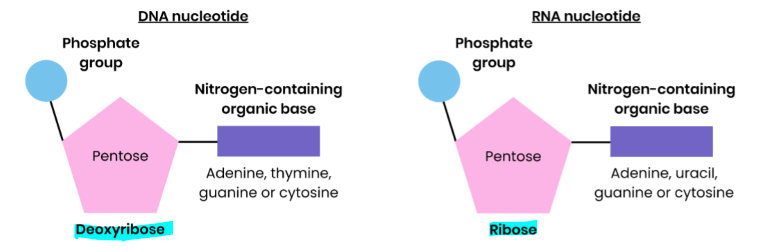
Describe the differences between a DNA nucleotide and an RNA nucleotide
DNA Nucleotide:
pentose sugar is deoxyribose
base can be thymine
RNA Nucleotide:
pentose sugar is ribose
base can be uracil
Describe how nucleotides can join together to form polynucleotides
condensation reactions, removing water molecules
between phosphate group of one nucleotide and deoxyribose / ribose of another
forming phosphodiester bonds
Why did many scientists initially doubt that DNA carried the genetic code?
The relative simplicity of DNA - chemically simple molecule with few components
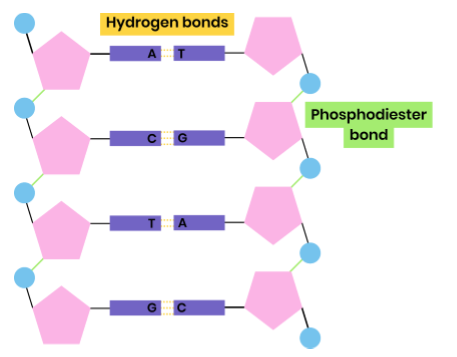
Describe the structure of DNA
polymer of nucleotides (polynucleotide)
each nucleotide formed from deoxyribose, a phosphate group and a nitrogen-containg organic base
phosphodiester bonds join adjacent nucleotides
2 polynucleotide chains held together by weak hydrogen bonds
between specific complementary base pairs - adenine / thymine and cytosine / guanine
double helix
Describe the structure of (messenger) RNA
polymer of nucleotides (polynucleotide)
each nucleotide formed from ribose, a phosphate group and a nitrogen-containing organic base
bases - uracil, adenine, cytosine, guanine
phosphodiester bonds join adjacent nucleotides
linear (single stranded)
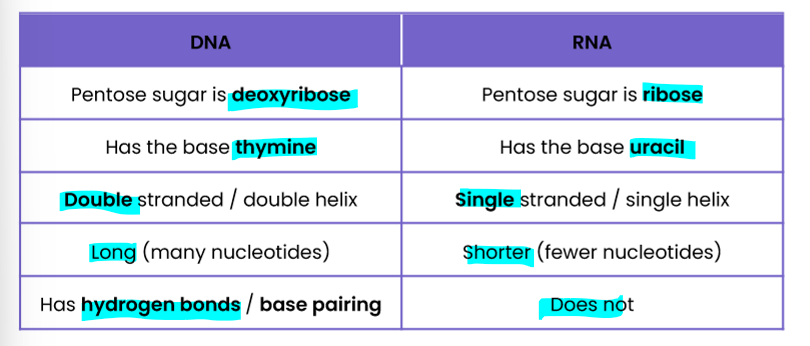
Compare and contrast the structure of DNA and (messenger) RNA
Suggest how the structure of DNA relates to its functions
two strands → both can act as templates for semi-conservative replication
hydrogen bonds between bases are weak → strands can be separated for replication
complementary base pairing → accurate replication
many hydrogen bonds between bases → stable / strong molecule
double helix with sugar phosphate backbone → protects bases / hydrogen bonds
long molecule → stores a lot of genetic information (that codes for polypeptides)
double helix (coiled) → compact
Suggest how you can use incomplete information about the frequency of bases on DNA strands to find the frequency of other bases
% of adenine in strand 1 = % of thymine in strand 2 (and vice versa)
% of guanine in strand 1 = % of cytosine in strand 2 (and vice versa)
Because of specific complementary base pairing between 2 strands
Why is semi-conservative replication important?
ensure genetic continuity between generations of cells
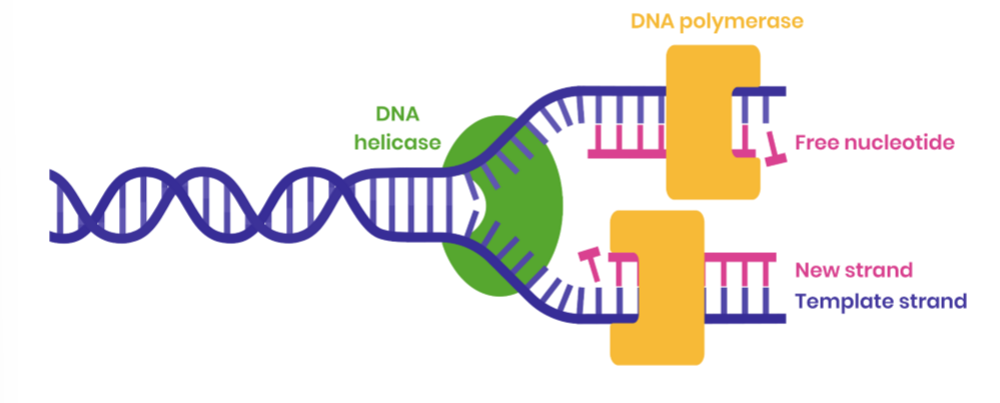
Describe the process of semi-conservative DNA replication
DNA helicase breaks hydrogen bonds between complementary bases, unwinding the double helix
both strands act as templates
free DNA nucleotides attracted to exposed bases and join by specific complementary base pairing
hydrogen bonds form between adenine - thymine and guanine - cytosine
DNA polymerase joins adjacent nucleotides on new strand by condensation reactions
forming phosphodiester bonds
semi-conservative - each new DNA molecule consists of one original / template strand and one new strand
Use your knowledge of enzyme action to suggest why DNA polymerase moves in opposite directions along DNA strands
DNA has antiparallel strands
so shapes/arrangements of nucleotides on two ends are different
DNA polymerase is an enzyme with a specific shaped active site
so can only bind to substrate with complementary shape (phosphate end of developing strand)
Name the two scientists who proposed models of the chemical structure of DNA and RNA replication
Watson and Crick
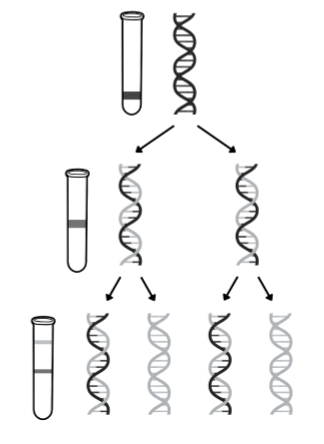
Describe the work of Meselson and Stahl in validating the Watson-Crick model of semi-conservative DNA replication
bacteria grown in medium containing heavy nitrogen (15N) so nitrogen is incorporated into DNA bases
DNA extracted and centrifuged → settles near bottom, as all DNA molecules contain 2 ‘heavy’ strands
bacteria transferred to medium containing light nitrogen (14N) and allowed to divide once
DNA extracted and centrifuged → settles in middle, as all DNA molecules contain 1 original ‘heavy’ and 1 new ‘light’ strand
bacteria in light nitrogen (14N) allowed to divide again
DNA extracted and centrifuged → half settles in middle, as contains 1 original ‘heavy’ strand and 1 new ‘light’ strand; half settles near top, as contains 2 ‘light’ strands
other models (e.g. dispersive, conservative) not supported - bands would be in different places
 Note
Note  Flashcards (34)