In-Class Topics
 Call Kai
 Learn
Learn Practice Test
 Spaced Repetition
 Match
Match Flashcards
 Knowt Play
1/66

There's no tags or description
Looks like no tags are added yet.
Name | Mastery | Learn | Test | Matching | Spaced | Call with Kai |
|---|
No analytics yet
Send a link to your students to track their progress
67 Terms
Product Focused Questions
Who will use this?
Why will they care?
What can it do that people will pay for?
What features are most important?
How does everything fit together?
People Focused Questions
Who is it for?
Why does it matter to them?
What can they do that they couldn’t do before?
What features do they need to do that?
How do those limited features fit together?
Why do we build products?
delight customers
get lots of them signed up
Make a lot of money
Realize a big vision; change the world
“Decide and Follow the Plan”
•Build a great product with enough features that increase the odds that customers will want it
•Problem: no feedback until the end, might be too late to adjust
“Release early, release often”
•Get as much feedback as possible, as soon as possible
•Problem: run around in circles, chasing what customers think they want
What do you want to learn first?
If customers will buy your product
Validated Learning
A process in which one learns by trying out an initial idea and then measuring it to validate the effect. Each test of an idea is a single iteration in a larger process of many iterations whereby something is learnt and then applied to succeeding tests
Minimum Viable Product
•The minimum set of features needed to learn from early evangelists – visionary early adopters
MVP Principles
less is more in development
the most boring feature is the most important one
Pretotype steps
Proposal
Smoke test
Fake demo
Proposal
a document describing the solution
Smoke test (Twittr)
landing page to test interest
Pretotyping
A way to test an idea (a hypothesis) quickly and inexpensively by creating extremely simplified, mocked or virtual versions of that product to help validate the premise that "If we build it, they will use it."
Prototyping
focuses on a model for building the product.
Types of Pretotypes
in person interview/proposal
smoke test: landing page + adwords
explainer video
fake door
pinocchio (mockup)
mechanical turk/wizard of oz
Pivot
A structured course correction designed to test a new fundamental hypothesis about the product, strategy, and engine of growth.
Pivoting Rules
1.Successful pivoting is a function of your employees – there is only so much change possible
2.Swinging for the fence rarely works (e.g., focus on a different target, not a completely different product)
3.Timing and externalities matter more than you think (e.g., post 9/11, being first, etc.)
4.Success comes from incremental gains, not Hail-Mary’s
Zoom-In Pivot
A single feature becomes the whole product
Zoom-out pivot
The whole product becomes a single feature of a larger product
Customer segment pivot
Good product, bad customer segment
Customer need pivot
Responding, or a completely new product
Platform pivot
Change from an application to a platform, or vice versa
Business Architecture pivot
High margin, low volume. Low margin, high volume
Valure capture pivot
changes in the revenue model
Engine of growth
Picking how to grow: Viral, sticky, and paid…
channel pivot
How the product is delivered to customers
Technology pivot
New technology improves the competitiveness
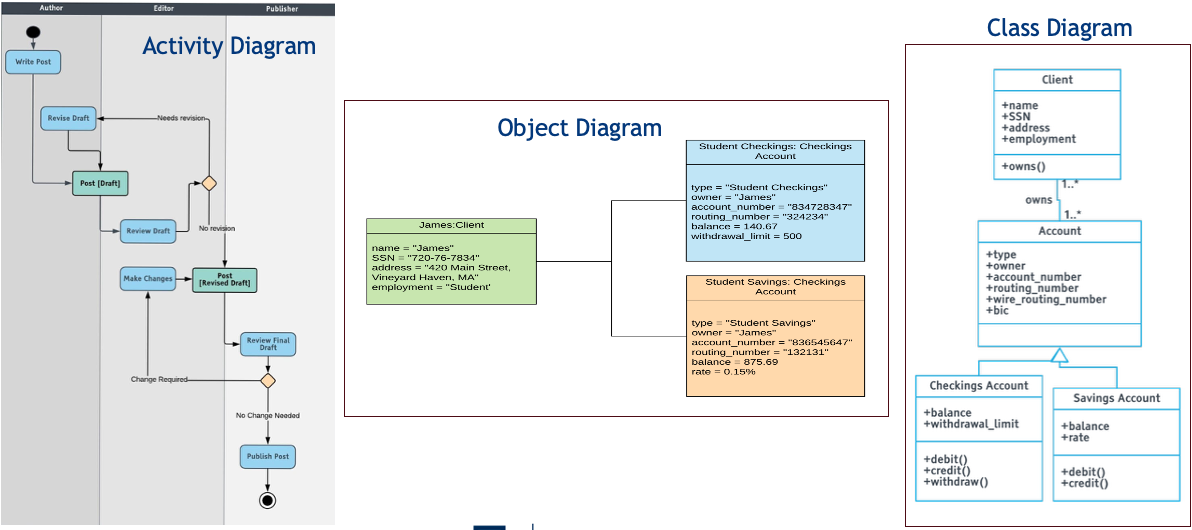
Unified Modeling Language (UML)
Has syntax and semantics which convey meaning, understanding, and constraints
Not a programming language
13 graphical notations supplemented with text
Use what you need
Best used in large and complex projects spanning a length of time
Probably a burden in small projects
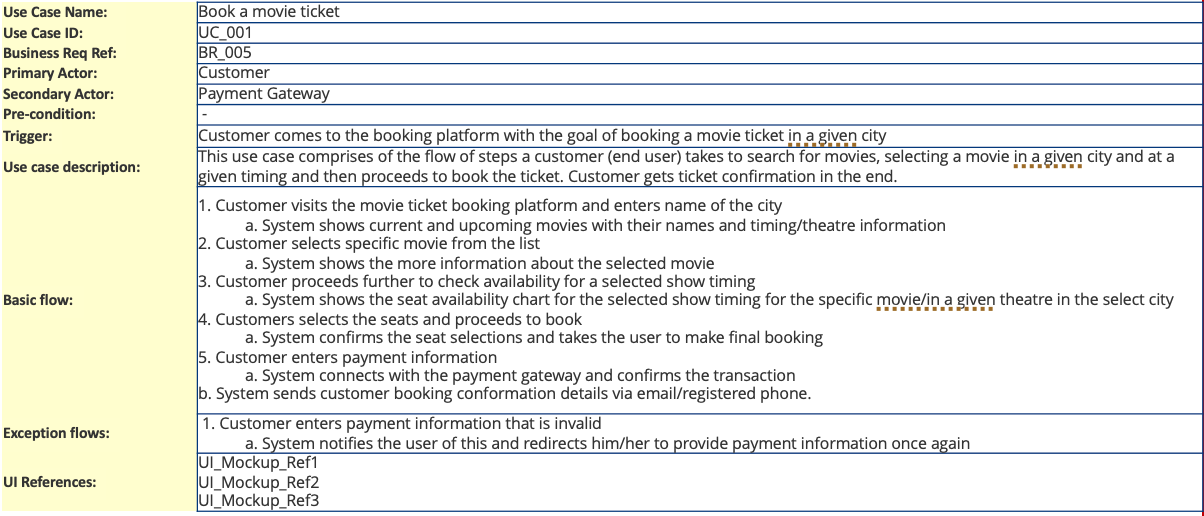
Use Case - A UML Diagram
•Requirements analysis phase
•A case of a use of the system / product
•Describes the system’s actions from the point of view of an “actor” (i.e., a user, persona, etc.)
•Specifies one aspect of the behavior of a system, without specifying the structure of the system
Use case v. User stories
Use case: focus on the interaction between the user and a process in the system. Can be a big functionality
User stories: functionality the user wants. Focus is on small stories that can be developed in one sprint
How do we capture use cases?
•Start with narrative (each system high-level functionality is a “use case”)
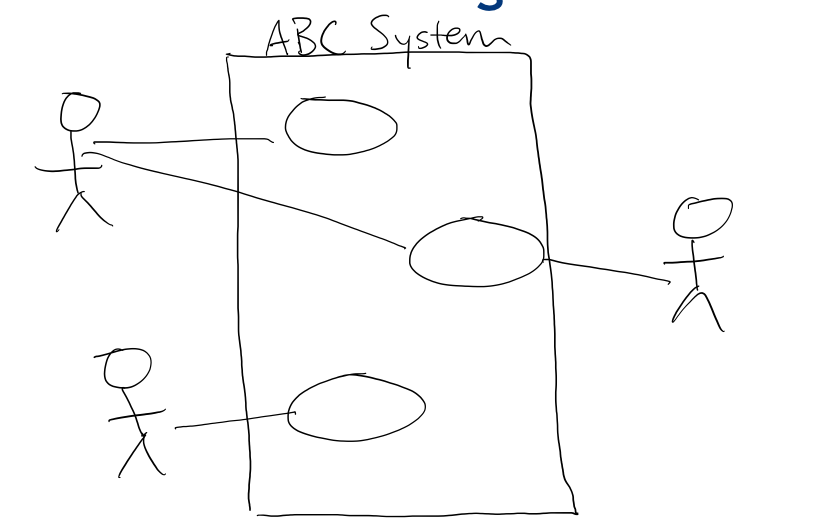
•Use case diagram
•This is a very simple diagram involving 3 symbols (for the purposes of this class), and a connecting line
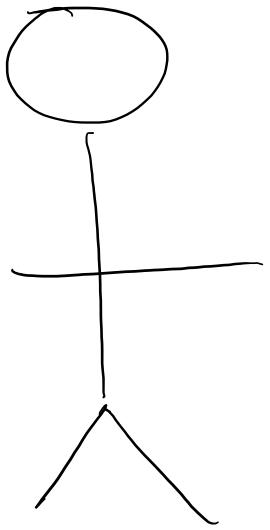
Use case diagram: Actor (user/persona)
•External entity outside the domain of the system we are modeling
•Initiates a use case
•Gets some measurable benefit from that interaction
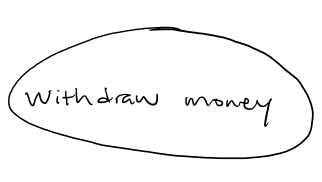
Use case diagram: a “use case”
•Reflects a high-level functionality of system
•As such, use cases must be initiated by actors
•Detailed documentation elsewhere; only represented on diagram graphically
•Starts with a verb
Use case diagram: “The system”
•Shows the system boundaries
•Advanced diagrams will have many boxes (as releases); we will just use one for class purposes
Complete use case diagram
Why create a use case diagram?
show the big picture
customer can relate
developers can quickly access functionality and risk
advanced diagrams will be more complex
Use case interactions
An interaction is a specific instance of user-system exchange (we draw a line between the use case and the Actor)
Examples: withdrawing money from an ATM is the use case (other things implied by this)
•PIN correctly entered
•PIN incorrect
•Insufficient funds
•ATM out of money
Important use case notes
should involve some documentable interaction between the actor and system
must have at least one Actor (user)
Getting ___ right is the hardest part of software developement
requirements
Source/sink might consist of the following:
•Another organization/organization unit which exchanges data with the focal system
•A person who interacts with the system (customer of a banking system)
•Another information system
___ to a process are always different than ___
inputs; outputs
Objects always have ___
a unique name
Miracle
no process can have only outputs
Black hole
no process can have only inputs
Processes must have ___ labels
verb
Data cannot move directly from one __ to another __ .They can be separated by inserting a _
data store; data store; process
Data cannot move directly from an outside __ to a __. It must be moved by a __
source; data store: process
Data cannot move directly to an outside __ from a __ -- it must be moved by a __.
sink; data store; process
Data store must have a __ label
noun
Data cannot move directly from a __ to a __. It must be moved by a process.
source; sink
Source/sink must have a __ label
noun
Fork
means that exactly the same data goes to two different processes or data stores.
Join
means that exactly the same data comes from two different processes and data stores.
Data flow rule
A data flow cannot go directly back to the same process it leaves
A data flow to a data store means update (delete or change)
A data flow from a data store means retrieve or use
Noun phrase label
candidate key
an attribute that uniquely identifies each instance of an entity type
Identifier
a candidate key that has been selected as the unique, identifying characteristic for an entity type
Required attribute
attribute that must have a value for every entity instance
Optional attribute
attribute that may not have a value for every entity instance
Composite attribute
attribute that has meaningful component parts
Derived attribute
attribute whose value can be computed from related attribute values
One

Many

One (and only one)

Zero or one

One or many

Zero or many

Rules for stopping decomposition. Stop when:
Process becomes a single decision or calculation.
● Data store represents a single entity.
● Users do not need more detail.
● Data flows do not need further splitting.
● Each business form or report is shown as one data flow.
● Each menu choice has a separate process.
● More documentation adds no value

