Research Methods Wolgin Exam 2
 Call Kai
 Learn
Learn Practice Test
 Spaced Repetition
 Match
Match Flashcards
 Knowt Play
1/61

There's no tags or description
Looks like no tags are added yet.
Name | Mastery | Learn | Test | Matching | Spaced | Call with Kai |
|---|
No analytics yet
Send a link to your students to track their progress
62 Terms
Construct Validity
Degree of accuracy in measuring conceptual variables.
Threats to Construct Validity
Factors that compromise the accuracy of constructs.
Threat to Construct Validity: Confounding Variables
Extraneous factors affecting study outcomes.
Threat to Construct Validity: Confounding Variables ~ Reactivity of Subjects
Participants' awareness influencing their behavior.
Threat to Construct Validity: Confounding Variables ~ Random Error of Measurement
Variability from misreading or inaccuracies.
Minimize confounding variables: Operational Definitions
Specific criteria for producing and measuring constructs.
Minimize confounding variables: Protocols
Rules for conducting and observing experiments.
External Validity
Generalizability of study findings to broader contexts (i.e., other situations, populations).
Establishing external validity: Subject Representativeness
Sample's similarity to the larger population.
Establishing external validity: Variable Representativeness
Relevance of chosen variables to the study.
Establishing external validity: Setting Representativeness
Applicability of results to real-world settings.
Internal Validity
Degree of confidence in causal conclusions from a study.
Internal Validity Threat: History
External events (occurring while study is being conducted) affecting study outcomes.
Internal Validity Threat: Maturation
Natural changes in participants over time.
Internal Validity Threat: Testing
Effects of prior measurements on participant's subsequent responses.
Internal Validity Threat: Instrumentation
Changes in measurement tools during study.
Internal Validity Threat: Attrition
Loss of participants affecting study integrity.
Internal Validity Threat: Selection
Pre-existing differences among participant groups.
Confounding
an extraneous factor that systematically varies along with the variables we are studying and therefore provides a potential alternative explanation for our results
How does a confounding variable pose a problem to results interpretation?
Presence prevents us from drawing clear causal conclusion
Reliability
Degree pf consistency of measurement across trials.
Reliability issue: Reliability of Measurements
Every set of measures contains some variability (random error); the more variability, the less reliability
Reliability issue: Statistical Reliability
The likelihood that results are due to chance; if less than 1 in 20 (p < .05) reject possibility of chance
Reliability issue: Experimental Reliability
Replicability of experiments yielding consistent results.
Reliability issue: Test Reliability
Administering the same measures to the same participants on different (two or more) occasions, under equivalent test conditions
Random Assignment
Assign subjects to experimental conditions on a random basis; minimizes confounding
Random Sampling
Equal chance of selection for study participants.
3 criteria by which measurement scales differ: Magnitude of Attribute
Certain scales attribute quantitatively or relatively
3 criteria by which measurement scales differ: Intervals Between Values
Equal vs. unequal/unknwon spacing in measurement scales.
3 criteria by which measurement scales differ: Zero Point
True (i.e., bathroom scale) vs. arbitrary (i.e., temperature) zero in measurement scales.
Nominal Scale
Categorical scale with qualitative differences.
Nominal scale examples
gender, political party
Ordinal Scale
Scale indicating relative differences without equal intervals.
Ordinal scale examples
popularity; ranking
Interval Scale
Scale with equal intervals but no true zero.
Interval scale examples
temperature, calendar date
Ratio Scale
Scale with equal intervals and a true zero point.
Ratio scale examples
money, age, weight
Between Subjects Design
Different groups get different treatments; different participants are assigned to each of the conditions in the experiment.
Within Subjects Design
All subjects get all treatments; each participant engages in every condition of the experiment one or more times.
Controlling a priori differences: Matching Subjects
Matching subjects on some criterion, then random assignment to groups.
Potential problems with matching
May create mismatch on other criteria; subject attrition (loss of subject)
Controlling a priori differences: Randomization
By randomly assigning subjects to groups, confounding variables should be equally distributed.
Carry-Over Effects
When participants' responses in one condition are uniquely influenced by the particular conditions that preceded it.
Order Effects
When participants' responses are affected by the order of the conditions to which they are exposed.
Controlling for carry-over/order effects: Randomization
Randomize the order of treatments
Controlling for carry-over/order effects: Counterbalancing
A procedure in which the order of conditions is varied so that no condition has an overall advantage relative to the other conditions.
Complete Counterbalancing
Each treatment occurs in each time period of the experiment; conditions of an IV are arranged in every possible sequence, equal # of participants assigned to each sequence
Problem with complete counterbalancing
As the number of treatments increases, the number of orders increases disproportionately; therefore, can't run all orders
Incomplete Counterbalancing
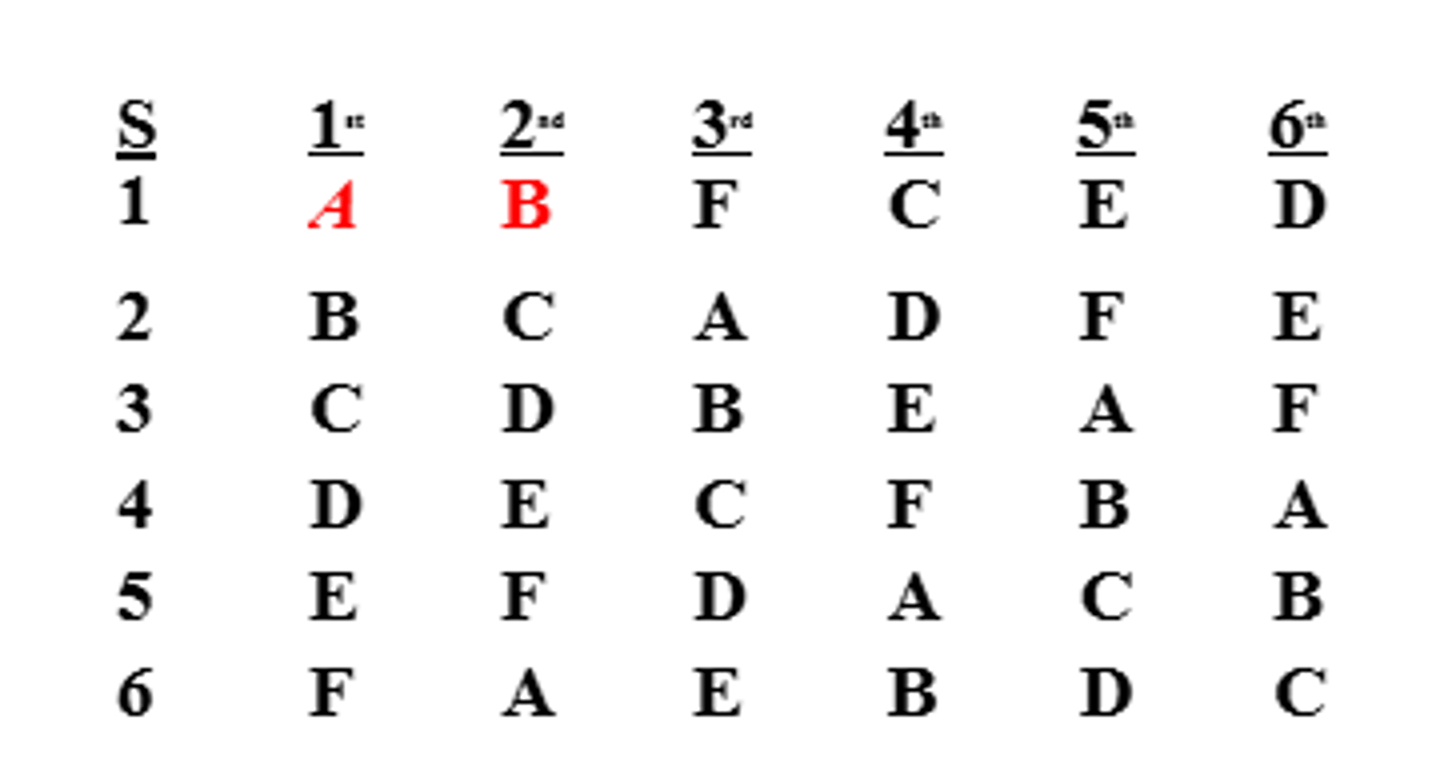
Each treatment occurs equally often in each portion of the experiment; an example is a Latin Square design.
Latin Square design
A design where each independent variable shows up only once in each row and column.

How to create balanced Latin Square for within-subjects experiment w/ five levels of IV?
5 columns for each of 5 levels of IV, & 5 rows for each participant; need 2 Latin Squares due to odd # of IVs; must have at least double amt of participants, need min of 10
Latin Square Formula
A, B, C, X, X-1, X-2, etc. where X = final condition
Mixed Design
A factorial design that includes at least one between-subjects variable and at least one within-subjects variable.
Mixed design example
between groups administering a drug via bottle or cannula (one group of participants gets either one or the other) and the within groups would be amphetamine or saline (everyone gets one of each)
IVs in 2 X 4 X 3 between groups design
There are three independent variables.
How many levels of IVs in 2 X 4 X 3 between groups design
There are a total of nine levels of the three independent variables (2 + 4 + 3 = 9)
Main Effect
In a factorial design, when an independent variable has an overall effect on a dependent variable.
Interaction
Occurs when the way in which an independent variable influences a dependent variable differs, depending on the level of another independent variable.
Complete Randomization
Where subjects are randomly assigned to treatment levels or combinations.
Block Randomization
An experimental procedure in which researchers conduct a round of all the conditions, then another round, then another, for as many rounds as needed to complete the experiment; w/in each round, order of condtions is randomly determined
Advantage of Balanced Latin Square over randomization
Each treatment precedes and follows every other treatment equally and every possible confounding effect in the sequence is completely counterbalanced.

