MCB 11 Chapter 6D - Survey of Microorganisms: Viruses, Viroids, and Prions
 Call Kai
 Learn
Learn Practice Test
 Spaced Repetition
 Match
Match Flashcards
 Knowt Play
1/80

Earn XP
Description and Tags
These flashcards cover the essential vocabulary and concepts related to microorganisms, specifically focusing on viruses, viroids, and prions, as discussed in the lecture.
Name | Mastery | Learn | Test | Matching | Spaced | Call with Kai | Chat |
|---|
No analytics yet
Send a link to your students to track their progress
81 Terms
Viruses
Non-living obligate intracellular parasites that replicate only in living cells. Nucleic acid encased in a protein shell which may be surrounded by a lipid-containing membrane.
Capsomeres
Protein/capsid subunits arranged in a precise and highly repetitive manner around the nucleic acid.
Viral Symmetry
Can be helical (rod shaped), icosahedral (spherical w/ 20 triangular faces & 12 vertices), or complex (asymmetrical)
Infectious Agents
Viruses, Viroids, Prions
Non-living obligate intracellular parasites
Virus Nucleic Acid
Can be either DNA or RNA, linear or circular, double or single-stranded, segmented or non-segmented
Virus Proteins
Serve as protection against inactivation by nucleases; participate in attachment to host; facilitate transfer of viral NA from 1 host cell to another; initiation of virus replication; provide structural symmetry; determine antigenic property
Virus Lipids
Found in virus envelopes; derived from host cell
Virus Carbohydrates
Present as glycoproteins in virus envelopes; virus-coded; attach virus to host cell via receptors; also function as antigens
Embryonated Eggs Cultivation
Virus cultivation wherein viral growth is indicated by death of embryo, embryo cell damage, or formation of lesions
Living Animals Cultivation
Viral cultivation where either an animal is observed for signs of disease or is killed so infected tissues can be examined for the virus.
Cell Cultures Cultivation
Viral cultivation wherein a tissue is treated with enzymes to separate the cells; the cells are then suspended in culture medium; normal cells or primary cells grow in a monolayer across the container. The transformed cells / continuous cell cultures do not grow in a monolayer.
Viroids
Infectious agents consisting of a single piece of RNA without a protective coat.
Prions
Infectious proteins that cause neurodegenerative diseases, consisting of protein only.
Nucleocapsid
Structure formed by nucleic acid and a protein coat in viruses.
Virion
Complete infective form of a virus outside a host cell.
Capsid
Protein shell that encases the viral genome.
Genome
The complete set of genetic material in a virus.
Helical viruses
Viruses with rod-shaped symmetry.
Icosahedral viruses
Viruses with spherical shape, featuring 20 triangular faces.
Complex viruses
Viruses with asymmetric structures, including bacteriophages.
Naked virus
Virus without an envelope, consisting only of nucleic acid and a capsid.
Enveloped virus
Virus with an outer lipid membrane derived from the host cell.
Viral replication cycle
The process by which a virus infects a host and produces new virions.
Attachment (adsorption)
The first step in the viral replication cycle, where the virus adheres to the host cell.
Penetration
The step where viral nucleic acid enters the host cell.
Synthesis of viral components
The process of replicating viral nucleic acid and proteins inside the host.
Assembly
The stage of the viral replication cycle where new virions are constructed.
Release
The final step of the viral replication cycle, where new virions exit the host cell.
Lytic cycle
Virus cycle resulting in the destruction of the host cell.
Lysogenic cycle
Virus cycle where it integrates its DNA into the host without immediate destruction.
Bacteriophage
A virus that infects bacteria.
SARS-CoV-2
A novel coronavirus responsible for the COVID-19 pandemic.
HIV
Human Immunodeficiency Virus, which can lead to AIDS.
Dengue virus
An RNA virus transmitted by mosquitoes causing Dengue fever.
Hepatitis B
A vaccine-preventable liver infection caused by the hepatitis B virus.
Rabies virus
Virus spread through animal bites, affecting the brain and is often fatal.
Cytopathic effects
Detection of virus infected cells: change in host cells due to viral infection, often observable under a microscope. E.g. after human cervical cell is infected w/ HHV-2, the nuclei is filled with viruses.
Hemagglutination test
A laboratory test for detection of virus infected cells through the clumping of red blood cells.
Plaque assay
A method for detection of virus infected cells based on the formation of clear areas in a lawn of host cells/culture.
Basis of virus classification
Genome
Structure
Route of transmission
enteric
respirstory
zoonotic
sexually-transmitted
immunologic properties
pathology / symptomatology
Virus replication cycle
Attachment (adsorption of phage virion)
Penetration of viral nucleic acid
Synthesis of viral nucleic acid & protein
Assembly & packaging of new viruses
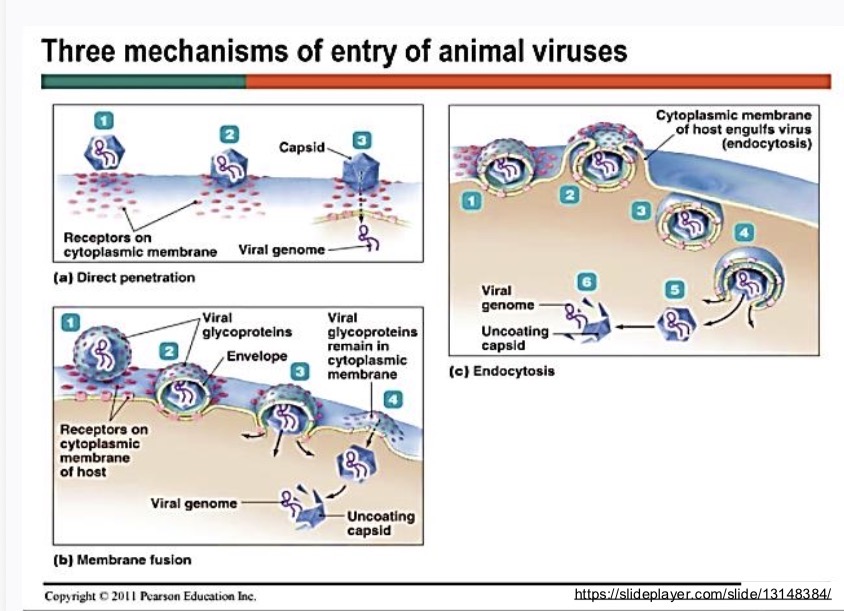
Entry of Animal Viruses
Three mechanisms
Direct penetration
Membrane fusion
Endocytosis
Baltimore classification
Classification of viruses based on their genome type and method of replication.
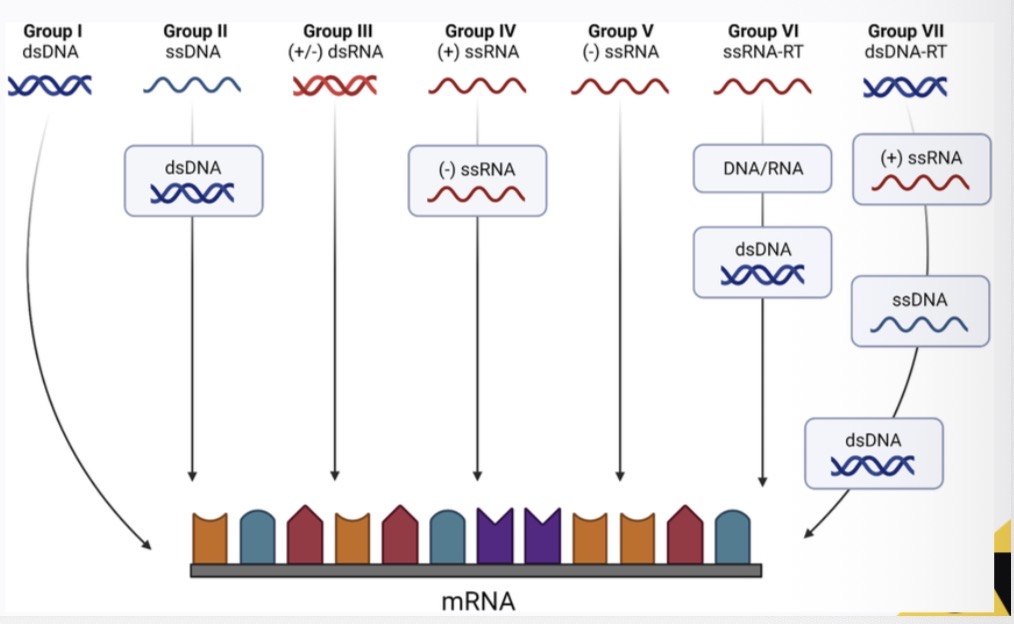
RNA viruses
Viruses that use RNA as their genetic material.
Replication of DNA viruses
attachment
penetration
NA synthesis
protein synthesis
assembly
release
Replication of RNA viruses
attachment
penetration
protein synthesis
NA synthesis
protein synthesis
assembly
release
Replication of a Retrovirus
The virion carries two identical copies of the RNA genome (orange). Reverse transcriptase, carried in the virion, makes single-stranded DNA from viral RNA and then double-stranded DNA that integrates into the host genome as a provirus. Transcription and translation of proviral genes leads to the production of new virions that are then released by budding.
Bacteriophages
Viruses that infect bacteria; can be lytic/virulent, or temperate/lysogenic
DNA viruses
Viruses that use DNA as their genetic material.
Carbohydrates in viruses
Molecules found in viral envelopes, often serving as receptors and antigens.
Lipids in viruses
Components found in the viral envelope, derived from host cell membranes.
Glycoproteins
Molecules in viral envelopes that facilitate attachment to host cells.
Cell culture
Method for growing viruses in a controlled environment using live cells.
Vaccination
Administration of a vaccine to induce immunity against viral diseases.
Antigenic properties
Characteristics of a virus that determine the immune response it elicits.
Viral enzymes
Proteins encoded by viruses that facilitate viral replication and assembly.
Antibody
A protein produced by the immune system that binds to specific antigens.
Immune response
The body's defense mechanism against viral infections.
Obligate intracellular parasites
Organisms that can only reproduce inside a host cell.
Non-segmented viruses
Viruses whose genome consists of a single continuous piece of nucleic acid.
Segmented viruses
Viruses whose genome is divided into separate pieces.
RNA polymerase
Enzyme that synthesizes RNA from a DNA template in viruses.
Reverse transcriptase
An enzyme used by retroviruses to convert RNA into DNA.
Viral pathogenesis
The process through which a virus causes disease.
Viral transmission
The method by which a virus spreads from one host to another.
Zoonotic infections
Diseases transmitted from animals to humans.
Vaccination strategies
Approaches used to prevent viral infections through immunization.
COVID-19 symptoms
Common signs of infection include fever, cough, and fatigue.
Viroids
Consists of a single piece of nucleic acid (RNA) without a protective coat; only abt 30 known; cause serious plant diseases
Prions
Contain only protein, no nucleic acid; smallest infectious agent
Viroid diseases
Plant diseases caused by viroids, characterized by stunted growth and deformity.
Prion diseases
Neurological disorders caused by infectious prions, such as Mad Cow Disease.
Viral shedding
The release of virus particles from an infected host.
Serological tests
Laboratory tests that detect antibodies or antigens in a sample.
Genome sequencing
Determining the complete DNA or RNA sequence of a virus.
Viral evolution
The process by which viruses change and adapt over time.
Interferon
Proteins produced by host cells in response to viral infections.
Public health measures
Strategies implemented to prevent and control viral outbreaks.
Diagnostic methods
Techniques used to identify viral infections in patients.
Lytic or Virulent bacteriophage
Bacteriophage released by cell lysis
Temperate or Lysogenic bacteriophages
Bacteriophage where no lysis occurs but lytic cycle may be spontaneously expressed