Guest Speaker
 Studied by 0 people
 Call Kai
 Learn
Learn Practice Test
 Spaced Repetition
 Match
Match Flashcards
 Knowt Play
1/21

Earn XP
Description and Tags
Lecture 10
Name | Mastery | Learn | Test | Matching | Spaced | Call with Kai |
|---|
No analytics yet
Send a link to your students to track their progress
22 Terms
Defining: Politics
• “the authoritative allocation of values for a society” (Easton, 1953)
• “activity related to influencing, making, and implementing collective decisions for a political community” (Mintz, Close, & Croce 2018)
• Power as the principle category of politics
Dimensions of Power (Lukes, 2005)
1. Power over someone or a group
2. “Agenda-setting power to determine what becomes focus of public discussion and decisionmaking”
3. Invisible power that reinforces “the way things are” as informed by ideology and hegemony
Types of Power
-Soft power
-Hard power
Soft power
-forms of power that seek to influence outcomes through non-coercive means, involving the politics of persuasion or attraction (i.e. sportwashing; the use of sports events to launder the images of governments and corporations)
-ex: -RCMP in Olympics opening ceremony
-the flag and soldiers to reinforce nationalism of Canadian identify
-soft power as it reinforces Canadian nationalism
Hard power
-trade sanctions or military coercion
“Opening Ceremonies of the Olympic Games are…
by their very nature, profoundly political occasions. As Jackie Hogan suggests, they are widely circulating discourses of national narrative and identity and "may generally serve to reproduce relations of dominance, [and] they may also reflect and fuel social change.” (O’Bonsawin, 2010)
Nationalism
• Collective identity of a nation
• Reinforces and promotes a singular image of ”Canadian-ness”
• Is constructed internally through the values of sports teams and externally how they perform to audiences
• Can be challenged by globalization
-athletes can also be a product of their contract
Sport Governance:
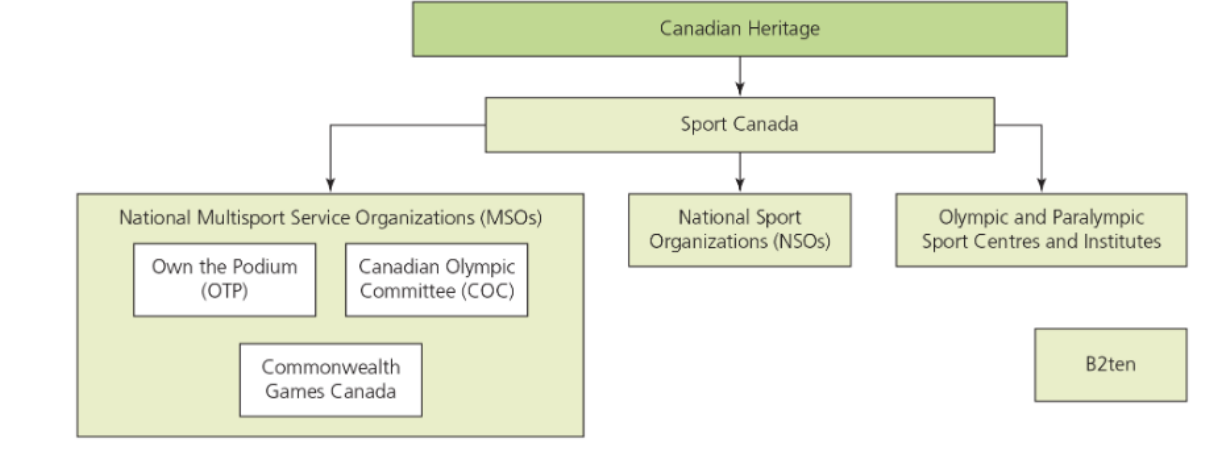
-the regulation for sporting events occurs in a Canadian context in the provincial and national level

Canadian Federal Sport System
Ko Uhia Mai: Composed by Whetu Tipiwai
• Te-rā (the Sun) and Hine-Raumati (the Summer Maiden), had a son named Tānerore, who is known as the ruler of haka. Tānerore dances for his mother with the wiriwiri (trembling hands) “which is said to represent the hot air during Summer” (Palmer 2016)
Women’s Rugby World Cup 2025
-new Zealand teams
-first 1820
-a result of the musket wars
-adapted by new Zealand's national team 2001
-have significance to maui people
-black ferns (women’s)
If nationalism can be displayed through icons and symbols, what about gestures and movement?
-form of self-power
-rowing gesture (capa hawaka of the musket wars)
-coaches make sure the non maui players do it correctly (they can say some lines)
-ex Women’s Rugby Vancouver Sevens 2025
What is typically said about the haka
“Despite its popularity and prominence on the world stage, the epistemic value of haka is largely underappreciated, and its cognitive dimensions overlooked.” (Mingon, Sutton 2021)
-how the knowledge is further abstracted from social media
Karanga: Call to Welcome
• Settler individuals or visitors (manuhiri) have taken choreographic gestures from Māori contexts for the creation of contemporary dance works and abstracted their meanings
• Māori haka performances at rugby events and beyond reassert their choreographic origins amid global abstraction in contemporary dance and non-Māori spaces
• Māori performance is redress in Te Ao Māori
-not as gender binary as western culture
-warrior like, strong, masculine physical cultures
-women exhibiting this
-the performance in itself is not form them
Globalization: Dance Works with Haka
-white women appropriating haka (very problematic)
-difference between the globalization of the world of culture to taking it negligently and benefiting from it
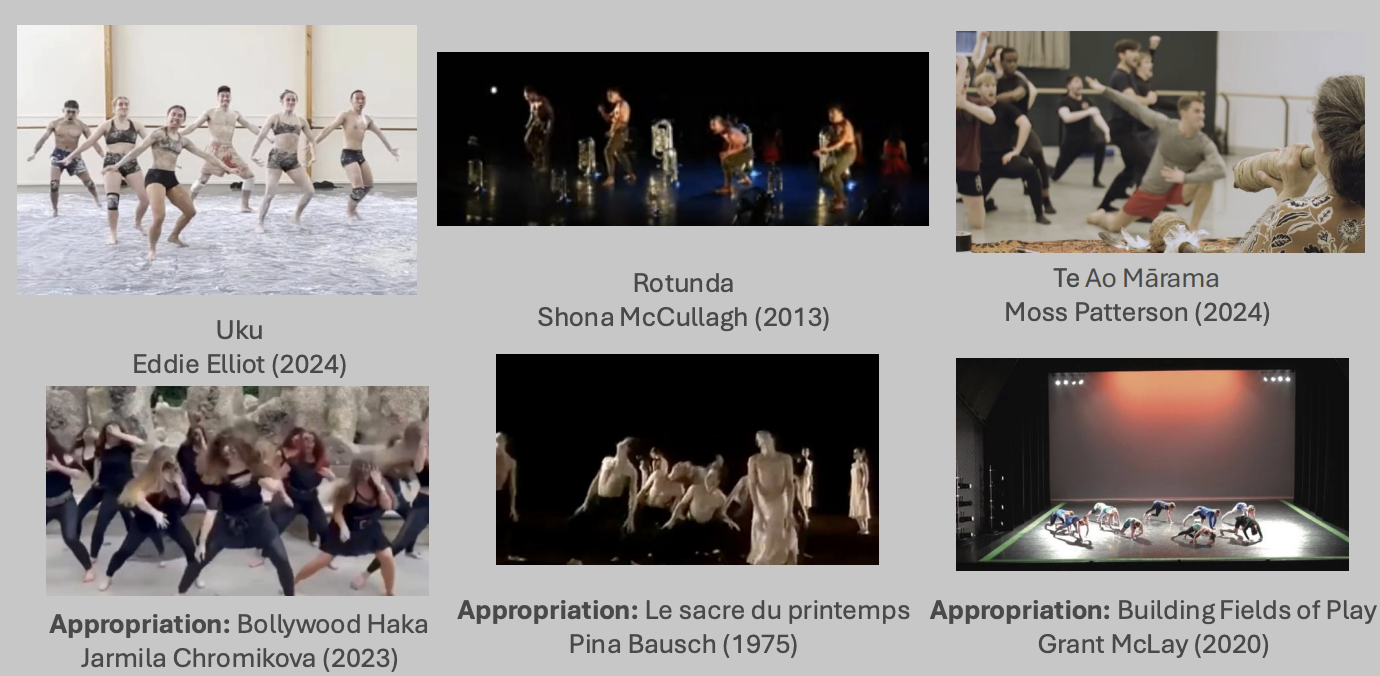
Cultural translation nation to nation
-eddie elliot
-the gestures and the origin of them and how they are commodified in artistic practice
Ownership and identity
-build connections across cultures and countries
Gendered assumptions in choreography:
• Pūkana (dilating of eyes)
• Ngangahu
• Pōtete (closing of eyes; to be performed by women)
“Kapa haka (troupe) actually began as an event initiated by women[…] according to the founding whare tapere story of Tinirau and Kae” (Banks 2017)
-troupe (group)
Global Spectacle:
• Both elite actors and grassroots organizations can use sporting events to counter hegemony
• Ceremonial performances and event structures are rooted in tradition and nationalism
-also performed in small rugby clubs
-deemed as insignificant for highschoolers who don't know what they are doing to perform their own haka
Take-aways:
• There are embodied implications within Māori whānau and tangata whenua (stewards of land) for haka performances
• The globalization of haka in contemporary dance can further abstract its origins among manuhiri (visitors or settlers)
• Contemporary Māori-led dance performances and haka at rugby events illustrate the role of Indigenous existence as a form of resistance and redress
-perform that history to the community but also to a global audience
Discuss: Nationalism and Violence
-used the image without consultation
-having a whole hut of first nations heritage
-reinforcing settler colonialism
-I can take this part of a culture that is not mine and brand it that it is
-law enforcement (RCMP) that targeted black indigenous peoples (not great to have them represent canada)
The Impact:
• Power operates on many levels when examined in sporting events
• SMEs hold power to reinforce ideas of nationalism through iconography and symbolism
• Indigenous performances serve as redress as a form of soft power amid ongoing settler colonialism
• Elements of collective national identities can also serve as violence
-can re-enforce the ideas of what it means to be a nation?
-how Canadas industry is also absent from sports in the past
-USA usually doesn't have land acknowledgements
 Note
Note  Flashcards (20)