biological approach + biopsychology?
 Call Kai
 Learn
Learn Practice Test
 Spaced Repetition
 Match
Match Flashcards
 Knowt Play
1/20

There's no tags or description
Looks like no tags are added yet.
Name | Mastery | Learn | Test | Matching | Spaced | Call with Kai |
|---|
No analytics yet
Send a link to your students to track their progress
21 Terms
What is the biological approach?
The approach investigates how biological structures and processes within the body impacts on behaviour
What are the basic assumptions in the biological approach?
Everything psychological is at first biological
Genes affect behaviour and influence individual psychological differences between people
Evolutionary psychology considers genetic influences in common behaviours
Psychologist should study the anatomy of the brain, nervous system and other biological system (e.g. hormones - endocrine system, chemicals acting on the brain - neutransmitter)
GANE
Genetics
Anatomy
Neurotransmitter
Evolution / Endocrine
What is evolution and the 2 main concepts within it?
Evolution is the changes in inherited characteristics in a biological population over successive generations
Natural selection: animals with particular traits that provide them with an advantages are more likely to survive and reproduce thereby passing on their ‘adaptive traits’ to their offspring
Sexual selection: choosing a mate with genetic ‘fitness’ ensures that your genes will be passed onto future generations
How is the human nervous system organised?
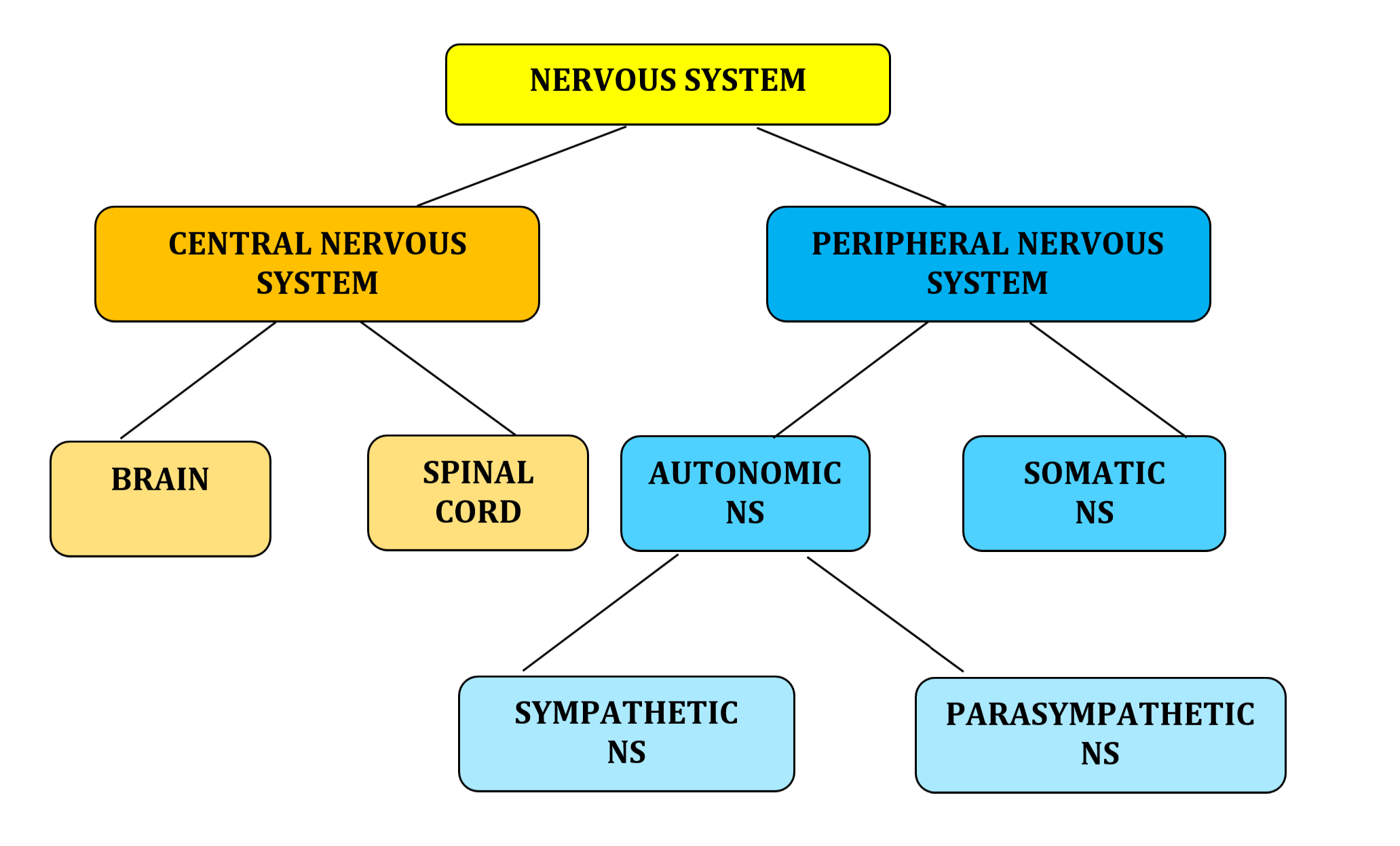
Describe the functions of the peripheral NS
The peripheral NS transmits messages to and from the CNS
The autonomic NS transmits information to and from internal bodily organs
The sympathetic NS works with the endocrine system to bring about physiological arousal in the flight to fight response
The parasympathetic NS works with the endocrine system to return the body back to its resting state in the rest and digest response
The somatic NS transmits information from sense organs to the CNS, then to effectors
What is the excitation and inhibition effect?
Neurotransmitters have either an excitatory or inhibitory effect on the neighbouring neurone
An excitatory effect increases the likelihood of a new action potential - e.g. adrenaline causes excitation of the post-synaptic neurone by increasing its positive charge and making it more likely to fire
An inhibitory effect decrease the likelihood of a new action potential - e.g. serotonin causes inhibition in the receiving neurone, resulting in the neurone becoming more negatively charged and less likely to fire
(Mention summation)
What is summation?
Summation decides whether a post-synaptic neurone fires - the excitatory and inhibitory influences are summed
The excitatory and inhibitory signals are summed across all the dendrites of the postsynaptic neuron
If the postsynaptic neuron receives more excitatory signals than inhibitory signals, it will be more likely to create an action potential
If more inhibitory signals are received than excitatory signals, it will be less likely to create an action potential
What are genes?
They are the basic units of heredity
function in pairs and recombination of genes from parents offsprings provide the basis for genetic variability
What are genotype and phenotype?
Genotype: genes - only determine the potential for characteristics
Phenotype: the observable characteristics of an individual - depends on the interaction between genetic and environmental factors
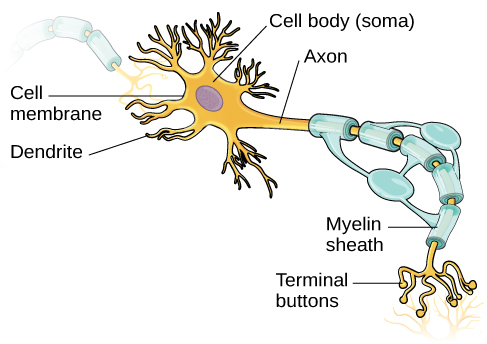
What is the structure of a neurone and its function?
When an electrical signal called an action potential reaches the axon terminal (terminal buttons),it triggers the release of neurotransmitters into the synaptic cleft
these neurotransmitters then bind to receptors on the postsynaptic neuron
The cell body includes a nucleus
Dendrites protrude from the cell body - carry nerve impulses from neighbouring neurons towar the cell body
Axon carries the impulses away from the cell body, down the length of the neuron
Axon covered in a layer of myelin sheath - protects the axon and speeds up electrical transmission of impulse
Axon has gaps called Node of Ranvier - speeds up transmission by forcing impulse to ‘jump’ across the gap
Axon terminal communicate with the next neuron (dendrite of the posts synaptic neuron) across the synapse
What is the synaptic connection? What is its structure?
Neurons don’t physically touch each other - there is a gap between them known as the synaptic cleft
At this location, known as the synapse, the electrical signal must be converted into a chemical signal to continue its journey to the next neurone
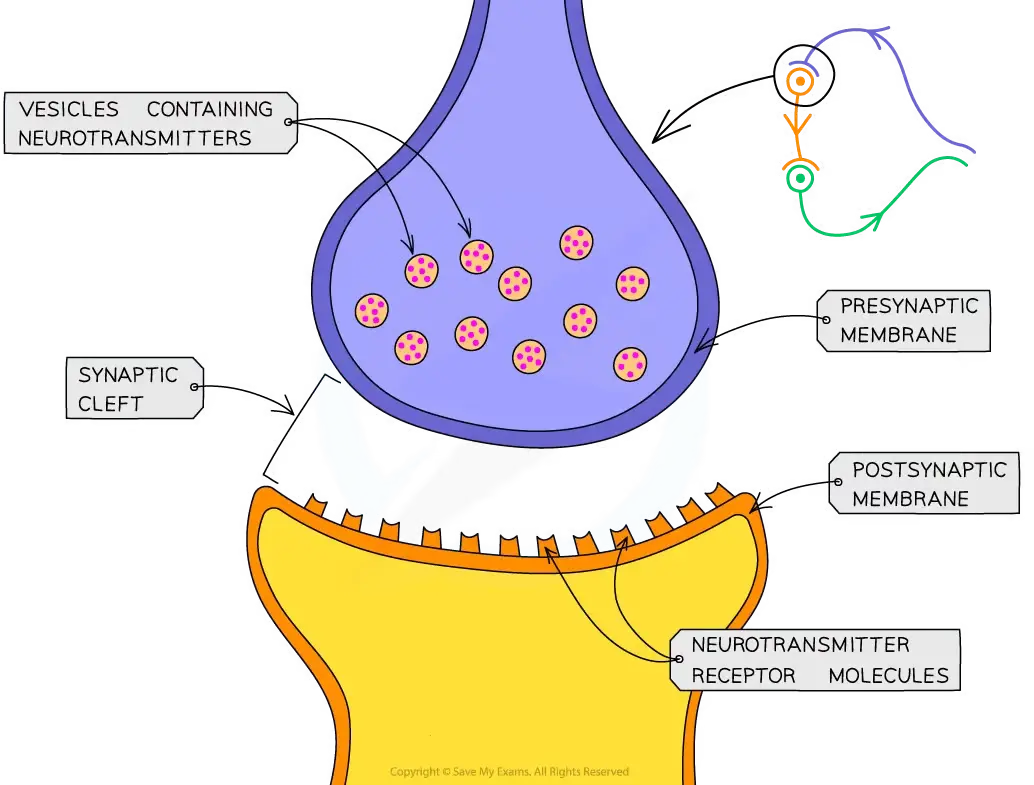
Explain the process of synaptic transmission
Electrical impulses (action potentials) reach the presynaptic terminal
Electrical impulses (active potentials) trigger release of neurotransmitters from synaptic vesicles
Neurotransmitters diffuse across the synaptic cleft
Neurotransmitters bind to receptors on the postsynaptic membrane
What are the 3 types of neurones?
Sensory neurons: carry signals from receptors to the spinal cord and brain
Relay neurons: carry messages from one part of the CNS to another
Motor neurons: carry signals from the CNS to effectors
What is the reflex arc?
Stimulus > receptor > sensory neuron > relay neuron > motor neuron > effector > response
In a reflex arc, like the knee-jerk reflex, a stimulus, suck as a hammer hitting the knee, is detected by sense organs in the peripheral nervous system, which conveys a message along a sensory neuron.
This message reaches the central nervous system where it connects with a relay neuron.
This then transfers the message to a motor neuron.
This then carries the message to an effector such as a muscle, which causes the muscle to contract and hence the knee to move
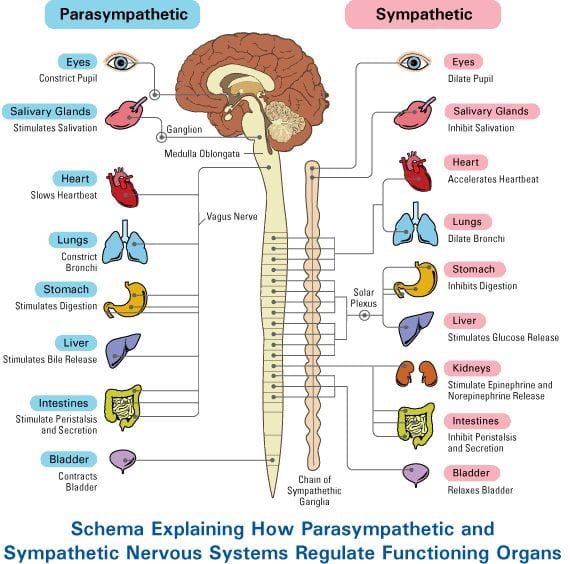
What is the difference between parasympathetic and sympathetic nervous system?
Parasympathetic: rest and digest - normal
Sympathetic: flight or fight
(No need to know kidney in sympathetic, but add adrenal glands- releases adrenaline)
What is the endocrine system?
The endocrine system consists of glands - produce hormones which are released in the blood stream to the target organs which contain receptors for specific hormones
The pituitary gland consists the release of hormones from all the other endocrine glands
Hormones work more slowly than nerve impulses but often together with the nervous system
How do the endocrine system and the nervous system work together?
They work together to produce the acute stress response
Hypothalamus > sends a signal to the Adrenal Medulla > which produces Adrenaline > causing a flight or fight response > then the parasympathetic nervous system brings the body back to an optimum state by slowing down the heart rate and bringing blood pressure back to an optimum level
What are the different glands and hormones? What are their functions?
Pituitary gland (master gland)
Gonadotropin: development of ovaries and testes
Growth hormone: growth of bones and muscles
Anti-diuretic hormone: increase re absorption of water in kidneys
Pineal gland
Melatonin: involved in sleep
Thyroid gland
Thyroxine: rate of metabolism
Thymus
Thymosin: promotes production and maturation of white blood cells
Adrenal gland
Adrenaline: flight or fight
Pancreas
Insulin: converts glucose to glycogen
Glucagon: converts glycogen to glucose
Ovary
Oestrogen: controls ovulation and sexual characteristics
Progesterone: prepares the uterus lining for embryo
Testis
Testosterone: controls sperm production and sexual characteristics
What are twin studies?
Determines the likelihood that certain traits have a genetic basis by comparing the concordance rate between pairs of twins
Concordance rate: the extent to which a pair of twins share similar traits or characteristics
Comparisons can be made between twins raised together and twins raised apart
What are the 2 different types of twins?
Monozygotic twins are identical - share 100% of each others’ genes = should have a 100% concordance rate
Dizygotic twins are not identical - share about 50% of each others’ genes = should have a lower concordance rate
What is cognitive neuroscience?
Scientific study of neurological structures, mechanisms, processes and chemistry that are responsible for cognitive processes
Use of scanning methods
The study of neurotypical individuals to locate the physical basis of cognitive processes in the brain
E.g. Lisofsky et al. (2014) - identified areas of the brain that are active when we tell lies