Human Anatomy: Digestive System Functions and Structures
 Call Kai
 Learn
Learn Practice Test
 Spaced Repetition
 Match
Match Flashcards
 Knowt Play
1/58

There's no tags or description
Looks like no tags are added yet.
Name | Mastery | Learn | Test | Matching | Spaced | Call with Kai |
|---|
No analytics yet
Send a link to your students to track their progress
59 Terms
What is the difference between mechanical and chemical digestion?
Mechanical is the physical breakdown of food via teeth and tongue; chemical is the enzymatic breakdown of food via saliva.
What role does saliva play in the mouth?
Saliva moistens the bolus and contains digestive enzymes that begin the breakdown of certain macronutrients.
What is lingual lipase responsible for digesting?
Lingual lipase is responsible for the chemical digestion of triglycerides.
What is salivary amylase responsible for digesting?
Salivary amylase is responsible for the chemical digestion of starch.
What is the role of salivary glands?
Salivary glands secrete saliva and digestive enzymes, allowing digestion to begin in the mouth.
What tissue makes up the dorsal surface of the tongue?
Keratinized stratified squamous epithelium.
What is keratin?
Keratin is a dead, fibrous protein that is protective and commonly makes up hair, skin, and nails.
What are the 5 basic human taste profiles?
Bitter, Umami, Salty, Sweet, Sour.
What are immature teeth in children aged 2-5 called?
Deciduous or Milk Teeth.
What are the general layers of a tooth from superior to inferior?
Crown, Root, Bone.
What are the specific layers of a tooth from superior to inferior?
Enamel, Dentin, Pulp, Root canal, Periodontal ligament, Nerves/Blood vessels.
What are the 3 muscles of mastication?
Pterygoid, Temporalis, Masseter.
What is the pharynx?
The pharynx is a cavity connecting the oral and nasal cavity to the esophagus and trachea.
True or False: The esophagus secretes digestive enzymes and digests food.
False, the esophagus plays no role in digestion.
What is the purpose of circular layers of esophageal musculature?
To increase lumenal pressure.
What is the purpose of longitudinal layers of esophageal musculature?
To shorten and contract.
What describes the manner in which the esophageal musculature moves to transport food?
Peristalsis.
What is the purpose of keratin in the esophagus?
To protect the wall of the esophagus from pathogens and reduce friction.
What are the key functions of the stomach?
Holds food, temporary storage, mechanical digestion, chemical digestion, controlled emptying into the small intestine.
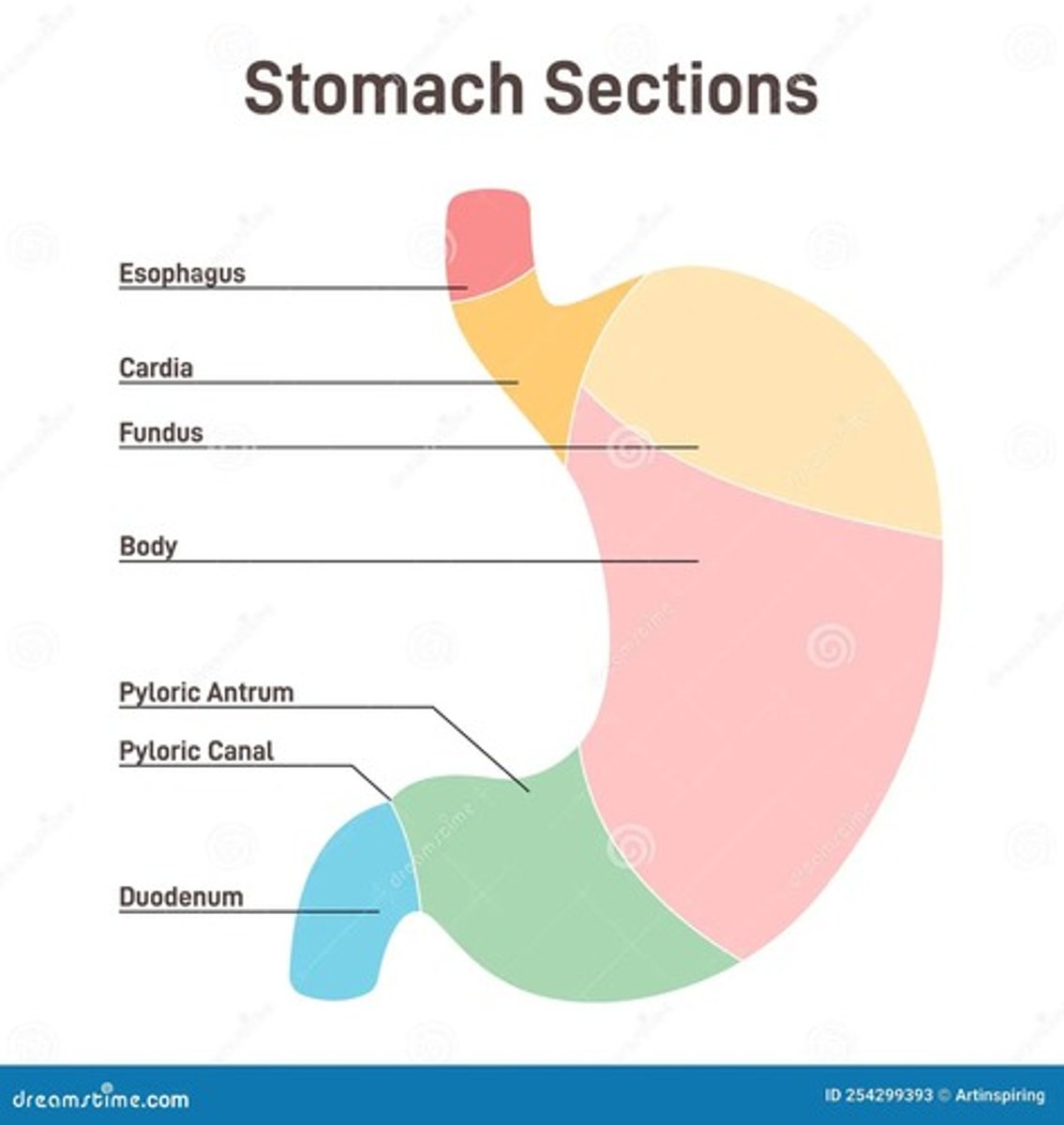
What is the mucosa of the stomach made out of?
Epithelial lining, connective tissue, and smooth muscle.
What are the folds in the mucosa called?
Rugae.
What is found within gastric pits?
Gastric pits contain glands that secrete acids for digestion.
What cells in gastric pits secrete HCl and Intrinsic Factor?
Parietal cells.
What is the purpose of HCl in the stomach?
To aid in the chemical breakdown of food.
What is the purpose of Intrinsic Factor?
Crucial for absorption of vitamin B12.
What cells in gastric pits secrete Pepsinogen and Gastric Lipase?
Chief cells.
What is Pepsinogen in the stomach?
A zymogen that is converted to pepsin for protein digestion.
What is a zymogen?
An inactive form of an enzyme that requires activation.
What activates pepsinogen?
It is activated into pepsin once it exits Chief Cells and enters the lumen of the stomach.
What does pepsin do?
Aids in the digestion of protein into peptides and amino acids.
What does gastric lipase break down?
Triglycerides into diglyceride and free fatty acids.
What role do sphincters play in the stomach?
They control how much food enters the small intestine at once.
What are the two sphincters of the stomach?
Cardiac/Lower Esophageal Sphincter and Pyloric Sphincter.
What pH does stomach acid need to reach for the pyloric sphincter to open?
A pH of 2.0.
What is chyme?
Digested food once it enters the small intestine.
What is GERD?
Gastroesophageal Reflux Disease, where stomach acid bubbles back into the esophagus.
What is the exocrine function of the pancreas?
To create and secrete pancreatic juices and enzymes for mechanical digestion.
What does the pancreas secrete to neutralize chyme?
Bicarbonate.
What is the endocrine function of the pancreas?
To produce and secrete hormones that regulate blood sugar levels.
What hormones are produced by the pancreas?
Insulin and glucagon.
What does the liver produce?
Bile.
What is the function of bile?
To aid in the breakdown of fats and nutrient absorption.
What major vein is found in the liver?
Hepatic Portal Vein.
What is the functional unit of the hepatic circulation system?
Hepatic Lobule.
What is liver cirrhosis?
Chronic fibrotic changes of the liver due to injury and inflammation.
Where is the gallbladder located?
Beneath/inferior to the liver.
What does the gallbladder do?
Stores bile.
What is a cholecystectomy?
A surgical procedure to remove gallstones.
What are the three sections of the small intestine?
Duodenum, Jejunum, Ileum.
What valve is found at the end of the ileum?
Ileocecal valve.
How is surface area maximized in the small intestine?
Through circular folds, villi, and microvilli.
What do Paneth cells secrete?
Antimicrobial peptides.
What is Celiac Disease?
A severe gluten intolerance that flattens the villi of enterocytes.
What are some essential functions of the large intestine?
Absorb water and electrolytes, form stool, facilitate bacterial fermentation, and protect against infections.
What are the four main parts of the large intestine?
Ascending Colon, Transverse Colon, Descending Colon, Sigmoid Colon.
What is the purpose of the rectum?
Reservoir for stool before elimination.
What are the two sphincters connecting the rectum to the anus?
Internal Anal Sphincter and External Anal Sphincter.
Which anal sphincter is involuntary?
Internal Anal Sphincter.
What is appendicitis?
Inflammation of the appendix that requires surgical removal.

