Chapter 12 (viruses, viroids, prions)
 Call Kai
 Learn
Learn Practice Test
 Spaced Repetition
 Match
Match Flashcards
 Knowt Play
1/67

There's no tags or description
Looks like no tags are added yet.
Name | Mastery | Learn | Test | Matching | Spaced | Call with Kai |
|---|
No analytics yet
Send a link to your students to track their progress
68 Terms
virus
noncellular particle containing a genome that can replicate only inside a host cell; no cell membrane, no binary fission, no ATP generation, no ribosomes
Obligate Intracellular Parasite
Requires a living host for replication and survival (all viruses)
bacteriophage
A virus that infects bacteria
nucleocapsid
capsid (protein coat) and nucleic acid (viral genome) together
nucleic acid of viruses
DNA or RNA; linear or circular or segmented; double or single stranded
capsid
protein coat surrounding a virus, determines the shape of a virus
capsomeres
repeating or identical protein subunits that make up capsids
genome of viruses
primary characteristic used to classify viruses; aka how do they make RNA?
envelope and shape
Secondary characteristic for determining virus classification
baltimore classification
a classification scheme that groups viruses into seven classes according to how the mRNA is produced during the replicative cycle of the virus
naked virus
virus without an envelope; nucleocapsid only, more resistant to disinfectants ; fully assemble before release because host dies
enveloped virus
A virus enclosed within a phospholipid bilayer derived from its host cell
Matrix or tegument
protein layer attaching envelope to the nucleocapsid
host range
the spectrum of host cells a virus can infect; determined by attachment proteins on the outside of a virus
spike proteins
protruding structures of virus that are recognized by antibodies
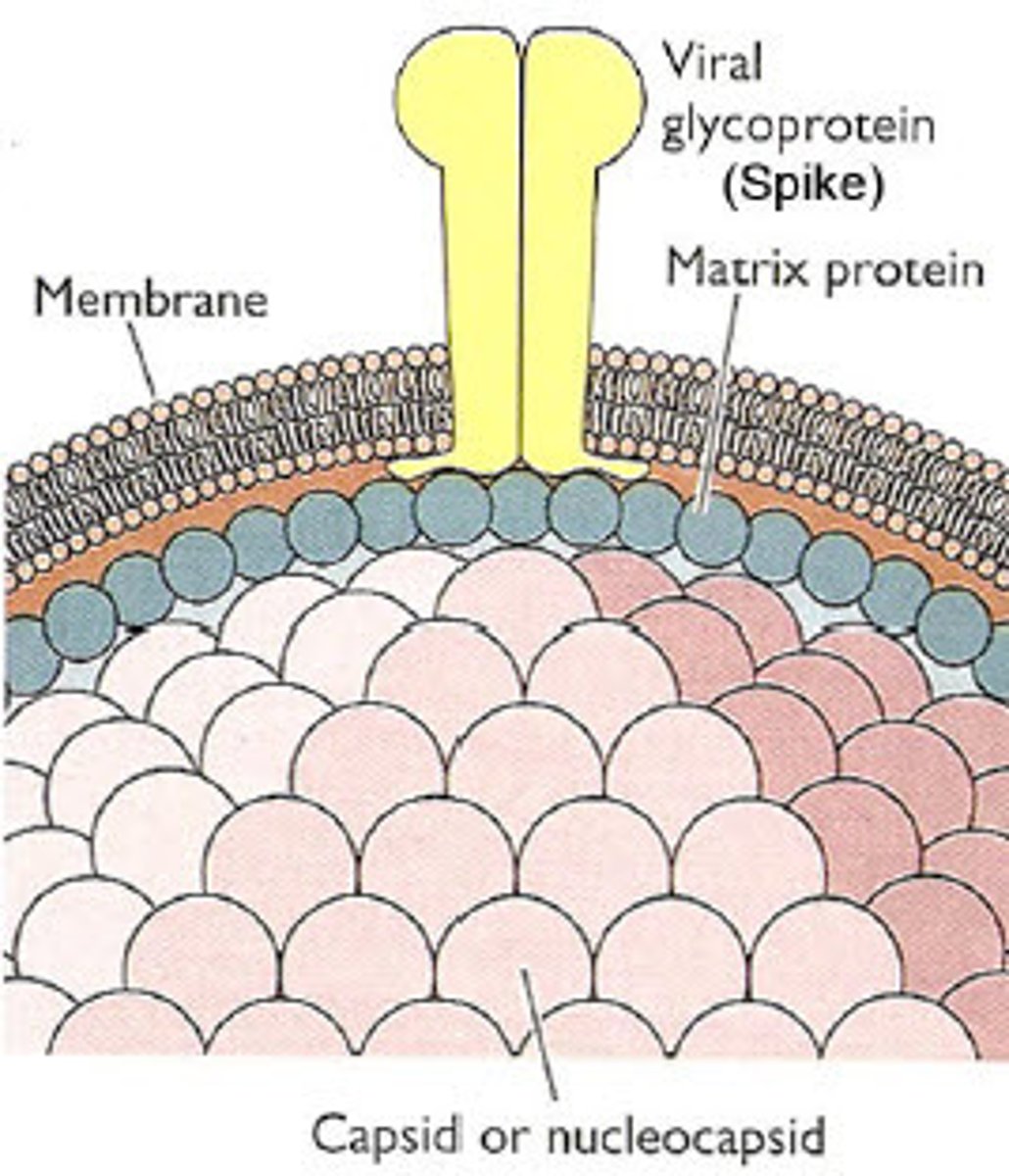
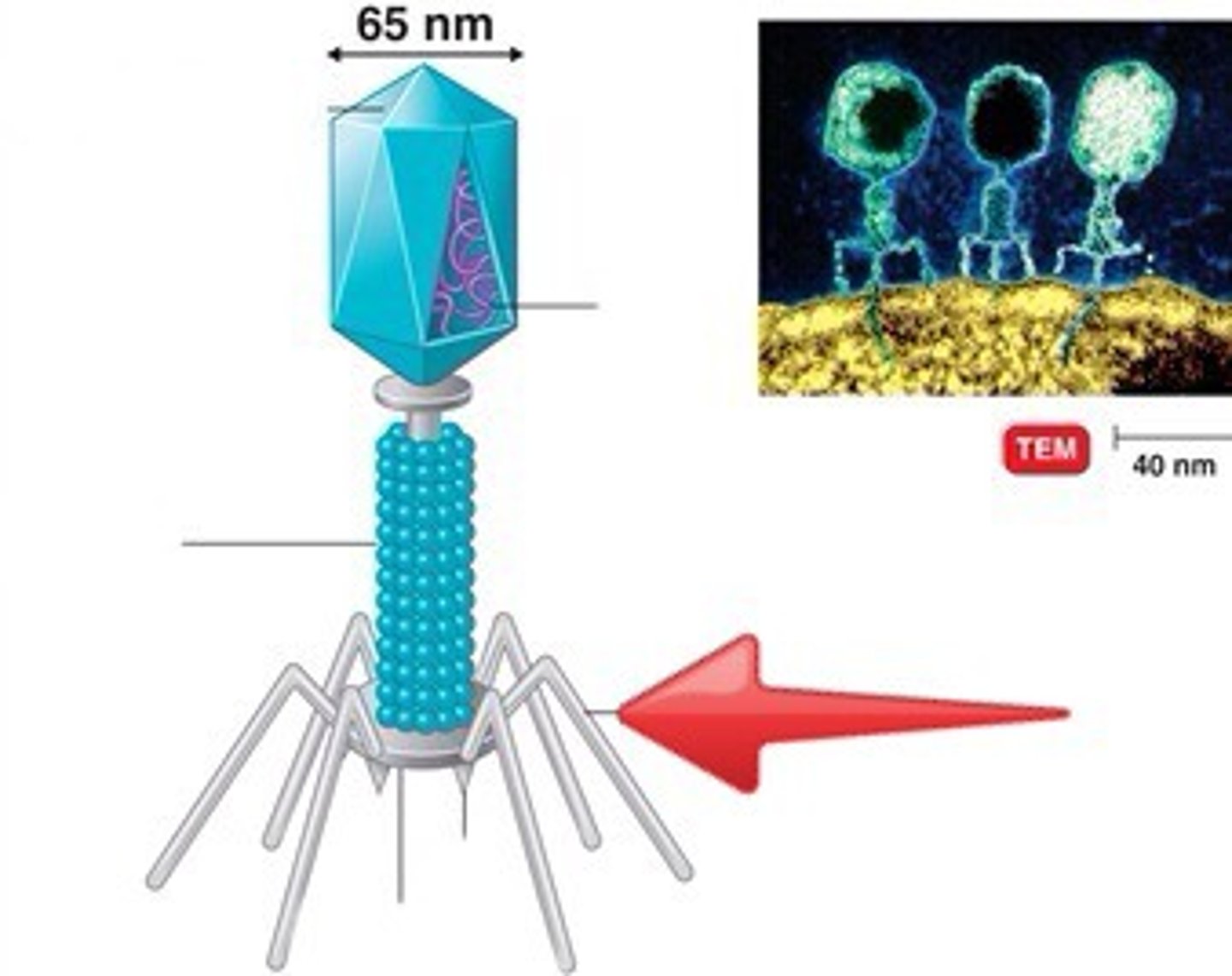
tail fibers
Allow the bacteriophage to attach to the host cell
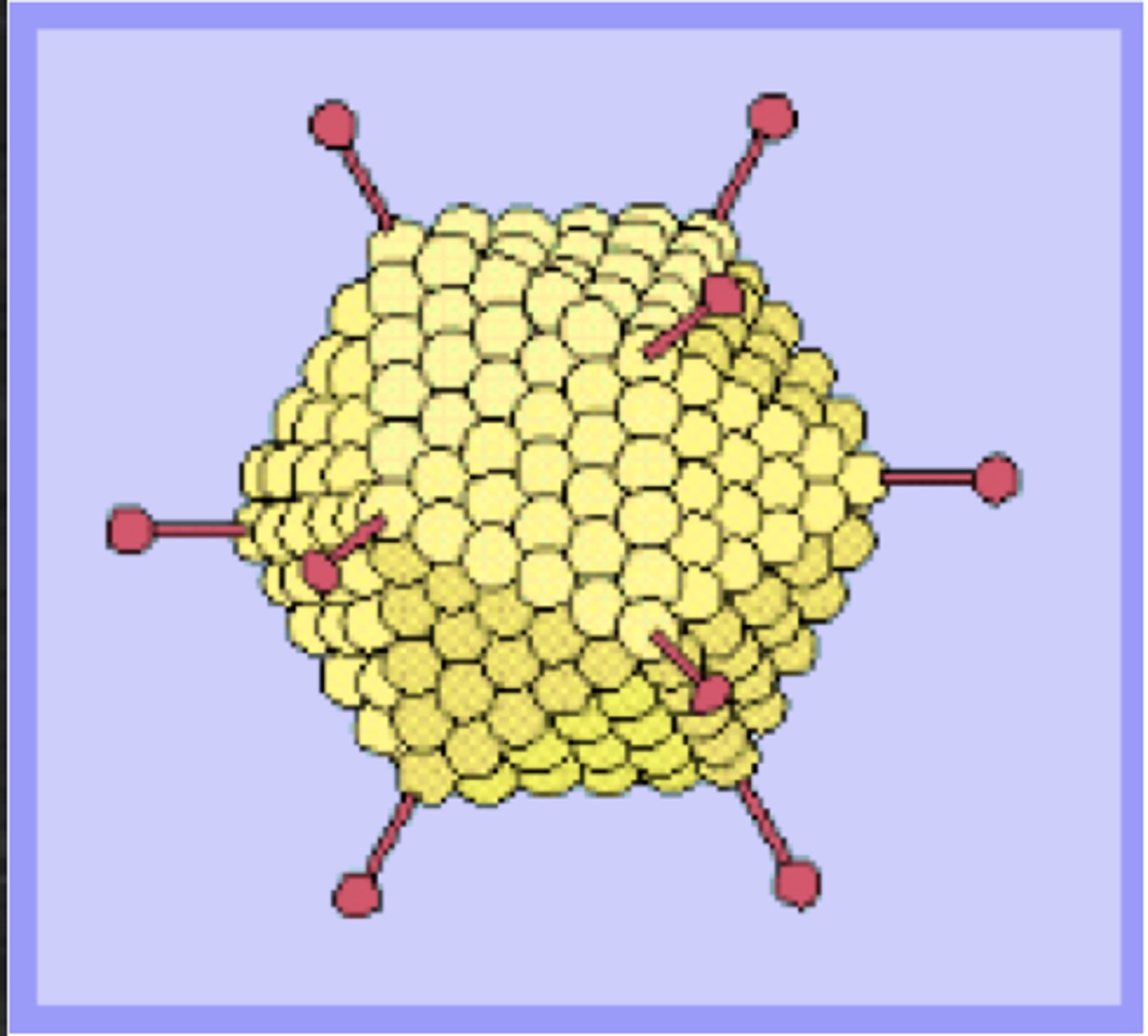
fiber proteins
on capsid of naked viruses
icosahedral capsid
Virus structure with 20 triangular faces.
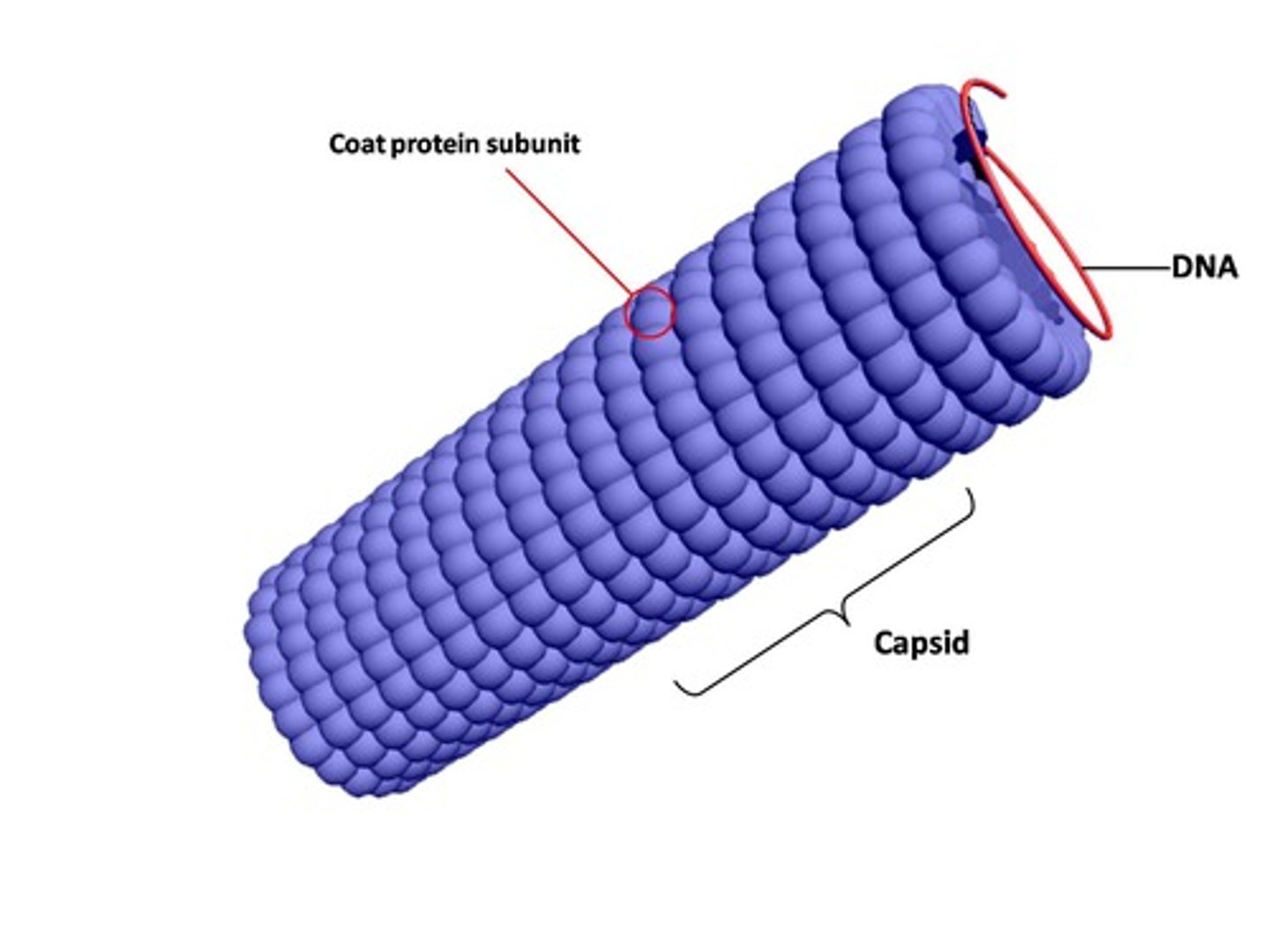
helical/filamentous capsid
Rod-shaped, form a continuous helix around the nucleic acid (genome)
complex capsid
No symmetrical form, often found in bacteriophages; contains "core" structure that contains the genome
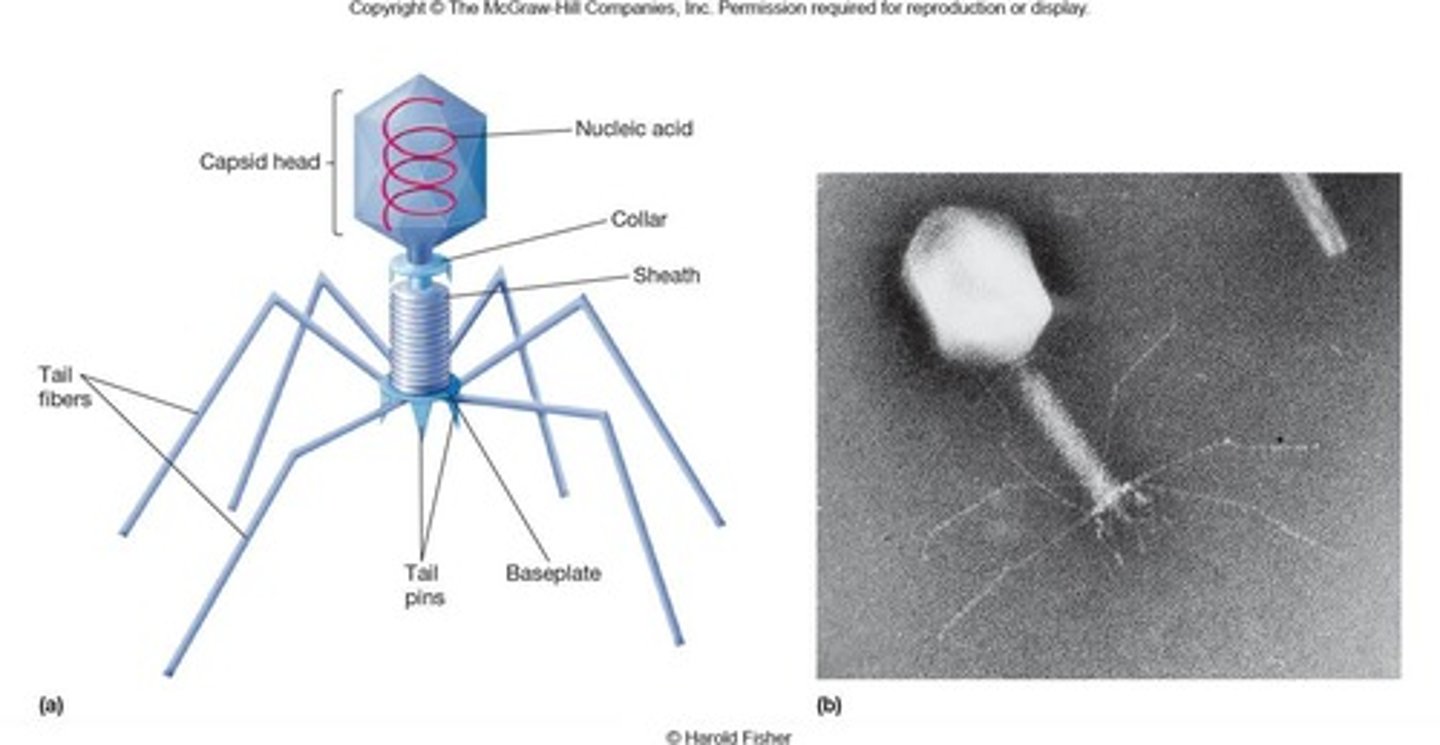
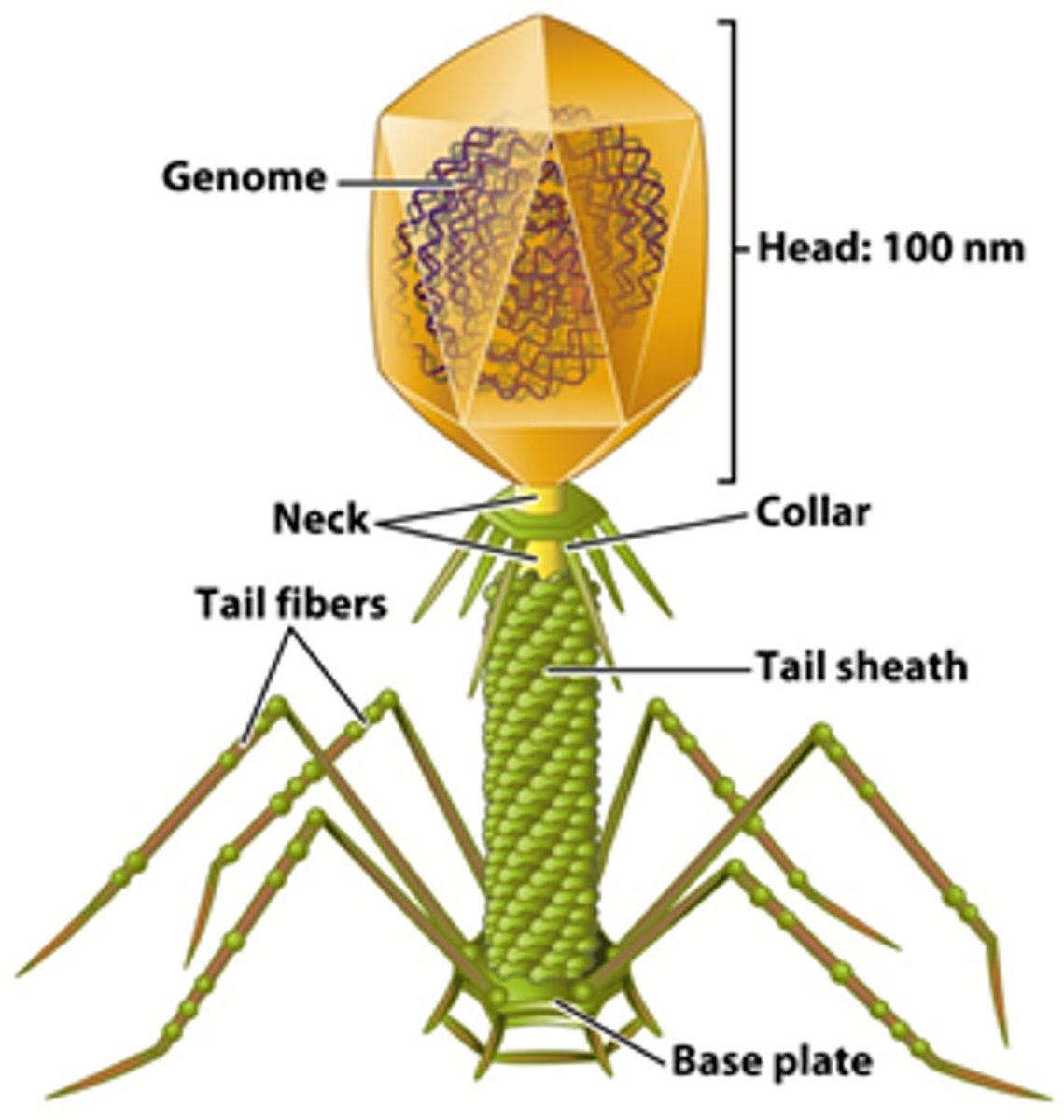
complex-tailed bacteriophages
-head: icosahedral, contains genetic material
-tail: injects genome into host cells
-tail fibers: attachment
1. Host cell recognition and attachment
2. Genome entry
3. Biosynthesis
4. Assembly/Maturation
5. Release (and transmission)
General Scheme of viral replication:
virion
single, infectious virus particle; can be productive or latent
productive (lytic phage) virion
making or capable of making large amounts of; giving good results
latent (lysogenic) virion
Viral genome integrates or replicates as a circular DNA (non-productive or no virions are produced); can still affect host even when not productive (Ex: chicken pox)
tail fibers bind to bacterial host cell "receptor" (LPS, pilli, porin)
Host cell recognition and attachment (phage lytic infection):
complex phage will inject genome alone into host using potential energy; sometimes uses lysozyme to make a hole in peptidoglycan
Genome entry (phage lytic infection):
some phage digest host bacterial genome; gene expression is regulated by regulators (early genes/proteins, late genes/proteins)
Biosynthesis (phage lytic infection):
early genes/proteins
modify or alter host's replication or transcription
late genes/proteins
build the phage tail, capsomeres, etc; ex: lysozyme to break out
generalized transduction (only if a mispackaging event happens); complex phage virion assembly is complicated and follows a specific, step-by-step process
Assembly/maturation (phage lytic infection):
Many phase will lyse and kill host; burst size = number of virions released (productive infection, so more virions
Release (phage lytic infection):
plaque
a clearing in a bacterial lawn resulting from lysis by phages; phage infection occured
temperate phage
A phage that is capable of reproducing by either the lytic or lysogenic cycle
prophage
the viral DNA that is embedded in the host cell's DNA; during lysogenic cycle
induction
When infection switches to lytic pathway
specialized transduction
a highly specific part of the host genome is regularly incorporated into the virus
environmental conditions, the nutritional state of the host, and molecular, density-dependent signaling. Favorable conditions typically favor lysogeny, while environmental stress (UV light, DNA damage) triggers the lytic cycle
What determines if a bacteria will enter the lytic cycle?
phage conversion
Prophage genes give the host bacterial cell new properties (new phenotypes), even in the lysogenic state; prophage are considered mobile genomic elements
mobile genomic elements
DNA segments capable of moving within a genome (intracellularly) or between cells (intercellularly) via transposition or horizontal gene transfer
filamentous phage
typically don't directly burst/kill the host but use host secretion or pili structure to exit; Some are always Productive, some can also go Latent
1. Bacterial restriction enzymes
2. CRISPR
bacterial defenses against phage
bacterial restriction enzymes
cut DNA molecules at specific DNA sequences called restriction sites; cut foreign DNA
methylation
helps distinguish self from non-self
CRISPR
bacteria integrate phage sequences in their own genome after surviving infection; creates a memory; crRNA and CAS proteins
- spikes (enveloped) or fiber proteins
- more than 1 host receptor may be utilized
- receptors are the host's
- determines host range and tissue tropism
How do viruses recognize the host cell?
tissue tropism
the range of tissue types that a virus can infect
- endocytosis (animal host cell) (only way for naked virus)
- Fusion (envelope fuses at host plasma membrane)
How do viruses enter the genome?
uncoating
once inside the host, the capsid is broken down to release the genome
proteases
enzymes that break down proteins; viral proteins are often translated as one large polypeptide then processed by these enzymes
viral genome (need viral mRNA) and virus proteins
biosynthesis involves making more...
Dna polymerase
DNA --> DNA; Host or viral enzymes
RNA polymerase
DNA ---> RNA; Host or viral enzymes
Replicase
RNA ---> RNA; viral enzyme only
Reverse transcriptase
RNA ---> DNA; viral enzyme only
HPV; uses DNA polymerase and RNA polymerase
DNA viruses biosynthesis
provirus
Viral DNA that inserts into a host genome; genome is replicated when the host's is replicated; typically DNA viruses (like HPV)
viral oncogenes
pieces of DNA from viruses that infect a normal cell and cause it to become malignant
Sars-CoV-2; use replicase; replicates viral genome and makes more viral mRNA; +RNA can also serve as mRNA and be directly translated first, no need to package replicase protein in the nucleocapsid
+RNA ---> -RNA ---> +RNA
+RNA viruses biosynthesis
Measles, influenza; Use replicase; host ribosome cannot directly translate the -RNA strand, so the virus must use replicase to make +RNA first; Replicase is packaged in the nucleocapsid
-RNA ---> +RNA ---> +RNA
-RNA & dsRNA viruses biosynthesis
HIV; use reverse transcriptase; host transcribes genome and viral mRNAs; DNA copy integrates into host genome, CAN'T be eliminated
RNA ---> DNA ---> RNA
reverse transcribing RNA viruses biosynthesis:
Hepatitis B; use reverse transcriptase; starts with a DNA genome that enters the host nucleus first, then RNA polymerase transcribes into mRNA, then Reverse transcriptase replicates mRNA into DNA
DNA ---> RNA ---> DNA
reverse transcribing DNA viruses biosynthesis:
antigenetic drift
slow, small changes in the virus; ex: mutations, mistakes in replicase and reverse transcriptase, new flu strain
antigenetic shift
a large, rapid change; recombination and reassortment; ex: flu pandemics
exocytosis and budding of the cell membrane (HIV)
How do enveloped viruses release?
often apoptosis, some might use vesicles
How do naked viruses release?
viroid
single-stranded RNA molecule that has no surrounding capsids or virions; no ORFs (can't make proteins); most infect plants, not well understood
prions
infectious protein particles; no genome; very stable, resistant to heat, and proteases; leads to aggregates in the brain

