Exam 2 - Personality Theories
 Call Kai
 Learn
Learn Practice Test
 Spaced Repetition
 Match
Match Flashcards
 Knowt Play
1/102

There's no tags or description
Looks like no tags are added yet.
Name | Mastery | Learn | Test | Matching | Spaced | Call with Kai |
|---|
No analytics yet
Send a link to your students to track their progress
103 Terms
Biochemistry (Week 7)
Study of how our bodies (bio-) produce and are influenced by fluids (-chemistry)
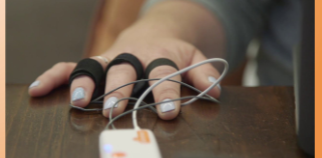
Biochemistry and Personality (Week 7)
Study of how sensitivity to and production of chemicals changes long-term behavior patterns
Two major classes of chemicals:
Hormones
Neurotransmitters
Hormones (Week 7)
Chemical signals made in one area of the body that influence a different area of the body
Often involve “activating” or “turning off” processes or systems in other organs
Key Hormones for personality:
Testosterone
Oxytocin
Cortisol
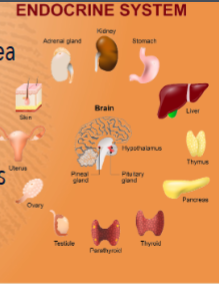
Testosterone (Week 7)
Hormone produced in gonads (testes and ovaries) that develops secondary sexual characteristics
Present in much larger amounts in cis men than cis women, but levels also change over lifespan
Effects are easiest to observe when artificially elevated
Consuming testosterone as a drug (anabolic steroids)
Increase muscle mass, especially ins arms and torso
Increases physical aggression
Increases impulsive and reckless behavior
Decreases sexual appetite and performance
‘Roid Rage (Week 7)
Testosterone Results (Week 7)
Being successful in a physical fight or sports match increases testosterone from before to after
Becoming physically larger results in more testosterone production
Appears to ready behaviors associated with social dominance
Aggression
Talkativeness
High-energy action
Facets of Extraversion (Week 7)
Like all Big 5, extraversion divided into two major facets
Dominance
Influenced by testosterone
“I usually take charge in groups”
“I like public speaking”
“I’m bold and outgoing”
Sociability
Influenced by oxytocin
“I love talking to people”
It’s easy to make friends”
“Being alone bums me out”
Oxytocin (Week 7)
People who have higher dispositional levels experience easier bonds, especially with new offspring
Levels increase from baseline during pregnancy and remain elevated for the first several months after childbirth
When injected artificially, lowers fear response
Especially true for fear of strangers
Appears to ready formation of new connections
Cortisol (Week 7)
Stress hormone
Works in concert with epinephrine (adrenaline)
Floods body during times of perceived threat, readying responses to the threat
Direct resources away from “non-essential” systems (immune system, digestion) toward “essential” ones (respiration, circulation)
Cortisol: Good for Tigers, Bad for Math Tests (Week 7)
Tigers:
Type of threat common for most of human history, with immediate physical danger presented by outside force
Readies anti-tiger responses:
Fight
Flight
Freeze
Fawn
Math Tests:
Type of threat common in contemporary U.S., with long-term abstract stressor giving gradual pressure over weeks or months
Cortisol Pt.2 (Week 7)
Dispositional levels associated with neuroticism, especially negative emotionality facet of neuroticism
“I often worry about the future”
“I sometimes avoid new experiences”
“I lack confidence”
Neurotransmitters (Week 7)
Chemical signals that travel from cell to cell within the brain and spinal cord
Make patterns of emotion and behavior more or less likely
Two studied most for impact on personality and behavior
Dopamine
Sometimes called “want” neurotransmitter
Notices potential rewards in environment
Motivates seeking of rewarding stimuli
Increases energy for movement towards rewards
Serotonin
Sometimes called “chill” neurotransmitter
Balances goals against one another
Helps with focus, ignoring distractions, and regulating negative emotions
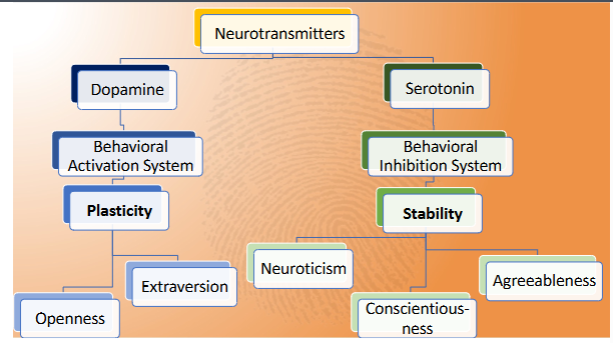
Dopamine (Week 7)
Associated with motivation, physical motion, learning, and reward-seeking
“Want” neurotransmitter because underpins curiosity and other forms of seeking behavior
Behavioral Activation System
Dopamine pathway that creates and promotes motivation to seek out rewarding experiences
Influenced by genetics (how many receptors)
Influenced by lifetime of experience with being rewarded for risk-taking or novelty-seeking
Plasticity
Broad tendency to seek out new experiences and to find novelty rewarding rather than frightening
Intellectual curiosity → Openness
Social curiosity → Extraversion
Serotonin (Week 7)
Associated with stability, self-control, perspective-taking, and ability to resist temptation
Sometimes called “chill” neurotransmitter because underpins ability to set aside worries and distractions
Behavioral Inhibition System
Serotonin pathway that involved ability to take long-term view of behavior and plan out actions
Influenced by genetics (how many receptors)
Influenced by lifetime of experience with risk and regret
SSRIs (selective serotonin reuptake inhibitors)
Medicines that treat mental illness, including clinical depression and anxiety disorders
Associated with decrease in worry and regret, but no change in positive emotions or curiosity
Stability
Broad tendency to modulate one’s behavior based on long-term goals and situational demands
Social modulation → Agreeableness
Emotional modulation → Neuroticism
Goal modulation → Conscientiousness
Evolutionary Psychology (Week 8)
Evolution: study of how match or mismatch between individual adaptations and the environment influences probability of gene survival
Evolutionary Psychology: study of how patterns we observe in contemporary humans may have helped our ancestors survive and/or reproduce
Fit: degree to which any given feature of an organism matches well or poorly to the demands of the environment
Evolution of Self-Esteem (Week 8)
Self-Esteem
Extent to which one views oneself as competent, likeable, capable, and morally good
Feels fundamentally important to us, to point of being an entire industry built around its measurement and improvement
Sociometer Theory
Self-esteem evolved as a sense of how well we are doing at being liked by other people
Important for our survival because humans rely one another for almost all of our needs, and being shunned by the group will lead to death
Socio meter Theory (Week 8)
Socio = social
Meter = measure
Sociometer theory of self-esteem
Self-esteem acts as an approximate measure of how well we are doing at being likeable to other people
Fit (Week 8)
NOT “fitness” in the sense of being physically strong
NOT an organizing unit from “best” to “worst” or “strongest” to “weakest”
Degree of match between organism and demands of that organism’s environment
As environment demands change, so best-fitting characteristics will change
Many possible ways to achieve fit for one environment
High Agreeableness
Causes easy relationship-formation when people are around you are mostly honest
Makes you easy to cheat or use if there are dishonest people in the area
High Impulsivity
Causes you to take advantage of opportunities in fast-changing environment
Can sabotage long-term goals in a stable environment
Ex. Tide Pods
Altruism and Aggression (Week 8)
Aggression: behaviors meant to hurt a person who doesn’t want to be hurt
Chimpanzees
Humans’ closest living relatives
Strict social hierarchies, enforced through violence
Known to engage in systemic violence, described as “war”
Show sophisticated tool use
Altruism: behaviors meant to help a person with no potential for self-gain
Bonobos
As related to humans as chimpanzees are
Resolve conflicts through grooming, recreational sex
Rarely engage in violence
Show complex social behaviors
Kronk - angel and devil on shoulders
Altruism and Aggression Pt.2 (Week 8)
Aggression likely helped many humans ancestors win fights and get stuff from other groups
Now can be a major disadvantage — mostly has a poor fit to contemporary environment
Altruism (sacrifice to help other) also likely helped human ancestors get along well in groups and protect those who needed protecting (human saving dog/cat)
Are humans inherently selfless or inherently selfish?
Both
Which one gets expressed probably depends on the circumstances one has experienced in the past.
Criticisms of Evolutionary Psychology (Week 8)
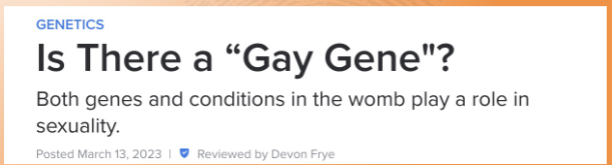
Controversial sub-field of personality
Has been subject to over-applications
C: “Just-So Stories” (Week 8)
Explain the world as “it’s just so” - pure speculation, not evidence-based
Most hypotheses are difficult to test directly
Cannot observe humans for 400 million years in a lab
Makes it hard to know degree of evidence basis behind most claims
Ex. elephant having along trunk by being pulled by an alligator
C: Naturalism Fallacy (Week 8)
False assumption that something being “natural” means it is healthy, good, or as things should be
Cyanide, lead, and anthrax are 100% natural and organic — all of which kill on contact
Brushing one’s teeth is fundamentally unnatural — estimated to have added 25+ years to average human life expectancy
Nature is filled with imperfect solutions
Funder’s First Law!
Ex: big brains help humans with social coordination… and cause 1000s of death during childbirth each year
Ex: humans’ upright stance makes tool use easier… and causes chronic lower back problems for >30% of adults
C: We don’t just exist to make babies (Week 8)
Over half of adults in U.S. currently choose not to have children — which flies in the face of “reproduction at all costs”
Some principles that hold at population level don’t hold at individual level

C: Humans are flexible (Week 8)
Humans’ single greatest unique skill is learning
Means there are many many many MANY things about us that can’t be explained by inheritance

C: Widespread doesn’t mean biological (Week 8)
Studies have mistaken social norm-determined behaviors for being innate (biological)
“Women prefer richer and more powerful partners; men prefer younger and more beautiful partners”
…only replicates in societies where women need male partners in order to be financially stable
Behavioral Genetics: Nature and nurture influence each other (Week 8)
Twin Studies
Adoption studies
Twin adoption studies
Nature shaped nurture (Week 8)
Evocative forces
Ways our genetics shape the way other see us
Bidirectional relationships
Active forces
Ways our genetics cause us to choose environments and influences
We chase rewards and avoid punishments
Nurture is needed to express nature (Week 8)
Without necessary environments (culture, parenting, socioeconomic status, etc.), genetic tendencies won’t be expressed
Genes influence behavior (Week 8)
… in ways that are not necessarily linear
… in ways that are not strictly passed from parent to child
… in ways that get interpreted as well as learned
Nature vs. Nurture? (Week 8)
“Both. Always.”
Funder quoting Watson
Nurture is needed to express nature (Week 8)
Cohort effects
Generation Z are, on average, better at reading and writing than Baby Boomers
Baby Boomers are, on average, better at navigation and survival than Gen Z
Flynn Effect
Average IQ has increased over time
Epigenetics (Week 8)
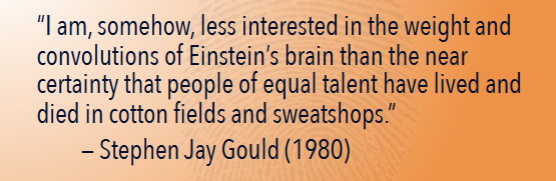
Changes to gene structure due to life events
Life experiences (nurture) of parents influence genes (nature) of their children
Sibling Effects (Week 8)
In S date [self-reports], personalities of one’s biological siblings do not predict one’s own personality
Birth order does not account for effect
Does not reflect lack of influence of genetics or parenting
In B data, L data, and especially I data, siblings do resemble each other
Biological siblings resemble each other more than adopted or step-siblings
Siblings resemble each other more than friends do
Siblings Effects Explanations (Week 8)
We understand ourselves through comparing ourselves to other people in the vicinity — and nowhere is that comparison more obvious than with siblings
“The golden child”
“The rebel”
“The responsible one”
“The brat”
Siblings can share 50% of their genes and be raised by the same parents — and still have extremely different upbringings and life experiences
Ex. Anna and Elsa
Heritability (Week 8)
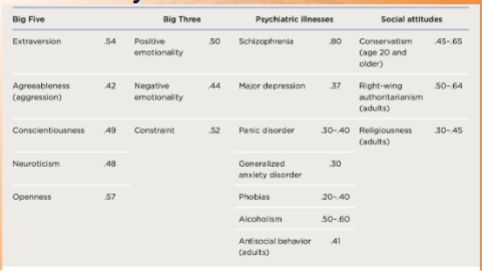
Measure of the extent to which variability in a trait is shared between individuals who share genes
Used to approximate how much influence genes have on that trait
For most major traits, r = 0.4
Aggregation (combining more measures) increases scores
Using more-precise measures can decrease estimates
Heritability Pt.2 (Week 8)
Becomes stronger if the environment is more supportive
If child is given no education, poor nutrition, high stress: IQ will be bounded at an upper limit
If child is given good enough environment: IQ free to vary to as high or low as genes make possible
Accounts for recent reversal in IQ variability and gender
Boys used to have more variable IQs (gone now in U.S.)
Good Enough Environments (Week 8)
Don’t have to be perfect or privileged
Instead
Enough food not have serious health problems
Enough love and support not to suffer neglect or trauma
Enough opportunities not to end up stunted
Will increase the overall variability (and thus heritability) in a trait
Psychoanalytic Theory (Week 9)
View that each human is driven by inner conflicts between parts of their mind that are often unconscious, or outside of self-awareness
Developed by Sigmund Freud
Physician interested in mental energy, or drive for life (libido)
Talking Cure (Week 9)
Discovery that talking over one’s problems with a sympathetic but uninvolved other person often causes those problems to resolve
Foundation for all modern talk therapies
As effective, or more so, than drugs for treating most forms of depressive and anxious disorders
Helps client understand sources of problems, put them in an ordered narrative, and develop solutions
Doctrine of Opposites (Week 9)
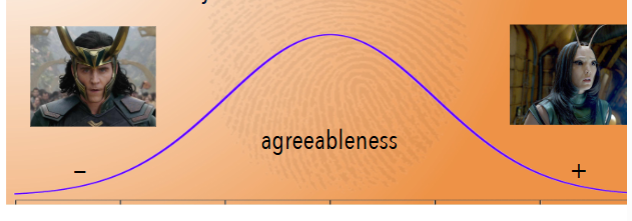
Any major concept implies the existence of its opposite in order to have meaning
Life needs death to have meaning
Bounty needs deprivation to have meaning
Happiness needs unhappiness, etc.
The extremes of any opinion will be more similar than the moderate middle
(Ex. Swift fans/ haters, protestors against porn, democratic/ republicans)
Suggests that personalities which are moderate are more well-adjusted than those at either extreme
Neo-Freudian Theory (Week 9)
Various theories that have developed more recently, building on Freud’s work in new directions
Klein: Objects Relations Theory
Adler: Inferiority Complex
Jung: Personas and Archetypes
Object Relations Theory (Week 8)
Holds that we are driven to be close to other people
But we can never know another person’s true self, only the object (version of them that exists in our heads)
Objects can be more or less accurate
Mismatch often source of interpersonal conflict
Doctrine of Opposites
Every important relationship is source of both pleasure and pain, of affection and annoyance
Examines how we grow to (or fail to) see loved ones as not just sources of pleasure or pain, but complex humans in their own right
No such thing as a percent parent (or kid) - reconciling that is part of becoming a healthy adult
Niffle (Week 9)
In object relations theory, physical object to which a person shows a strong emotional attachment
Common for kids, but can occur for adults too
Notable example of a transitional object
Helps a child self-soothe when loved one not around
Exists midway between fantasy and reality
“Magic” of object usually supported by family
Splitting (Week 9)
Maladaptive tendency to want one’s loved ones to be all good with no room for bad
Results in desire to destroy everything harmful (or annoying, or imperfect) about a person you love
Failure to mature enough to understand human complexity
Individual Psychology (Week 9)
Examines how people measure themselves against other, and strive to correct problems in themselves
Social Interest
Hypothesized to be our deepest motive: to have positive and productive relationships with others (avatar)
Inferiority
The aspect of a person they perceive to be their greatest weakness, starting in childhood
Usually motivates striving to correct that part of oneself
Compensation
Efforts to overcome or defend against feelings of inferiority as an adult
Adaptive: focusing on one’s values
Maladaptive: trying to make others feel inferior too
Masculine Protest
Type of compensation that reflects ways boys are socialized that they must be dominant and powerful, or else they are not “real men”
Creates desperation to defend one’s gender identity against perceived femininity
Collective Unconscious Theory (Week 9)
All humans share certain memories, ideas, dreams, images, and motivations
Collective Unconscious
Hypothesized to be common “pool” of images and concepts that all human minds draw from
Filled with fairly universal archetypes (heroic journey)
Archetypes (Week 9)
Symbols that organize how people think about the world, including general ideas about types of people and figures from religions
Give us sense of how the world is meant to work
Hypothesized to be the same in slightly different forms across different times and places (Gods)
Persona (Week 9)
The social version of one’s personality that a person “puts on” in public
Overtime, common to come to identify more with one’s persona than with one’s private self
Psychoanalysis Lacks: Generalizability Problems (Week 9)
Theory assumes that:
Every person is raised by a mother and father who are married and live together
Every person wants sex with the other gender
Sex is a taboo (forbidden) subject
Sexual desire is a source of shame and fear
Theory does not apply well to
Times/places where it is acceptable to talk openly about sexual desire
Non-nuclear families and queer people
PL: Parsimony Problems (Week 9)
Parsimony
The quality of being simple and clear as possible
Requires avoiding unnecessary assumptions
Theory is more complex than it needs to be
Assumes the presence of many structures that cannot be observed directly
Id, ego, superego
Defense mechanisms
Collective unconscious
Dream symbolism
Preconscious mind
Oedipus complex, Electra complex, etc.
Infant sexuality
Many competing theories in psychology are much simpler and fit the data better
PL: Open Science Problems
Open Science
Not possible with case study methods that involve intense discussion with a single therapy client
Means that there is a major lack of replication evidence for any of these theories
Most cannot be reproduced, by definition
Making a study likely to replicate through
Publishing all data you collected
Explaining how you reached the conclusions you did
Detailing your procedure, including how things went wrong
Inviting other scientists to critique you
PL: Validity Problems (Week 9)
The quality of measuring only what one intends to measure, and measuring that in its entirety
In order to be present, you must know exactly what it is you intend to measure
“Mental energy” — vague concept, not associated with exact units
Id cannot be directly measured by definition
Problem persists for most psychoanalytic constructs
PL: Operational Definition Problems (Week 9)
Operational definition:
The specific, concrete, replicable definition of a construct that gets used for one particular study
Doesn’t need to be all-encompassing, but must be precise and replicable
Most concepts are not specific and concrete enough to be measured consistently
“Unconscious” cannot be observed, and is different for every single person
PL: Falsifiability Problems (Week 9)
The quality of being able to be influenced by evidence, such that new evidence being found would force the theory to change
Ex: Behaviorist theory that humans don’t truly think was falsified by evidence of cognitive dissonance
Psychoanalytic theory can explain anything
If Joy takes up riding — she sublimated her conflict to herself and redirected it
If Joy doesn’t take up riding — she is in denial about her own conflicts and regressing
Psychoanalytic theory predicts either is equally likely to happen
Male Default (Week 9)
Freud discussed exclusively sexuality of men
Regarded women as mutated or deficient men
Didn’t consider other sexes at all, despite having scientific evidence of them
Objectification of Women (Week 9)
Psychoanalysis views women as inherently (often uncontrollably) sexual and as always desiring sex from all men at all times
Many dream symbol guides reduce women to breasts and hips alone
Penis Envy (Week 9)
Explains women as longing to have penises, and driven by the inferiority created by lack of penis
Suggests that women will be forever incomplete
Reduced all genders to just genitalia
Heteronormativity (Week 9)
Tendency to assume that male-dominated heterosexuality is only form of romance that can or should exist
Freud’s work hinges on there being exactly 2 genders, each sexually obsessed with the other
Extremely specific to gender roles of 1850s - 1920s Austria
Denial of Sexual Abuse (Week 9)
Most clients who sought Freud’s help were women in severe emotional distress
Therefore, high incidence rate of surviving childhood sexual abuse
Freud came to believe that these were instead sexual fantasies that his clients constructed about their fathers, and that they then lied to him about abuse
“Doctor Knows Best” Paradigm (Week 9)
Psychoanalysis assumes that a therapist knows the client’s mind better than the client themself does
Explains away client’s attempts to correct doctor as denial or defense mechanisms
Dismisses any non-doctor as emotional and irrational
Creates an uneven power dynamic
Therapist is absolute authority
Client is supposed to listen to everything they say
Now widely recognized this is not a good foundation for a healing relationship
History of Philosophy in Europe (Week 10)
Middle Ages
~1300 - 1650: philosophy most determined by Christian moral teachings
Enlightenment Era
~1650 - 1930: philosophy most driven by rationalism
Modernism
~1930 - present: philosophy most influences by existentialism
Mid-Century Shift (Week 10)
Rationalism assumes world is orderly, predictable, easy to measure, and possible to describe in logic problems that always have a single correct solution
And then the World Wars happen
Phenomenology (Week 10)
Subjective human experience is more important than any kind of objective or quantifiable measure
Reactionary to rationalism — chooses to value love, emotion, imagination, and human imperfection
Existentialism (Week 10)
Expansion on phenomenology that says we imbue objects and settings with meaning through the decisions that we make, but meaning is not built in
…which can be terrifying, because it means our decisions are our primary source of meaning
We are “condemned to freedom”
Freedom creates angst…because it removes all guidelines on our behavior
Angst:
Awareness that to waste one’s life on bad choices is to waste everything, if life is all there is
Angst = fear of freedom
Angst (Week 10)
Awareness that
There is no such thing as a risk0free or perfectly moral choice - even choosing to help someone might neglect someone else
Choices are your own, and there is no unquestioned set of values that will always guide to the right one
You often don’t even have enough information to know which of two choices is better
Bad Faith (Week 10)
Refusal to consider questions of meaning, instead focusing on acquiring material goods and not trying to imbue them with any significance
Schedule making
Authentic Existence (Week 10)
Alternative to bad faith
Says that we can have good and meaningful lives through seeking our own sense of meaning
We are lucky enough to be alive and able to experience the world!
So we should use our times to go discover things, make things, appreciate things
Says that you are the only person who can answer the questions
“Why am i here?”
“What should i do with my life?”
Which is both empowering and terrifying
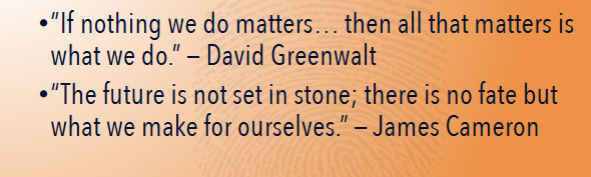
Humanism (Week 10)
Only subfield of personality science to acknowledge that human are not
Subatomic particles
Rats, mice, guinea pigs
Meteorological phenomena
They know when they’re being observed
They choose what to tell you
Begins with assumptions of existentialism, adds in assumption that humans are fundamentally good
Humans want to help each other
Humans strive to make positive change in the world
Self-actualization
Proposed need to maximize positive experience in life and create own meaning
Can only be met if more fundamental needs are met first
Primary contemporary application is in the workplace
Understanding hierarchy of needs helps to explain employee choices
Which job to take
When to leave a job
When to turn down a promotion
How much education to seek
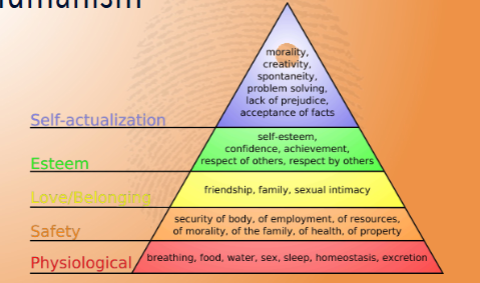
Core virtues identified by positive psychology (Week 10)
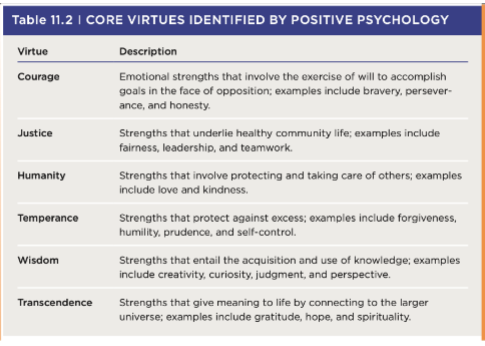
Hierarchy of Needs (Week 10)
How much of your decision about which jobs to pursue in the future is determined by…
Having enough money to live on?
Having somewhere to live?
Long-term guarantees of work?
Passion and interest?
Prestige?
Making a positive impact?
Awareness that existentialist ideal of “make your own meaning of life” is not necessarily within reach for those who need all resources just to get to safety
The “Great Resignation” (mass quitting in 2020s) blamed on the growing awareness that passion, belonging, and meaning were being offered as alternative to enough pay or benefits
Money is worth more to those who have less
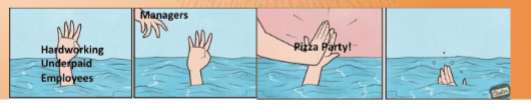
Humanistic Psychology (Week 10)
Full Functioning
Ability to live passionately and without self-doubt, seeking positive experiences
Requires unconditional positive regard
Unconditional Positive Regard (Week 10)
Sense of being a person who has value an dis worthy of love, no matter what
Does not mean that can behave badly without consequence
Means that you can trust people might be angry with you but will still love you or respect you as a person
Conditional Positive Regard (Week 10)
Sense of having value and being worthy of love, if…
…if you’re healthy
…if you’re prosperous
…if you’re thin
…if you’re happy
…if you’re moral
…if you’re smart
Conditions of Worth
Preclude becoming fully functioning because lock individual into trying to get at a particular goal or to maintain a certain standard of worthiness
Consequences
Can cause distorted self-perceptions
“If only intelligent people are worthy, then I need to perceive myself as intelligent no matter what”
Often closes off the choices one can make in life
“If only intelligent people worthy, then I must go to college even if I don’t want to because I must achieve that standard”
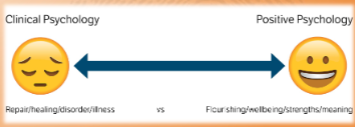
Positive Psychology (Week 10)
Builds on humanistic psychology and specifically examines the ways to increase human thriving
Examines what positive traits are, how to have positive experiences, what makes one a positive being
Virtues
Traits that increase thriving for oneself and for other
Mindfulness
Flow
Awe
Mindfulness (Week 10)
Originates with Buddhist philosophy
State of being aware of your own experiences in a way that them in without judgement and tries to live them as richly as possible
Possible to learn more mindfulness through training brain to take in more information — growing popularity of meditation classes to help
Flow (Week 10)
In some ways the opposite of mindfulness — involves lack of awareness of one’s surroundings
State of being caught up in moderately challenging and enjoyable activity
Ability to practice a skill one has partially mastered
Ability to expand one’s skill beyond the current level
Characterized by not being aware of one’s body
Lack of hunger, thirst, tiredness, or fatigue
Focus is entirely on the activity, with no self-consciousness or distractability
Leaves person feeling refreshed, as if after a nap
Gives person sense of control and competence
Associated with a broad variety of activities
Playing an instrument
Cleaning one’s house
Writing essays
Programming software
Practicing a sport
Fixing one’s car
Awe (Week 10)
Related to mindfulness — awareness of oneself as small and fleeting in the face of something much larger, older, or more powerful
Involves encountering an enormous experience that challenges your reality and knocks you out of view of yourself as center of the world
“Three parts beauty, one part terror.” — Thomas Gray
Constructs (Week 10)
Lenses or frames through which we actively create our view of the world
Ex: “Wasn’t it silly, that time our car got stuck in the mud? I’m so glad we all worked together to get it out!”
- vs. -
“Wasn’t it terrible, that time there was so much mud our car got stuck? It took all of us so much work just to get it out.”
How one’s cognitive systems form input from the world into a sense of what to expect from the world
Partially determined by past experience
Used to predict the future
Constructive Alternativism (Week 10)
View that construals of the world are not forced on us by past experience, but that we can actively choose between them
Many different frames we can adopt to explain our own experiences
Ex: therapy and reframing trauma
Anyone have an example of an experience that felt catastrophic at the time, but feels like no big deal (or even a silly good time) to your present self?
One way to embrace existentialist ideal of seeking out positive experiences through limited time is to adopt satisficing construct for decision-making
Two different constructs for decision making
Satisficing
Maximizing
Easiest way to adopt a satisficing as a frame?
Choose to do so!
Satisficing (Week 10)
Goal is to make a good-enough decision
Working at a decision until a “good enough” or satisfying option occurs
Involves going with the first reasonably sufficient answer after considering a few answers
Benefit: Spends time, effort, and money strategically
Drawback: has potential to miss a better option
Maximizing (Week 10)
Goal is to make the best possible decision
Putting in all effort necessary to choose best-possible option from all the ones available
Considers all available information to arrive at most rational decision
Benefit: extremely high-quality decision
Drawback: enormous time, effort, and potential for dissatisfaction
Hedonic Happiness (Week 10)
What tend to think of when we say “happiness”
Involves maximizing pleasure and minimizing negative experiences as a goal in its own right
Good news — and bad news — is that it tends to be fairly stable from day to day and over life events
Can be enjoyable, but will not lead to long-term well-being if
pursued at the expense of other goals
leads to impulsively grabbing pleasure now
requires too much worry about “am I enjoying myself?”
Eudaimonic Happiness (Week 10)
Involves seeking a meaningful life through seeking goals that are valuable in their own right and give one a sense of meaning
Culture (Week 11)
Patterns of belief, habit, ritual, and behavior that shape group identity
Involves cultural outputs: food, art, language, religion, institutions, etc.
Usually defined through shared language, shared ethnicity, shared geography, and shred ethics
Hard to define
Boundaries between cultures are not firm
Growing number of bicultural or multicultural individuals
Ex: Australians share more language and values with Americans, more food and social norms with Indonesians
Etics (Week 11)
Fairly universal aspects of any given cultural idea
Ex: kids should work to better themselves to be self-sufficient adults
Emics (Week 11)
Culturally specific aspects of any given etic
Ex: kids should work to better themselves to be self-sufficient adults
…by becoming financially and socially independent (United States)
…by becoming able to support their parent in older adulthood (China)
U.S. Values (Week 11)
Based on connotations of phrases as well as literal meanings, what does U.S. culture value?
Universal(ish) Values (Week 11)
Concepts that several different cultures all hold to be important
Differ in the way they are expressed
Ex: “duty” in U.S. vs. “duty” in India
Differ in relative importance
Ex: stance on killing some to protect the whole
Values:
Power
Achievement
Stimulation
Self-direction
Understanding
Benevolence
Tradition
Conformity
Security
Universal Values (Week 11)
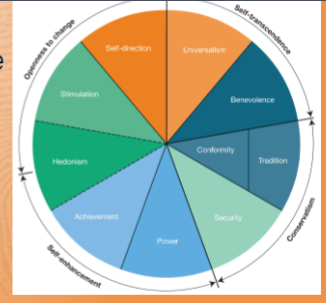
High Openness to Change
Self-direction
Stimulation
Hedonism
High Conservatism
Conformity
Tradition
Security
High Self-Enhancement
Hedonism
Achievement
Power
High Self-Transcendence
Universalism
Benevolence
Theory states that cultures vary in the extent to which they choose to emphasize Conservatism vs. Changes; Self-Transcendence vs. Self-Enhancement
Value Conflict (Week 11)
Lack of understanding between cultures or negative emotions at values that contradict one’s own
Can lead to misunderstandings and even violence
One reason that role of culture in personality cannot be ignored, even if psychologists have historically overlooked it
Ex: social clocks are specific to one’s cultural values
Head vs. Heart (Week 11)
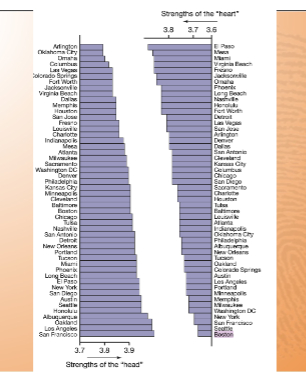
Hypothesized difference in types of values within a culture — “warm” vs. “smart” ones
Head Values:
Artistic excellence
Self- improvement
Formal education
Critical thinking
Progress and innovation
Creativity
Curiosity
Heart Values:
Mercy and forgiveness
Religion and spiritualism
Hope
Love and compassion
Gratitude
Temperance
Reciprocal Causality (Week 11)
Boston is first U.S. city to have a college
Boston attracts more people interested in “head” values represented by college
Boston develops more colleges
Social influence causes people to become more like neighbors
Boston encourages “head” type activities with festivals, values, etc.
Individualism (Week 11)
View of self as distinct, consistent, and contained
Personality comes from private thoughts and feelings
Self-regard is very important
Each person is a single self-contained unit
Views personality as stable, clear, private, and “true”
Life satisfaction comes primarily from self-esteem
United States
Netherlands
Britain
Germany
Australia
New Zealand
Collectivism (Week 11)
View of self as part of various situations and groups
Personality comes from interactions with others
Close relationships are very important
Each person is a part of several greater wholes
Views personality as flexible, changeable, and less fixed
Life satisfaction comes primarily from close others
Japan
China
India
Colombia
Peru
Venezuela
Individualism and Collectivism (Week 11)
Duty…
…means taking care of your family
Collectivism
…means fighting for what’s yours
Individualism
Saying you love your boss while at work and that you hate him while at home…
…is hypocritical
Individualism
…is just good manners
Collectivism
The early bird…
…gets the worm
Individualism
…draws the hunter’s shot
Collectivism
People want to be distinct from others
For individualistic cultures, best way to do this is through being independent and self-sufficient
For collectivistic cultures, best way to do this is through attaining leadership and/or caring positions
Culture and Motivation (Week 11)
Personal strivings
Long-term goals for one’s life
“Self as agent”
Individualism
Approach motivation
People encouraged to go out and try new things, to break out of comfort zone, to be bold and adventurous
Risk of loss is considered worth potential of reward
Collectivism
Avoidance motivation
People encouraged to minimize risk, keep away from bad outcomes, protect and preserve what they have
Risk of loss means grabbing for rewards not worth it
Respect (Week 11)
Different cultures have different views of who earns respect, who deserves most respect, and how
Three broad types
Dignity
Honor
Face
Dignity culture
Common in northern U.S. and other structure capitalist economies
Honor culture
Common in southern U.S., Mexico, and other areas of variable law enforcement
Face Culture
Common in Japan, Scandinavia, and other cultures based on cooperative hierarchies
Dignity Cultures (Week 11)
View that individuals have value and deserve respect simply because they are individuals
Being internally strong and consistent leads to self-respect, which is the only kind anyone needs
Value in being true to oneself, no matter what others say
Honor Cultures (Week 11)
View that individuals have deserve respect if they can fight to defend it, never letting an insult stand
Ability to defend one’s property is strength, and strength deserves respect
Value in fighting for what one is owed by the world
Explore top notes

