Week 5 Radiation
 Studied by 0 people
 Call Kai
 Learn
Learn Practice Test
 Spaced Repetition
 Match
Match Flashcards
 Knowt Play
1/43

There's no tags or description
Looks like no tags are added yet.
Name | Mastery | Learn | Test | Matching | Spaced | Call with Kai |
|---|
No analytics yet
Send a link to your students to track their progress
44 Terms
Ionizing Radiation
has the ability to displace an electron from an atom or a molecule,
producing ions in the process.
Sources can be
cosmic rays
X-ray machines.
These rays have higher frequency but shorter wavelength.
can affect the atoms in living things, so it poses a health risk by damaging tissue and DNA in genes
types of ionizing radiations are
Alpha particles
Beta particles
Gamma rays
X-rays
frequency, f
is the number of waves passing a point in a certain time.
per one second, gives the unit hertz (Hz)
The wavelength, λ
a wave is the distance from any point on one wave to the same point on the next wave along.
measured in metres (m)
Alpha particles
are emitted from atoms of radioactive materials during radioactive decay
Beta particles
are emitted from atoms of radioactive materials during radioactive decay
are more penetrating than alpha particles
less damaging to living tissue and DNA
the ionizations they produce are more widely spaced
Gamma rays (γ)
are weightless packets of energy called photons.
are similar to visible light, but have much higher energy
are often emitted along with alpha or beta particles during radioactive decay.
X-raysare a hazard to the entire body.
X-rays
are also photons of pure energy
X-rays and gamma rays have the same basic properties but come from different parts of the atom.
X-rays are generally lower in energy
therefore, less penetrating than gamma rays.
Order of ionizing ray penetration
gamma rays and X-rays
beta 𝛽 particles
alpha 𝛼 particles
Non-Ionizing Radiation
do not carry enough energy to ionize atoms or molecules.
examples
Radiation from sun
light bulbs
electric power lines
radio
TV antenna
lasers
Three major types of non-ionizing radiation found in laboratories
lasers
microwaves
ultraviolet radiations.
Laser
monochromatic
contains one specific wavelength of light (one specific color).
Laser beams are very narrow and focused with the outcome being a large amount of energy focused onto a small target
Laser radiation can be generated in different parts of the spectrum
ultraviolet (UV)
visible light
infrared (IR).
It can cause Instant injury to
cornea
retinal
cause skin burn.
must always follow the proper precautions when handling Lasers.
Examples of laser usage:
Eye surgery (surgical lasers)
CD players
Medical and laboratory instruments
Tattoo removal
Hair replacement
LASER is an acronym for
Light
Amplification by
Stimulated
Emission of
Radiation.
Laser Hazards
• eye injury because the cornea and lens of the eye can focus these parallel light beams and burn the retina
• fire (lasers for surgery or cutting processes)
Hazard Controls
• Install and certify/re-certify lasers according to manufacturer’s recommendations.
• Limit access, especially during use.
• Operate lasers of Class IIIB and above only in posted laser-controlled areas.
• Use shielding.
• Avoid direct viewing of the laser.
• Avoid reflections from objects (mirrors, walls).
• Wear eye protection appropriate for the laser type and energy.
Classes of Lasers: Type 1
Enclosed beam or low power
• Unlikely to cause eye injury
Examples
Compact disc players
laser printers
bar code scanners
Classes of Lasers Type 2
Low power lasers (<1 milliwatt)
Staring into beam could damage eyes
examples
Classroom pointers
some surveying leveling equipment
Classes of Lasers: Type 3A
1 to 5 milliwatts power
Staring into the beam or through lenses hazardous to
the eyes
example
some pointers
some surveying leveling equipment
therapeutic lasers (for localized heating of tissue)
Classes of Lasers: Type 3B
5 to 500 milliwatts power
Instant injury to the eyes
from direct or specularly reflected beam
Examples
Lasers for light shows
lasers for engraving labels
certain medical lasers
Classes of Lasers: Type 4
Greater than 500 milliwatts power
Instant injury to the eyes or skin
from direct, specularly reflected or diffuse scattered beam
Can cause fires
example
surgical lasers
computer controlled cutting lasers
Microwaves
work partially due to heating.
The following are the guidelines for proper use of microwaves:
Make sure doors hinges are sealed tight
Check oven for leaks
Do not use metal
Place the object to be heated in the centre
When using high powered microwaves
ensure shields and protective covering are in place
post warning signs to protect people wearing pace makers
electromagnetic waves may interfere with the device’s pulse generator and can permanently damage it.
Common home use microwaves are considered to be of low risk
however, it is better to be at a distance of at least six inches away from the equipment.
Microwaves Hazards
principal hazard associated with microwave use
is heating of tissue
Overheating and overuse can also result in fires.
Hazard controls
Choose microwave ovens that are approved for commercial not domestic use.
Perform regular maintenance (e.g., ensure door hinges are secured and door seals are tight).
Avoid heating screw-capped or any tightly closed containers in a microwave.
High-powered microwave and radio wave devices require additional controls:
Ensure shields and protective covers are in place during operation.
Post warning signs to protect people wearing pacemakers.
Ultra Violet Radiations
consist of lamps having wavelengths between 180 to 390 nm (nanometer).
commonly used wavelength is 254nm.
mainly used as a sterilizing agent.
As UV radiation has a very low energy
it has a very low penetration power
can penetrate not more than 1 cm
cannot penetrate through opaque surfaces
it is mostly used for surface treatment.
Sunlight is made up of three kinds of UV radiations
UV-A (Alpha)
UV-B (Beta)
UV-C.
UV radiation Hazards
Pain and injury may result from overexposure to UV.
This may be particularly acute in the eye
can cause conjunctivitis
photosensitivity
loss of vision.
UV radiation may be reflected by some surfaces, such as stainless steel
Hazard controls:
Use goggles or full-face shield with lens filters.
Cover exposed body parts
Turn off UV lights after use.
UV-Alpha (A)
falls between the wavelengths of 323-360 nm
is not readily absorbed by the human skin
generally used in tanning machines
UV-Beta (B)
falls between the wavelengths of 230-320 nm
is the most lethal as this is the optimal absorption wavelength for DNA of the cells.
Too much exposure to UV-B causes
sunburn
wrinkled/aged skin.
USED IN LABS
UV-C
falls between the wavelengths 100-280 nm
this radiation is absorbed by the atmosphere
does not reach the earth.
U. V as a sterilizing agent
causes modification or break in DNA
which in turn causes death of the organism.
It is used to sterilize and decontamination of hospital
operating rooms
food processing areas
infected waste stations.
It is also used in the sterilization of the work area of bio safety cabinets.
Radiation Hazard
Exposures to radiation, specifically ionizing radiation, can be external and internal.
eternal exposures
radiation can penetrate deeply into human body through the skin.
Internal exposure to any radioactive nuclear material can
inhalation
ingestion
through eyes, or cuts.
Effects of radiation can be
acute (Immediate)
chronic (appearing years after exposure).
Body parts at greatest risks are:
Blood forming cells
Breasts
Thyroid
Lungs
Examples of acute effects
(i.e., large dose over a short period)
• skin
• bone marrow
• digestive system
• neuromuscular system
such as
Skin sunburns
Aplastic anemia (bone marrow stops producing enough new blood cells)
Loss of appetite
Fatigue
Nausea
Vomiting
Diarrhea
Fever
Examples of chronic effects
• leukemia
• other malignancies
Leukemia
Other malignancies
Premature skin aging
Skin cancer
Weakening of the immune system
Eye problems like cataract
Safety Procedures for Handling Radioactive Materials
Know the proper shielding requirement for material presenting external radiation hazard and use the appropriate shielding like
Bench top Plexiglass shield
Face shield
PPE like gloves
Avoid direct contact to the eyes and skin
Use a Fume Hood for any work involving
dry powders
volatile material
Be aware of all dangerous properties of the radioactive material
store and handle accordingly.
Minimize the radiation dose
maximize the distance between
the radiation source and people.
Radioactive signs should be posted on all doors to rooms where radioactive material are used or stored.
International System of Units (SI) for absorbed dose
for radiation measurement
the official system of measurement
uses the "gray" (Gy) as a unit for the absorbed dose
potential damage from an absorbed dose depends
type of radiation
the sensitivity of different tissues and organs
Sievert" (Sv) or Rads
The SI unit for the effective dose
The effective dose is used to measure ionizing radiation in terms of the potential for causing harm.
The Sv takes into account
the type of radiation
sensitivity of tissues and organs.
Units for Radiation Activity
Curies (CI)
Becquerels (Bq)
Exposure Units
Roentgens (ren)
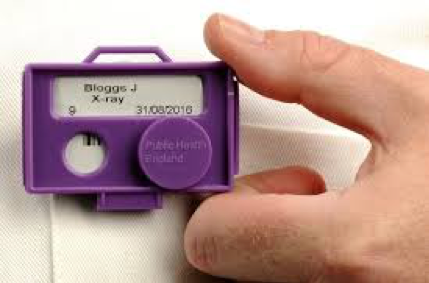
dosimeter
equipment used to monitor radiation
Thermoluminescent Dosimeter (TLD) Badge
is a type of radiation dosimeter.
It can monitor the
whole body
upper extremities (hands, fingers, wrists and forearms)
lower extremities (feet, ankles and lower legs).
are used to monitor radiation exposure.
The two most common types of TLDs are
calcium fluoride
lithium fluoride
Guidelines for Minor Radioactive Spills
Notify all in the immediate area and limit access to those cleaning up the spill
Cover spill with absorbent paper. Never apply paper to flammable or corrosive material
Survey staff with radiation monitor before they leave the area
Remove contaminated clothing and footwear and wash affected area with soap and water
Dispose of clean-up material in a labelled container according to institutions policy and procedure
Notify radiation safety officer
Guidelines for Major Radioactive Spills
Notify all in the immediate area and limit access to those cleaning up the spill
Turn off any ignition source
Vacate room, close door and post warning sign
Contact radiation safety officer
Qualified personnel will select the appropriate PPE, refer to SDS and all reference and supplies
Survey staff with radiation monitor before they leave the area
Remove contaminated clothing and footwear and wash affected area with soap and water
If contamination persists, use diluted potassium permanganate or 3-5% EDTA (Ethylene diamine tetraacetic acid)
Dispose of clean-up material in a labelled container with the radioactive symbol and according to institutions policy and procedure.
Government Legislation and Licensing
All radioactive nuclear substances must be handled and disposed of in accordance with the conditions instituted by the Canadian Nuclear Safety Commission (CNSC).
acquisition, possession, use and disposal of nuclear materials
is regulated and monitored by them
a federal regulatory agency with responsibility for radiation safety
ensures that the use of nuclear substances does not pose undue risk to
health
safety and security of the public,
environment.
The CNSC recommends dose limits for those working with radiation.
Ionizing Radiation (CLMLS definition)
is a form of radiation that can displace an electron from an atom or a molecule, thereby producing ions.
sources
X-rays
gamma rays
alpha particles
beta particles
neutrons
CLMLS
External exposures (radiation)
are of concern when dealing with radiation that can penetrate deeply into the human body.
Highly penetrating radiation types include:
• X-rays
• gamma rays
• high-energy beta particles, which can produce X-rays in collision with metal, and which,
if exposed to the eyes or in direct contact with the skin, present an external exposure hazard
Internal exposures (radiation)
Internal exposures occur when a nuclear material is:
• inhaled
• ingested
• absorbed through the skin or eyes, or via cuts or abrasions
hazards include:
• alpha particles (these are the most damaging to human tissue when absorbed)
• beta particles
• gamma emitters
Organs at greater risk to radiation
• blood-forming cells (e.g., bone marrow)
• breasts
• thyroid
• lungs
• digestive system
• a fetus is also highly sensitive to radiation
Canadian Nuclear Safety Commission requirements for the use of radiation
• a license
• dose monitoring and dose limits
• possession limits
• wipe testing for laboratory surface contamination
• inventory tracking and record-keeping
• security
• training
Radionuclide Information Booklet
The Canadian Nuclear Safety Commission publishes a Radionuclide Information Booklet provides “information on various nuclear substances”
radiation characteristics
detection methods
preventive measures
annual limits on intake
Refer to the most recent publication for specific information
Ionizing Radiation Hazard Control
Time, Distance and Shielding are the hazard control principles used to reduce exposure:
• Demarcate “hot” (radioactive) work areas by using radiation warning signs and tape.
• Identify all hazards of radioactive materials (flammability, chemical toxicity, corrosivity, volatility, etc.), not just the radiation-emitting properties.
• Minimize exposure by practising techniques without radioactive material. Handling proficiency tends to minimize time of exposure and surface contamination.
• Maximize the distance between radiation sources and employees.
• Wear dosimeters.
• Use effective shielding (e.g., Plexiglas) and protective equipment (e.g., gloves).
• Use shielded storage where appropriate.
• Perform surface contamination checks (e.g., wipe tests) and decontaminate as required.
• Use disposable absorbent liners on trays or work surfaces.
• Monitor incoming shipments of radioactive materials for leakage
 Note
Note  Flashcards (74)