Lecture 2: Identifying Atypical Development
 Studied by 0 people
 Call Kai
 Learn
Learn Practice Test
 Spaced Repetition
 Match
Match Flashcards
 Knowt Play
1/35

There's no tags or description
Looks like no tags are added yet.
Name | Mastery | Learn | Test | Matching | Spaced | Call with Kai |
|---|
No study sessions yet.
36 Terms
atypical development
the extremes of individual differences in development
-statistical deviation from the norm
-includes advanced and delayed development
-associated with neurodevelopmental conditions
difficulties with defining atypical development
individual differences in the rate of development
individual differences in people’s traits, strengths and weaknesses
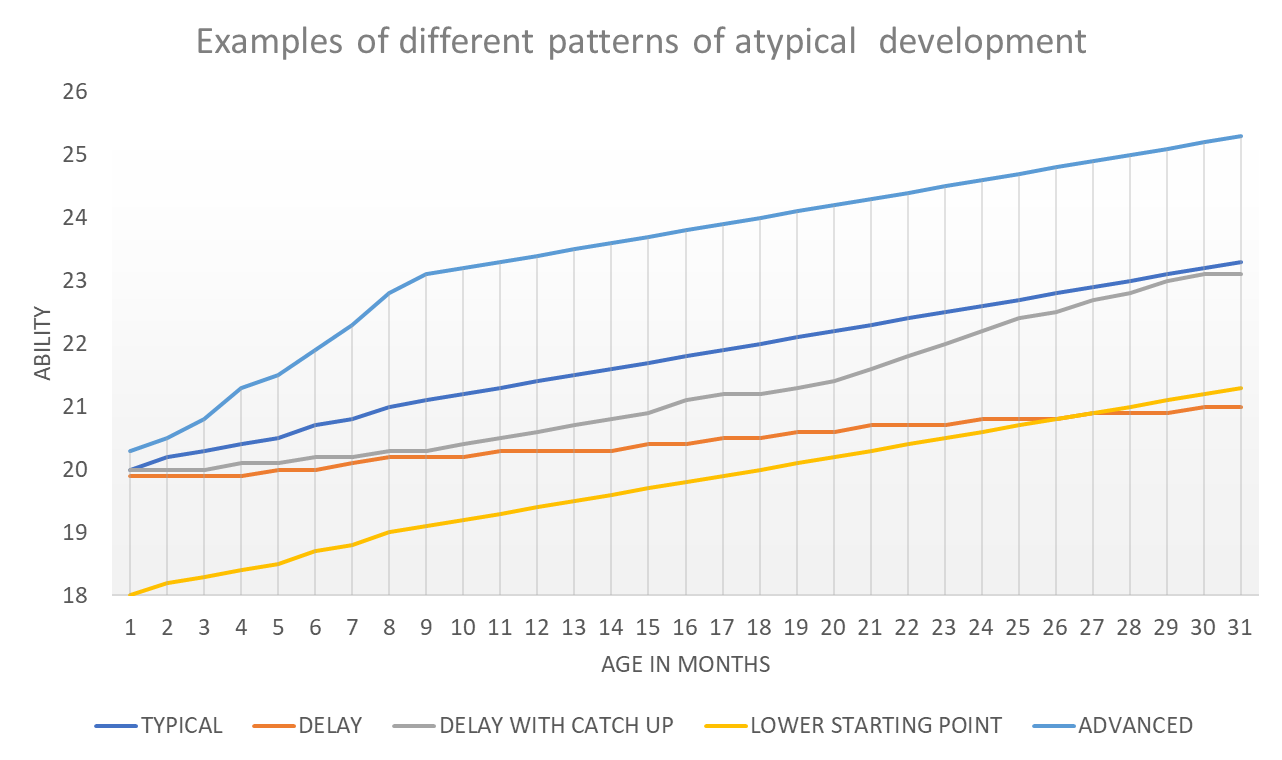
typical development
-normal ability level at start
-increases and progresses with age
delayed development
-gap between this and normal development
-gap continues to grow as age increases
-child has weaker abilities than normal development
delayed development with catch up
-starts at same ability level as normal development
-as child gets older there is some delay in ability levels
-catches up in ability as time passes → delay is resolved
lower starting point development
-child’s development starts from a much lower point to begin with than normal development
-develops at same rate as a typically developed child
-never catches up to ability level as started at a much lower ability level
advanced development
-starts at same ability point as normal development
-rapid growth at a much faster rate than expected of a typical child
-maintains this stronger ability over time
different patterns of atypical development
developmental regression
-period where a particular skill is developing along a typical trajectory → but then child stops developing and loses aspects of this skill
-typically seen is ASC and/or intellectual disability
-most often language and motor skills
multiple domains of development
-adaptive behaviour
-social
-cognitive
-physical
-motor skills
adaptive behaviour (domain of development)
ability to work
functional decision making
personal safety
managing money
personal responsibility
independence
daily living skills
social (domain of development)
gestures
reciprocal eye contact
empathy
verbal communication
social interactions
non-verbal communication
turn-taking
emotional IQ
cognitive (domain of development)
IQ
attention
language
executive function
numerical ability
memory
physical (domain of development)
facial dysmorphism
microcephaly
macrocephaly
physical features
motor skills (domain of development)
fine/gross motor skills
balance
coordination
activity level
normal distribution
-obtained by testing many participants
-for may variables samples from the population generate a normal distribution
-bell shaped curve
identifying atypical development
-group comparisons against a representative sample
-choose appropriate control group
profile of child’s abilities
-understanding of child’s abilities cannot be built without identifying strengths and weaknesses
-strengths can be subjective or relative:
something they’re good at compared to other skills
not necessarily a strength compared to other people
specific experimental design (cognition - measuring development)
-investigate a specific research question or hypothesis, target specific behaviours
-format can vary widely depending on the research question and methodology
-can compare results with a matched control group
standardised tests (cognition - measuring development)
-designed to measure knowledge or skills in a consistent and comparable way across a large population
-fixed format with specific instructions, questions and scoring procedures
-scores can be standardised → given a value that indicated how well they performed against everyone who has taken the test
comparing specific and standardised tests
-standardised tests aim to measure broader knowledge or skills → experiments aim to test a specific skill or test hypothesis
-standardised tests are broad, covering a range of topics or skills → experiments focus on specific research question
-standardised tests aim to generalise results to a larger population → experiments have limited generalisability depending on sample and conditions
Wechsler Intelligence Scale for Children (WISC)
-widely used intelligence test
-aged 6-16
-measures:
verbal comprehension index
fluid reasoning index
visual spatial index
processing speed index
working memory index
verbal comprehension index (WISC)
-measures a child’s ability to understand and use language and their verbal reasoning skills
visual spatial index (WISC)
-measures ability to perceive, analyse and manipulate visual information
fluid reasoning index (WISC)
-measures ability to solve novel problems and think flexibly
-abstract reasoning
working memory index (WISC)
-measures ability to hold information in mind
processing speed index (WISC)
-measures ability to quickly and accurately process information
tasks of the WISC
-full test measures the Full Scale IQ (FSIQ), which is split into:
performance IQ (PIQ)
verbal IQ (VIQ)
Vineland Adaptive Behaviour Scales (measuring development - adaptive behaviour)
-semi-structured interview carried out with parent/caregiver/teacher
-measures:
communication
daily living skills
socialisation
motor skills
maladaptive behaviour
Wechsler Nonverbal Scale of Ability (tests for non-verbal participants)
-assesses non-verbal reasoning and problem solving skills
-aged 4-21
-uses visual stimuli and requires minimal verbal instructions
Leiter International Performance Scale (tests for non-verbal participants)
-assesses cognitive abilities
-aged 3-75
-matching pictures, completing patterns, solving mazes → assess different aspects of intelligence
-useful for assessing those with autism, language impairments or hearing impairments
Bayley Scales of Infant and Toddler Development (tests for younger participants)
-aged 1-42 months
-cognitive, motor, language, social-emotional and adaptive behaviour
-observation of motor skills, tests of cognition and social interaction
Infant-Toddler Developmental Assessment (tests for younger participants)
-birth to 36 months
-those at risk of developmental delays or conditions
-cognitive, motor, language, social-emotional, and adaptive behaviour
-observation, parental report and standardised tasks
-often used in early intervention programs to identify those who require additional support
standardised scores (interpreting task performance)
-add scores together to create raw score
-convert raw score to standardised score
-this converts the raw score to a value that represents how a participant has performed to others of the same age/gender
-removes individual differences and generates a score that can be compared across participants
look-up table (interpreting task performance)
-after completing a test and obtaining a raw score, experimenter can use a look-up table based on appropriate representative sample to identify a scaled score
-can create a standardised score by making raw score into t-score
benefits of using standardised scores (interpreting task performance)
-enables clinicians to standardise performance across different groups
-provide a common language for discussing test performance regardless of how the actual test is designed
-easily interpretable
-no one set way of standardising but all allow the same comparison
 Note
Note  Flashcards (48)