Poppies
 Studied by 3 people
 Call Kai
 Learn
Learn Practice Test
 Spaced Repetition
 Match
Match Flashcards
 Knowt Play
1/7

Earn XP
Description and Tags
Name | Mastery | Learn | Test | Matching | Spaced | Call with Kai |
|---|
No analytics yet
Send a link to your students to track their progress
8 Terms
Who was “Poppies” written by?
Jane Weir
What is the context of Poppies?
Jane Weir has two sons which may have influenced her desire to explore what caused young boys to go to war and fight. She is also a textile designer which explains her use of related imagery
Poppies grew in battlefields and became a symbol of remembrance in 1921, armistice Sunday also became a way to remember WW2. Weir uses these symbols to establish from the outset that the poem is an act of remembrance
What is the structure of Poppies?
Free verse and enjambment - shows that these are the speakers uncensored thoughts and their outpouring of emotion
Caesura shows how she tries to hold her emotions together
Domestic imagery is interweaved with violent military metaphors showing how war prevents people from having a normal domestic life
What other poems can you compare “Poppies” to?
The Emigree (Loss and absence)
Remains (Memory)
War photographer (Effects of conflict)
“I pinned one onto your lapel, crimped petals, spasms of paper red”
This is ironic as it foreshadows a time when she would have to wear a poppy herself in remembrance of her son. She may also be unknowingly marking him for death
‘Crimped petals’ suggests a torn or damaged poppy. It implies that war damages people, whether a fallen soldier or grieving family. This also links with the theme of death. The crimped poppy may represent flowers that are withering and dying, the remains of funeral wreaths.
‘Spasms’ suggests injury, showing that she’s thinking about her son’s possible death. ‘Red’ also suggests blood and injury. It is a powerful, emotive image. The word ‘spasms’ could also relate to a short time span, implying that the life expectancy of a fighting soldier is brief and ephemeral. Spasms are also uncontrollable, and may suggest the waves of grief and pain that the mother will experience. The reference to paper could also indicate how disposable the soldiers are viewed as by those in power and something that civilians take for granted
“I resisted the impulse to run my fingers through the gelled blackthorn of your hair”
The use of hair gel suggests that she’s casting her mind forward to an older boy now, a less childish one. This is the point where he’s about to leave for battle and she wants to hold him while she still can.
‘Blackthorns’ has a religious connotation. It represents Jesus' crown of thorns – this woman believes her son is being metaphorically ‘crucified’ unjustly by leaving for battle at a young age. It may also represent the barbed wire used to protect the trenches in the First World War.
The woman desperately wants to touch her son, but he is out of reach
An impulse is an involuntary action, therefore resisting one could signify her strength and how focused she is on appearing strong to her son. This could foreshadow the drastic effects it will have on her after her son leaves.
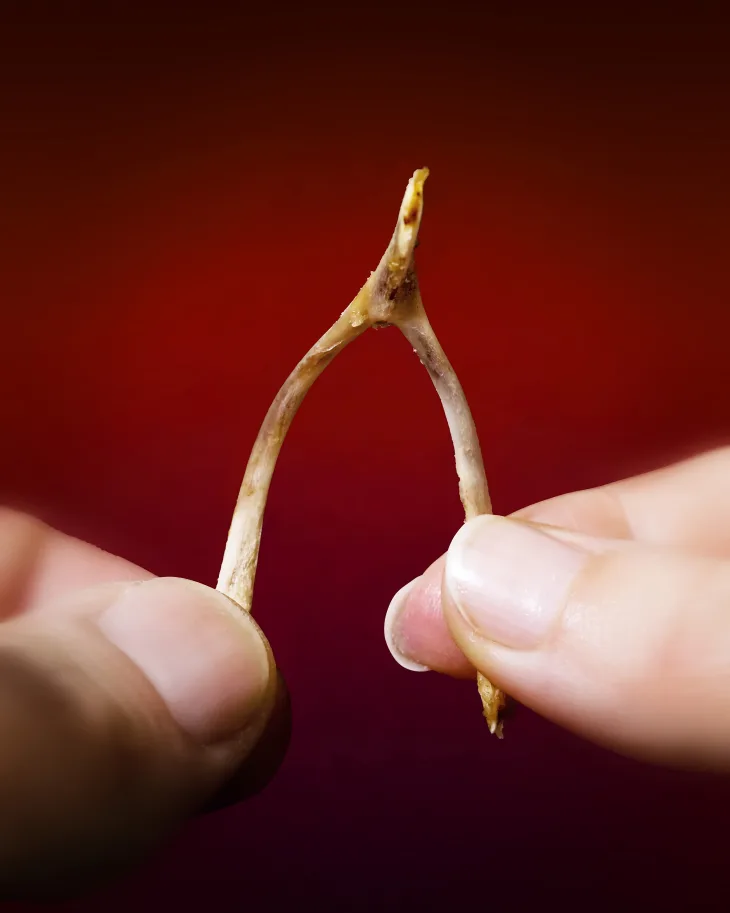
“I traced the inscriptions on the war memorial, leaned against it like a wishbone”
She’s looking through the names of the dead and wishing that her son’s name wasn’t there. Wishbones are supposed to bring good luck; this is ironic, as she knows that her wish for his life to be spared wasn’t granted. She leans against it as she is weak with grief.
Another possible interpretation is that the wishbone is located over the heart. Traditionally, wishbones are broken, showing that the physical and metaphorical protection of her heart is gone and she is vulnerable.
It can also suggest that the mother and son are like two halves of a wishbone; they used to be inseparable and without each other they are incomplete, even though they are destined to be ripped apart.
Usually when we lean on something, it is a strong and sturdy object that we need to keep us upright to prevent us from falling. The fact that the object she is leaning on is a wishbone perhaps is ironic and represents how fragile and vulnerable she really is, as she has nothing to rely on apart from something that she knows will surely break. The wishbone could be a metaphor for many different things like her mental state, the memories of her son or her happiness because ultimately, all of these things will deteriorate and she will fall short.
“The dove pulled freely against the sky”
“The dove” is primarily a Christian symbol of hope, freedom and especially peace. The dove is flying away from the memorial “freely into the sky” almost as if it was carrying the spirits of the dead away to their final resting place. The mother of the dead soldier is almost begging it to fetch back the spirit and voice of her son, but the word ‘freely’ implies that it ignores her.
The dove also symbolizes the hope for her son but as it ‘pulled freely against the sky’, it implies that her son has passed away.
The juxtaposition of ‘pulled’ and ‘freely’ conveys the bird is still trapped, encased by its troubles, just like the mother is. The verb “pulled” implies unwillingness to leave, symbolising that the spirit of the son does not want to leave his mother
The dove could represent her finally accepting that her son is really gone, and finding her inner peace that she has lost for so long. She now has hope of moving towards letting him go. The ‘pulled’ and ‘freely’ could refer to the inner turmoil and conflict she had over losing him, but also the conflict she experiences now over taking that last push and fully freeing herself from her grief and mourning.
 Note
Note  Flashcards (78)