Microbial growth micro
 Studied by 1 person
 Call Kai
 Learn
Learn Practice Test
 Spaced Repetition
 Match
Match Flashcards
 Knowt Play
1/24

There's no tags or description
Looks like no tags are added yet.
Name | Mastery | Learn | Test | Matching | Spaced | Call with Kai |
|---|
No analytics yet
Send a link to your students to track their progress
25 Terms
what is microbial control ?
Microbial control is all about reducing or eliminating unwanted microbes (decontamination). This can be done through physical, chemical, or mechanical methods.
Main Targets of Microbial Control
What type of organism do we focus on when it comes to microbial control?
We focus on microbes that cause infection or spoilage, including:
Vegetative bacterial cells (active, growing bacteria)
Fungal hyphae + spores, yeast
Protozoan trophozoites + cysts
Viruses
Endospores
Prions (the hardest of all to destroy)
How should you think of resistance?
Least resistant - Yeast, fungal spores/hyphae
Moderate resistance - Pseudomonas
Highest resistance - Endospores
Term Type of surface Control mechanism Example
Antisepsis:
Disinfectant:
Sanitization :
Degermation:
Sterilization:
Antisepsis: Living tissue Kills some organisms Iodine solutions
Disinfectant: Non-living Kills some organisms bleach
Sanitization : Non-living Dislodges organisms from surface Dish washing
Degermation: living Dislodges organisms Hand washing
Sterilization: Non-living Kills all cells including endospores Autoclaving, gamma
irradiation
What is Microbial Death?
How is it measured?
Microbes don’t show vital signs, so death is defined as:
Permanent loss of the ability to reproduce, even under perfect conditions.
Measured two ways:
Qualitative (+/– growth) - test if any antibacterial left
Quantitative (plate counts) - # of bacterial / how many molds
Factors That Affect Death Rate , how do these effect death rate ?
Number of microbes
Nature of microbes
Temperature & pH
Concentration of agent
Mode of action
Organic matter present
Number of microbes → more microbes = takes longer to kill
Nature of microbes → resistance level, mixed culture vs pure
Temperature & pH → warm temp = faster killing
Concentration of agent → higher concentration may kill faster
Mode of action → what the agent targets
Organic matter present → blood, mucus, dirt can block the agent
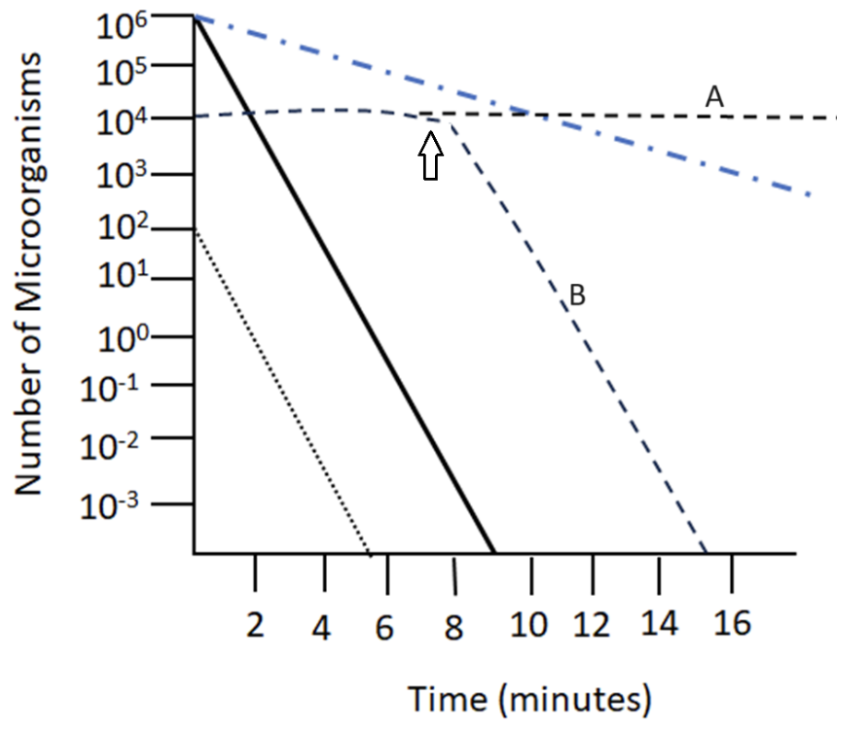
If you start with 1,000,000 organisms and a D=10 minutes how long would it take to achieve a 12D sterilization?
what is a d value ?
population reduces at a predictable rate
D-value (decimal reduction time)
D-value
Time required to kill 90% of a microbial population under specific conditions.
High population = takes longer
Washing/scrubbing reduces the number → so it works faster
12 x 10 = 120 minutes
Chemical + physical agents kill microbes by damaging these parts how?
Cell wall
Cell membrane
DNA/RNA synthesis
Proteins
Cell wall
→ Becomes fragile → cell lyses (detergents, alcohol)
Cell membrane
→ Loses integrity → leakage (surfactants)
DNA/RNA synthesis
→ Stops replication/translation (UV light, formaldehyde)
Proteins
→ Denatures enzymes → no metabolism (heat, acids, alcohols)
Methods of Physical Control
how do these effect
Heat (most common)
Cold
Desiccation
Radiation
Filtration
Heat (most common)
Moist heat (faster, lower temp) → denatures proteins
Dry heat (higher temp, longer time) → dehydration + oxidation
Cold
→ Slows growth, doesn’t kill
Desiccation
→ Removing water inhibits microbes
Radiation
→ UV damages DNA
→ Ionizing radiation → sterilization
Filtration
→ Removes microbes from air or liquids (HEPA, membrane filters)
Heat: Mode of Action & Effectiveness
Moist heat: what temperature, time and its effectiveness
dry heat : what temp , time , example
Moist heat
Low temp + short time
Denatures proteins
Examples: autoclave, boiling
Dry heat
High temperature
Longer time
Examples: oven, incineration
Thermal Death Measurements
Thermal Death Time (TDT)?
Thermal Death Point (TDP)?
Which one is used for items that are not sensitive and items that are sensitive?
Thermal Death Time (TDT)
→ Shortest time to kill everything at a specific temp.
Thermal Death Point (TDP)
→ Lowest temperature that kills everything in 10 min.
Thermal death times (TDT) are used for items that are temperature sensitive, while thermal death points (TDP) are used for items that are temperature insensitive. ________ insensitive
The only moist heat method that guarantees sterilization is?
Autoclaving
What is autoclaving? what does it kill? what are the 2 requirments ? psi? tmep? min?
What is tyndallization? What does it do? min? how many days?
what is boiling and what does it do ? degrees? min?
Autoclave: 15 psi, 121°C, 10–40 min. Sterilizes everything if it’s not heat/moisture sensitive, Kills proteins, membranes, DNA; Steam must reach surface of item being sterilized ; Item must not be heat or moisture sensitive
Tyndallization: For items that cannot handle autoclave, Cycle: Steam 30–60 min, Incubate 24 hrs, Repeat for 3 days , Disinfection (not sterilization)
Boiling: 100°C for 30 min, Kills most pathogens (not endospores) → Disinfection
What is pasteurization?
what are the three main pasteurization methods?
degree / temp? for each
Kill pathogens without ruining the taste or quality of food. (Disinfection)
Three main pasteurization methods
Batch method
63°C for 30 minutesFlash (HTST – High Temp Short Time)
72°C for 15 seconds
(Most commonly used for milk)Ultra (UHT – Ultra High Temperature)
135°C for 1–2 seconds
→ Can make milk shelf-stable
DRY HEAT
what is it
What are the 2 types, and how do they work?
temp for first one?
Dry heat requires higher temperatures because it lacks moisture to transfer heat quickly.
Two types:
1. Dry ovens
150–180°C
Kills by oxidizing and coagulating proteins
CAN sterilize
Cheaper than autoclaves
Used for: glassware, metal instruments, powders, oils
2. Incineration
Direct flame → complete burning
Absolute destruction of biological materials
Used for: inoculating loops, biohazard waste
NOT used for reusable items
COLD
What is it?
What is it used for?
temperatures to slow down or kill?
Cold is microbiostatic, not microbicidal.
→ It slows growth but does not kill.
Used for: foods, vaccines, lab cultures.
Temperatures
Refrigeration: 1–15°C → slows bacterial growth
Freezing: < 0°C → stops growth completely
DESICCATION
What is it?
Does this kill the microbe?
What is lyophilization?
Removes water → microbes go dormant → metabolism stops
This does NOT reliably kill microbes. Many regain activity when water returns.
Lyophilization (freeze-drying) method of DESICCATION
Freezing + vacuum drying
Long-term preservation of microbes, foods, vaccines
Used to preserve as much of the original product properties from before processing resulting in a dried product
RADIATION
Ionizing Radiation? what type of penitration? example? what isit used for?
Ionizing Radiation (deep penetrating)
→ High energy → Knocks electrons out of atoms → breaks DNA
Examples: gamma rays, X-rays, electron beams
Used for:
✔ Sterilizing medical supplies
✔ Sterilizing food
✔ “Cold” sterilization (no heat involved)
Nonionizing Radiation: What type of penetration? What type of exposure? What is it used for?
Nonionizing Radiation (shallow penetration)
→ UV light
→ Creates thymine dimers in DNA → blocks replication
Requires direct exposure.
Used for:
✔ Disinfecting air
✔ Water
✔ Lab surfaces
Not for deep surfaces or thick materials.
FILTRATION
What is it used for? What is the difference between membrane and deep filters ?
WHat are HEPA filters?
Used when a substance is heat-sensitive.
Fluids
Membrane filters
Very thin
Small pore size (0.2 μm)
Physically remove bacteria
Depth filters
Thick layers of fibers (cellulose)
Larger pores
Trap organisms by charge or entanglement
HEPA filters remove most microbes from air.
Used in:
Biosafety hoods
Hospital rooms
Airplanes
An ideal chemical agent is:
what is the highes level of germicides ?
Fast; Stable; Cheap; Non-toxic; Works under real-world conditions
High-level germicides are often sporicidal
Category | Examples | Key Properties / Uses |
|---|---|---|
1. Halogens | ||
2. Phenolics | ||
3. Alcohols | ||
4. Oxidizing Agents | ||
5. Surfactants | ||
6. Heavy Metals | ||
7. Aldehydes | ||
8. Gases | ||
9. Aniline Dyes |
Category | Examples | Key Properties / Uses |
|---|---|---|
1. Halogens | Chlorine, Iodine | Disinfect water & surfaces; iodine = antiseptic for skin |
2. Phenolics | Lysol, Triclosan | Moderate strength; can irritate skin |
3. Alcohols | Ethanol, Isopropanol | Fast-acting; good for degerming skin; leaves no residue |
4. Oxidizing Agents | Hydrogen peroxide | High concentrations are sporicidal |
5. Surfactants | Soaps (anionic), Quats (cationic), Chlorhexidine | Soaps = degerming; Quats = bactericidal; Chlorhexidine = surgical scrub |
6. Heavy Metals | Silver, Mercury | Low toxicity; used in burn creams & newborn eye drops |
7. Aldehydes | Formaldehyde, Glutaraldehyde | High-level disinfectants; very toxic; can sterilize |
8. Gases | Ethylene oxide (ETO) | Sterilizes heat-sensitive materials; used for medical devices |
9. Aniline Dyes | Gentian violet | Low-level disinfectant; mainly antifungal |
CHEMICAL PRESERVATIVES
Organic acids
what does it inhibit 2 things
what does it prevent?
what does it lower?
Nitrates/nitrites
Where is it used
what does it prevent?
what can it form?
CHEMICAL PRESERVATIVES
Organic acids
Acetic → inhibits bacteria
Propionic → prevents mold
Benzoic, sorbic → inhibit yeast
lower PH
low level control agen
Nitrates/nitrites
Used in meats
Prevent endospore germination
Can form carcinogenic nitrosamines
REDUCING WATER AVAILABILITY
What is it used for?
What are some examples?
How is it achieved?
REDUCING WATER AVAILABILITY (Aw)
Used for food preservation.
Salt → draws water out of bacteria (plasmolysis)
Sugar → same effect
Drying + salting is more effective
Still microbiostatic
→ Stops growth but doesn’t kill.
Reducing available water (Aw) is achieved by desiccation ___ or by adding an ____ osmotic ___ agent
What is the difference between bacteriostatic and bacteriocidal?
Bacteriostatic: These agents stop bacteria from growing or reproducing but do not kill them outright. They let the immune system finish clearing the infection.
Bactericidal: These agents kill bacteria directly, reducing the number of living cells. They cause a rapid drop in the bacterial population.
 Note
Note  Flashcards (63)