Cognitive psychology
 Studied by 0 people
 Call Kai
 Learn
Learn Practice Test
 Spaced Repetition
 Match
Match Flashcards
 Knowt Play
1/115

There's no tags or description
Looks like no tags are added yet.
Name | Mastery | Learn | Test | Matching | Spaced | Call with Kai |
|---|
No analytics yet
Send a link to your students to track their progress
116 Terms
What is cognition?
Mental action/process of acquiring knowledge and understanding through thought experiences and the senses.
All the thoughts and experiences that happen within our minds, scientific study of thought and experience - study how the mind generates our perceptions of the world, our thoughts and how we apply these to our perceptions
What is the history of cognitive psychology?
In 19th cent men looked at thoughts and decided they were perverts (Freud - involved with impulses and subconscious),
20th cent men consulted own thoughts and decided they were stimulus responses machines (behaviourism - humans are input-output machines that behave according to external rewards and punishments with cues in their environment = conditioning).
Human mind then translates inputs into outputs via reward processing.
By end of 20th cent, cog science came along and identified the fact that the input-output description of the mind often doesn’t work as things happen within brain that changes way we perceive things.
Explain the idea that humans are stim-response machines
People are stim-response machines - stim enters brain from outside world, processed through range of different modules that change information in a systematic way sequentially (in order) until decision module where we decide what to do with stim (from senses) causing response
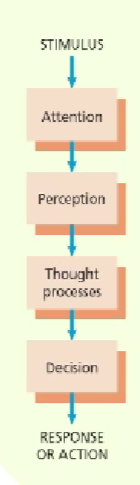
What are assumptions of stim-response machine?
Everything happens in order where no info travels backwards.
Processing is bottom up (lower level sensory processes drive higher order thoughts and decisions, everything is determined by the stim as it drives what happens in brain and behaviour).
What are some issues with stim-response machines?
No opportunity for parallel processing even though we know were capable of it (multitasking).
Ignores top down processing (higher order cog processes and thoughts determine how info is processed, when prior knowledge and expectations shape how we see the world).
e.g. see a cat on screen and letters underneath, however H and A are identical so letters should be the same for our brains, but we automatically interpret first one as H and second one as A = top down processing where you're applying your own knowledge of the world to change how we perceive the letters. So input-output approach is oversimplification
What does bottom-up processing (representations in our heads) mean?
All of our thoughts and perceptions comes from our brains, forming a representation in our brain
Brains are made of billions of neurons so saying there's a representation, saying neurons fire in a pattern to produce specific representation/experience
Some neurons are on and others are off to combine to make a meaningful experience.
Some neurons have preferred stimuli i.e. respond to a certain orientation, colour, or complex concept. Sometimes referred to as grandmother cells
e.g. implanting electrodes in medial temporal cortex of patients who are having epilepsy surgery, electrodes used to relieve epilepsy but can also be used to record how neurons work. Presented patients with lots of pictures and words and looked at how often neurons fire. Found the specific neurons fire a lot when the patient cared or felt strong about the image e.g. things from star wars but fired less when it was about other things.
Neurons fire to particular concepts
Compare rates and temporal codes in bottom up processing?
Neurons work in a way which is rate coding - information is represented in how fast each neuron fires. Temporal coding - more important when it fires, greater synchrony of responses of several neurons is used to code information
What is the binding problem?
Binding problem - e.g. seeing a blue moving ball is perceived as one thing and not three separate things (blue, moving and a ball), cant experience its features individual, it’s a single bound thing.
Challenge in cog psych as how do you combine all the different features represented by different neurons in your brain into one experience in your mind?
Temporal coding is one way this might happen - having neurons that represent blue, ball and movement fire in synchrony
How do we study cognition?
Experimental cognitive psychology
Cognitive neuropsychology
Cognitive neuroscience
Computational modelling (writing mathematical formulas or implementing them in computer code to describe how an agent would solve a problem)
Artificial intelligence
What is experimental cognitive psychology?
Studying behaviour in controlled lab settings
Sheds light onto cog processes by using clever experimental manipulations
Traditionally, experimental psych doesn’t care abt underlying brain processes
Instead of 'brain measures', cognitive psych uses behavioural measures like reation time or accuracy as indirect measures
An experiment:
Extremely successful at generating theories abt cognition that can be tested in neurosceince
Has made huge contributions to making psychology a more empirical science
e.g. stroop task - see colour names that have different colours on them, need to respond to print colour. Tests if word reading is automatic, if it is it will interfere with colour naming and cause longe reaction times and more errors
e.g. to test how your phone works you can measure if the calculator app is slower if there are 100 open youtube videos
What are limitations with experimental cognitive psychology?
Ecological validity - can we generalise findings outside the lab?
Face validity - only provides indirect measures of cog processes
Do psych concepts even exist - scientists should guard againsts tactly granting reality to things simply because we have words for them (Bacon)
What is cognitive neuropsychology?
Studying cognition in patients with brain injury e.g. patients with damage to parietal lobe become unable to orient attention to one side of space
Goal is to find which cog functions are impaired and which ones are preserved when a given brain region is damaged
e.g. testing how your phone works you can do it by dropping phone and breaking microchip X and asking how is the phone functioning affected?
What are limitations with cognitive neuropsychology?
No baseline - we don’t know exactly what the patient could do before injury
Generalisations - lesions in some areas of brain are relatively common, while others are very rare
Modularity - cog process X is likely distrusted across multiple areas not just one
What is cognitive neuroscience?
Relates brain structure and brain function to cog processes
Typically done by recording brain activity while pps perform cog tasks
Need lots of ppl to do it bc of differences in brain structure
What is the human brain?
The human brain has 80 million neurons and each neuron may connect with 10,000 others (can get from one neuron to any other in 3 neurons). Neurons make up only 10-50% of brain cells - glia cells compromise rest
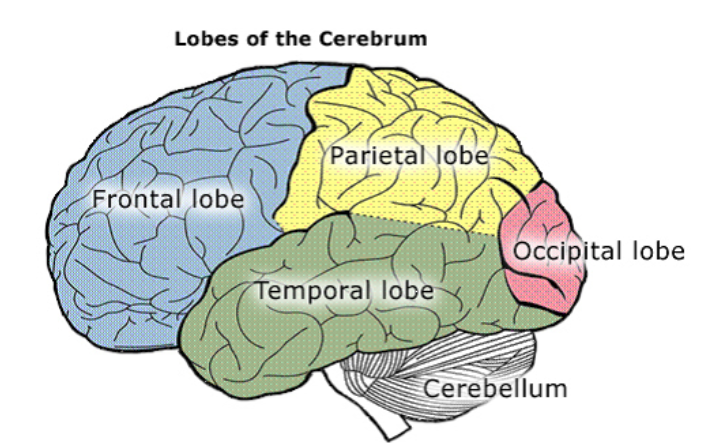
Give examples of tools to study the brain
Electrophysiology (EEG)
Structural imaging (MRI)
Functional imaging (fMRI)
Brain stimulation (TMS)
How do EEG (single-cell recordings) study the brain?
Very small electrode records neural activity from within axon (intracellular) or from outside axon membrane (extracellular)
Usually only obtained from animals bc cannot open humans brains and put electrodes in
Sometimes we have the rare chance of recording from patients with epilepsy when they are undergoing surgery
Electrical activity of large numbers of neurons all firing together, recorded via electrodes on the scalp
Allows us to measure neural activity in real-time (millisecond scale)
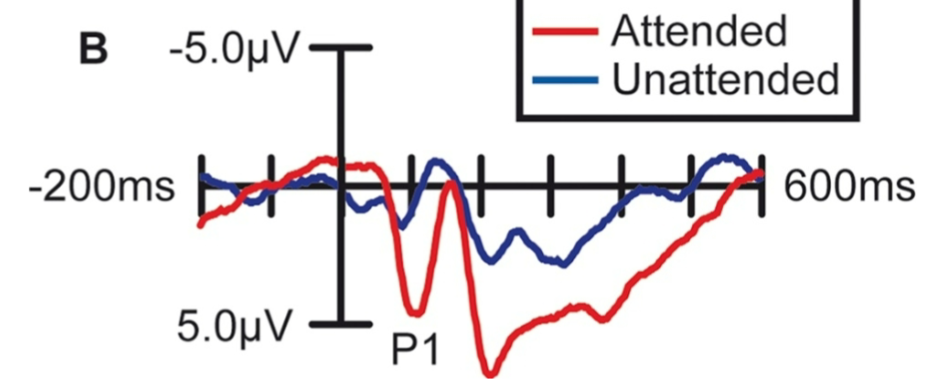
How do event related potentials study the brain?
Measure EEG response to the same stim/task over and over
Average waveform to generate an event-related potential
Just like averaging reaction times to get a cleaner estimate of the 'true' efffect
We can compare ERPs between different psych conditions e.g. attented vs unattended stim
What are strengths/limitations of EEGs and ERPs?
Very good temporal resolution
Protable and relatively cheap
Poor spatial resolution (centimetres): there are an infinate number of possible origins for any signal recorded at the scalp, so we need solid computational models to make an informed guess
How do MRIs study the brain?
Very strong magnetic field (0.5-7 Tesla, 1 Tesla = 10,000 Gauss and magnetic field of the earth = 0.5 gauss)
So scanner is 60,000 times the magnetic field of the earth
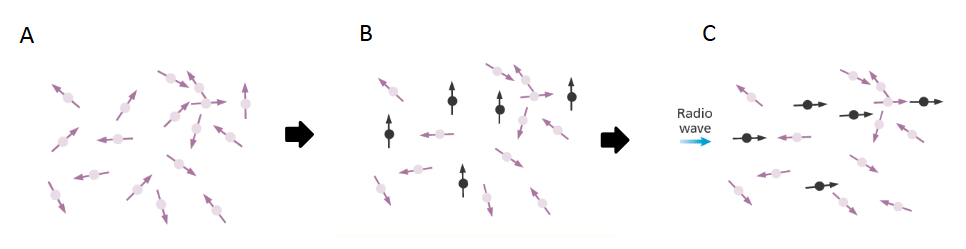
Single protons in water molecules (A) tend to align to the powerful and stable magnetic field generated by the scanner (B). We then disturb the alignment with short radio-frequency pulses and measure the resulting change in magnetic field (c )
Different parts of the brain (grey matter, white matter, CSF) take different times to 'relax' from the radio frequency disturbance, and show as lighter/darker
Structural MRI: diffusion tensor imaging - image white matter fibres (bundles of axons) by measuring the direction of water diffusion. Allows us to study how cognition/perception is supported by connections between brain regions
How do functional MRIs study the brain?
fMRI doesn’t measure neurons directly
fMRI measures the BOLD - blood oxygenated level dependent signal: active neurons need oxygen, the brain starts supplying oxygen to active areas, producing an overshoot in oxygenated blood. Oxygenated blood causes less magnetic field disturbance than deoxygenated blood, so active brain regions will have higher signal
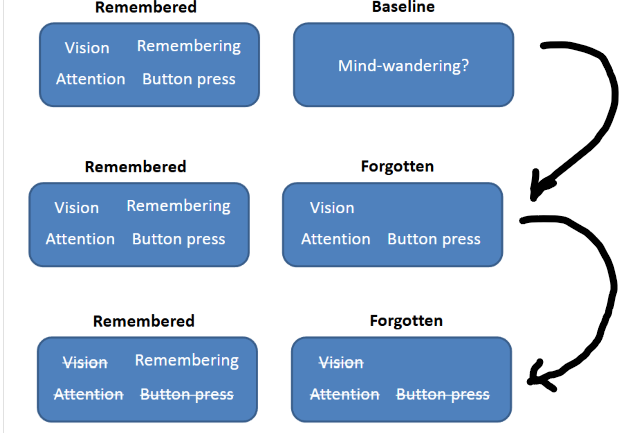
Give an example of subtraction logic
Research question - what regions of the brain are involved in successful memory retrieval?
Task: pps study a list of words and then are visually presented with words individually on the screen and asked if it was studied or not
Remembered VS baseline doesn’t isolate the cognitive process we care abt because too many factors involved
Cognitive tasks should be designed so that the only differences between th two conditions is the thing youre interested in.
What are strengths and limitations of fMRIs?
Pros: very good spatial resolution (millimetres) i.e. where something happens
Cons: poor temporal resolution (seconds), not a measure of neurons themselves - requires an indirect inference that neurons are firing because that part of the brain is using more oxygen
What are brain stimulation techniques?
All the methods so far are purely correlational
To know if a particular part of your brain is important for a cognitive process, we need to change the activity of that part of the brain and show that it changes behaviour i.e. we need causal evidence, not just correlational
What is transcranial magnetic stimulation (TMS)?
Short magnetic pulses that briefly affect electrical activity in a localised patch of brain tissue under the coil
Is typically applied either before or during a cognitive task
Can have positive or negative effects on task performance
What are advantages and limitations of brain stimulations?
Pros: causal evidence that a particular brain region is important for a cog function - not just correlational, like brain image. Mostly non-invasive i.e. safe and painless for healthy populations
Cons: stimulation to the brain is very weak as it happens from outside of the head, therefore, the effects are often weak. Potential risk to individuals with history of epilepsy
What are limitations of cognitive neuroscience?
Expensive/invasive - worth the expense? Often means that sample sizes are small, is it generalisable?
Theories - emphasis in the literature on measuring brain effects rather than testing theories
Does it help us understand cognition - what does it mean to understand? Could a neuroscientist understand a microprocessor?
What can we learn from illusions?
The brain doesn’t see it all
It receives electrical signals abt how light interacts with the eye and then it mut infer what is out there in the world
We can learn from illusions that our cog abilities have limits as you arent aware of the world as you think you are. Implications for eye-witness testimony, driving safety, UX/UI design
Generally you perceive what you expect to perceive
Expectations play a significant role in what you perceive. Implications for schizophrenia and depression
Your sensory systems are imperfect and idiosyncratic = perception feels richer than it is
A lot happens between a 'noisy' sensory input and your subjective perception - multiple stages of these processes including things that can happen before your brain even knows it
Top-down processes have a strong influence on perception - perception isnt veridical, we'll learn abt top-down influences and the ways they sometimes don’t function correctly
Mental/cog processes have limits - your brain resources are finite and need to be distributed
How do we make inferences?
We make inferences based on photons which are bouncing off surfaces in front of us and coming into our eyes and hitting the retina
How does information flow from eye to cortex?
We need information from outside world to enter our sensory system to be sent to brain, then we can perceive it and have thoughts abt it.
Reception - absorption of physical energy i.e. photons enters eyes, hits retina and interacts with photoreceptors. Information is received
Transduction - physical energy is converted into an electrochemical pattern in the neurons, photoreceptors convert energy from photon to electrochemical signals to be sent to brain.
Coding - one to one correspondence between aspects of the physical stim and aspects of the resultant nervous system activity
What is the retinas role in vision?
The light enters through the pupil and then hits the back surface of the eye (retina)
The retina is covered in photoreceptors - either rods or cones.
Rods care abt dim light, don’t care abt colour, 125 million in outer retina
Cones care abt colour, loads of them layered to form retina, 6 million in retina, most in fovea
Sighted people don’t consciously experience things as being in colour, only when they look directly at them - perception is a constructive process
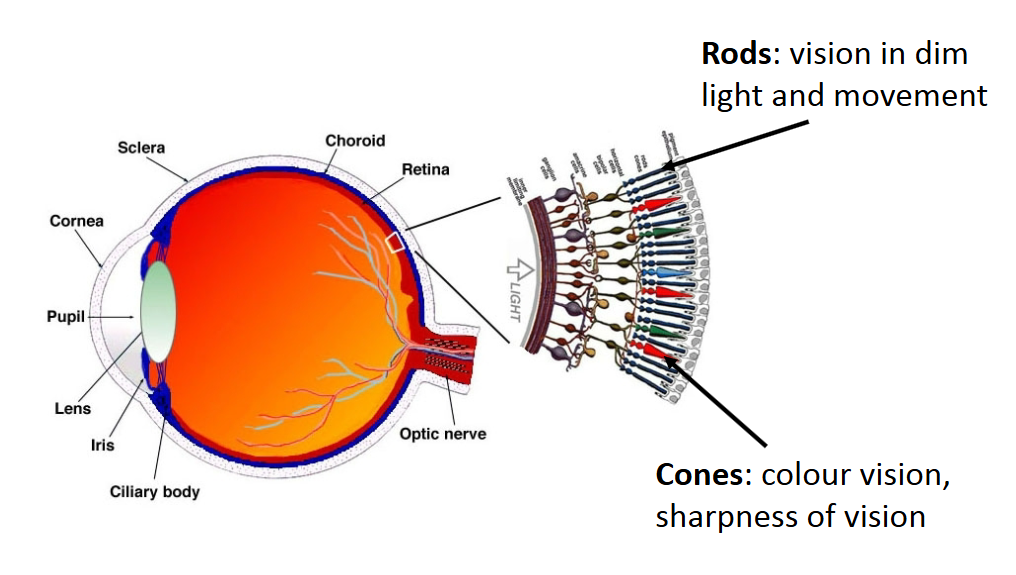
Explain evidence for the difference in roles between rods and cones
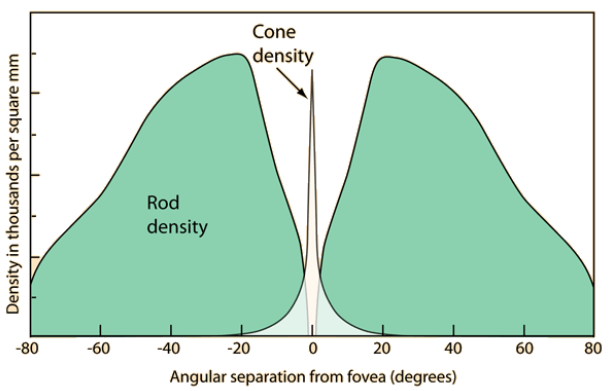
Cones highest density is in the middle and rods further out
Evidence for idea we don’t just process info, were actively constructing experience based on info as we don’t just see colour on outside where rods are, we always see colour
What is colour vision?
Fact we see colour is a result of the fact our eyes respond to a specific part of the electromagnetic spectrum (goes from radio to x-rays and gamma rays). Our eyes respond to certain wavelengths and perceive as being a certain colour.
Eyes are most sensitive to green light.
What is the trichromatic theory of colour vision?
Thomas Young discovered you could produce any colour by additive mixing primary colours onto black surface (red, green, blue) (subtractive colour mixing is mixing paints)
What is Herman von Helmholtz theory of colour vision?
Most efficient way for eye to work is to just have three types of colour receptors (blue, red, green) bc different amounts of inputs can combine to give all possible colours of light.
Inferred this without doing anything with eye but then found its true.
What is the opponent-process theory (Hering) of colour vision?
However, cannot conclude that if you can create any colour light from relative combinations of blue, red and green lights and have blue, green and red cones then the experience of any colour comes from the activation of these cones on your retina.
Never describe seeing colour on a reddish green scale, and also experience negative afterimages
Opponent process theory - idea maybe these inputs from our three different types of cones are processed in an opposition manner to not give us how blue something is, but tells us where something falls on a scale e.g. red to green or dark to light.
What is dual process theory (Hurvich and Jameson)?
Dual-process theory (Hurvich and Jameson): Take input from red and green cones and subtract to find difference of activation which is sent as electrical signal to the brain = signal that describes red and greenness. Something cant be red and green at the same time, it has to fall between red and green. If we add all our cones inputs together, we get a measure of how bright something is/how many photons are hitting retina in that space
So trichromatic theory works at the level of photoreceptors and opponent-process theory works at the level of neurons
What is colour constancy?
The tendency for a surface to appear to have the same colour despite a change in the wavelength contained in the illuminate (the light source)
e.g. in a dark room shining red light onto a blue object will appear black on not appear because its not reflecting blue light (rarely happens as brain creates construction of perception in the dark = percieve things to be the colour they are even if theyre lit with light that doesn’t allow that colour to hit our retinas)
Has colour constancy developed through evolution?
Evolutionarily very helpful - colour of light from sun changes across the day so colours of things like fruit change across day and its important to know if something is safe to eat throughout the day when we look at it in different light
Give an example of colour constancy
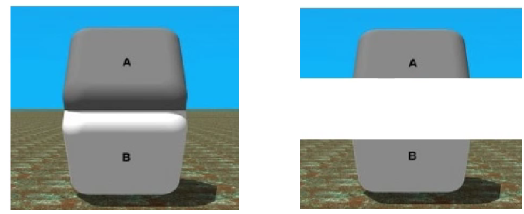
A looks darker in first photo
Same photo in second just with white box = A and B same colour
Perceive top as darker - colour constancy
Brain helps us construct what the colours are in real life as must be light source in top = top of object lit brightly by a light source and the bottom is a shadow
Why do we perceive this image in that way?
Our brains fill in the gaps and say if the photons that are hitting the retina are this shade of grey, but the top is being lit bright and bottom is shadow = top is darker than it appears and bottom is lighter = that’s what we perceive and its different to what our cones perceive as they know these things are the same colour but we don’t
Perception is constructive process. Theres top down influence all the way through this, even from very low level processing of colours
Is how we perceive the world the way the world is?
Butterfly's eyes perceive colours differently to human light as they care about ultraviolet light.
So in outside world because a flower is yellow doesn’t mean its intrinsically yellow, it just reflects yellow light and UV light but our eyes don’t process UV light.
How we perceive the world isnt how the world is
What is the pathway from the eye to the brain?
After the retina, neurons go through the parvocellular (P) pathway which is sensitive to colour and fine detail where most input comes from cones.
After the retina, neurons could also go through magnocellular (M) pathway which is most sensitive to motivation and most input comes from rods
Path from eye to brain: retina -> optic nerve -> optic chiasm -> lateral geniculate nucleus (LGN) -> cortical area V1
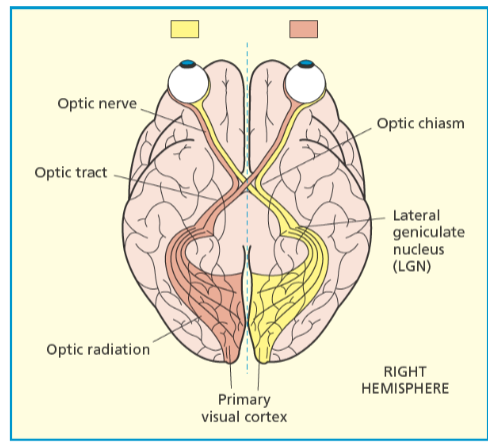
What direction does the eye receive information?
Signals reaching the left visual cortex come from the left sides of the two retinas, and signals reaching the right visual cortex come from the right sides of the two retinas. But the sides of retinas get light from other side of visual space
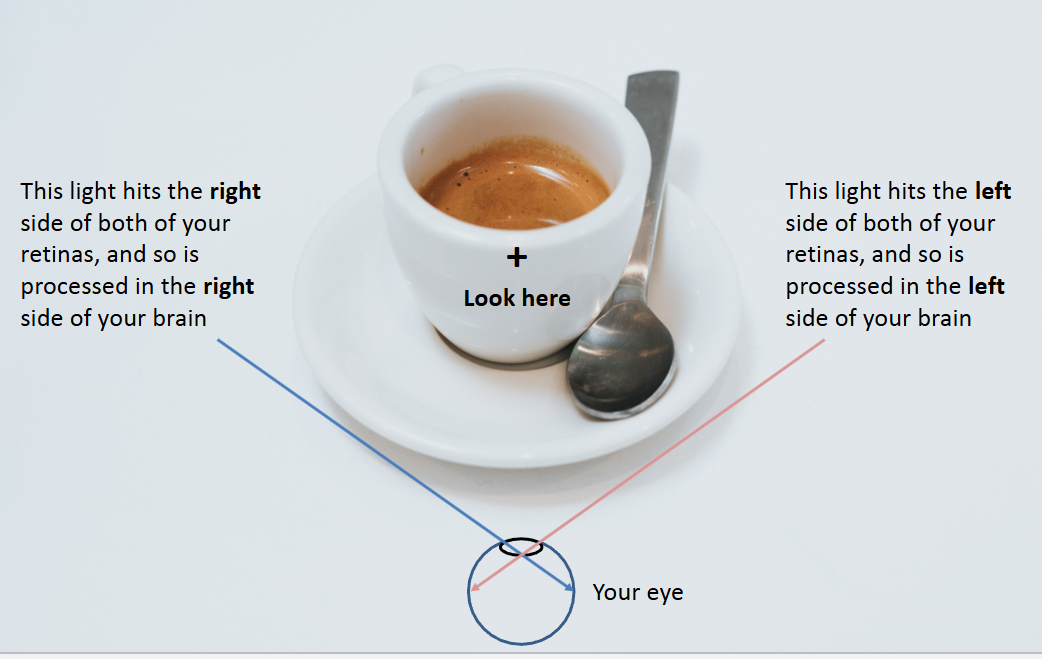
What are the properties of visual neurons?
Respective fields
Retinotopy
Lateral inhibition
What are respective fields?
The region of the sensory space (i.e. the retina) within which light will cause the neuron to fire, neurons are selective so visual neurons respond when there's something relevant happening in specific area
What is retinotopy?
Things that are near to each other in space are processed in cells that are physically near to one another (something next to each other where we see it are next to each other in the brains
What is lateral inhibition?
A reduction of activity in one neuron that is caused by a neighbouring neuron. Useful for enhancing contrast at edge of objects
What is the lateral geniculate nucleus (first stop)?
Part of the thalamus - a subcortical relay for most of the brains sensory input and motor output
Cells have a centre-surround receptive field - responds to differences in light across their receptive fields e.g. light in centre, dark in surround
Maintains retinotopic map - neurons that respond to neighbouring receptive fields will be next to each other
Correlates signals from the retina in space and time - 'is an object moving towards me?'. Provides the 3D representation of space for action
What is the primary visual cortex/V1 (next stop)?
Extracts basic info from the visual scene e.g. edges, orientations, wavelengths of light
Sends this info for later stages of processing of shape, colour, movement
Maintains retinotopy
Single-cell recordings by Hubel and Wiesel indicate that some cells respond to simple features (e.g. points of light) and others combine those features into more complex ones (e.g. adjacent points of light may combine into a line)
What happens when there is damage to the V1?
Damage to V1 leads to a clinical diagnosis of cortical blindness (patient cannot consciously report objects presented in this region of space)
However, the patient is still able to make some visual discriminations in the 'blind' area (e.g. orientation movement direction) - called blindsight
This is because there are other routes from eye to brain
The geniculostriate route may be specialised for conscious vision but other routes act unconsciously
What is blindsight?
People with blindsight report different things depending on where they show semi-circle
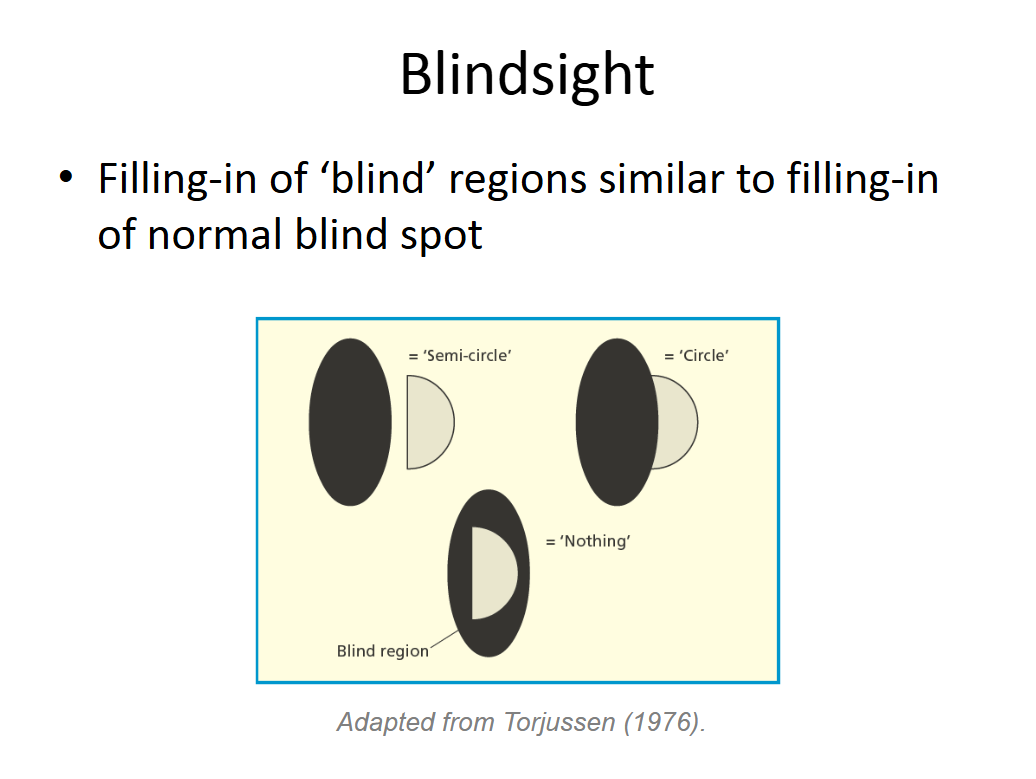
What visual processing occurs beyond V1?
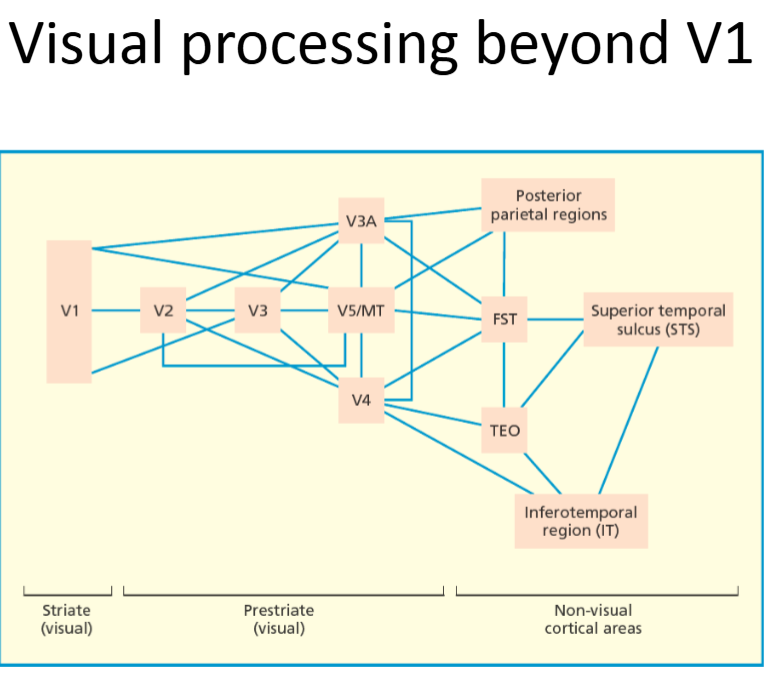
What is functional specialisation theory (Zeki)?
Different parts of the visual cortex are specialised for different visual functions
The visual system resembles a team of workers each of whom works on their own to solve part of a complex problem
The central assumptions from Zeki is that colour, form and motion are processed in anatomically separate parts of the visual cortex
But evidence comes mostly from studies in macaques, what about humans?
Zeki et al did a brain imaging (PET) study: V4 more active for coloured than greyscale images = specialised for colour. V5 more active for moving dots compared with static dot = specialised for motion
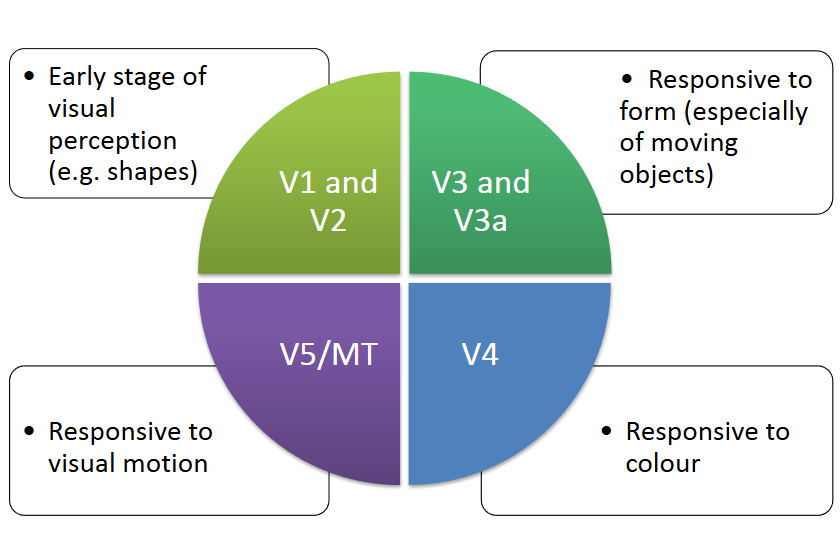
What happens in V4 - the colour centre of the brain?
Patients with cortical ACHROMATOPSIA cant see colours because of damage to V4, but often also due to damage in V2 and V3 (despite a fully functioning retina)
Case studies indicate intact implicit colour processing in patients with achromatopsia
V4 is involved in colour processing but the link between colour processing and V4 isnt perfect
What happens in V5/Mt - the motion centre of the brain?
Heavily involved in motion processing in brain imaging studies of humans
Brain damage to V5/MT leads to AKINETOPSIA
Patient LM: bilateral damage to V5/MT, was good at locating stationary objects, had good colour vision, motion perception was grossly deficient
How does the binding problem challenge the functional specialisation theory?
Sighted ppl don’t perceive the colour of things separately to shape, but in your brain those things are processed separately so where in the brain is the thing that is perceived?
How are the different features bound together to enable coherent object processing
Possible solution: coherent perception depends on synchronised neural activity between brain regions which is most likely dependent on attention
What are the two pathways beyond the visual cortex?
where
what
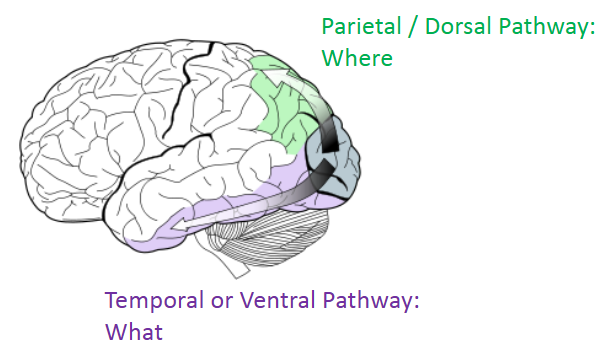
What is the where pathway?
Parietal (or dorsal) processing pathway, goes up - concerned with movement processing - 'vision for action'
What is the what pathway?
Temporal (or ventral) processing pathway, goes down - concerned with colour and form processing - 'vision for perception'
What is the vision for perception/vision for action?
Patient DF has a lesion to her lateral occipital cortex, she has trouble locating and identifying objects
However, her conscious perception is entirely different from the info that’s available to her motor system - she has where but not what
Why is object perception not trivial?
How do we decide where one object begins and another ends
How do we recognise shapes despite different viewpoints
How do we classify objects into one class despite enormous different visual appearances e.g. chairs
How do we know more abt a object then we see e.g. what its used for
What is the model of object recognition?
Early visual processing (colour, motion, edges)
Perceptual segregation: grouping of visual elements (Gestalt principles, figure-ground segmentation)
Matching grouped visual description onto a representation of the object stored in the brain (called the structural descriptions)
Attaching meaning to the object (based on prior semantic knowledge)
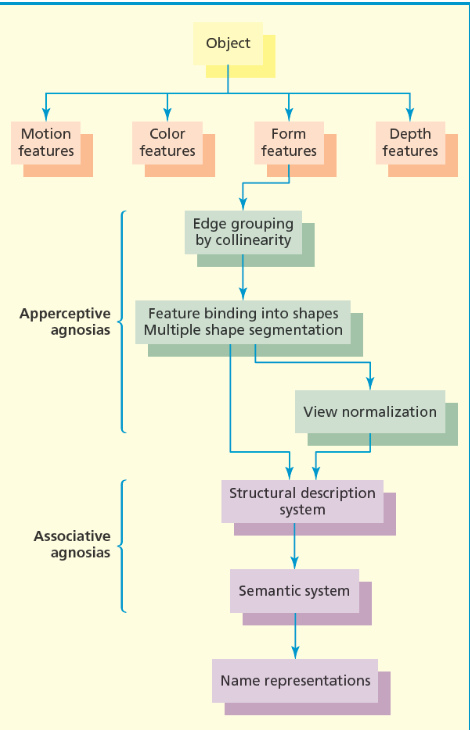
What is perceptual segregation?
Separating visual input into individual objects
Thought to occur before object recognition
What is gestalt psychology?
Fundamental principle the 'law of Pragnanz' - of several geometrically possible organisations, that one will actually occur which possesses the best, simplest and most stable shape (Koffka)
Assumes a set of rules that operate early in visual processing
Refers to the whole that’s holistically perceived
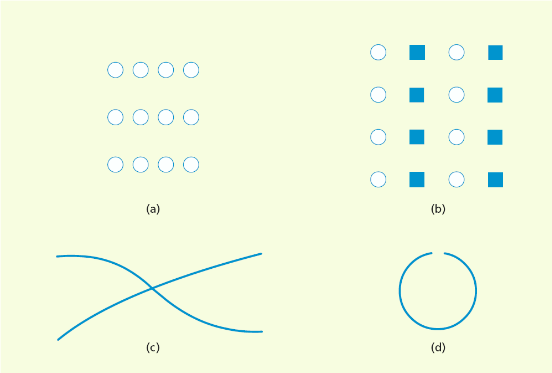
What is gestlats laws of perceptual organisation?
law of proximity - because dots are close together in rows, perceive them as dots in lines instead of columns (a)
The law of similarity - group things together that are more similar to one another (b)
The law of good communication - lines crossing ©
The law of closure - see d as a circle even though its not closed (d)
What is the figure-ground segregation (faces-goblet illusion)?
An ambiguous drawing which can be seen either as two faces or as a goblet
Whichever you perceive seems to be in front of the other i.e. it’s the figure
It is assumed that more attention is paid to the figure than the ground
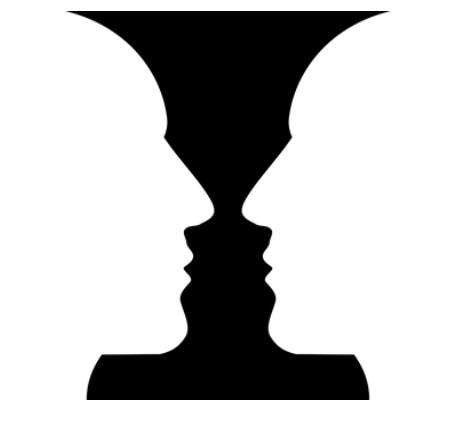
What are problems with gestalt psychology?
Segmentation processes aren't always bottom up and following the laws of perceptual organisation
Most evidence only descriptive, not explanatory
Relies heavily on introspection and evidence from 2D drawings - report experience and look at images but that’s not how perception really works
Some segmentation clearly occurs via top-down prior knowledge (knowing what an object is already so know where it starts and stops)
Where is object recognition processed in the brain?
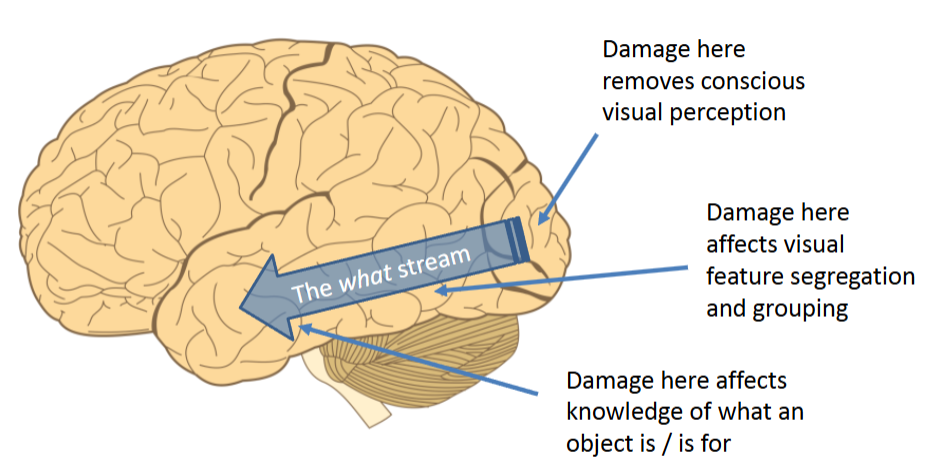
Two major information processing streams
Object info processed in what stream
What are the object recognition deficits?
Agnosia - impairment in object recognition (without primary visual deficits) - cant put objects together WATCH VID
Different kinds of impairments should arise depending on the stage at which object recognition is damaged
What are the two types of agnosia?
Apperceptive and associative
What is apperceptive agnosia?
Impairment in process which constructs a perceptual representation from vision, cant tell difference between whats part of object and what isnt e.g. grouping.
Seeing the parts but not the whole.
Associated with lateral occipital lobe damage.
Patient HJA had bilateral ventral-medial occipital damage, could recognise objects from touch but had marked impairment in visual object recognition, particularly for line drawings over silhouettes.
When shown paintbrush said it appears to be two things close together but its obvs one thing or else you would have told me.
Had problems grouping or organising info e.g. recognising any objects presented together with other objects.
What is associative agnosia?
impairment in the process which maps a perceptual representation onto knowledge of the objects functions and associations.
Seeing the whole but not its meanings. Associated with occipito-temporal damage
Visual object agnosia - one of several varieties of associative agnosia
Patient LH (left) - preserved ability to copy drawings of objects, but unable to name them or show what they are for i.e. no access of semantics
Damage to occipito-temporal regions
What is the neuropsychology of object perception?
Consistent with hierarchal, multi-stage process
What are object perceptions caveats?
Most psych research comes from white male western researchers and pps, generalisable?
Culture plays sig role in psych
Westerners prioritise processing/categorising objects, while east asians prioritise the relationships between objects and context
Less activation of object perception regions in east asians than westeners during scene viewing
Never assume that psych truths apply to all of humanity
What are different categories of objects?
There is some evidence that patients with damage to the ventral visual stream (what stream) have impairments in only one particular category of objects
Lesions to different areas of the what stream can be associated with agnosia for different types of objects, like naming faces, animals and tools
Faces seem to be special
What is the problem with faces?
Face recognition is a within-category discrimination - all faces look very similar
Other objects recognition is between-category e.g. distinguishing a pen from a cup
Maybe faces require different types of processing to other objects?
Faces are so important from a social/evolutionary perspective that they may have a mechanism all to themselves? - other ppl are what keep us alive or kills us so its important to identify whether someone is a friend and can help us or if not
What is neuropsychological evidence for faces being special?
Prosopagnosia: prosop = face and agnosia = 'without knowledge'. Impairment of face processing that doesn’t come from damage to early visual processing
De Renzi: patient failed to recognise his own family but could do so by voices or clothes. 'are you (wife)? I guess you are my wife because there are no other women at home'
Could match different views of faces and name other objects. Impairment at the stage of matching to stored information
Fusiform face area: part of ventral (what) stream. Responds to faces more than other types of objects in functional imaging experiments (kanwisher)
Why are faces special: other reasons may include them being more difficult to process, holistic/configural processing where have to integrate different pieces of face, maybe we process faces so much we have visual expertise or maybe theres domain specificity
Evidence for face specific brain regions e.g. FFA, though this could be visual expertise regions too
After brain injury, some patients appear to have impairment in face but not object recognition (e.g. prosopagnosia) suggesting that faces are special
What is evidence from hollistic processing that faces are special?
Features of faces are processed and remembered less than for other types of objects like houses. It is disproportionately harder to remember/process upside-down faces than upside-down objects.
Sighted ppl are slower and less accurate at identifying inverted faces, typically interpreted as evidence of holistic processing.
Qualitative differences in processing of upright and inverted faces i.e spatial-relational (holistic/configural) info is disproportionately affected by inversion and therefore face recognition suffers
What is evidence from visual expertise that faces are special?
Gauthier and colleagues suggest faces are special because we have become experts at within-category discriminations.
Claims that becoming and expert at 'greeble' discrimination involves the fusiform face area, as do other types of within-category discrimination.
Criticism: not all prosopagnosia patients are impaired on within-category discrimination e.g. patient WJ owned a flock of sheep and could distinguish them and patient RM could distinguish between his collection of 5000 miniature cars but couldn’t identify famous faces or his own and his wifes face
What is attention?
Taking possession by the mind, in clear and vivid form, of one our of what may seem several simultaneously possible objects or trains of thought (William James) - way we select one thing to be aware of out of large possible things in front of us that we could be aware of at any given moment.
What are cross-cultural differences in attention?
Cross-culturally, different words are used to describe attention e.g. in english someone pays attention VS spanish lends attention. Theme that attention is a resource we distribute into our environment.
What would happen without attention?
If it werent for attention then our conscious experience of the world would be overloaded e.g. Koch and Tsuchida suggest theres an enormous amount of information entering our eyes down to our optic nerve every second and no way can be conscious of all info so maybe attention reduces the info overload into a serious stream of consciousness
What are the three paradigms to study limits of attention?
Inattentional blindness
Change blindness (not covered)
Attentional blink (topic of essay)
What is inattentional blindness?
We overestimate how much of the world we are actually aware of
Even very salient (i.e. attention-capturing) things can be missed
Huge amounts of things happen in our environment that are attention grabbing which we don’t perceive - miss relevant events bc were paying attention to something else
What was Simon and Chabris study on inattentional blindness?
e.g. show pps a video of people throwing a ball and count how many times the ball was passed but a weird event happens in the middle of the scene like a gorilla suit walking through centre and they missed the weird event (simon and Chabris)
2 video styles: transparent - white team, black team and unexpected event all filmed separately and superimposed onto each other. Opaque - white team, black team and unexpected event all filmed simultaneously so ppl and objects can be occluded
2 counting conditions: easy - count overall number of passes of your team. Hard - count aerial and bounce passes of your team separately
Results - can induce inattentional blindness in healthy people easily, 1/3 ppl didn’t notice gorilla, shows strength of inattentional blindness. Happens more in transparent conditions than opaque as in transparent ppl don’t need to get out of the way for gorilla to move. Lower identification of gorilla in hard task as have left attention left to focus on gorilla in scene. Shows attention is a limited resource
What is central capacity theory of inattentional blindness (Kahneman)?
A single central capacity e.g. central executive, attention) that can be used flexibly
Strictly limited resources
Single pool shared between competing tasks
Dual task cost will emerge when two tasks exceed the total resource available
An experimental approach: pps talking on a hands-free mobile phone while driving in the simulator
Evidence shown in event related potentials - electrical signals recorded from scalps to average responses to events. Compare activity of two events.
Shows break lights are processed less when person is talking - fewer neural resources dedicated to them when someone is performing a second task at the same time then when they are paying all their attention to brake light in simulator experiment.
The more things we do at once, the less attention can be paid to each task
What is attentional blink?
We can make something invisible by showing it to ppl very quickly after showing them something else that is important to them
Discovered by Jane Raymond and Kim Shapiro
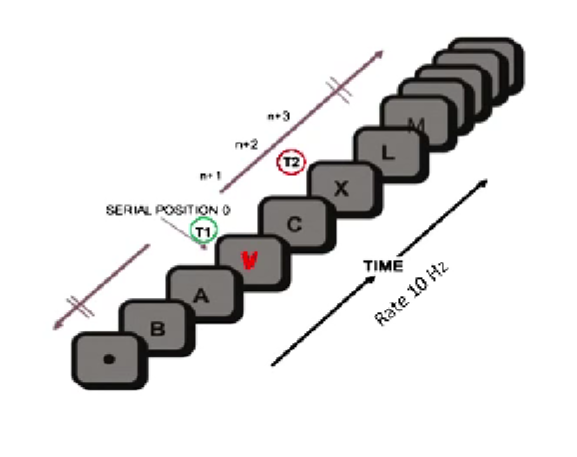
Key ingredients: rapid visual stimuli (10 Hz/ 10 images a second to make one invisible), pps asked to look out for 2 targets and report if they saw them at the end of each trial. The first target is referred to as T1, the second target is T2. Masks/distractors (other items irrelevant to the task but have to occur rapidly between the two targets for the effect) need to follow T1 and T2 for the effect to work
What is the attentional blink task?
Images presented once every millisecond
T1 is the red letter (V)
Ask pps to say what letter was written in red - task for T1
Ask pps if they saw an X - task for T2. can move position of x relative to T1
Allows you to measure how much processing T2 gets based on its position relative to T1
Classic results: single task asked to ignore T1 - ppl can detect X well as T1 not important. Dual task asked to say what letter T1 was and say if they saw T2 - big dip around 300 milliseconds, make T2 invisible half the time if task happened 300 milliseconds earlier (attentional blink is that dip in performance)
If two targets happen 300 milliseconds apart, pps are worse at identifying T2
If someone says they didnt see T2, does that mean the brain didnt process it at all?
N400 (negative, 400 milliseconds later) event related potential: when your brain accesses the meaning of almost any stimulus (a word, picture, sound) we see a negative event-related potential called N400. it reflects cog processes related to accessing the meaning (semantics) of a stimulus.
We can use N400 as a sign (or marker) that someone's brain is processing meaning without them telling us with their behaviour
Luck et al: classic AB to T2 - i.e. the word cat is less likely to be seen when shown 300ms after T1 but the N400 is the same size regardless of time since T1. therefore, even if you don’t know that you saw T2, your brain still did some processing of what it means.
What is interference theory of attentional blink (Shaprio et al)?
T1, T2 and their masks/distractors are all encoded into a temporal buffer (time-limited buffer where brain tries to process all items, 1 every 100ms) e.g. visual short-term memory
The AB is competition for retrieval among all items in short-term memory = cant report accurately seeing T2
Supporting evidence from Isaak et al - attentional blink increases with increasing numbers of task-irrelevant competitors (distractors)
What is the unified model of attentional blink?
Due to the mask following T1, increased attention is required to process T1
This leaves less attention for processing of T2, which leaves T2 vulnerable to decay or interference from distractors. T2 harder to be processed at short lag (not long after T1) than a long lag
(ESSENTIAL READING FOR OTHER THEORIES)
What is the cocktail party problem in attention?
Dichotic listening tasks (Cherry)
Presented two pieces of information to different ears. Found some was attended to and some wasn’t
Unattended auditory information is processed to a lower level of complexity than attended information
1/3 pps report hearing their name in the unattended channel - when not listening to information in one ear and then hear their name, report hearing name even if unattended to information
Easier if voices are physically different - bottom-up processing.
What is Johnsrude et al’s study of the cocktail party problem?
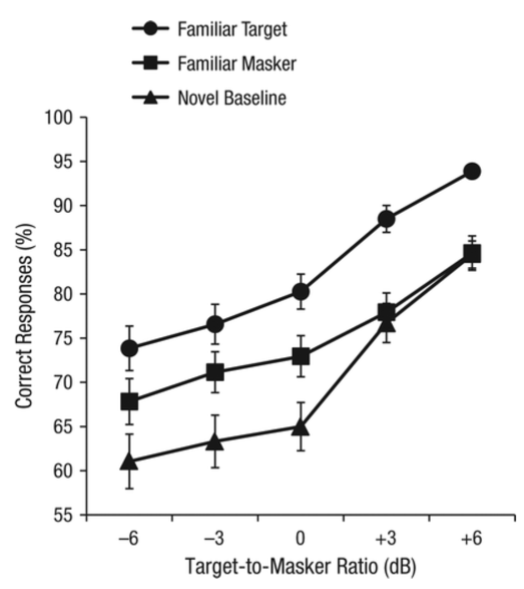
A familiar voice is easier to pay attention to and easier to ignore - manipulated how familiar pps were with person speaking
Pps were listening to familiar and unfamiliar person talking and had to listen to one of the people (switched between which person they needed to listen to)
We use our own experiences of the world to help to solve the cocktail party problem - top-down processing
Also manipulated bottom up effect by manipulating the volume of the person speaking
The higher the volume of person, the easier it was for pps to answer questions abt what that person said
Easier to answer questions correctly when the familiar person was the target to listen to. Easier to ignore familiar person. Easier to both attend to someone we know and ignore them
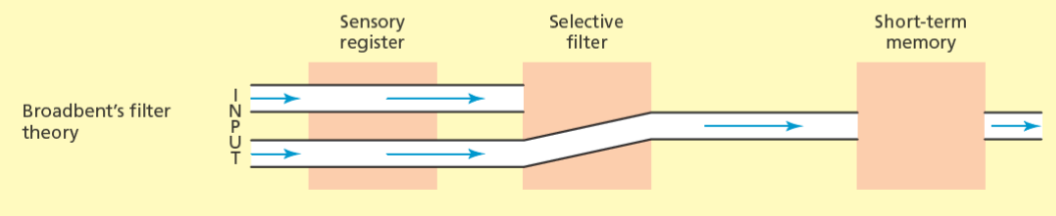
What is Broadbents theory of attention as early selection?
Parallel input into sensory register
Inputs are then filtered on the basis of its physical characteristics:
filtering prevents overloading of the limited capacity mechanism
inputs remaining in the buffer after filter are available for later (semantic) processing
Accounts for cherry's basic findings: unattended stimuli only undergo minimal processing before being filtered - cant recall much of this info
Accounts for findings from dichotic listening task: filter selects an input on the basis of the most prominent physical characteristics distinguishing the inputs e.g. know sound of someone's voice so its easier to filter
BUT
At least some parts of the unattended stream are processed semantically (e.g. hearing your name within a conversation you're not paying attention to)
Stimuli that ppl don’t report ever experiencing can still change their behaviour e.g. blindsight from last week
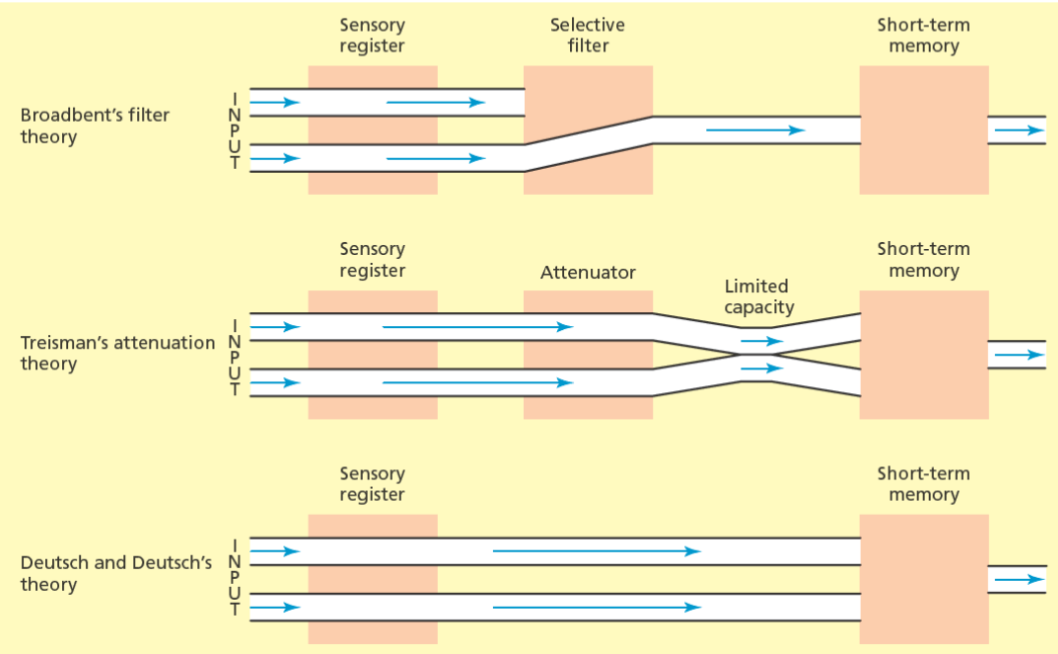
What is Deutsch and Deutsch’s theory of attention as late selection?
All stimuli are fully analysed: the bottleneck occurs late, before the response. The most relevant stimulus determines what response is made
But early sensory event-related potentials (100ms post-stimulus) are smaller if unattended: places the bottleneck much earlier during processing, results favour Treisman's perspective

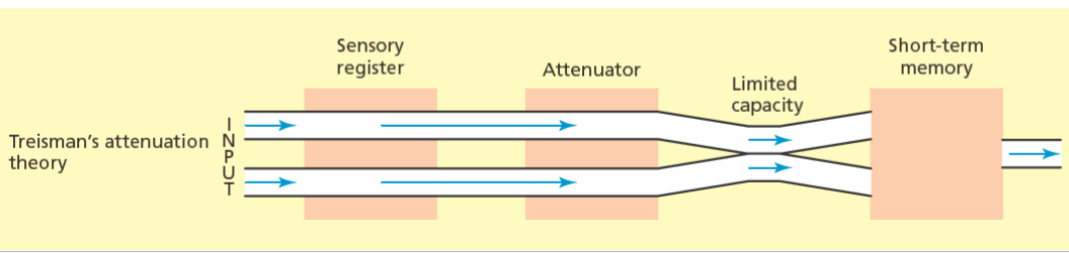
What is Treismans leaky filter theory of attention as flexible selection?
Unattended information is attenuated/filtered after the sensory register:
Stimulus analysis proceeds through a hierarchy from physical characteristics of the stimulus up to its meaning and beyond
When capacity is reached, tests at the top of the hierarchy are precluded for all but the 'attenuated' stimulus
Precise location of the bottleneck is more flexible than in Boradbents model
Compare all the theories of selective attention
Broadbent suggests we filter really early in sensory register, then immediately shrink it down and most important stuff gets passed on
Deutsch and Deutsch - everything gets passed on and then only things we need now gets passed on
Treisman - hen we have capacity might process everything all the way
When is attention selection happening?
Initially the field considered a distinction between early (e.g. Broadbent) and late (e.g. Deustch and Deutsch) selection
In reality its probably flexible and influenced by many top-down and bottom up processes
What is covert attention - the Posner cueing paradigm?
Slighted ppl can pay attention to a part of space that they aren't directly looking at - covert attention
Posner designed a paradigm to measure how that works
 Note
Note  Flashcards (62)