Biology - Inheritance, variation and evolution
 Studied by 0 people
 Call Kai
 Learn
Learn Practice Test
 Spaced Repetition
 Match
Match Flashcards
 Knowt Play
1/142

There's no tags or description
Looks like no tags are added yet.
Name | Mastery | Learn | Test | Matching | Spaced | Call with Kai |
|---|
No analytics yet
Send a link to your students to track their progress
143 Terms
What is sexual reproduction?
Involves the fusion of male and female gametes.
What is the process of fusion of gametes called?
Fertilisation
Why are offspring from sexual reproduction genetically different?
Because there are two parents. And offspring inherit characteristics from both parents.
What does sexual reproduction allow for in terms of offspring?
It allows for lots of variation. GENETICALLY DIFFERENT OFFSPRING.
What are gametes?
Cells like sperm and egg in animals. Cells like pollen and egg in flowering plants.
They contain half the genetic material of a normal cell. For example, a normal human cell contains 46 chromosomes but a gamete contains 23. When two gametes fuse, the resulting cell will have 46 chromosomes.
Through what process are gametes made?
meiosis
Asexual reproduction
Requires only one parent. Doesn't involve any gametes. Therefore not mixing of genetic material and no genetic variation.
ALL OFFSPRING ARE IDENTICAL CLONES.
Asexual reproduction in eukaryotic cells
Plants, fungi and some animals.
Achieved through mitosis.
Asexual reproduction in prokaryotic cells
Bacteria.
Achieved through binary fission.
Advantages of asexual reproduction
Requires one parent, no need to mate.
The process is very quick and allows a single organism to quickly colonise a new area.
Disadvantage of asexual reproduction
As all offspring are clones, there is no genetic variation. If a new disease is present and one of the plants is susceptible to it then all the plants will be susceptible to it. It could wipe out the whole population.
Disadvantage of asexual reproduction (2)
Organisms have less of a chance of adapting to new conditions like changes in the climate or introduction of a new competitor.
Advantages of sexual reproduction
A lot of genetic variation within the population. Short term: population is less likely to get wiped out by a single event like a new disease because some will be more resistant then others.
Advantages of sexual reproduction (long term)
Population can adapt to changing conditions because it allows for evolution to take place. Evolution is changes over time as most favourable traits are passed on.
Disadvantage of sexual reproduction
Takes a lot more time and energy than asexual reproduction.
e.g. animals have to find their potential mate which is time consuming.
Chromosomes
threadlike structures made of DNA molecules that contain the genes and are found in the nucleus. Humans have 23 pairs of chromosomes (one from father and mother) and the 23rd pair determines sex. XY = male and XX = female
Gene
A section of DNA on a chromosome that codes for a protein.
A code for a particular sequence of amino acids and when they are combined they form a protein. DNA determines which proteins the cell produces which determines what type of cell it will be.
Genome
all of an organism's genetic material.
Scientists know the entire code DNA holds which allows them to identify genes that are linked to certain types of diseases. Sometimes genes may cause a disease (inherited diseases) or the genes can increase risk of a certain disease.
Alleles
different versions of same gene
as we have 2 copies of every gene from each parent, we have 2 alleles of each gene (could be the same alleles or two different alleles)
Homozygous alleles
Two identical alleles for a trait.
Heterozygous alleles
Two different alleles for a trait
Dominant alleles
Alleles which are always expressed even if only one is present.
Recessive alleles
Alleles that are expressed only when both alleles are the same.
Genotype
Entire collections of alleles we have (heterozygous, homozygous dominant and homozygous recessive are all different genotypes).
Phenotype
Characteristics obtained from genotype (basically appearance). If both characteristics are the same for both organisms, they have the same phenotype even if they have a different genotype.
What is the shape of DNA?
double helix
Why is DNA a polymer?
It is made up of monomers called nucleotides.
Nucleotide
Monomer of DNA, consists of phosphate, deoxyribose sugar and a base
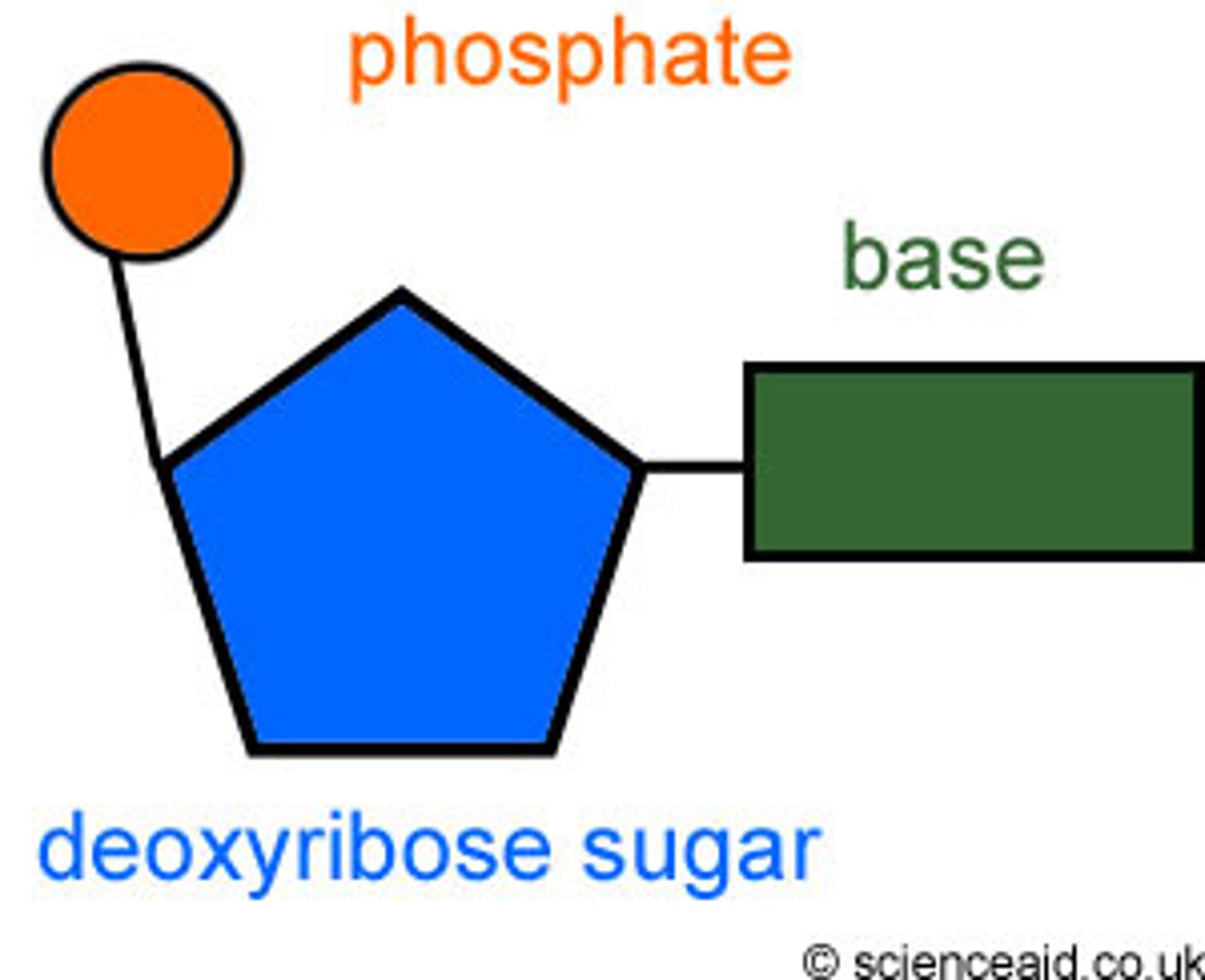
What makes a nucleotide different?
It's base as the phosphate and deoxyribose sugar stay the same.
What are the four different nucleotide bases?
A, T, C and G therefore 4 different nucleotides in DNA.
How do nucleotides bond?
Phosphate of one nucleotide bonds to the sugar of another.
What is one long chain of nucleotides called?
Sugar-phosphate backbone essentially protects the bases in the double helix structure
How do bases pair up?
Only complementary bases can pair. A and T (or T and A)
or G and C (or C and G).
Complementary base pairing
Genetic code
Sequence of bases. A gene is a particular sequence of bases that code for a protein.
What is a triplet?
a sequence of 3 DNA bases that codes for a specific amino acid
How are proteins formed from triplets?
Cells read DNA sequence as series of triplets, then cells take amino acids each triplet codes for and combine them in that order. The long chain of amino acids folds up and form a protein.
Why does each protein have a unique shape?
Made up of a different sequence of amino acids which carry out a particular function.
Main uses of proteins
Enzymes - biological catalysts
Hormones - carry messages around the body
Structural proteins - provide strength to cells/tissues
What is protein synthesis?
the process of making proteins
What are the two steps of protein synthesis?
1. Transcription
2. Translation
What is transcription?
The process of taking a single gene of of DNA and copying it into a structure called mRNA.
What is translation?
Taking mRNA strand and producing a protein.
How does a protein get made?
Specific sequence of bases has to be read by a ribosome.
Why do we have to make a copy of the gene?
As gene is a part of DNA, it is too big to leave the nucleus. Copies are small enough to leave the nucleus be read by a ribosome.
Copies = mRNA (messenger RNA)
Difference in structure of mRNA to DNA?
Much shorter then DNA.
Only single strand.
Instead of base T it contains base U.
What does a U on mRNA strand pair with in DNA?
It pairs with an A base on the DNA strand.
Process of transcription
Select gene you want to copy.
Enzyme - RNA polymerase - binds to DNA just before selected gene starts.
Just ahead of RNA polymerase, the two strands of DNA separate apart so that all their bases are exposed.
RNA polymerase moves along DNA strand and reads the bases one by one to make an mRNA strand.
mRNA bases are always complementary to DNA bases.
Once RNA polymerase has moved along entire gene and made mRNA, it will detach from the DNA and DNA strands can close back up.
mRNA can leave nucleus and go to a ribosome.
What is the strand that RNA polymerase moves along?
Template strand
What happens once mRNA makes it to a ribosome?
Undergoes translation to produce a protein.
Process of translation in ribosome
mRNA strand and ribosome bind together.
Ribosome builds protein by adding one amino acid at a time.
Amino acids are brought to ribosomes by molecule called tRNA (transfer RNA).
tRNA have amino acid at the top and anti-codon at the bottom.
Anti-codon is complimentary to 3 bases on mRNA strand these 3 bases on mRNA code for the amino acid that the tRNA is carrying.
What occurs once tRNA bring amino acids?
tRNA bring correct amino acids to ribosome in correct order and ribosome can join amino acids together. Ribosome moves along mRNA strand where more tRNA molecules come along. tRNA detaches but leaves amino acid behind. Repeated till ribosomes made it to the end of mRNA strand and made a complete chain of amino acids
What occurs once ribosome makes it to the end of mRNA strand?
Amino acid chain detaches from ribosome.
Chain can fold up on itself to make a protein
What is a mutation?
change in DNA base sequence, happen spontaneously in our cells
what increases risk of mutations?
carcinogens and radiation (xrays or gamma rays)
What can a mutation do to an enzyme?
change the shape of its active site and can't form enzyme substrate complex
3 types of mutations
insertion, deletion, substitution
substitution mutation
one of the bases is substituted for another random base
Insertion mutation
an extra base is inserted into the sequence
Deletion mutations
one of the bases is removed from the DNA sequence
What do eukaryotic organisms require a continuous supply of new cells?
For growth, development and repair.
Cell cycle stages
Growth, DNA replication and mitosis, division (cytokinesis)
Growth in cell cycle
1st stage
Cell grows in size and increases the amount of sub cellular structure e.g. mitochondria and ribosomes.
DNA replication
2nd Stage
DNA is duplicated
What does DNA do when cell is not dividing?
DNA is spread in long strings
What happens to DNA once the cell is ready for division?
DNA coils up into chromosomes.
Cell duplicates each chromosome (duplicate stays attached to the original) so together they form an 'X' shape.
What happens in the cell once chromosomes are duplicated?
The 46 chromosomes line up along the centre of the cell.
Fibres from each side of the cell attach to each half of the chromosomes. The cell fibres pull the chromosome arms to opposite sides of the cell. Two sides are called poles.
What occurs once genetic material has been pulled to either pole of the cell?
Division (cytokinesis)
Cell membrane and cytoplasm pull apart forming two daughter cells. Half of genetic material in both cells so the cells contain same DNA. They are identical to each other and the parent cell.
What does meiosis form?
gametes
contain half the genetic material of a human cell so we called them haploid cells
once the gametes fuse, they make a normal human cell and we call them diploid cells
First stage of meiosis
Replicate DNA, replicate chromosomes (adds an extra arm to each chromosome)
Second stage of meiosis
Chromosomes line up along centre of centre in pairs (4 arms in total)
Which chromosome is on left or right is random.
There is a random and different order each time.
Third stage of meiosis
First division
Chromosomes are pulled apart and the cell splits.
Chromosomes will be randomly distributed.
Each half gets a different combination of maternal and paternal chromosomes. DNA in each cell is different.
2 cells are formed
Fourth stage of meiosis
Second division
Chromosome line up along centre of each cell.
Arms of each chromosome are pulled apart to either side.
Cells split in half again.
What are we left with in meiosis?
Four genetically unique cells called gametes.
What is polydactyly?
A genetic disorder where a baby's born with extra fingers or toes
Isn't life-threatening - doesn't cause any other problems
What is polydactyly caused by?
A dominant allele, D
Cystic fibrosis
A genetic disorder which causes sticky mucus to be released in airway of the lungs and pancreas.
What is cystic fibrosis caused by?
recessive allele, a
two recessive alleles needed to have CF
How can you be a carrier of CF?
If you are heterozygous dominant (Ff) you don't have CF but you carry the allele for it.
Advantages of embryo screening
Help reduce suffering (less will have health problems)
Save money as treating genetic disorders is expensive
Disadvantages of embryo screening
Implies people with genetic problems are undesirable
In future people might screen for other traits
What is variation?
Any difference between individuals of the same species. Have different genomes therefore different proteins that make them look different.
Caused by mutations in genes.
Natural selection
Fittest individuals are selected to survive, proposed by Charles Darwin
Evolution
The gradual change in a species over time due to change in characteristics.
How does evolution occur?
Occurs through natural selection of certain genetic changes.
Principles of natural selection
1. All living organisms show genetic variation
2. Those with characteristics better suited to the environment survive, then reproduce and pass on their useful genes.
3. Overtime, the proportion of individuals with the useful characteristic increases.
Why was Darwin's explanation for evolution gradually accepted?
1. Natural selection challenged/undermined the idea that God created all animals and plants (creationism)
2. Insufficient evidence was available to convince scientists at the time when Darwin's theory was published. He only had 'drawings' and no fossil evidence/DNA.
3. The mechanism of how 'genes' were inherited was 'unknown'. It was discovered 50 years after Darwin's book was written.
Gregor Mendel
Monk who carried out breeding experiments with pea plants.
What did Mendel prove?
There is a pattern inheritance
Inheritance was determined by factors called 'units' (alleles) which were passed from parent to offspring unchanged.
What were Mendel's hereditary units?
Dominant or recessive units which could be passed on.
Why was Mendel's work finally accepted after his death?
Chromosomes were discovered.
Scientists repeated Mendel's experiments and noticed chromosomes behaved like Mendel's hereditary units.
Selective breeding
the human practice of breeding animals or plants that have certain desired traits
Method of selective breeding
1. Select parents with desired characteristics and breed them together
2. Select offspring with desired characteristics and breed them together
3. Repeat for generations until all offspring show desired characteristic
Problems with selective breeding
Variation is reduced as all animals are genetically similar and therefore all of them are susceptible to the same diseases.
Inherited defects can be passed on.
What is genetic engineering?
Taking the gene of a desirable characteristic of one organism and transferring it to another organism so that it develops then same trait.
We modify the organisms genome therefore the organism has been genetically modified.
How does gene therapy work?
Giving an individual a healthy version of a gene in order to fix the problem.
Problem with gene therapy
Faulty gene would be in every cell of the individual so we would need to transfer the new gene to every cell
How do we overcome this issue?
Transfer the gene at an early stage of development such as the egg or development because as individual develops, the healthy gene will get passed down onto other cells
Advantages of GM crops
Easily make crops with desired characteristics therefore make more food for less money. for example bigger fruits and resistant to disease
Disadvantages of GM crops
Don't know how genetically modified crops might affect our health.
There is a chance GM plants can make it out into the wild and outcompete local plants therefore changing an ecosystem.
How have bacteria been genetically engineered?
Bacterial cells have been genetically engineered to produce useful substances such as human insulin to treat diabetes.
 Note
Note  Flashcards (355)