Theme 6 II A: Firms and Decisions
 Studied by 0 people
 Call Kai
 Learn
Learn Practice Test
 Spaced Repetition
 Match
Match Flashcards
 Knowt Play
1/22

There's no tags or description
Looks like no tags are added yet.
Name | Mastery | Learn | Test | Matching | Spaced | Call with Kai |
|---|
No analytics yet
Send a link to your students to track their progress
23 Terms
Compare price and non-price strategies
Price strategies | Non-price strategies |
|
|
Explain how the 3 cognitive biases are used by firms generally
Sunk cost fallacy: encouraging customers to continue spending after an initial investment
Loss aversion: businesses frame offers to make people fear missing out, pushing quicker purchases
Saliency bias: highlight flashy features or discounts, drawing attention away from better options
Draw our graphs for increased revenue and reduced costs
Increased revenue | Reduced costs |

|
 |
Define price discrimination and 3rd-degree discrimination
Price discrimination PD (Def.): Same product is sold at different prices to different buyers for reasons not associated with differences in production costs (SAME cost of production)
3rd-degree PD (Def.): Consumers segmented into distinct groups are being charged different prices for the same product for reasons not arising from cost difference
Describe 3rd-degree price discrimination + examples
Firms charge a higher price for consumers with a price inelastic demand and a lower price for other consumers with a price elastic demand assuming cost of production is constant
Eg. Public transportation rates – Lower bus and MRT fares for students and senior citizens (they have lower income -> greater proportion of income spent -> PED > 1) VS working adults
Eg. Airline tickets – Lower airfares for those who buy in advance (likely leisure travellers) VS last minute buyers (likely business or urgent travellers)
Eg. $9 for weekday movie ticket VS $13 for weekend movie ticket = NOT price discrimination = not same product (screened on different days) + due to cost difference (higher labour costs on weekend)
Describe conditions for 3rd-degree price discrimination
Price setter -> this strategy is for imperfectly competitive firms
Ability to differentiate markets and PED value must differ in each market
Separate customers into separate and identifiable groups, each with different PED
Markets must be kept separate
No possibility of resale or ‘seepage’ between markets
Explain how 3rd-degree price discrimination increases TR
*Q-Q’ is equidistant to Q1-Q
If you draw AC, AC curves MUST be the same!
Assuming a firm sells its output in 2 markets…, [describe 2 markets and their PEDs]
If apple charges the same price, TR = P x Q + P x Q
Since the PED differs between the two markets, the firm can charge different prices in the two markets to earn more revenue for the same output produced
[Describe charge what price individually market + how it increase revenue]
With total cost faced by the firm being the same (because there is no change in the overall quantity produced, where QA+QB = Q+Q’), price discrimination allows the firm to earn more profits as TR increased
Explain how 3rd-degree price discrimination increases TR graph
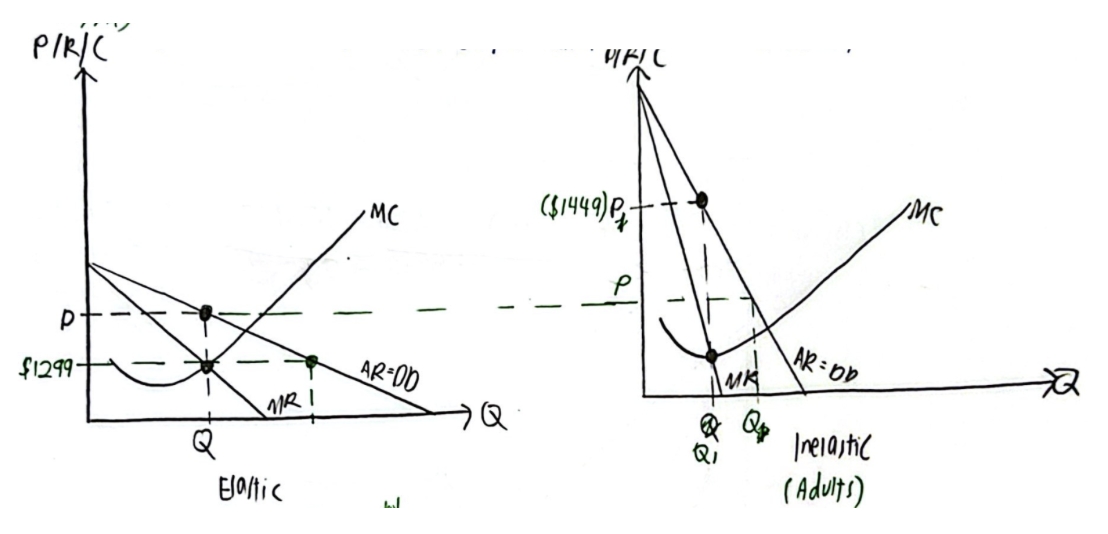
Impact of 3rd-degree price discrimination on consumers
Consumers with a price inelastic demand are negatively impacted as they get charged a higher price, consume less and lose consumer surplus
Consumers with a price elastic demand benefit as they get charged a lower price, consume more and gain consumer surplus
Impact of 3rd-degree price discrimination on government (efficiency VS equity)
Efficiency | Equity |
|
|
State limitation of 3rd-degree price discrimination
Difficult to segment market according to PED
Due to imperfect information, firms may segment market wrongly
For income groups: If firm charge higher price for low-income adults with PED > 1, it will lead to a more than proportionate fall in Qd -> fall in TR instead of rise in TR -> strategy ineffective in increasing profits
Others (use different PED factor): Even if the consumer has a low level of income, the demand for the sugar sweetened sodas may still be price inelastic (due to the addictive nature of the good)
For countries (developing VS less developed): Degree of necessity will be different between countries. In a developing country like Nepal with large geography and harsh terrain, cars take a large proportion of income but have a high degree of necessity -> PED hard to determine
Evaluation: In SR, difficult for firms to identify overall PED value but easier to identify in LR after firm collect more data on effects of its pricing strategies
Evaluation: Depends on pre-existing profits
Smaller problem if firm has ability to hire more data analysts to analyse sales patterns and effects of pricing strategy
Define price competition
(Def.): Firm sells its good/service at a lower price than a similar good/service sold by other firms (in the same market/industry)
Explain how price competition can increase TR by increasing demand
Assume that a firm is initially earning only normal profits
When demand is price elastic (due to availability of close substitutes) where a fall in price leads to a more than proportionate rise in Qd, the firm could cut its price to increase TR
In diagram (a), the cut in price from P to P’ causes TR to rise from area 0PexQe to area 0P’yQ’ because the rise in TR from increase in Qd exceeds the fall in TR from fall in P
Cut in P will also win customers
Entice consumers to try its good/service with the hope that consumers come to see the benefits of the product after trying it
If taste and preference change in favour of your product -> their MPB rises -> consumers’ demand rises in the next period to DD’ in diagram (b)
Firm switches back to the normal practice of charging the price that enables it to sell its profit-maximising output and earn more profits
In diagram (b) (next time period), the firm produces Qe’ units (where MR’=MC) and charge price Pe’ -> total profits rise to area Pe’ABC
Explain how price competition can increase TR by increasing demand (graph)
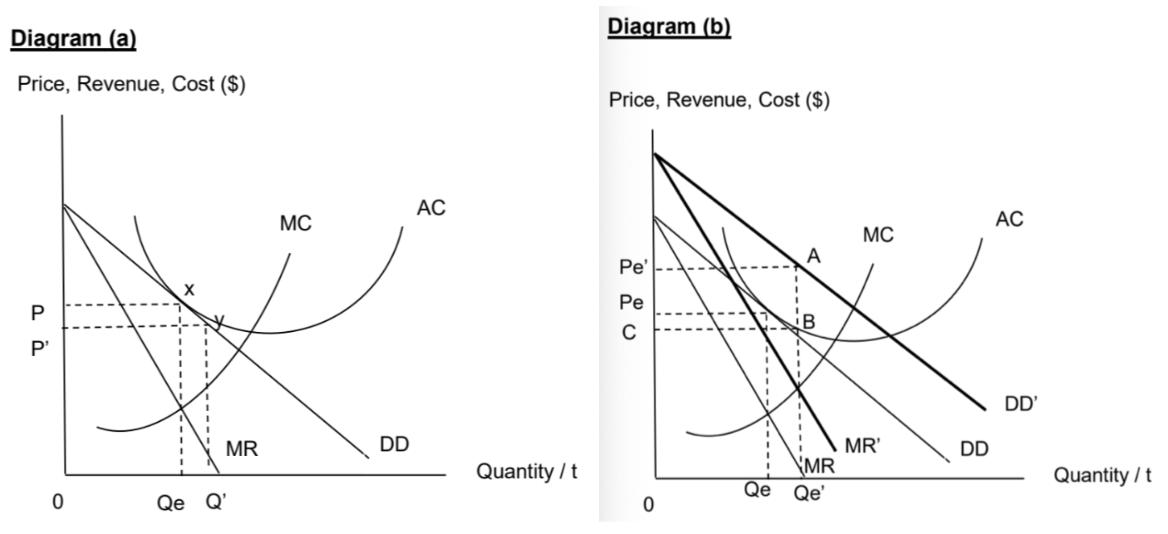
Explain how firms use behaviourial economics in price competition
Firms tap into loss aversion by offering the price discount only for a limited period to increase the likelihood of swaying the decision of potential customers to buy the good/service
This triggers an emotional response where the consumer is driven to act impulsively by going ahead to buy, to avoid the negative emotions associated with a loss
Explain how price competition can increase TR by increasing demand of complements
A firm might perceive the demand for its good/service (printer) to be price inelastic, such that a cut in price leads to a less than proportionate rise in Qd
Rise in revenue from the rise in quantity sold does not exceed the fall in revenue from the price cut leading to an overall fall in revenue from the sale of printers
While this causes it to move away from its profit-maximising output level for printers, the rise in Qd for printers leads to increases in demand for its complement where the cross- price elasticity of demand is negative (printer ink), such that its profits from the sale of the complement rises
Leads to overall rise in profits if the rise in profits from printer ink exceeds the fall in profits from printers
State limitation of price competition
Unintentionally trigger a price war
Occurs in an oligopoly where there is rival consciousness among the firms in the market / industry and a price cut by one firm may cause other firms to follow suit -> Qd rise less than proportionate -> fall in TR
Oligopolists prefer to engage in non-price competition
Describe impact of price competition on other firms, consumers, government objectives
Other firms |
|
Consumers |
|
Government objectives |
|
Define marketing and advertising
Marketing: (Def.): Efforts taken by the firm to promote its product
Advertising: (Def.): an activity of making a product known to the public to persuade them to purchase it
Explain whether PC, MC, Oligo, Mono will carry out advertising
PC: no advertising due to perfect information and homogeneous products
MC: with more limited financial resources (since they only earn normal profits in the long run), engage in less costly types of advertising like flyers or small-scale social media publicity
Oligopolies: have the financial resources (since they may earn sustained supernormal profits in the long run) to compete by creation of brand loyalty through extensive advertising in the mass media
Monopoly: will engage in advertising if demand can still increase and become less price elastic + market is contestable (potential threat of new entrants, need to strengthen brand loyalty and create artificial BOE) -> depends on nature of the product
Explain how advertising can be persuasive
Firm aims to subjectively influence consumers about the quality or desirability of its product
Relies heavily on aesthetic and emotional appeal and celebrity endorsement
This may distort choices as consumers are swayed to buy _ instead of basing their decisions on actual MU (tangible quality of products)
Consumers may end up paying a price higher than their ‘true’ MU, which they only realise after consuming the product
Explain how advertising can be informative
Relies more heavily on information of the product
Firm aims to inform consumers about the prices of its products, tangible characteristics of its products, or the locations and conditions of sale
Describe evaluation for price discrimination
Eval: Condition not met (Eg. Given that air travel is now common and affordable for those in more affluent countries, resale could be possible if those from more affluent countries travel to less-affluent countries to buy the same drug that is priced more cheaply there -> If this were not controlled, price discrimination might not be effective)
 Note
Note  Flashcards (32)