Kin 411: Lecture 12
 Call Kai
 Learn
Learn Practice Test
 Spaced Repetition
 Match
Match Flashcards
 Knowt Play
1/32

There's no tags or description
Looks like no tags are added yet.
Name | Mastery | Learn | Test | Matching | Spaced | Call with Kai |
|---|
No analytics yet
Send a link to your students to track their progress
33 Terms
What is Herpes Zoster (aka Shingles)? What are it's symptoms (3)?
Shingles is a sensory disorder caused the reactivation of chicken pox virus that was previously lying dormant in the dorsal root ganglions (this is important to know, bc that's where the sensory neuron cell bodies are). The reactivated virus will travel down a sensory nerve and will show up in the skin supplied by that nerve.
Sx:
1. Shingles cause ipsilateral rashes following one dermatome. It does NOT cross the midline.
2. Allodynia and paresthesias along specific dermatome
3. Sometimes pain lasts much longer tho, this is post herpetic neuralgia
Post herpetic neuralgia
Long term pain sensation from herpes zoster (shingles)
What is Tabes Dorsalis? What are it's symptoms?
Tabes Dorsalis is late-stage untreated neurosyphilis (for at least 10-30 years) that progessively destroys the dorsal (posterior) columns, dorsal roots and ganglia of the spinal cord, typically in the lumbar region
Symptoms:
1. Loss of proprioception (d/t damage of dorsal columns)
2. Paresthesias (d/t ^^)
3. Allodynia
4. Tabetic Gait to compensate for lack of proprioception: high steppage, foot flapping, wide stance, knee locked
What is neuropathy?
A nerve disorder that may affect/influence the function of axons, myelin, or both.
1. Damage to axons affect what function? 2. What about myelin?
1. The ability for signals to travel
2. The speed at which the signal travels, OR how the signal travels (e.g., distortion of how signals travel lead to inapprioprate sensations like tingling, burning, and weakness where that shouldn't happen)
What is mononeuropathy? Give an example!
1. A condition by which only one nerve is affected. These conditions are usually more localized and specific.
2. Example: Carpal tunnel syndrome
What is a polyneuropathy? Give 4 examples
A condition that results from multiple effected nerves and is generalized/widespread
Examples:Diabetes, overdose of pyridoxine (Vitamine B6), ganglionopathies, and polyneuritis
Diabetic neuropathy. Effects/Sx/Cause
a. Diabetes:
- typically affects the distal limbs
- “Glove and stocking” pattern of sensory loss
- Symptoms:
Allodynia: d/t ALP damage
Paresthesias: d/t PCML damage
Cause :
High glucose levels: neurotoxic
Leads to inflammation of nerves
poor blood supply to those small nerves
Vit B6. Sx/Cause
Overdose of Pyrodoxine (Vitamin B6)
- Symptoms: severe proprioceptive loss, sensory ataxia, delayed postural response
- Cause: overdose of Vitamin B6 leading to degeneration of the large, myelinated Ia afferents
Ganglinopathies
c. Ganglinopathies:
- Doral root ganglion damage (by extension, also sensory neuron cell bodies)
-Symptoms: issues with standing/walking w/o visual input since no proprioception or cutaneous input
-Causes : dorsal root ganglia damage * note this is very similar to Tabes Dorsalis
Polyneuritis. Cause? Sx?
Polyneuritis (random hint: wherever you see -itis, that means inflammation)
- Polyneuritis is inflammation of many nerves that may be caused by autoimmune disorders, infections, or toxins
- Symptoms: sensory loss, pain, and weakness.
3 major functions of the vestibular system
maintenance of balance
muscle tone (primarily extensor tone, remember VST)
eye muscle control / reflexes
where is the vestibular system
within the inner ear, colocated with the auditory system
inner ear is embedded in / carved out of the petrous ridge of the temporal bone
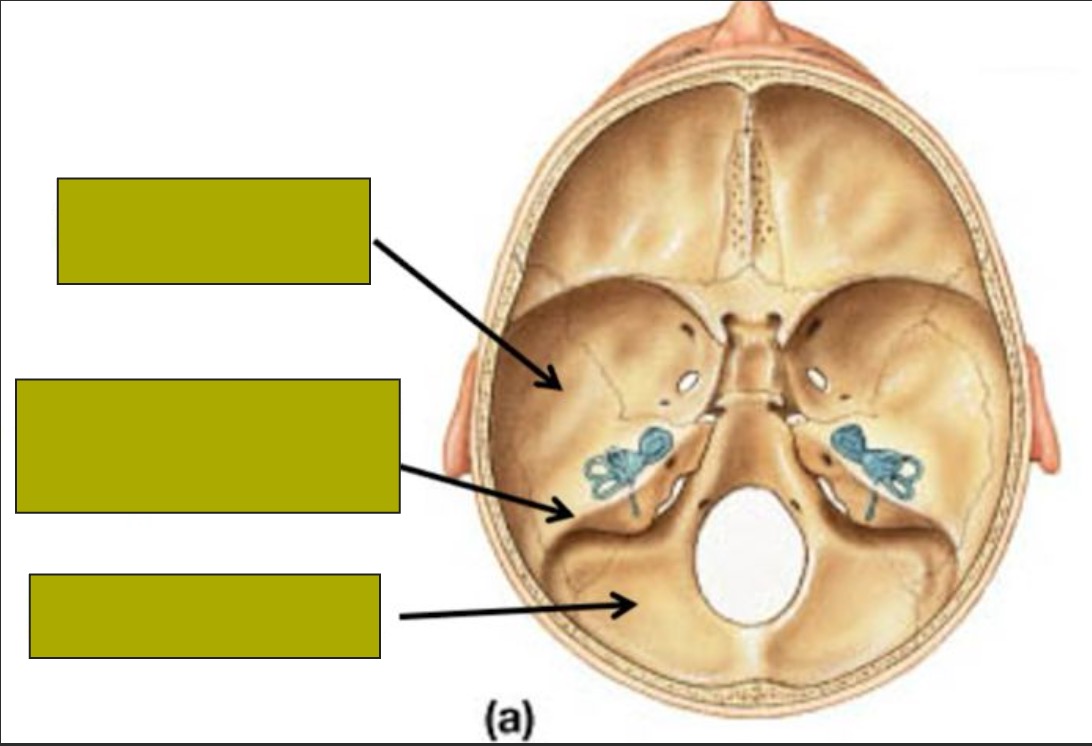
Top to bottom
Middle fossa
Petrous ridge of temporal bone
Posterior fossa
Vestibular system is made of what kind of labyrinths?
the vestibular system is made up of the bony labyrinth and the membranous labyrinth
What is bony labyrinth carved out of
petrous ridge of temporal bone
Bony lab is filled with ____ which surrounds the _____ ____ which is filled with ____
Bony labyrinth is filled with perilymph fluid which surrounds the membranous labyrinth which is filled with endolymph fluid
What is membranous lab made up of?
Semi circular canals
Utricle and saccule (2 large swellings)
It’s floating in perilymph fluid
Location of utricle vs saccule
The saccule is adjacent to the cochlea
Utricle is what all the semi canals are coming out of (like bagpipe)
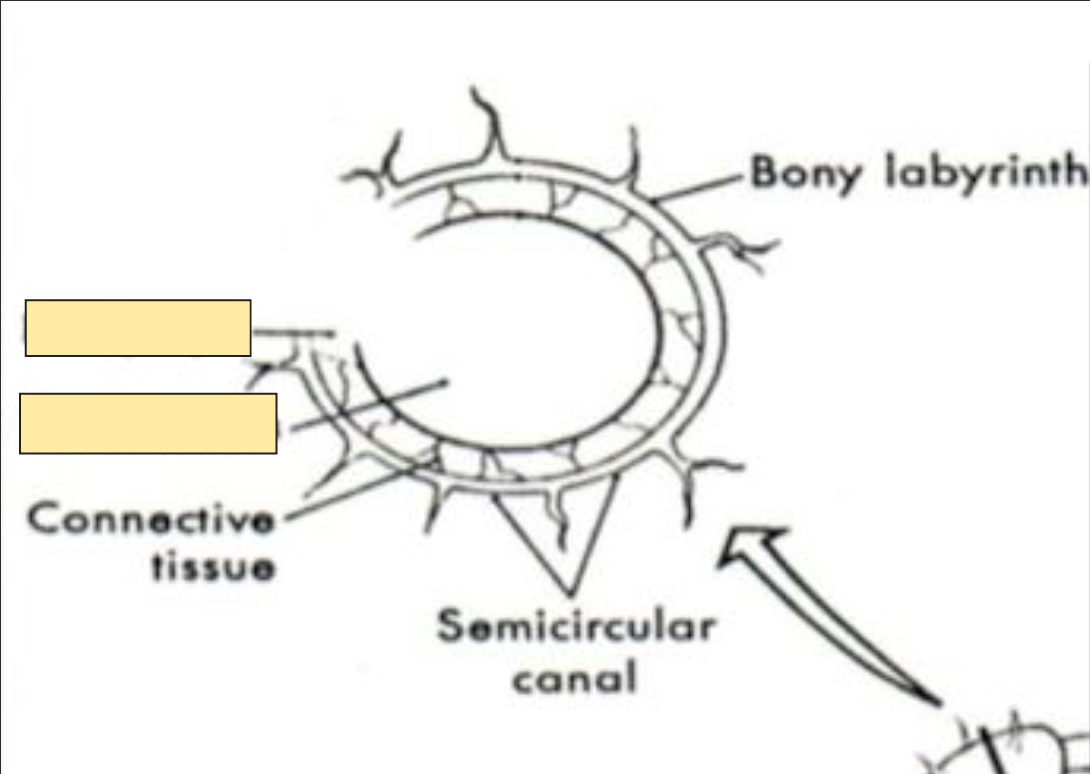
top to bottom
perilymph fluid
endolymph fluid
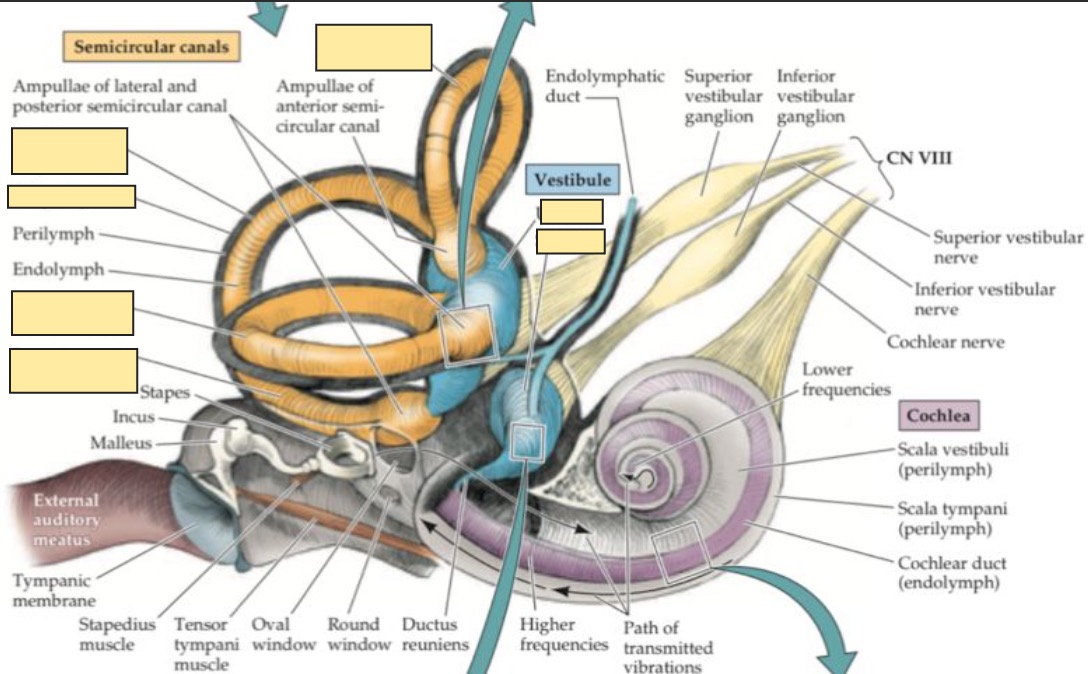
Left to right clockwise
Posterior semi canal
Horizontal semi canal
Bony labyrinth
Membranous labyrinth
Anterior semi canal
Utricle
saccule
the 3 semi-circular canals and their orientation
Anterior (goes about 45 degrees out and forward)
Posterior (goes about 45 degrees out and to back)
Horizontal / Lateral (roughly parallel to horizon)
all orthagonal to each other (all 90 degrees apart)
specify which semi-circular canals are parallel to each other on left and right side
left horizontal and right horizontal
left anterior and right posterior
left posterior and right anterior
What is the ampulla?
One side of each semi canal bulges to form the ampulla adjacent to the utricle
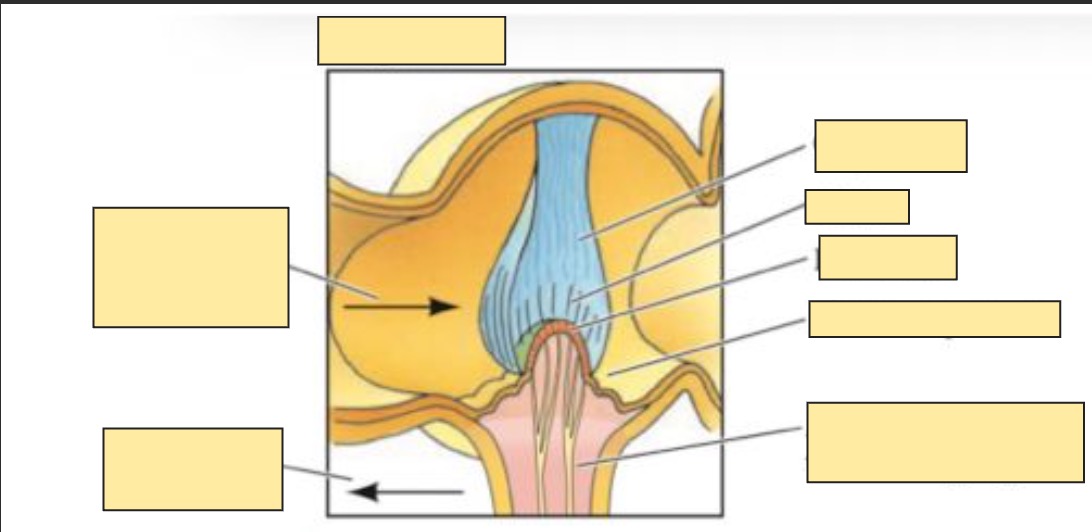
Left to right clockwise
Endolymph flow
Ampula
Cupula
Cilia
Hair cells
Crista ampullaris
Axons to vestibular ganglion
crista ampularis
ridge of epithelial cells that form the floor of the ampulla
hair cells are embedded in the ___and have ___projecting out from them to
crista ampullaris; cilia; embed in the cupula
What is cupula
Gelantinous mass that is attached to the crista ampularis and goes up to the roof of the ampulla
What happens when endolymph flows thru ampula?
Cupula deflects and moves, moving the cilia encased with it
hair cells within the cupula are activated as a _____
population
The two types of cilia that make up the hair cells
Kinocilum: thick and stiff, one per receptor
Stereocilia: flexible, moves as population, organized in descending order as they move away from kino
Stereocilia moving towards kinocilium leads to? away from kinocilium? (3 each)
depolarization, excitation and increased firing rate
hyperpolarization, inhibition, and decreased firing rate
Where do axons from hair cells go?
Axons from hair cells project down to cell bodies in the vestibular ganglion

