Personality and individual differences
 Studied by 1 person
 Call with Kai
 Learn
Learn Practice Test
 Spaced Repetition
 Match
Match Flashcards
 Knowt Play
1/23

There's no tags or description
Looks like no tags are added yet.
Name | Mastery | Learn | Test | Matching | Spaced | Call with Kai |
|---|
No analytics yet
Send a link to your students to track their progress
24 Terms
The dark triad
The term the “Dark triad” emerged ~ 20 years ago when personality psychologists, Paulhus & Williams wanted to explore personality traits that are maladaptive, but still within the normal range of functioning (ie. sub-clinical)
Referes to a constellation of three socially undesirable personality traits
Narcissism
Machiavellianism
Psychopathy
Although 2 of these traits are established clinical disorders, there is support for a subclinical definition since these traits can also be found in normal populations
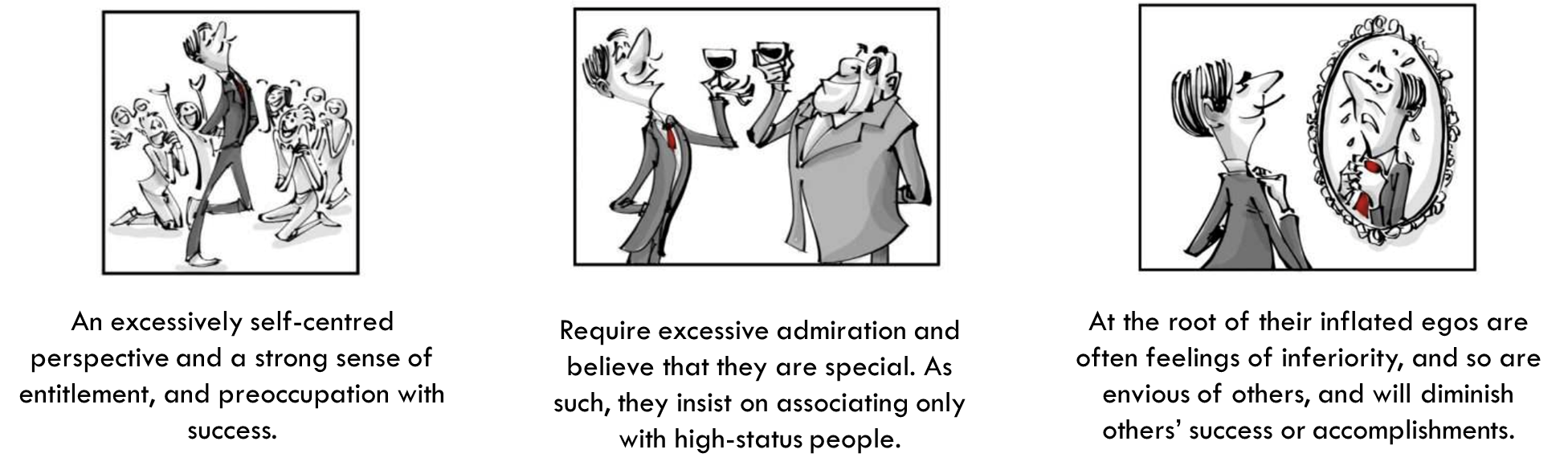
The Narcissistic Personality
A grandiose, yet fragile sense of self, as well as a preoccupation with success and demands for admiration
Machiavelli
The term Machiavellian is derived from the name of Niccolo Machiavelli an Italian diplomat, philosopher, and writer who lived during the renaissance
He wrote the book, The Prince which discusses the strategies and tactics that rulers and leaders should employ to maintain power and achieve their political goals
He famously argued that it is sometimes necessary for leaders to be ruthless, cunning, and willing to use any means, even morally questionable ones, to achieve and maintain political authority
“Never attempt to win by force what can be won by deception”
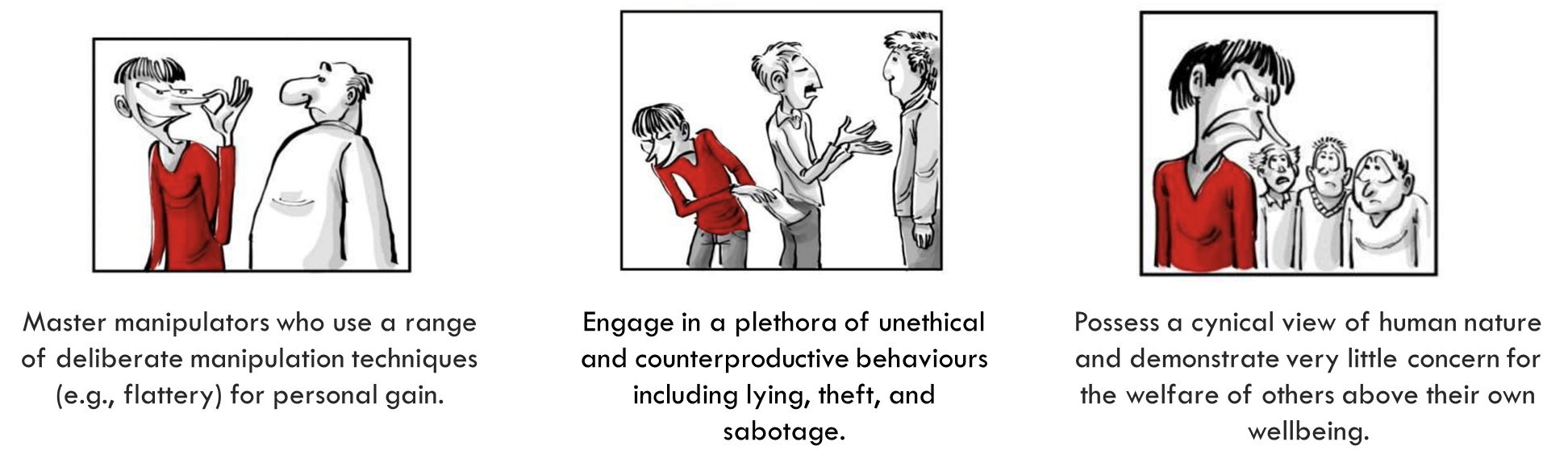
The machiavellian personality
Defined as a personality trait that refers to a strategy of social conduct that involves manipulating others for personaly gain, often against the others self-interest
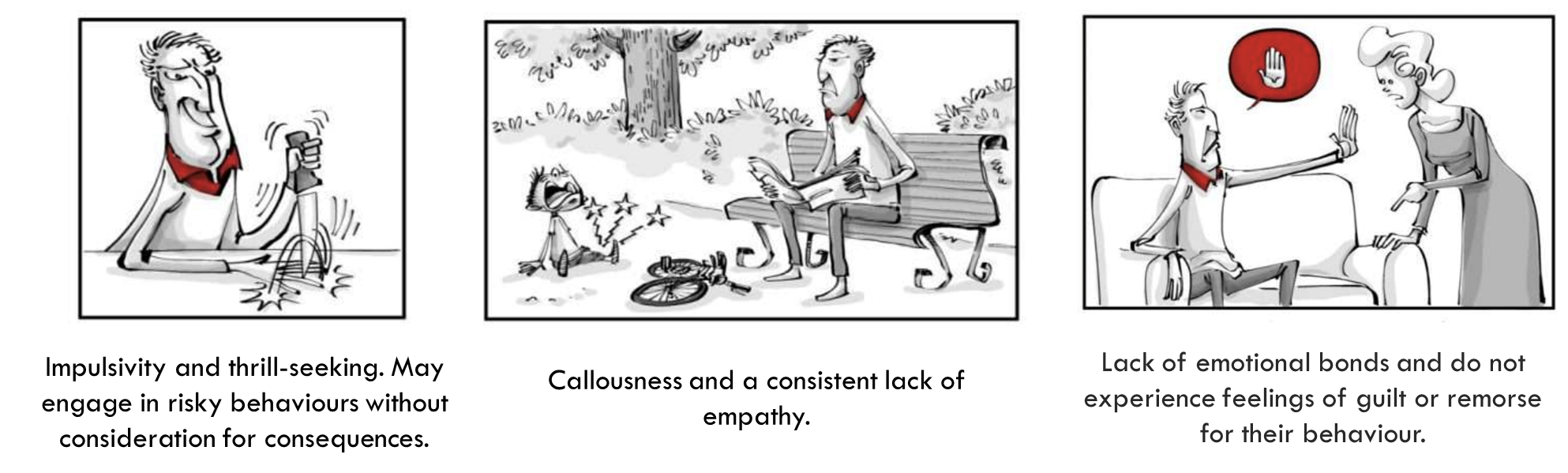
Psychopathy
Defined as a drive to engage in impulsive or antisocial behaviour without empathy, anxiety, or remorse
If we asked them who has the darkest personality
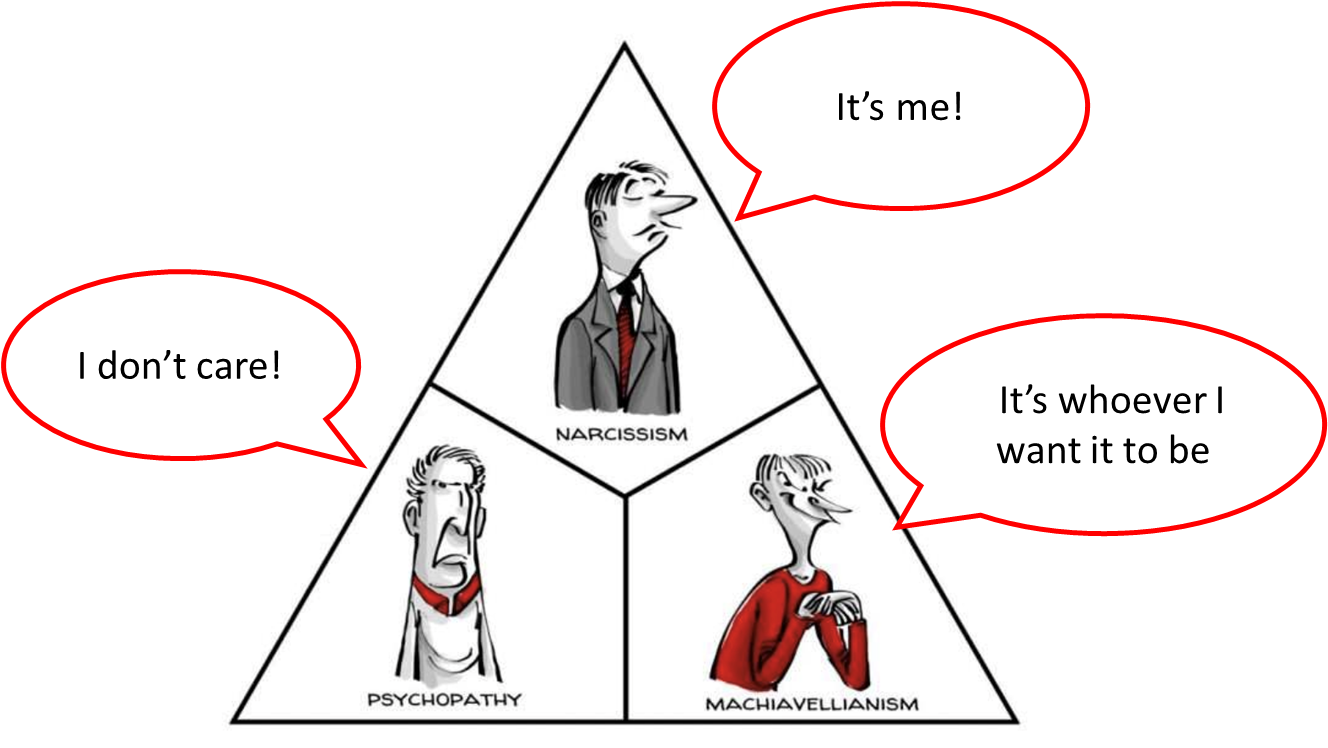
Measuring the dark triad traits
Two questionnaires commonly used to measure all three of the dark triad traits within the general population are
The Dirty Dozen (12 items)
The Short Dark Triad (27 items)
Criticisms of Dark triad measures
Social desirability bias for self report measures, but particularly for socially “dark traits”
People high in these traits are more likely to lie, manipulate, or fake good, so asking them to rate themselves may not be reliable
Some items are very blatant (“I tend to manipulate others to get my way)
Short measures lose nuance in each construct
Short scales (like the dirty dozen) are convenient, but they do not capture the complexity of each trait
Some argue they may measure the dark vibe rather than the specific traits well
Cultural assumptions
Many scales were developed on western samples
Items may not capture how manipulation or nacissism is expressed in other cultures
Demographics and the dark triad - Gender
Muris et al
Meta analysis to explore gender differences in the 3 dark triad traits
50 studies, comprising of 65 samples, 25,930 ppts
Dummy coded gender (0 = female, 1 = male) and computed effect sizes (r) for the relationship between gender and each dark triad trait
Positive r = higher in men
Results
Psychopathy (r+ = .29)
Narcissism (r+ = .15)
Machiavellianism (r+ = .16)
Conclusion
Men in general display higher levels of dark trias traits relative to women
Stronger effects found for psychopathy (medium sized effect) than Narcissim and Machiavellianism (Small sized effects)
Demographics and the dark triad - Age
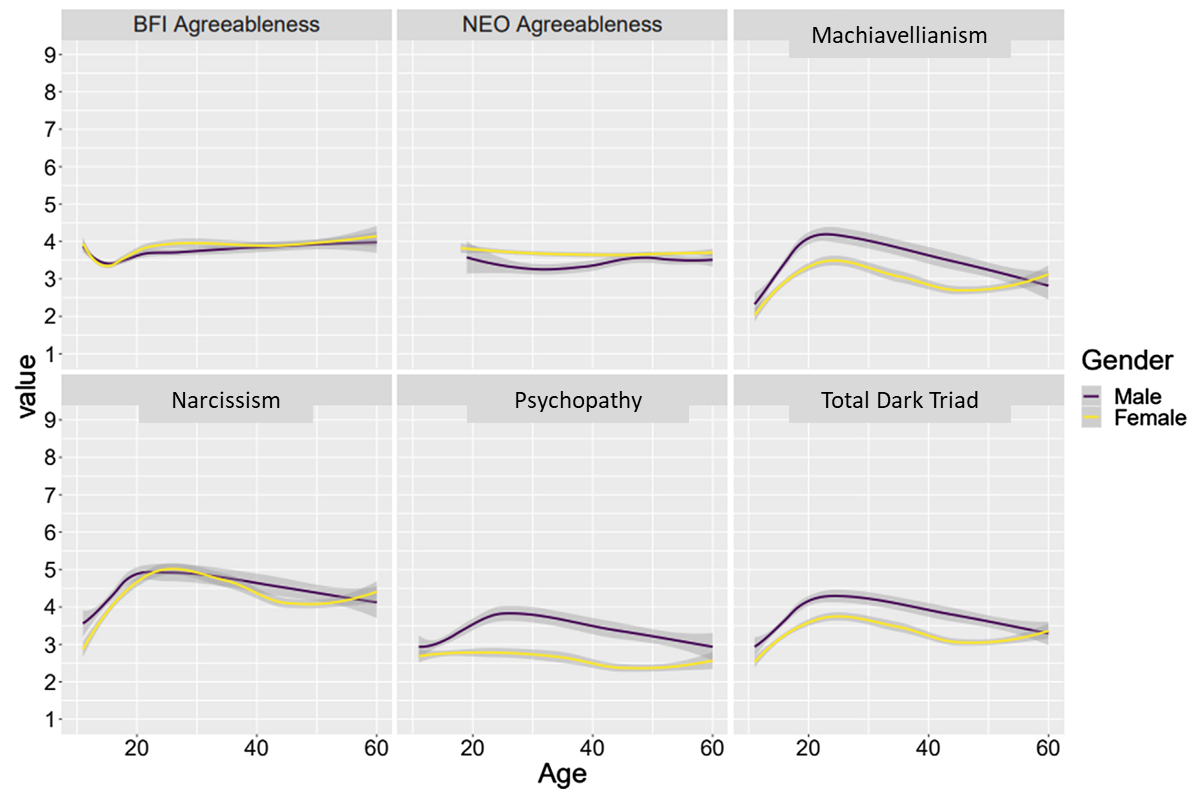
Klimstra et al
Combined multiple cross sectional data sets
N = 4,292 of various ages completed the dirty dozen scale (and measures of agreeableness)
Findings
Machiavellianism, Narcissism and Psychopathy show a rise during adolesence
After early 20, these traits seem to descrease
Suggesting ageing is associated with lower levels of these dark tendencies
Suggests evidence for the maturity principle - as people age, traits that are socially useful and acceptable tend to go up, on average
Do psychology students have the darkest personalities?
The big five and the dark triat were measured in a sample of newly enrolled students (N = 487) from different academic majors
Psychology
Enconomics / business
Law
Political science
Mean scores on the dark triad traots were compared across academic courses
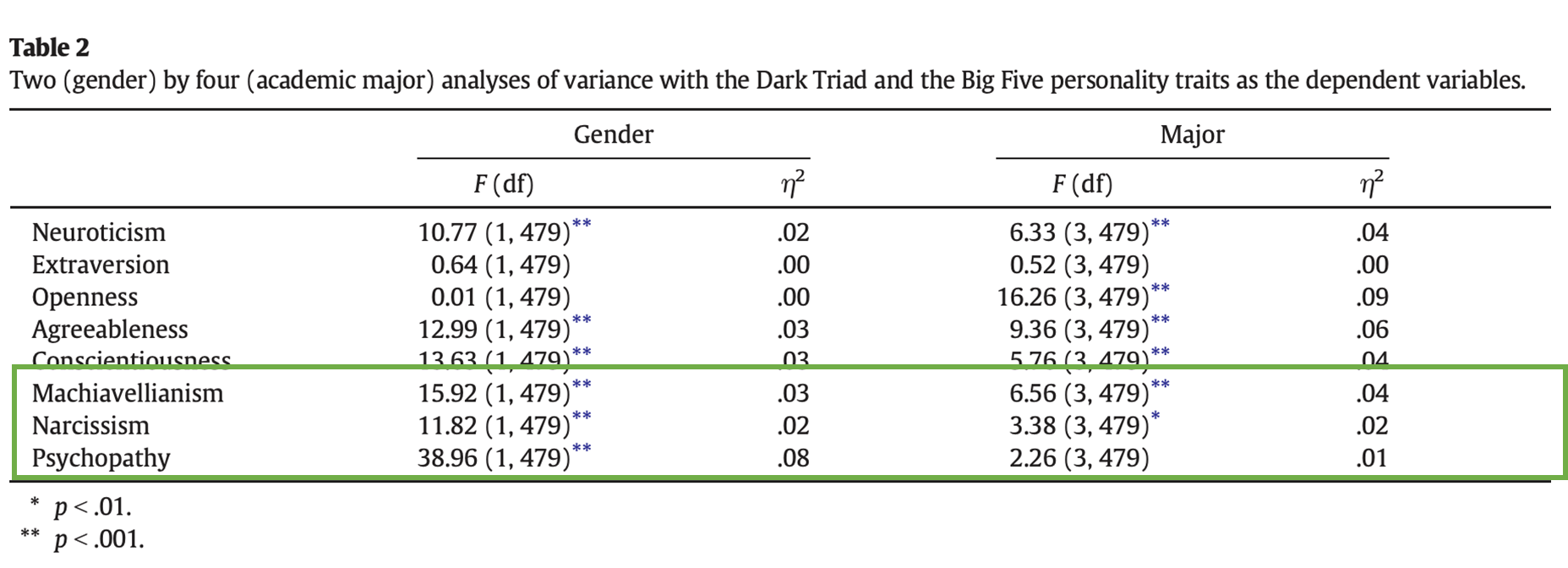
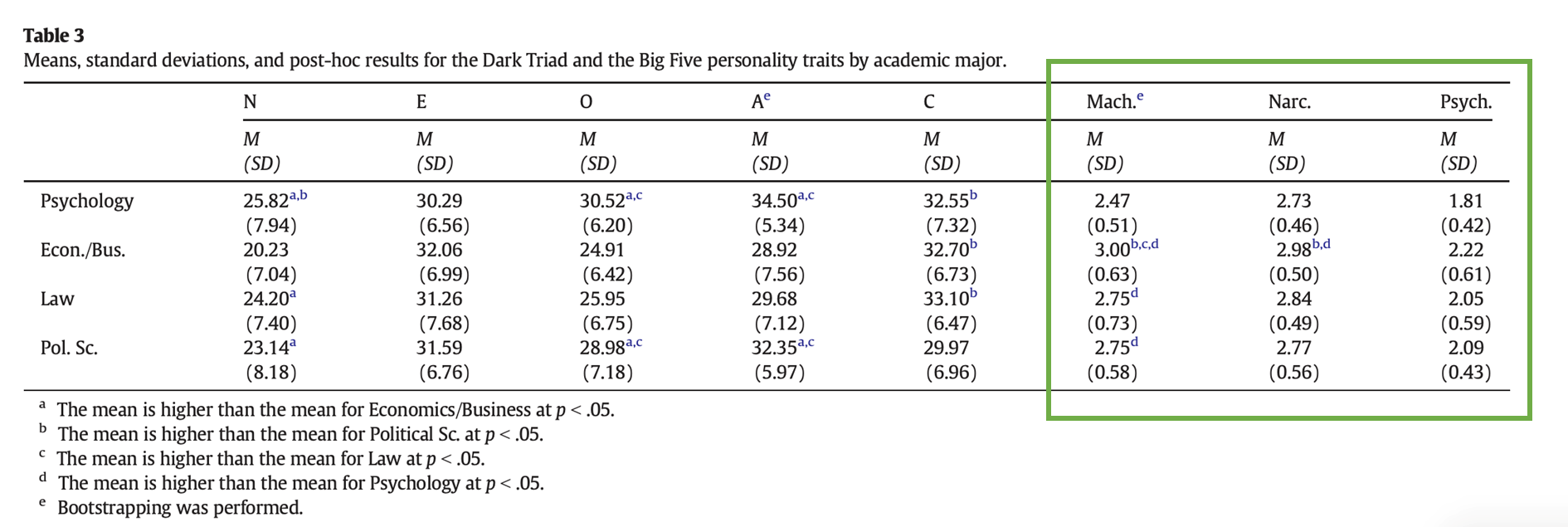
There was no difference in scores on psycopathy according to course
Psychology students scored lower on machiavellianism than students on all other courses
Psychology students scored lower on Narcissism than students studying economics and business
Is narcissism increasing
Twenge et al
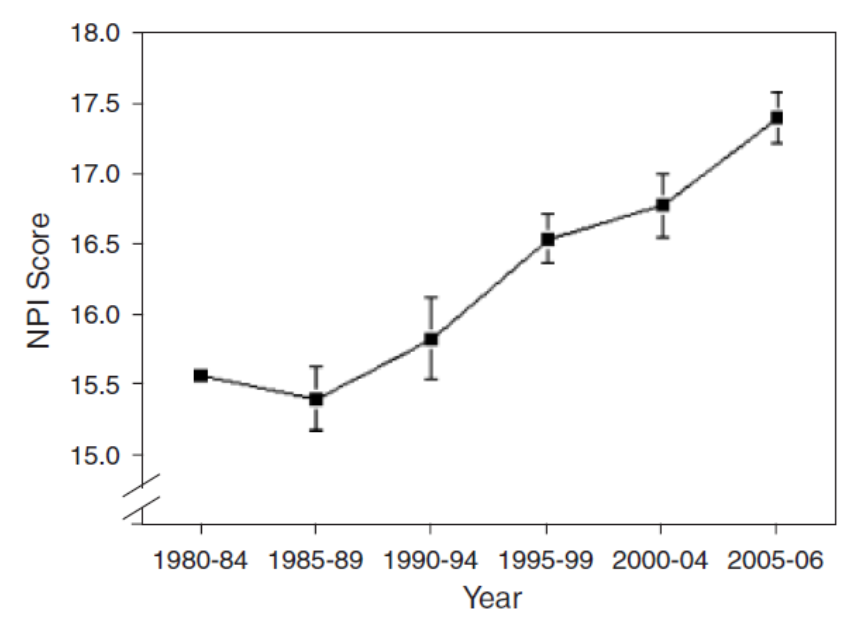
Examined how narcissism scores have changed over time in college students
85 samples (n = 16,475) from 1979 to 2006 Found that since 1982, narcissism scores have increased significantly
NPI scores were 30% higher in the most recent cohort compared to the first cohort
Increase was found particularly amoung women
Why might we be seeing a rise in Narcissism? - social media usage
Research has found a relationship between social media use and narcissism in young adults
Reed et al
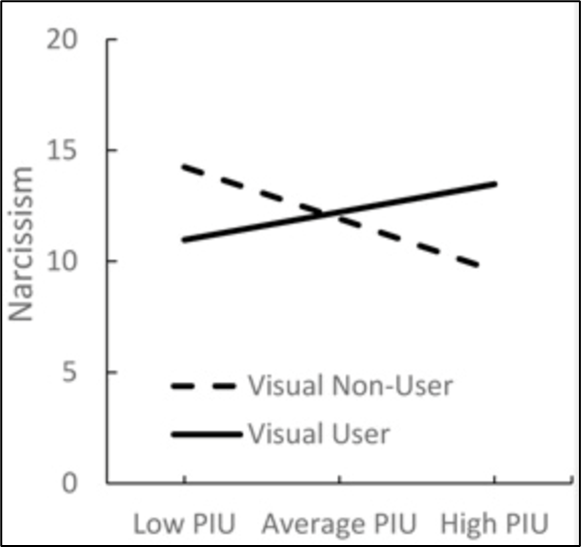
Tracked 74 ppts aged 18-34 over 4 months
Higher amounts of (visual) social media use was associatedn with higher levels of narcissism
Specifically ppts who posted large quantities of phots and selfies showed a 25% increase in narcissism
However, this relationship was only found for visual forms of social media as opposed to non-visual forms (eg. twitter)
Why might we be seeing a rise in Narcissism? - parenting style
Other research blames a rise in narcissism on changes in parenting style
Brummelman et al
Monitored 565 children aged 7 - 12 and their parents over a 2 year period
Measured 4 variables
Child self esteem
Child narcissism
Parental warmth
Parental overvaluation (Parents believing their child to be more special and more entitled than others)
Parental overvaluation predicted child narcissism, but not child self-esteem
Parental warmth predicted self esteem but not narcissism
Criticisms of the dark triad
There is a debate about whether the dark triad traits are independent traits or represent a single construct
Unification hypothesis
Traits show strong, positive intercorrelations and have been found to load onto the same factor in factor analsysis
Uniqueness hypothesis
The three traits have different patterns of associations with other traits and outcome variables
Three traits are not enough to capture the dark side of human nature
Recently it has been proposed that the trait subclincial sadism defined as proneness to feel pleasent emotions while hurting others or watching others in pain should be included to form a dark tetrad
The light triad
Qualities that embody a loving and beneficient orientation toward others (everyday saints)
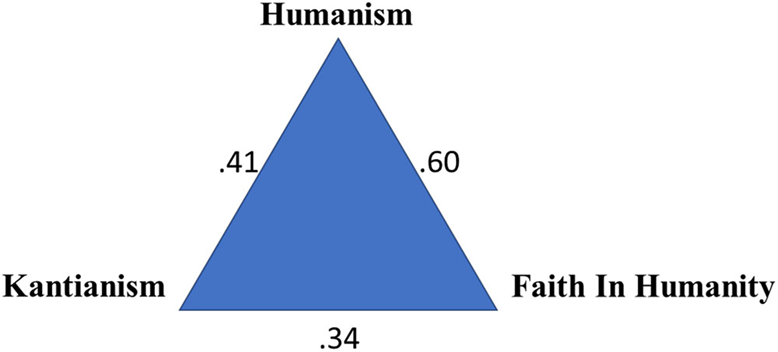
Comprised of 3 traits
Kantianism = treating people as ends unto themselves (not mere means) - treat people like they matter as humans, not just as tools to get what you want → authentic, prefers honesty over charm, truly interested in others
Humanism = valuing dignity and worth of each individual - every person has value and deserves respect → admire others, applauds the success of others, values all people and cultures
Faith in humanity = believing in the fundamental goodness of humans - believing that most people are basically good → trusts people, quick to forgive, looks for the best in others
The light triad scale
12 items
The scale was developed by brainstorming items relating to the conceptual opposite fo each of the dark trias traits but also items related to forgiveness, trust, honesty, caring and acceptance
Three factors also emerged from the factor analsysis
Issues with the light triad scale
Would you agree with most of these statements?
Issues with social desirability bias?
As a relatively new scale, there is not much evidence to support cross cultural validity
Tests have primarily been on western cultures
The nomological netowerk of the dark triad and light triad
The network of traits, qualities and outcomes that you would expect to be associated with a trait to demonstrate that it is a valid construct
It helps to establish that a measure has construct validity (ie, the extent to which the measure behaves in way consistent with out hypotheses and represents how well scores on the instrument are indicative of the construct)
To assess the nomological network you can
Correlate the measure with measures that you expect to be highly correlated (convergent validity)
Correlate the measure with measures that you expect would not be correlated (discrminate validity)
Explore whether the traits correlate or predict outcomes in line with expected hypotheses (predictive validity)
The nomological network of the dark triad and light triad - Kaufman et al
Design
Cross sectional, online survey
Ppts
1,518 adults
Variables measured
Light triad
Dark triad
Big five personality
Measures of well being
Measures of moral and social behaviour
Aim
Explore the nomological networks of light vs dark triad traits
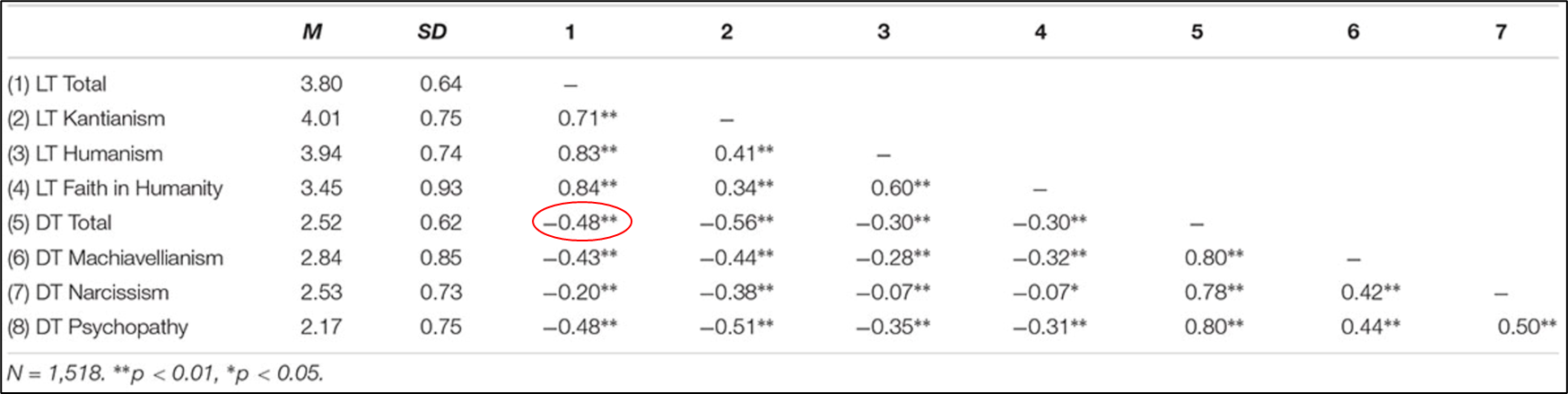
Correlations between the dark and light triat
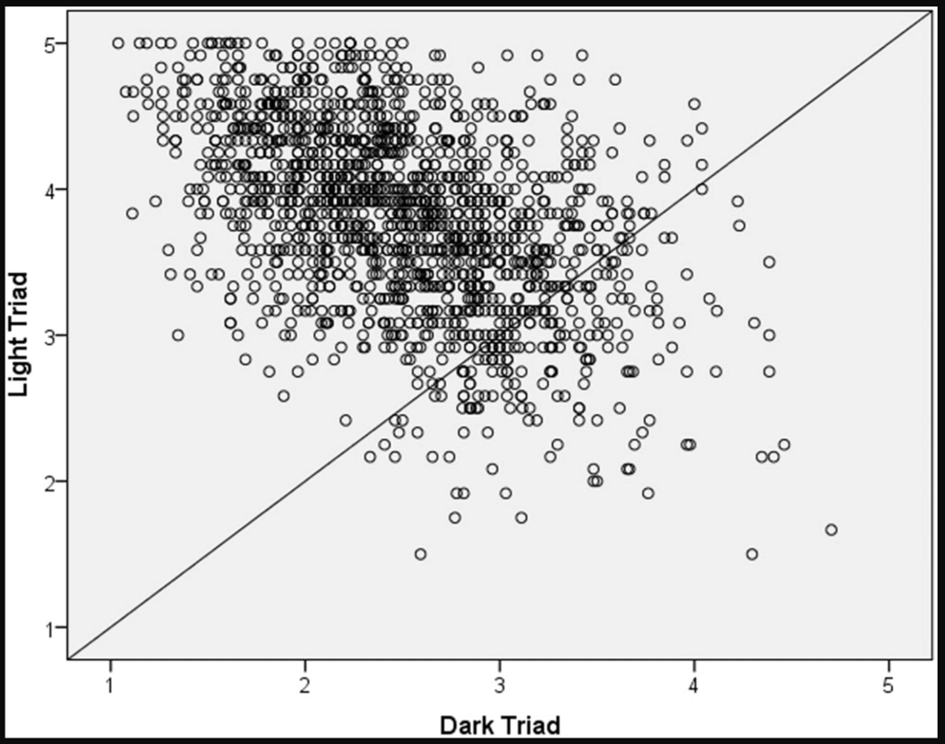
People are more good than bad
Calculated a light vs dark triad balance score by substracting each person’s score on the dark triad from their score on the light triad
The mean balance score of the entire sample (1518) was 1.3 suggesting that the average person is tipped more towards the light triad
Thankfully, extreme dark traits are rarer than extreme light traits
Correlations with the big five
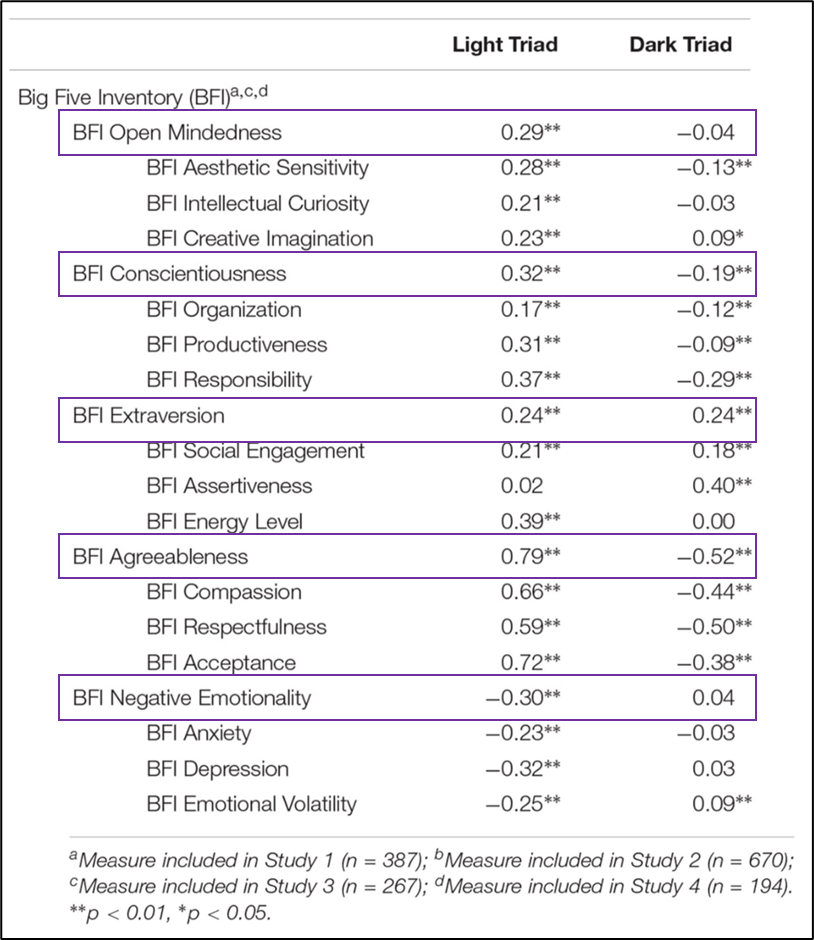
Correlations with other measures
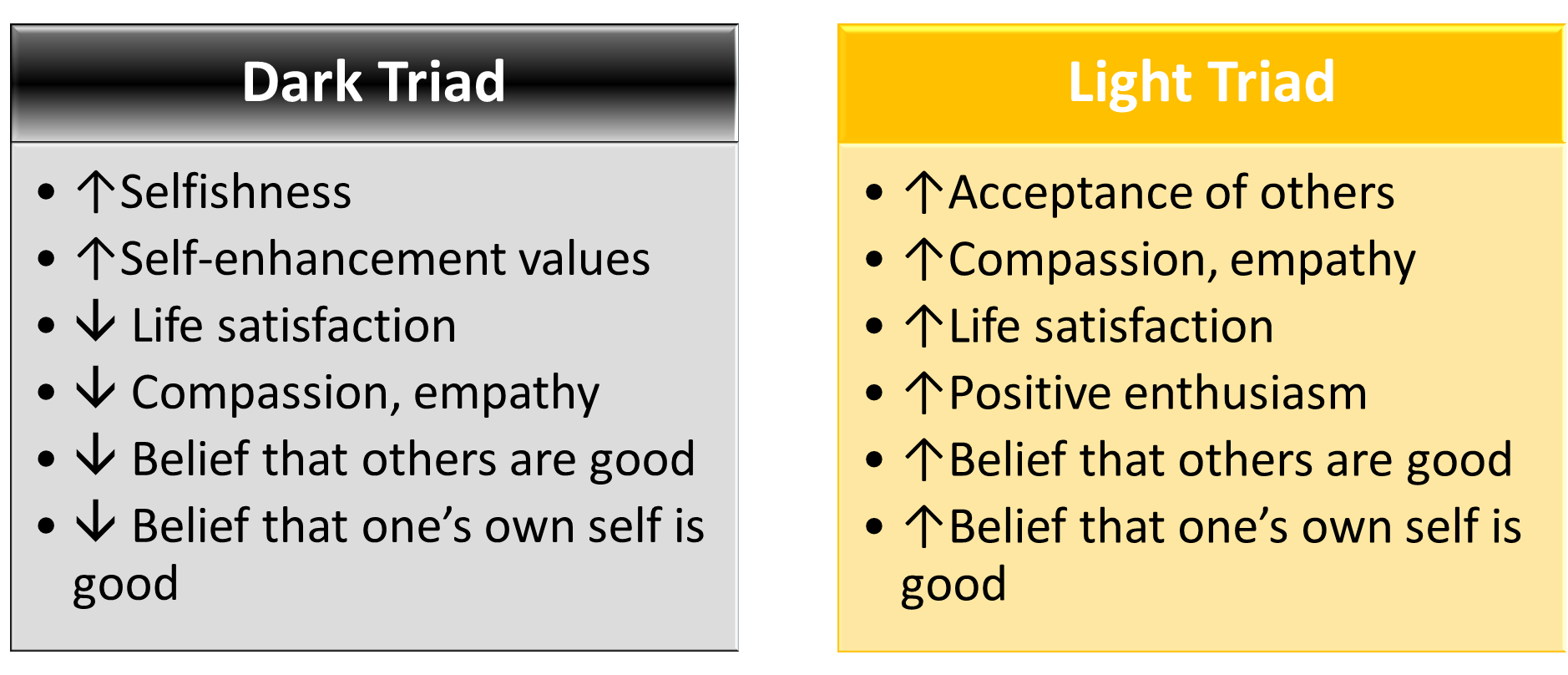
 Note
Note  Flashcards (22)