Individual difference in interpersonal relationships: From attraction to dissolution
 Call Kai
 Learn
Learn Practice Test
 Spaced Repetition
 Match
Match Flashcards
 Knowt Play
1/15

There's no tags or description
Looks like no tags are added yet.
Name | Mastery | Learn | Test | Matching | Spaced | Call with Kai |
|---|
No analytics yet
Send a link to your students to track their progress
16 Terms
What is Attraction?
Is influenced by many factors
Krueger and Caspi (1993) identified four key hypotheses:
similarity hypothesis
ideal partner hypothesis
repulsion hypothesis
optimal dissimilarity hypothesis
What is the similarity hypothesis?
People are attached to those with similar personalities and attitudes.
Similarity enhances mutual understanding and validation.
Byrne (1971): Reciprocal liking strengthens attraction.
Rushton (1989(: Genetic similarity may play a role.
What is ideal partner hypothesis?
people seek partners who possess ideal traits (e.g., sociability, intelligence).
attraction is higher when individuals match personal ideals.
Buss and Barnes (1986): Ideal traits influence partner choice.
Kenrick and Keefe (1992): gender differences in ideal preferences.
What is Repulsion hypothesis?
Dissimilarity leads to active avoidance.
Rosenbaum (1986): Dissimilar individuals are elminated first.
Emphasises rejection of dissimilarity over selection of similarity
What is fatal attraction?
Concept (Felmlee, 1995):
traits initially attractive may later cause relationship dissatisfaction.
Common Fatal Attractions:
nice to passive: over-nicesness leads to frustration.
strong to stubborn: independence becomes inflexibility
Funny to Flaky: Humour turns into perceived immaturity.
Summary of attraction…
Interpersonal attraction is multi-faceted, influenced by similarity, ideals, and aversion to dissimilarity.
Fatal attraction underscores evolving perceptions in relationships.
What is understanding love styles: insights from Sternberg and Lee?
Psychologists view love as multidimensional, shaped by personal and cultural experiences.
Two influential theories: Sternberg’s Triangular Theory and Lee’s Colours of Love.
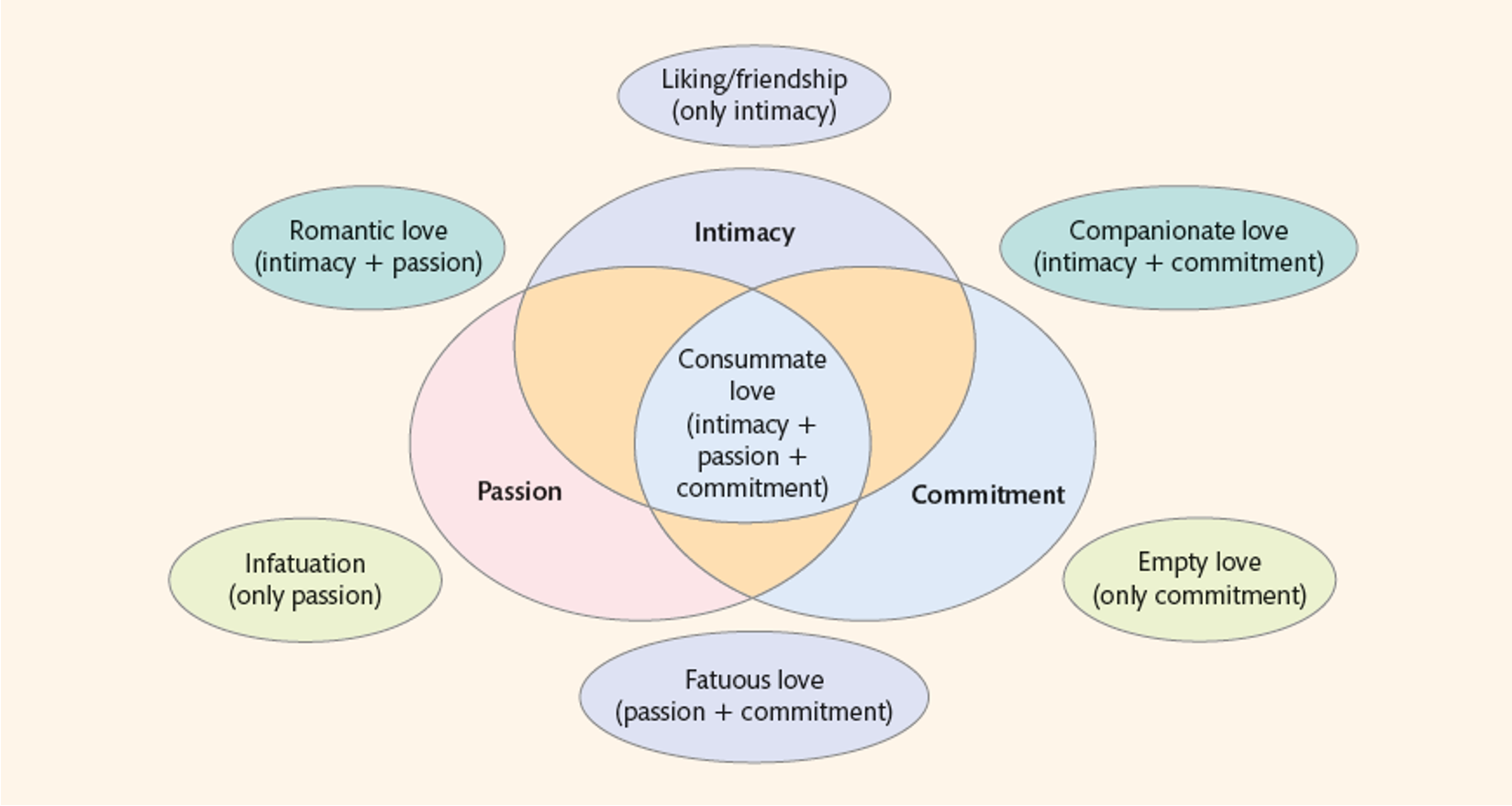
What is Sternberg’s Triangular theory of love
•Intimacy: Emotional closeness and connection.
•Passion: Romance and physical attraction.
•Commitment: Cognitive decision to maintain the relationship.
•These elements combine to form seven love styles.
What is Lee’s Love styles?
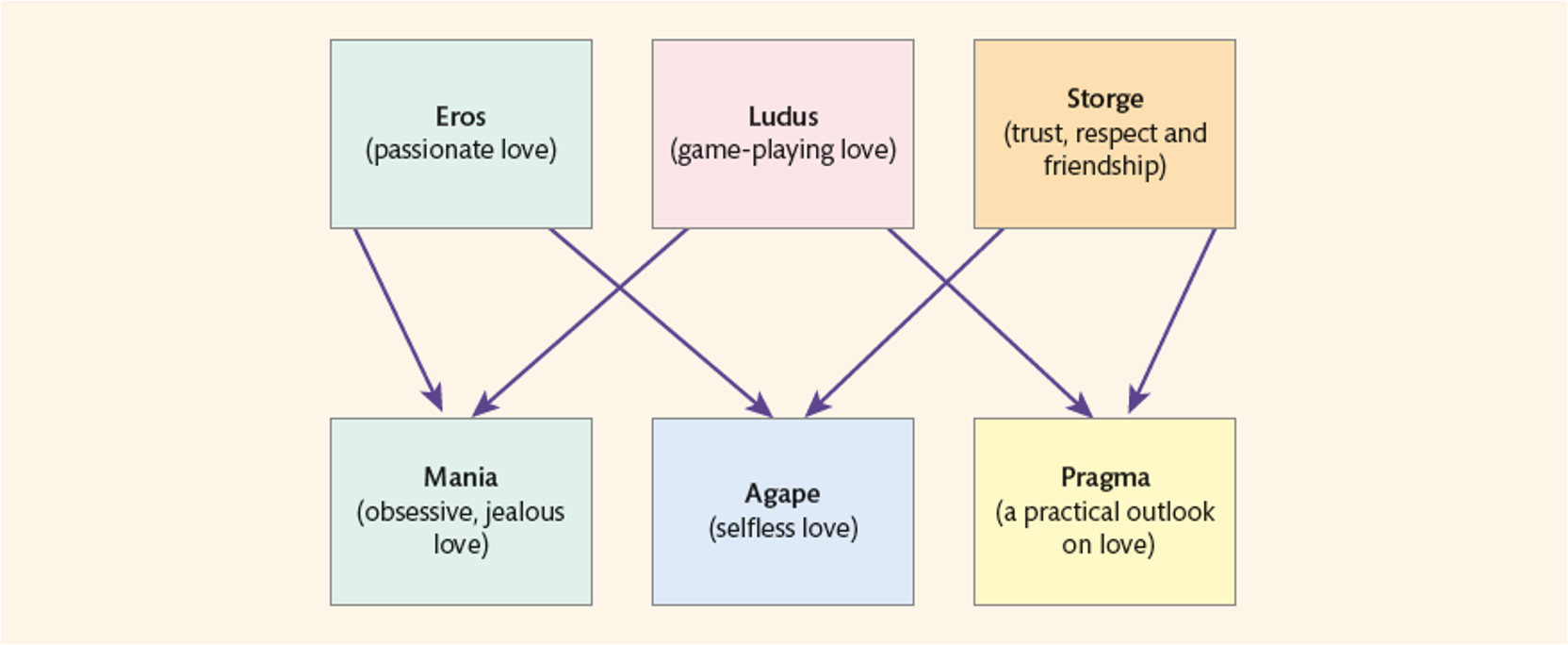
Love styles compared to primary and secondary colours.
Primary Love Styles:
Eros: Passionate, physical attraction, "love at first sight."
Ludus: Game-playing, non-committal relationships.
Storge: Friendship-based love, built on trust and respect.
What are secondary love styles?
Formed by mixing primary love styles:
Pragma (Storge + Ludus): Practical, logical love.
"Shopping list" approach to partners.
Mania (Eros + Ludus): Obsessive, jealous love.
Desperate for affection, lacks self-confidence.
Agape (Eros + Storge): Altruistic, selfless love.
Loving without expecting anything in return.
What are the primary love style?
Eros
My partner and I were attracted to each other immediately after we first met.
I feel that my partner and I were meant for each other.
Ludus
I try to keep my partner a little uncertain about my commitment to him/her.
I have sometimes had to keep my partner from finding out about other partners.
Storge
I expect to always be friends with my partner.
Our love is the best kind because it grew out of a long friendship.
What are the secondary love style?
Pragma
I tried to plan my life carefully before choosing a partner.
In choosing my partner, I believed it was best to love someone with a similar background.
Mania
Sometimes I get so excited about being in love with my partner that I can’t sleep.
When my partner doesn’t pay attention to me, I feel sick all over.
Agape
I would rather suffer myself than let my partner suffer.
I am usually willing to sacrifice my own wishes to let my partner achieve his/hers.
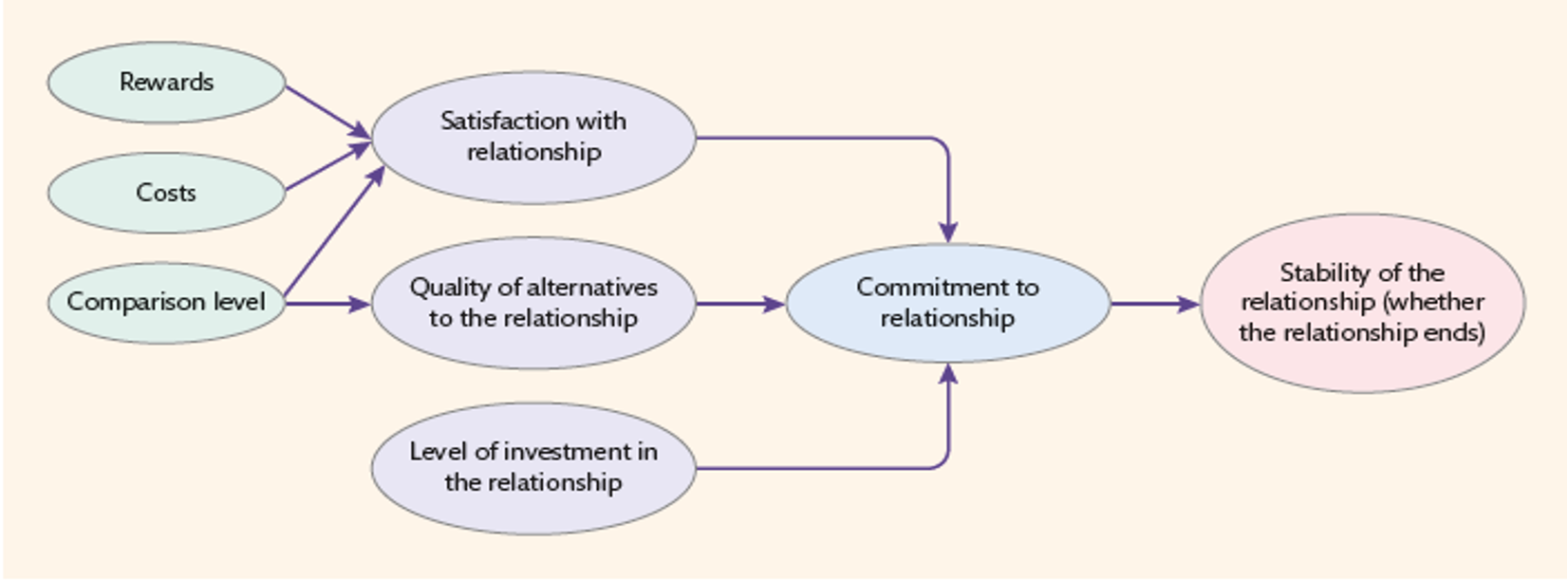
What is the Investment model of relationship (Rusbult)?
What is the Rusbult’s EVLN Model?
Core Idea: Relationships end through a range of active or passive and constructive or destructive strategies.
Strategies:
Exit: Active, destructive (e.g., ending the relationship, moving out, threatening divorce).
Voice: Active, constructive (e.g., discussing problems, seeking solutions, therapy).
Loyalty: Passive, constructive (e.g., waiting or hoping for improvement).
Neglect: Passive, destructive (e.g., ignoring problems, spending less time together).
Theoretical Basis: Responses are shaped by satisfaction levels, investment in the relationship, and the quality of alternatives.
•Connection to the Investment Model: Higher satisfaction and investment promote constructive strategies (voice, loyalty), while high-quality alternatives may drive active responses (exit, voice).
What is Baxter’s Expectations and Strategies for relationship Dissolution?
Core Idea: Dissolution occurs when unmet expectations persist over time.
Key Expectations: Autonomy, similarity, emotional support, loyalty, honesty, time together, equity, and maintaining "spark."
Direct Strategies:
Open discussions (e.g., "Do you think our relationship is working?").
Clear declarations (e.g., mutual agreement to end).
Indirect Strategies:
Avoidance behaviours (e.g., pseudo-de-escalation, withdrawal).
Passive-aggressive or cost-escalation tactics.
Gradual distancing ("fading away").
Active vs. Passive Nature: Echoes Rusbult’s active (direct) vs. passive (indirect) framing.
What is the Duck’s Phase model of relationship dissolution?
Core Idea: Break-ups occur in stages, triggered by psychological thresholds.
Four Phases:
Intrapsychic Phase: Internal dissatisfaction; focus on partner's flaws. Threshold: "I can’t stand this any more."
Dyadic Phase: Open confrontation and discussion of issues. Threshold: "I’d be justified in withdrawing."
Social Phase: Public acknowledgment of the break-up; seeking social support. Threshold: "I mean it."
Grave-Dressing Phase: Post-relationship narrative creation; preparing for future relationships. Threshold: "It’s now inevitable."
Unique Contribution: Describes the entire process, not just initiation, and suggests interventions for repair at different stages.

