258 chp 1
 Studied by 0 people
 View linked note
 Call Kai
 Learn
Learn Practice Test
 Spaced Repetition
 Match
Match Flashcards
 Knowt Play
1/38

There's no tags or description
Looks like no tags are added yet.
Name | Mastery | Learn | Test | Matching | Spaced | Call with Kai |
|---|
No analytics yet
Send a link to your students to track their progress
39 Terms
Mind
The mind can be understood in various ways, such as memory, problem-solving, decision-making, and normal functioning.
Cognitive Psychology
The study of mental processes like perception, attention, memory, emotions, language, deciding, thinking, and reasoning.
Representations
The mind creates representations of the world to help achieve goals and function effectively.
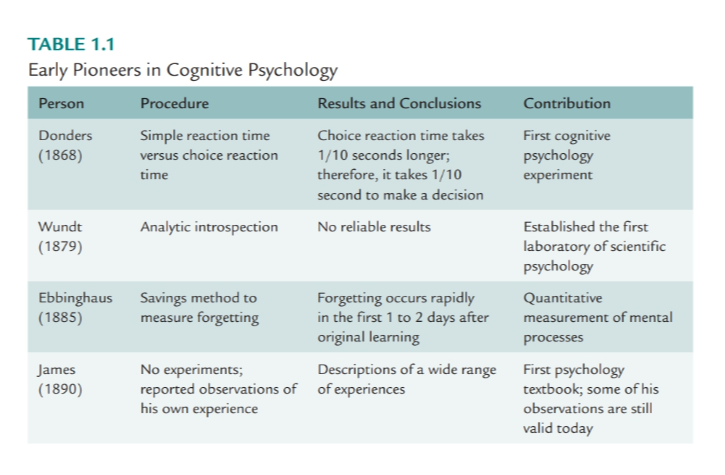
Donders's Experiment
An experiment by Franciscus Donders to measure reaction time and decision-making processes in the mind.
Structuralism
Wilhelm Wundt's approach in psychology that aimed to break down experiences into basic sensations through analytic introspection.
Savings Score
Hermann Ebbinghaus's measure of memory retention by calculating the time saved in relearning information after a delay.
Cognitive Topics
James considered various cognitive topics such as thinking, consciousness, attention, memory, perception, imagination, and reasoning.
Ebbinghaus's Savings Curve
Ebbinghaus plotted percent savings against time between learning and testing to show rapid forgetting in the first 2 days followed by slower forgetting.
Behaviorism
Watson's approach to psychology that focused on observable behavior rather than introspection and mental processes.
Operant Conditioning
Skinner's concept focusing on how behavior is strengthened by positive reinforcement or the removal of negative reinforcement.
Cognitive Maps
Tolman's idea of mental representations of spatial layouts, challenging behaviorism's focus on stimulus-response connections.
Cognitive Revolution
The shift in psychology from behaviorism to studying the operation of the mind, marked by a focus on understanding complex cognitive behaviors.
Scientific Revolution
Kuhn defined it as a shift from one dominant system of ideas (paradigm) to another, as seen in the transition from classical physics to modern physics in the early 20th century.
Behaviorism
A psychological approach that focuses on observable behaviors as the end result of learning.
Cognitive Approach
A paradigm shift in psychology that considers the role of the mind in creating behavior, emphasizing mental processes like memory and problem-solving.
Behavioral Therapies
Psychological treatments based on behaviorism principles, focusing on modifying behaviors through reinforcement and punishment.
Information Processing Approach
A method in psychology that studies mental operations as a sequence of stages, inspired by how computers process information.
Filter Model of Attention
Proposed by Broadbent, a model describing how the mind selectively processes information, filtering out irrelevant stimuli.
Artificial Intelligence
The concept of programming computers to mimic human-like intelligent behavior, as discussed in the 1956 Dartmouth conference.
Sensory Memory
The initial stage in the memory system that briefly holds incoming sensory information before passing it to short-term memory.
Short-term Memory
The memory system with limited capacity that holds information for a short period, like remembering a phone number temporarily.
Long-term Memory
The memory system with high capacity that stores information for extended periods, such as personal experiences and facts.
Model of Memory
Atkinson and Shiffrin's (1968) three-stage model describing the flow of information through sensory, short-term, and long-term memory.
Long-term memory components
Endel Tulving proposed that long-term memory is subdivided into three components:episodic memory, semantic memory, and procedural memory.
Physiological techniques in cognitive research
Neuropsychology and electrophysiology were two dominant physiological techniques used in early cognitive research to understand brain functioning.
Brain imaging techniques
Positron emission tomography (PET) and functional magnetic resonance imaging (fMRI) are brain imaging techniques used to observe brain activity during cognitive tasks.
Paradigm shifts in cognitive psychology
The introduction of fMRI marked a significant shift in cognitive psychology, leading to a new way of thinking and conducting research.
Real-world cognition
Modern cognitive psychology emphasizes studying cognition in real-world environments to gain a comprehensive understanding of how the mind operates.
Importance of knowledge in cognition
Knowledge plays a central role in cognitive processing, influencing perception and memory processes.
Encoding and retrieval
Encoding refers to learning new material, while retrieval involves remembering previously learned information; both are crucial processes in memory.
Mini-stories in cognitive psychology
Information in cognitive psychology is often presented as mini-stories, where basic ideas are supported by examples or experiments to aid in understanding and retention.
Paradigm shift
A fundamental change in the basic concepts and experimental practices of a scientific discipline.
Reaction time
The time it takes to respond to a stimulus.
Savings
The amount of time saved when relearning information compared to learning it for the first time.
Savings curve
A graphical representation showing the amount of savings in relearning information over time.
Scientific revolution
A period of significant change in scientific thought and experimentation.
Simple reaction time
The time it takes to respond to a single stimulus.
Structuralism
An approach to psychology focusing on the structure of the mind and conscious experience.
early pioneers in cog psych