Lecture 3 + 4: Membrane Potential
 Studied by 0 people
 Call Kai
 Learn
Learn Practice Test
 Spaced Repetition
 Match
Match Flashcards
 Knowt Play
1/43

There's no tags or description
Looks like no tags are added yet.
Name | Mastery | Learn | Test | Matching | Spaced | Call with Kai |
|---|
No analytics yet
Send a link to your students to track their progress
44 Terms
Ions
Charged particles that are responsible for the electrical signals in neurons.
How is the Resting Membrane Potential created?
The distribution and flow of ions (voltage) across the neuronal membrane at rest (when an action potential isn’t firing)
How is the action potential created?
Changes in the flow of ions when one neuron wants to send a signal to another
Neuronal Cell Membrane
Lipid Bilayer
Outside: Hydrophilic Head - polar
Inside: Hydrophobic Tail
Ion Channels
specialized proteins that allow specific ions to pass through; act as pores that can be opened or closed in response to environmental signals; allows the cell to regulate what is passing across its memrane
Importance of ion channels
Ions need to get in and out of the cell because this is crucial for neuronal function and communication
Can ions go through any channel they want?
No. Different ion channels allow diff ions to pass thru; selective; a Na+ channel will only allow Na+ to pass through
Leak Gates*
always open
Gated Channels
channels that can be opened or closed by a stimulus
Ligand-gated channels
open when a chemical messenger (a ligand, such as a neurotransmitter) binds to them
Voltage-Gated Channels*
open and close in response to changes in the cell membrane's electrical potential (voltage) to control the flow of specific ions; in axon
Mechanically-gated
open / close in response to pressure
What ion has a high concentration inside the cell?
Potassium
What ion has a high concentration outside the cell?
Sodium
Sodium-potassium pump
uses ATP to pump ions against their concentration gradients; actively transports 3 sodiums out the cell and 2 potassiums in.
Why is the cell using ATP?
To create a large store of potential energy in the form of ion concentration gradients
What is membrane potential?
The voltage of the cell; the difference in electrical charge (voltage) between the inside and outside of a cell's membrane.
Voltage
the electrical potential of ions across the membrane
How is voltage expressed?
Inside of the neuron relative to the outside
What are the two requirements for establishing a membrane potential?
Ion concentration gradient across the membrane
Permeability: selective ion channels in the membrane that will allow the ions to flow across
Resting Membrane potential
~-65mV
potassium ions are constantly trickling out through leak channels due to high intracellular concentration and they’re always open
Potassium Leak Channels
always open; allow K+ to flow across membranes out of cell
At rest the cell membrane is impermeable to most ions EXCEPT potassium leak channels
What causes large changes in membrane potential?
SMALL changes in ion concentration and what actual ion is moving
Equilibrium Potential
voltage that ONE ion wants to bring the cell to if a channel was always open to it
the theoretical voltage of the cell that would result from that ONE ion moving freely across the membrane and achieving equilibrium
takes only ONE ion into account
What does membrane potential depend on?
ALL ions and their equilibrium potentials
Permeability
What are the two basis’ of the equilibrium potential?
Concentration and charge
Why do charges matter for membrane potentials?
Eventually as an ion is leaving/entering a cell, the ionic charge will be attracted to the opposite charge - electrical force
ex: K+ will eventually attract to the inner cell even as it’s exiting because it’s positive and the cell interior is becoming more negative
What is the equilibrium potentinal for an ion?
The voltage where the chemical and electrical gradients are equal and opposite in direction
Nerst Equation
calculation of the equilibrium potential
increasing the outside concentration of a positive ion will make the equilibrium potential more positive; increasing inside = more negative
Ex= 61.5/z [log ( (x+)0 / (x+)1 ) ]
Ex = equilibrium potential
z = charge (negative or positive
X+0 = concentration of ion x outside the cell
X+1 = concentration of ion x inside the cell
If concentration of ion outside and inside is equal….
Log (1) = 0
Ex = 0
No movement of ions (no conc gradient)
If concentration of a positive ion is a little bigger outside than inside…
Log (10/1) = 1
+ 65mv
If concentration of a positive ion is a LOT bigger outside than inside…
Log (10000/1) = 4
+ 264mV
If concentration of a positive ion is a little bigger inside than outside…
Log (1/10) = -1
EP = -61.5mV
Are total ion concentrations changed?
No; there is a very small discrepancy
Where does the net difference in electrical charge occur?
Inside and outside SURFACES of the membane
Ionic Driving Force Equation
Vm - Eion
Vm = V that the cell is currently at
Eion = V which that particular ion wants to be at
Ionic Driving force
Determines the direction and magnitude of ion movement;
Negative Driving Force
Wants to make the cell more positive (positive ions move in, negative ions move out)
Positive Driving Force
wants to make cell more negative ( positive ions move out, negative ions move in
What conditions would allow Vm = Eion?
Channels to that ion and ONLY that ion are open
The more permeable the membrane is to an ion…
the closer the membrane potential will be to that ion’s equilibrium potential.
What do we use to calculate membrane potential when there is more than one ion?
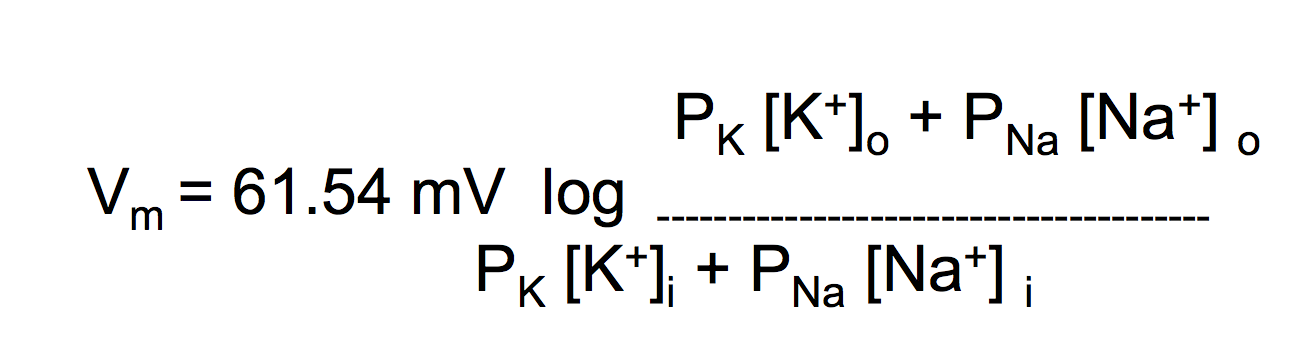
The Goldman equation
Goldman Equation
A weighted average of the Nernst potentials for all of the ions in the cell, weighted according to their relative permeaiblities
Why is resting membrane potential not -80mV (EP of K+)
Na+ also has some leak channels so a little bit is leaking in butit’s more permeable to K+
 Note
Note  Flashcards (62)