pt2
 Studied by 0 people
 Call Kai
 Learn
Learn Practice Test
 Spaced Repetition
 Match
Match Flashcards
 Knowt Play
1/10

There's no tags or description
Looks like no tags are added yet.
Name | Mastery | Learn | Test | Matching | Spaced | Call with Kai |
|---|
No analytics yet
Send a link to your students to track their progress
11 Terms
Define Sublimation and Deposition
Sublimation: solid transfers directly into gas, skipping the liquid stage
Deposition: gas skips the liquid stage and turns into solid
Define evaporation and condensation
evaporation - liquid to gas
condensation - gas to liquid
What is dewpoint?
Dewpoint is the temperature to which air must be cooled to become saturated by the water vapor already present in the air. Achieves 100% relative humidity.
One weather phenomenon which will always occur when flying across a front is a change in the?
wind direction
NOT: stability in the air mass or types of precipitation
What measurement can be used to determine the stability of the atmosphere?
Actual lapse rate - The difference between the existing lapse rate of a given mass of air and the adiabatic rates of cooling in upward-moving air determines if the air is stable.
Steady precipitation preceding a front is an indication of
stratiform clouds with little or no turbulence
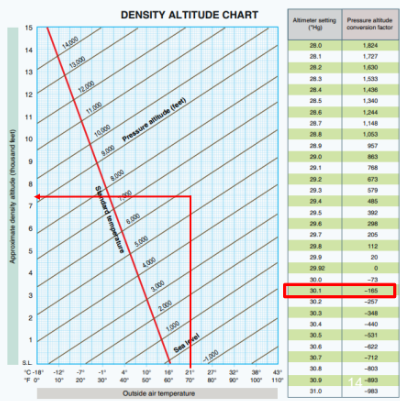
How to read density altitude chart
on the chart find the current altimeter setting and read the conversion factor
subtract or add based the conversion factor to the elevation
follow the “invisible” line for the corrected elevation and temperature
where these two points intercept is your density altitude
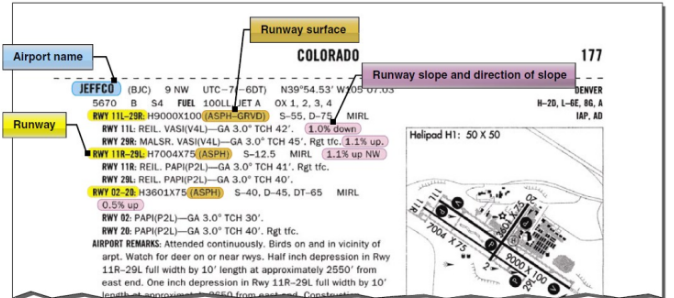
understanding chart supplement
Conditions that affect take off and landing
humidity (displaces air & fuel in the cylinder, % water vapor in the atmosphere, reduces power output)
surface wind conditions (headwind, tailwind, crosswind),
runway conditions (dry or wet surface, runway slope, pavement or turf)
preflight must be aware of
runway - calculate take off performance, length, obstacles, consider density altitude
altitude above you - select safe altitudes, know power settings for climb cruise, descent
fuel - understand the fuel system, compacity, burn rate, consider winds aloft
gross weight is in limits
crosswinds
What effect does high density altitude, as
compared to low density altitude, have on
propeller efficiency and why?
High temperature, high relative humidity, and high
density altitude.
 Note
Note  Flashcards (44)